
The Agile Retrospective “Good Bad Ugly” incl. direct access
You are looking for a “good bad ugly” retrospective? Okay, tada, here it is. It’s actually quite simple and based on the 1966 film “The Good, the Bad and the Ugly,” starring Clint Eastwood.
Agile Retrospective Good Bad Ugly: What should be considered before the retrospective?
I always emphasize that with every retrospective, be it the “Good Bad Ugly” retrospective or another, not only the 5 phases of a retrospective But also take into account the Double diamond model, which suggests to have even more than only the 5 phases.
Simply said, the model recommends to spend as much time on developing good action items to spend just as much time as for the “Gathering Information” at the beginning of the retro. Because the quality of the measures is the prerequisite for their success - and thus for the continuous improvement of your team.

But now to the format of the retrospective based on the film “The Good, the Bad and the Ugly”.
The Agile Retrospective Good Bad Ugly
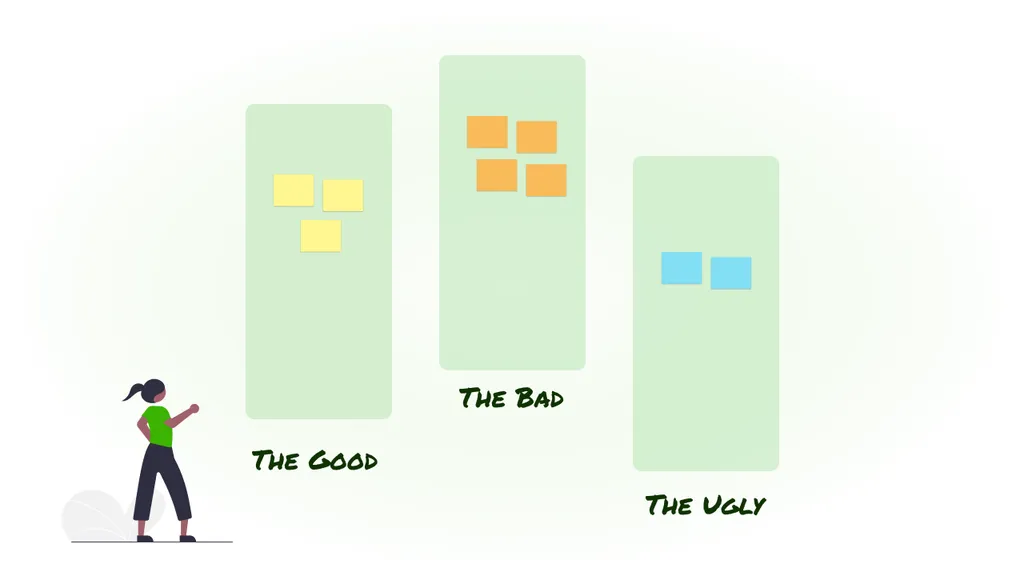
The process of the agile retrospective “Good Bad Ugly” is simple. Based on the three words, you ask three questions or specify three areas to which the team members can give feedback.
Obviously, feel free to draw a graph or draw these areas on an actual or digital whiteboard so that team members can draw on these. These are the three retrospective questions:
Good Bad Ugly Retro: How the retro works
Random Icebreaker (2-5 minutes)
Echometer provides you with a generator for random check-in questions.
Review of open actions (2-5 minutes)
Before starting with new topics, you should talk about what has become of the measures from past retrospectives to check their effectiveness. Echometer automatically lists all open action items from past retros.
Discuss retro topics
Use the following open questions to collect your most important findings. First, everyone does it themselves, covered. Echometer allows you to reveal each column of the retro board individually in order to then present and group the feedback.
- Good: What went well, where did you have fun?
- Bad: What didn't go so well?
- Ugly: What was unpleasant and should change for the better?
Catch-all question (Recommended)
So that other topics also have a place:
- What else would you like to talk about in the retro?
Prioritization / Voting (5 minutes)
On the retro board in Echometer, you can easily prioritize the feedback with voting. The voting is of course anonymous.
Define actions (10-20 minutes)
You can create a linked action via the plus symbol on a feedback. Not sure which measure would be the right one? Then open a whiteboard on the topic via the plus symbol instead to brainstorm root causes and possible measures.
Checkout / Closing (5 minutes)
Echometer enables you to collect anonymous feedback from the team on how helpful the retro was. This creates the ROTI score ("Return On Time Invested"), which you can track over time.
Good Bad Ugly Retro

By the way, you can do this retrospective online using our retrospective tool Echometer now (no registration necessary):
Conclusion - Agile Retrospective Good Bad Ugly
That’s how it goes! We can keep it pretty simple 🙂 However, before you decide on the agile retrospective ‘good bad ugly’, I would recommend that you also take a look at other approaches.
Specifically, you might want to have a look at our list of 32 retrospective ideas for beginners and pros - have fun!