
When should a sprint retrospective happen?

If you’ve just searched Google for “When should sprint retrospectives take place”, you probably want one of these two questions answered:

  • When in the sprint cycle should sprint retrospectives happen?
  • On which day should sprint retrospectives happen?

In this article I will answer both questions. And if you have the feeling that one of the two questions is superfluous, then I would like to convince you of the opposite.

Before we start:

When should a Sprint Retrospective happen

When should sprint retrospectives happen in the sprint cycle?

In the Scrum Framework, Sprint Retrospectives are a fixed and important part of each Sprint Cycle. The purpose of the sprint retrospective is to reflect on the past sprint cycle, to learn from it and thus to be able to approach the upcoming sprint cycle better.

Thus, the team should have the sprint retrospective after the sprint review and before the next sprint planning.

i18n/Sprint-Retrospective-in-the-Scrum-Cycle.png not found.

A classic sprint cycle lasts between one week and one month. So the Sprint Retrospective also takes place once a week to once a month.

In this regard, we studied over 30,000 retrospectives from more than 100 companies and found that team members’ subjective satisfaction was highest when retrospectives were held at intervals of 14 days or less.

When should a Sprint Retrospective happen

On which day should sprint retrospectives happen?

Even if this question seems much less relevant than the first one, I can assure you that this is not the case. In our data collection of more than 30,000 retrospectives, we also looked at when the best time of the week is to hold a Sprint retrospective. And even though the middle of the week (Tuesday-Thursday) turned out to be the days when most Sprint Retrospectives are held, subjective satisfaction with Sprint Retrospectives is highest on a Friday.

As can be seen, the subjective satisfaction with sprint retrospectives becomes higher the later they occur in the week. ( More about the ROTI score )/ We don’t have a scientific explanation for this phenomenon, but I would say it makes sense that the end of a sprint can also be seen as the end of a week. Whereas the end of a sprint at the start of the week seems counterintuitive to me at first. - Who doesn’t like to end their week by completing their tasks?

The interesting thing about this measurement is that the question “On which day should you hold a retro?” seems superfluous at first, but has just as great an influence on subjective perception as the frequency of retrospectives.

If you want to find out more about what we have learned from the 30,000 retrospectives, click here: “ Analysis of 30k retros: 4 tips for agile teams

Conclusion: When should a Sprint Retrospective happen?

All in all, it can be said that a sprint retrospective takes place at the end of each sprint cycle, which ideally lasts 14 days or less (7 or 14 days is my recommendation). Optimally, you can start these sprints on a Monday and thus end them with the sprint retrospective on a Friday.

If you want to find out under which conditions your team’s satisfaction is highest, feel free to test our retrospective tool for free …

Sailboat Retro ⛵️

⚓️ Your anchor: What holds us back?
🦈🧊 Your shark/iceberg: Which dangers or obstacles approach us?
💨 Your tailwind: What drives us forward?
🏝💰 Your paradise: What achievement or milestones are we working towards?

Blog category

More articles on "Agile Retrospective Ideas"

View all articles in this category
54 Fun Retrospective Templates That Spark Fresh Insights in 2026

54 Fun Retrospective Templates That Spark Fresh Insights in 2026

Discover 54 fun retrospective templates for agile teams in 2026! From classic to creative formats & templates – find the best ideas for your team.

26 Fun & Fresh Agile Retrospective Templates in 2026

26 Fun & Fresh Agile Retrospective Templates in 2026

Discover 26 fun & fresh Agile Retrospective templates for 2026. Find the best method for your team and make your retrospectives successful.

Spotify Health Check Retrospective: Moderation & Tips

Spotify Health Check Retrospective: Moderation & Tips

Use the Spotify Health Check in retrospectives for team development. This guide offers moderation questions and templates for Team, Tech & Co.

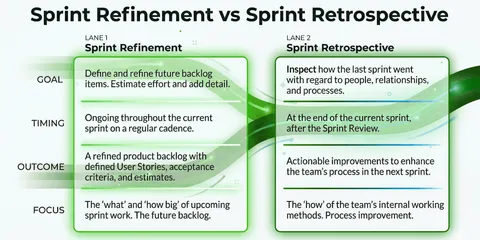
Sprint Refinement vs Sprint Retrospective: Explained Simply

Sprint Refinement vs Sprint Retrospective: Explained Simply

Sprint Refinement vs Sprint Retrospective explained simply: clear differences, practical examples, decision support, 2 retro ideas and FAQ.

4-Quadrant Retrospective: Examples & Implementation Tips

4-Quadrant Retrospective: Examples & Implementation Tips

What is a 4-quadrant retrospective? Learn about the structure, quick facts, origin, comparison, and concrete implementation for effective sprint retros.

42 Fun & Creative Retrospective Icebreakers breaking any Ice

42 Fun & Creative Retrospective Icebreakers breaking any Ice

Discover 42 creative retrospective check-ins and icebreakers for agile teams. Find the best questions and methods to make every retro interactive.

Sprint Retrospective Questions: 10 that actually help

Sprint Retrospective Questions: 10 that actually help

Sprint Retrospective Questions for your next meeting: 10 smart questions, 5 expert questions, decision framework, Spotify Health Check and PDF download in English.

What are the top-rated online retrospective software tools for agile (scrum) teams?

What are the top-rated online retrospective software tools for agile (scrum) teams?

Which online retrospective tools are best rated by agile (Scrum) teams? A comparison of Echometer, Parabol and others with advantages and disadvantages.

How do I find the right software tool for sprint retrospectives?

How do I find the right software tool for sprint retrospectives?

Which software tool is the best fit for your sprint retrospectives? We compare popular tools like Echometer, EasyRetro, and Metro Retro. Find the right one!

Echometer Newsletter

Don't miss updates on Echometer & get inspiration for agile working

FAQs about Retrospective Tool

Top answers for anyone exploring our Retrospective Tool.

Do I have to register to test the Retro Tool?

No, you do not need to log in to Echometer or register to test the Retro Board and Retro Tool in Echometer.

You can try out Echometer’s Retro Board via the following link without logging in: Try a Practice Round

How can I buy Echometer's retro tool?

First, simply register for free in Echometer. Then navigate to the workspace for which you would like to purchase the retro tool. If you haven’t already done so, you can do so here: Create account in Echometer 1:1 tool

You can then manage your subscription (for both the retro tool and the 1:1 software) within the workspace settings.

You can choose from various payment methods when upgrading.

If you do not have access to your company’s credit card yourself, you can simply add a buyer as a workspace admin in your Echometer workspace so that this admin can carry out the upgrade for you.

What is the difference between the Retrospective tool and the 1:1 software?

In Echometer there are two separate software solutions that are available within each workspace in Echometer:

  • 1:1 tool: Software for planning and conducting 1:1 meetings and tracking employee development
  • Retrospective tool: Software for planning and moderating retrospectives and tracking team development through team health checks

Both are independent software solutions, so they can be used separately from each other.

However, they work according to the same principles and aim to achieve the same added value: The continuous improvement of agile teams. In this respect, the simultaneous use of both software solutions is recommended.

Can I appoint several admins in Echometer?

Yes, you can assign administration rights to any number of users at both team level and workspace level. Please note the following:

  • Only workspace admins can take out and manage a Echometer subscription for a Echometer workspace.
  • Only workspace admins can create additional teams and name or remove additional workspace admins.
  • Team admins can appoint and remove additional team admins and team members for their team
What is the structure of retrospectives in Echometer?

The Echometer Retrospective software is designed to guide teams through the retrospective process with maximum ease and effectiveness, following best practices.

The steps and their sequence can be customized using the navigation within the retro. By default, a retrospective in Echometer is structured in this way:

  • Icebreaker
  • Review of open measures from past retros
  • Collect feedback (first Health Checks, then open questions)
  • Prioritization of feedback
  • Deriving action items
  • Concluding the retrospective with the “ROTI score” (Return on Time Invested)

Additional whiteboards (e.g. for workshops, for analyzing problems or for brainstorming measures) can also be added spontaneously at any point using the Retrospective navigation.

Is there an analysis dashboard to identify trends?

Yes, the Echometer Retrospective software has various detailed dashboards for monitoring the continuous improvement process of your agile team:

  • On the one hand, you can get a quick overview of past team retrospectives in the retro archive.
  • On the other hand, you can use the ROTI score and the Health Check items, which you can use as a regular happiness check, to visualize mood trends in the team based on specific KPIs or agile metrics.
  • There are also other activity trends

Echometer distinguishes between Team Health and Workspace Health in the Health Checks:

  • Results from Team Health are only ever made transparent within the team
  • Results from Workspace Health are made transparent across all teams