
9 effective team exercises for agile retrospectives
Many teams try retrospectives and fail. They do not fail because of the method itself, but because of the prerequisites for successful retrospectives.
Because a good retro needs more than just a board with three columns. The team must be able to address problems openly, phrase feedback constructively, and accept it. That is exactly what the following exercises are for. They help teams that still have little experience with self-organization. They help teams that tend to avoid conflict. And they help teams that are not yet used to talking openly about mistakes or tensions in collaboration.
Even if your team does not work with Scrum or agile methods, these exercises are still useful. Retrospectives also work excellently in classical work environments. You can find more about that here: Should I hold retrospectives in non-agile teams or projects without Scrum?
Who Are These Exercises For?
These exercises are especially helpful for:
- new teams
- hesitant teams
- teams with little practice giving feedback
- teams that are reluctant to address mistakes openly
- teams that are still learning agile collaboration
How to Facilitate These Exercises for Agile Retrospectives Safely
To make these exercises work, they require sensitive facilitation:
- Do not force anyone to share personal things.
- First talk about situations, not about people.
- Avoid blame, including from other participants.
- Summarize neutrally and ask follow-up questions.
- Do not expect overly large actions or changes. Instead, celebrate every small step in the right direction.
Team Exercises for Agile Retrospectives
The exercises build on one another and can be carried out one after the other (possibly with a bit of time in between).
But you also do not necessarily have to do all the exercises with your team, especially if you are not starting from scratch. What matters more is choosing the right exercise at the right time so that it helps your team move forward.
Alright, let’s get started with the exercises!
Exercises for Agile Retrospectives | #1 Mood Check
Check-In With a Mood Check 👋
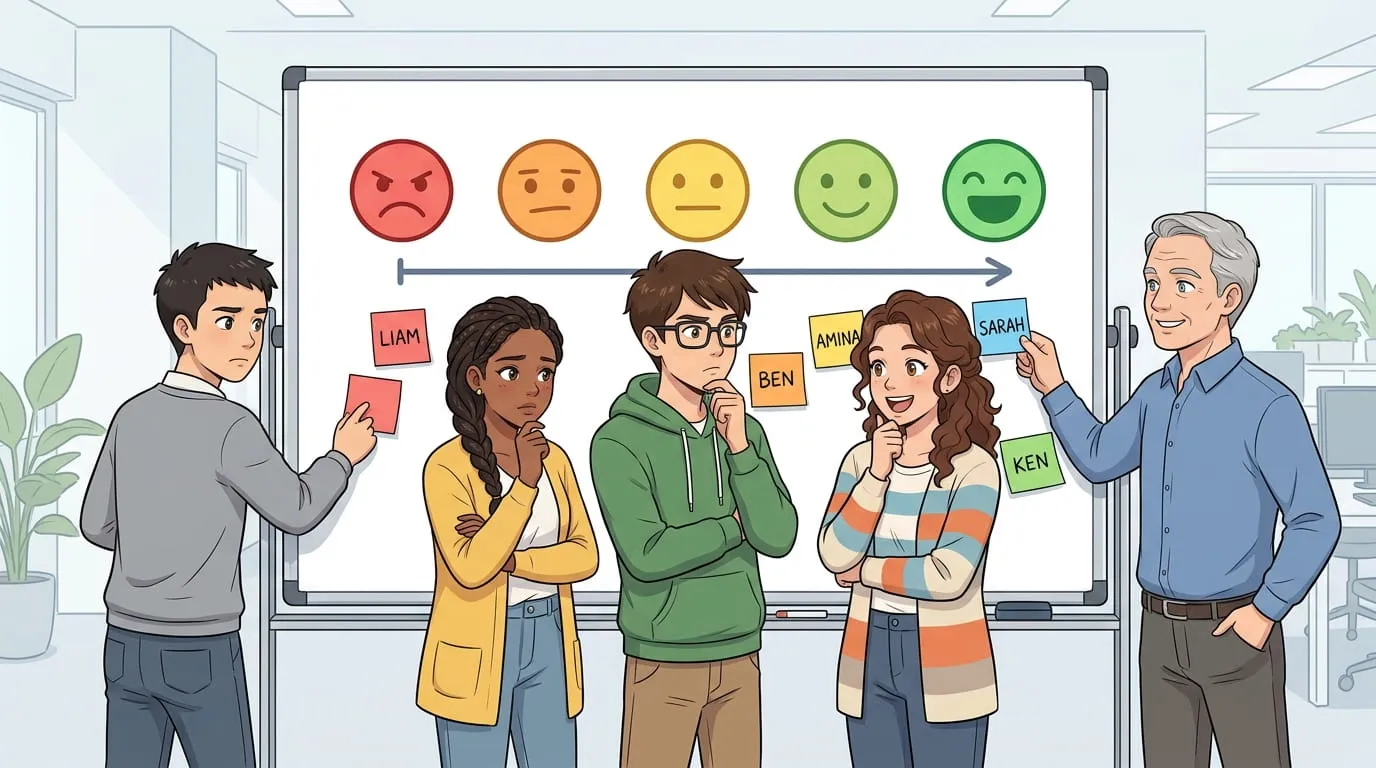
This exercise is a very easy start. It can easily be integrated into an existing team meeting.
Everyone gets a chance to speak. Nobody has to talk about problems right away. This is ideal for team members who are just learning to express themselves in a reflection and feedback format.
Goal: Create an initial feedback format with safe participation for everyone.
When is the exercise a good fit? If your team is reserved or if some people rarely express how they are feeling and what they think.
Duration: 5-10 minutes
Process:
-
Provide a simple scale, for example colors (🟢 - 🟡 - 🔴), emojis (🤩 - 😊 - 😕 - 😩), or numerically from “1 = 👎” to “5 = 👍”.
-
Then present a statement for reflection to the group and ask for a rating. Depending on the format of the team meeting and the scale, the wording could be something like this:
- In a weekly on Monday: “How confident are you going into the week?”
- In a weekly on Friday: “How satisfied are you with this week?”
- In a daily standup in the morning: “How much energy do you have for your tasks today?”
- In a (sprint) review: “How do you rate the value delivered to the customer from this iteration?”
-
Each person gives their rating in turn and, if they like, adds one or two sentences.
-
As the moderator, you briefly thank them, but do not open a discussion about the individual comments.
It is also best to announce right away that you will now do this mood check-in regularly in order to create an open space where people can share themselves and everyone is heard.
Of course, team members will not suddenly be able to open up automatically and openly express how they feel. But the format does at least help team members ask themselves: How am I actually doing in relation to my work? And why?
That is a necessary first step.
Facilitation notes:
- Start with your own assessment and lead by example.
- Keep contributions brief.
- Do not assess mood.
- No one should be pressured to give reasons.
How you notice the benefit: The group becomes more human and more familiar. The initial reluctance to speak up decreases.
Yes, this exercise may feel like a very small step – and it is. Integrate it regularly into your existing team meetings and you will feel the benefit.
Exercises for Agile Retrospectives | #2 Strengths
Focus on Strengths Instead of Mistakes 💪

Before a team speaks openly about problems, it often helps to take a look at what is already working well. This exercise builds trust. It shows: there is already helpful behavior in the team that we can build on.
Goal: Make appreciation visible and create a safe basis for discussion.
When is the exercise a good fit? If the team quickly turns to criticism or if mutual appreciation is rarely expressed.
Duration: 15–20 minutes
Process:
- Each person notes one or two observations about helpful behavior in the team. Important: This is about specific situations, not general praise.
- Everyone presents their cards to the group. After each presentation, place the cards on a board and group similar examples together.
- At the end, discuss: “What should we consciously do more often?”
Facilitation notes:
- Ask for concrete examples.
- Praise behavior, not personality traits.
- If things go quiet, offer a few harmless examples of your own to get things started.
Moderation questions:
- What has recently made work easier for you?
- Who recently helped you in a particularly helpful way, and how?
- When have you felt supported in the team?
How you notice the benefit: The team sees the strengths of individual team members, too, despite all the problems.
Exercises for Agile Retrospectives | #3 Feedback Culture
The Feedback Map 🗺️
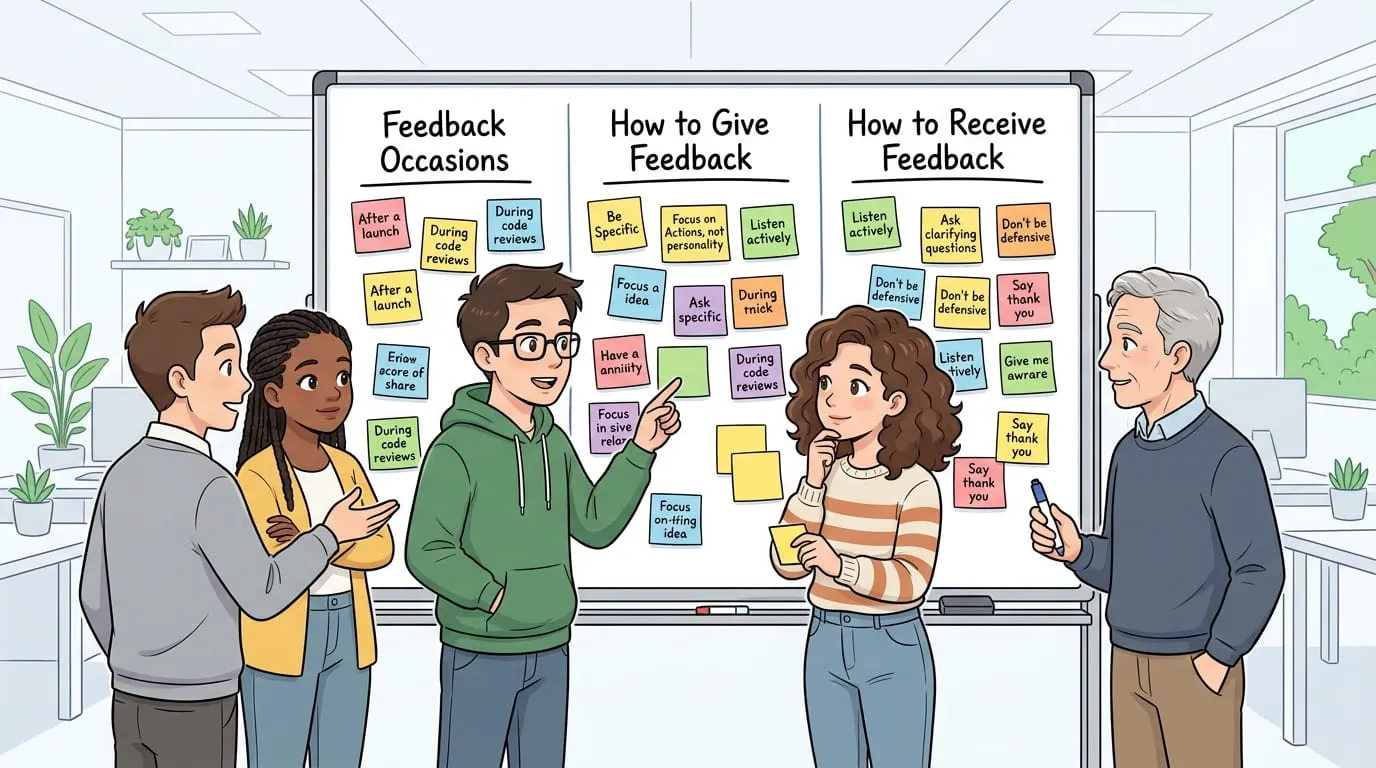
Many teams say: “We want to give feedback more often and better.” But often it remains unclear what that actually means. The feedback map makes the topic tangible.
The basic idea is simple. The team jointly collects answers to three questions:
- Occasions for feedback: When do we give each other feedback? Or also: When should we give each other feedback?
- Giving feedback: How do we want to give feedback?
- Receiving feedback: How do we want to receive feedback?
There are various frameworks for giving and receiving feedback, such as the SBI model (Situation-Behavior-Impact), which can serve as inspiration: Examples of feedback methods
If you want to dive deeper into the topic, you can find more background here: 6 measures to establish a fruitful feedback culture
Goal: Develop a shared picture of good feedback practice in the team.
When is the exercise a good fit? If feedback is rare, often comes too late, or is quickly understood as an attack.
Duration: 20-30 minutes
Process:
- Divide a board into three columns: Occasions, giving feedback, receiving feedback
- On the left, collect occasions for feedback. For example: mistakes, misunderstandings, conflicts, or successful collaboration.
- In the middle, collect rules for how feedback should be given.
- On the right, collect ideas about how feedback should be received.
- Then the team marks the two to three most important points per column.
- Hang the map somewhere visible or save it in a place everyone can find.
Moderation questions: The following points should later be answered on the board:
- When should we give feedback directly in the moment, and when is it better later (one-on-one)?
- What helps you not to hear feedback immediately as a reproach? How should we give feedback so that it is constructive?
- How can we lower the barrier to giving feedback?
- How should one react to feedback? How do you show the other person that you are also taking the feedback on board?
Use the opportunity as well to give each other feedback in a role-play and practice the points.
How you notice the benefit: Feedback becomes more predictable. The team gains clarity about how to give and receive feedback.
Exercises for Agile Retrospectives | #4 Normalize Uncertainty
Silly Question Challenge 🤔

Many problems in a team don’t start with a major conflict. They start when an ambiguity wasn’t resolved because an important question wasn’t asked. Out of shame. Out of uncertainty. Or because the question seems too obvious.
This exercise makes exactly that visible.
Goal: Reduce inhibitions to ask questions and make uncertainty visible.
When is the exercise a good fit? When the team often silently assumes instead of asking openly.
Duration: 15–20 minutes
Process:
- As a relaxed warm-up, collect examples of “silly questions” that someone else asked, so you no longer had to ask them yourself.
- Each person writes anonymously on a moderation card: a question they once didn’t dare to ask in their day-to-day work.
- The cards are collected and read aloud.
- The team discusses:
- Why might someone hesitate to ask this question?
- What would have been the downside if it had never been asked?
- What would have been the benefit?
- To conclude, the team answers the question: “What can we do as a team to make it easier to ask such questions?”
Facilitation notes:
- Make sure to really preserve anonymity.
- Respond appreciatively to every question.
- Allow laughter about situations, but not about people.
Moderation questions:
- Which of these questions would probably have been asked by several people as well?
- What does it cost us as a team when questions go unspoken?
- What could be a simple rule to make follow-up questions normal?
How you notice the benefit: The team realizes that uncertainty is normal. Questions feel less embarrassing and more like a contribution to learning.
Here’s another tip for a follow-up that has worked really well for us at Echometer:
We use the chat regularly, and not infrequently you even learn something yourself as an uninvolved person from the answers.
Exercises for Agile Retrospectives | #5 Error Culture
Learning from Mistakes 💩

Many teams are not yet ready to talk about major mistakes or tough conflicts right away. That’s normal. That’s why this exercise deliberately starts small.
It is about talking about improvement opportunities rather than blame, even when it comes to small mistakes and misunderstandings. This turns mistakes into opportunities for improvement. That is exactly the mindset teams later need for retrospectives.
Goal: Take the taboo out of openly talking about mistakes and put learning and improvement at the forefront.
When is the exercise a good fit? When the team takes mistakes personally right away or when problems are usually only talked about in passing.
Duration: 20-25 minutes
Process:
-
Each person thinks of a small mistake, a misunderstanding, or an unnecessary detour from day-to-day work.
-
Each person briefly notes:
- What happened?
- What did I learn from it?
- How can my learning help the team in the future?
-
The examples are shared one after another.
-
The moderator collects common patterns.
-
At the end, the team chooses one or two small lessons it wants to test in everyday work.
Facilitation notes:
- Explicitly ask only for small, safe examples.
- Step in if the round turns into justification or blame.
- Make openness visibly appreciated.
Moderation questions:
- What about this mistake was more annoying than dramatic?
- What helped you learn from it?
- What could the team have seen or done earlier?
- What small habit would make similar mistakes less likely?
How you notice the benefit: Mistakes become a little more normal. The team practices learning from situations instead of only judging someone.
Here, too, we can’t help but share a tip from our own experience:
Would a chat channel like that be something for you?
Exercises for Agile Retrospectives | #6 Unspoken Topics
The Elephant in the Room 🐘

Almost every team has this kind of problem that everyone knows about but that are rarely addressed openly. These very topics often block later retrospectives. Because if the obvious cannot be said, every retro remains superficial.
This exercise is not easy and not beginner-friendly. So if you are unsure whether it will work in your team, it is better to try one of the previous exercises first.
Goal: Address contradictions and unspoken issues constructively.
When is the exercise a good fit? When uncomfortable topics are avoided in the team and known problems are too rarely addressed openly.
Duration: 20-25 minutes
Process:
- Explain the concept of the elephant in the room: “Every team has problems that everyone knows about, but that are still rarely mentioned.”
- Each person writes anonymously:
- an elephant in the room
- or an issue that the team rarely talks about openly
- All cards are collected, read aloud, and grouped together.
- Joint reflection on the result:
- What patterns do we recognize in the topics we are reluctant to address?
- What makes it so difficult to address these topics?
- With which elephants would it make the biggest difference if we addressed them more openly in the future?
- What things do we want to address more openly in the future than before? What can we do as a team to make speaking up easier?
- In a closing round, everyone shares in turn: “What did it feel like to name the elephants in the room?”
Facilitation notes:
- Anonymity is especially important here.
- Let the group first see patterns before talking about solutions.
- If a topic is too sensitive for the group, park it neatly for a suitable setting.
Moderation questions:
- Which topics have been draining our energy for a while now?
- Which topics are uncomfortable, but important?
- What makes it difficult to speak openly about exactly that?
- What would be a safe next step for one of these topics?
How you notice the benefit: The team is training exactly the skill that retrospectives will later need: making uncomfortable truths visible without attacking people.
If your team was able to master this exercise well, chances are good that you have a good level of maturity for retrospectives.
Still, not too quickly. Here are a few more pro exercises for agile retrospectives that shouldn’t be skipped either:
Exercises for Agile Retrospectives | #7 Team Rules
Clarifying Team Norms and Ground Rules ⚖️

Feedback and retrospectives become easier when the team has a shared foundation. Otherwise, feedback quickly sounds like personal preference or criticism. Team norms create clarity here.
Goal: Establish shared ground rules for respectful, open, and learning-oriented collaboration.
When is the exercise a good fit? When expectations and standards in the team are unclear and lead to conflicts or tensions.
Duration: 30-45 minutes
Process:
-
Present the team with three guiding questions or adapt them as you see fit:
- What is important to us so that we feel comfortable as a team and can work together openly, honestly, and respectfully?
- In which situations are we lacking common standards or rules?
- Which conflicts could we avoid by creating more clarity?
-
Individual brainstorming: Each person first gathers their own thoughts in silence.
-
Then discuss the answers together and cluster similar points.
-
Use dot voting to identify the most important points with the greatest need for action, and formulate your team norms from them.
-
Keep the norms clearly visible and agree on how you will address violations in everyday work and when you want to review them again next time.
Facilitation notes:
- Formulate rules so that a rule violation can be clearly recognized and named.
- Less is more. Five clear rules are better than fifteen vague wishes.
- Question every rule critically: “Does this rule really make a difference for us?” and “Why is this rule important for us?” Avoid keeping rules that are currently unproblematic anyway.
Moderation questions:
- What is important to us so that we feel comfortable as a team?
- Which rules would make us a better team if we all followed them together?
- Which points from the previous exercises (e.g. giving and receiving feedback, dealing with mistakes) should we incorporate?
- How do we deal with it when rules are not followed?
How you notice the benefit: The team has a shared language for expectations. Feedback can be based on agreements rather than vague impressions.
It is completely okay if a few basics also come up here: We do not interrupt one another. We are not late for meetings. We schedule appointments only with an agenda. It is okay to leave meetings if you feel that you cannot contribute anything or take anything away from them.
Even these simple points can be very helpful for team members to know how they can behave and which behavior is tolerated in the team and which is not.
Exercises for Agile Retrospectives | #8 Agile Values
Anchors for Agile Values in Everyday Life ⚓️
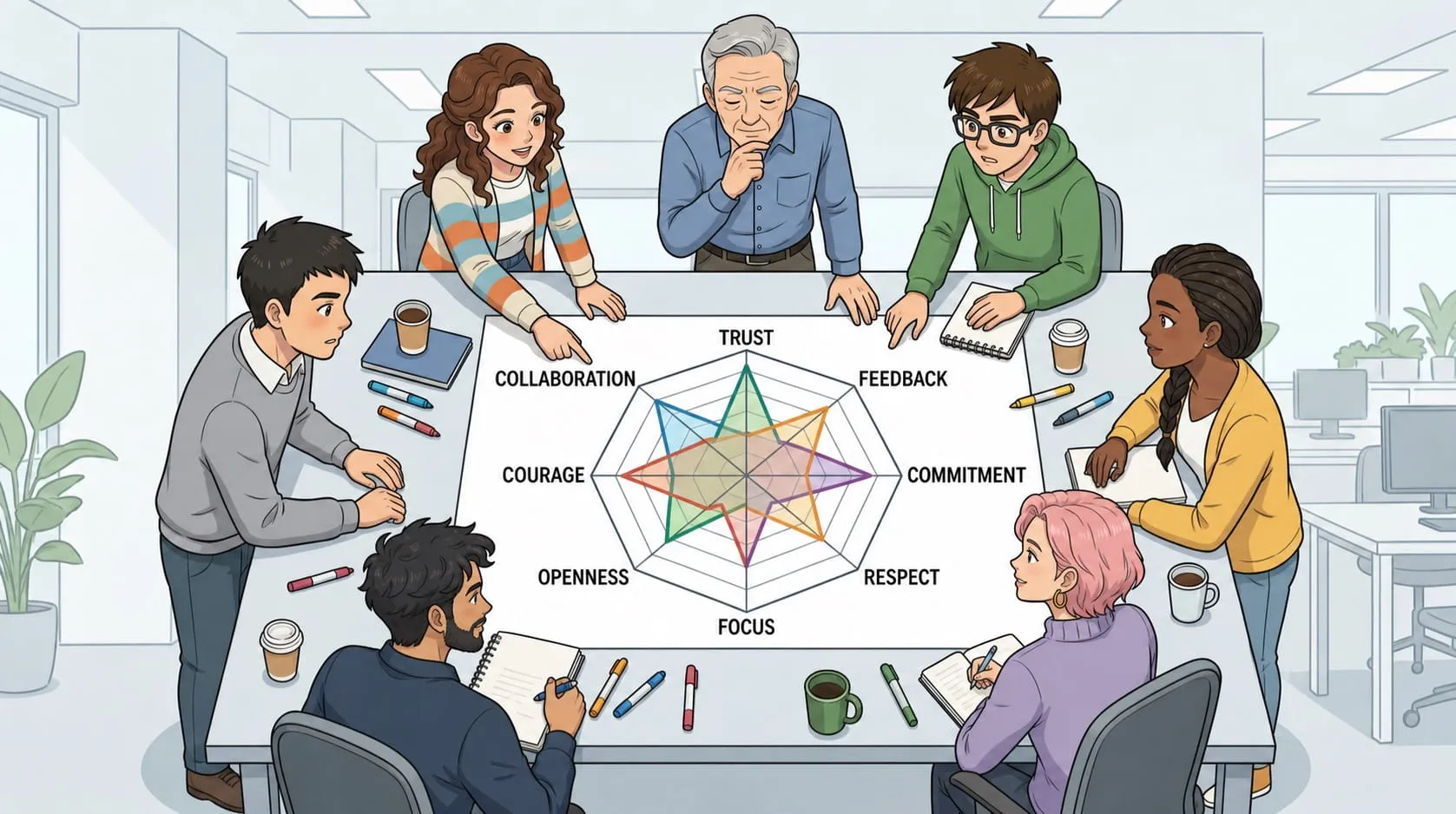
Agile values only help when they become tangible in everyday life. Many teams know the terms openness, respect, or focus. The more difficult question is: How do we behave concretely in order to put these values into practice?
Goal: Translate agile values into observable behavior.
When is the exercise a good fit? If agile terms feel rather abstract within the team or if you want to reflect on collaboration more consciously.
Duration: 25-35 minutes
Process:
-
Write the five agile values visibly on the board: courage, respect, openness, focus, and commitment.
-
The team collects concrete behavioral examples from everyday life for each value (a mind map for each value is recommended).
-
Then discuss:
- What are we already doing well?
- What is still difficult for us? / What could we do better? (And how?)
-
For each value, define a behavioral anchor that makes visible for you how this value is lived in the team. Here are some examples for inspiration:
- Courage:
- We address problems, risks, and conflicts early on.
- We critically question existing ways of working.
- We openly admit mistakes and take responsibility for them.
- Where appropriate, we also make decisions with incomplete information.
- Respect:
- We listen to one another attentively and let each other finish speaking.
- We treat differing opinions with appreciation.
- We always assume positive intentions on the part of others.
- Openness:
- We make progress, obstacles, and mistakes visible.
- We are willing to change and question our perspectives.
- We address uncertainty and gaps in knowledge.
- Focus:
- We consistently bring started work to completion.
- We stay on topic during discussions.
- We protect our attention and working time from distractions and interruptions.
- Commitment:
- We keep our commitments and proactively communicate deviations.
- Each of us acts in line with our agreed priorities and goals.
- Courage:
-
Finally, choose one value / behavioral anchor that you would like to implement more strongly in everyday life.
Facilitation notes:
- Keep the discussion grounded in everyday life and always ask about observable behavior.
- Avoid theoretical lectures and hair-splitting.
How you notice the benefit: The team reflects not only on processes, but also on behavior. That is exactly what makes later retrospectives more valuable.
Exercises for Agile Retrospectives | #9 Self-Efficacy
Iterative Improvements With Baby Steps 🚼
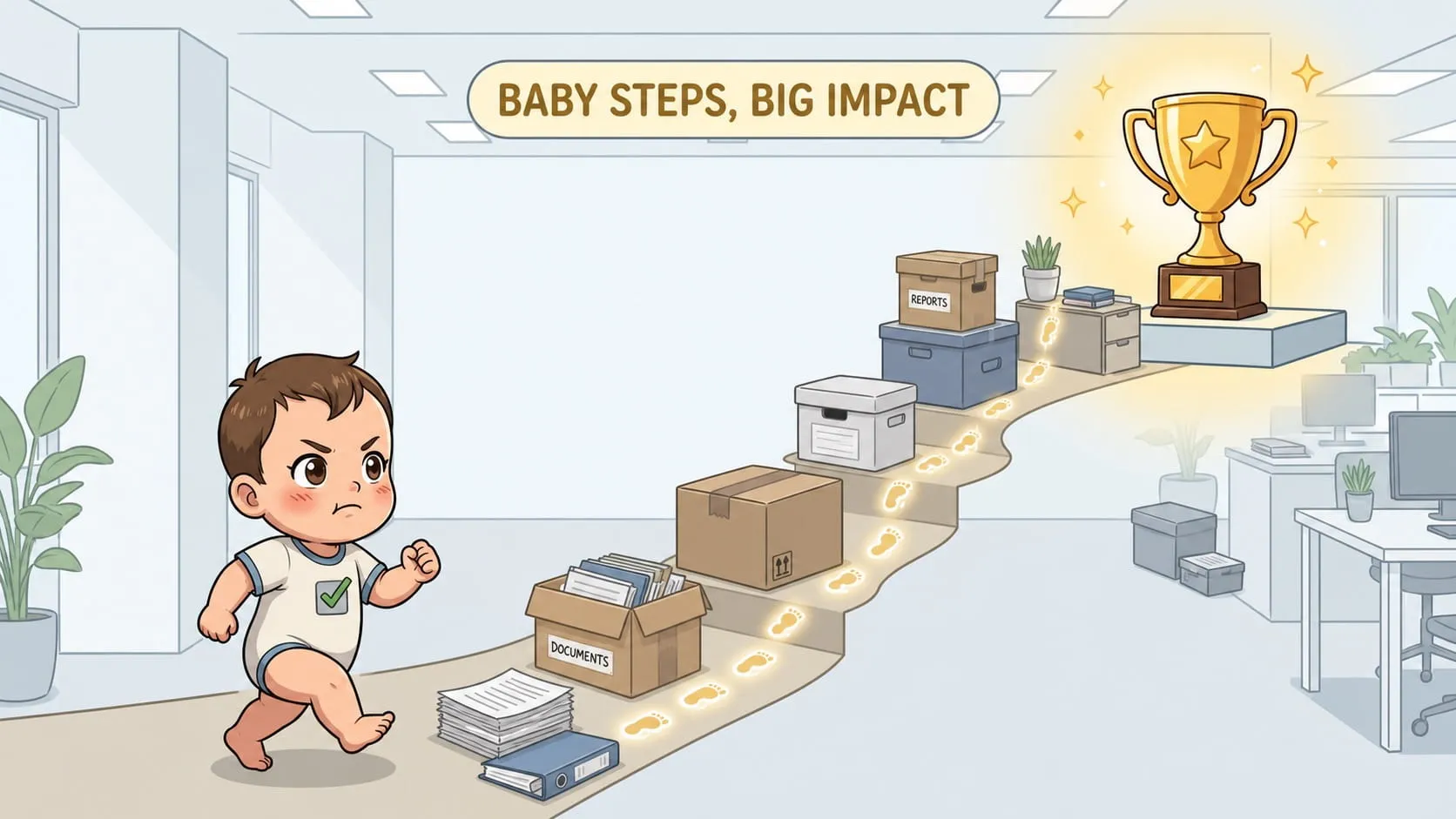
Many teams see problems. But they don’t know where to start with a solution – or see all possible solutions outside the team. This is exactly where this exercise helps. It turns a problem into a manageable first step.
This is important for retrospectives. Because good retros don’t end with a long wish list, but with small, realistic next steps.
Goal: Create a shared understanding of iterative work and strengthen the team’s sense of self-efficacy.
When is the exercise a good fit? When the team quickly demands big solutions or often feels they can influence little to nothing.
Duration: 20-30 minutes
Process:
- Choose a few example topics that should be improved, preferably well-known and recurring problems.
- Then phrase the desired result in a simple sentence.
- Now collect many small steps that one could take could, to get closer to a solution.
- Choose only the smallest meaningful first step that can be carried out within the next few days, at most weeks.
- Clarify:
- Who will try it?
- By when?
- How will we know whether it was helpful?
Facilitation notes:
- Stop overly large measures and break them down into individual steps
- Gather many alternative suggestions
- Keep the impact manageable and observable
Moderation questions:
- What is the smallest thing we could try for this?
- What change is so small that we can make it this week?
- What information, approval, or whose support are we missing in order to be able to implement a solution?
- Which stakeholders are involved in this problem? Who could we talk to?
- How would we know that this step has helped?
- What can we influence ourselves, without waiting for a major approval?
How you notice the benefit: The team experiences greater room to act. Improvements feel achievable. Small progress becomes noticeable.
Which Exercise Fits Which Team?
If your team is very cautious, start with the first 3 exercises.
If your team already trusts one another and communicates openly about less sensitive topics, exercises 4 to 6 could be a good fit.
If your team is ready to make more sensitive topics visible and can apply the feedback and communication techniques learned, continue with exercises 6 to 9.
And if you still need ideas for later real retros, you can find more formats here: 54 fun retrospective methods for agile teams in 2026.
Continuous Retrospectives: Why These Exercises Are Just the Beginning
These exercises are a solid foundation for effective team retrospectives. However, the real development of a feedback culture only comes through continuous repetition and getting used to it.
With every small action, the team’s sense of self-efficacy grows further and the limits of what can be achieved shift.
That is exactly why retrospectives are so valuable. They give the team a regular rhythm to consciously improve collaboration.
How Echometer Makes Teams Better
If you want to turn individual exercises into a real habit, a good tool helps. Echometer is strong for this because it not only prepares a retro, but also supports the team’s development over a longer period of time.
With Echometer, you can:
- Start retrospectives easily thanks to curated templates
- Involve participants optimally thanks to intuitive, fun facilitation tools
- Document action items and keep track of their implementation
- Make development visible over time, for example also through Team Health Checks
Especially for teams that are re-establishing retrospectives, Echometer is helpful. Because at the beginning, what is often missing is not goodwill, but a clear, actionable structure.
If you want to improve your team’s collaboration step by step and sustainably, a retrospective with Echometer is therefore a very sensible next step.
If you want to read more about Health Checks and continuous team development, take a look here as well: Agile Team Health Check
Starting the Team Retrospective Routine
Once you’re ready, you can get started directly and free of charge in Echometer to set up your retro routine. To begin, I recommend the simple Keep-Stop-Start template:
Keep-Stop-Start Retro: How the retro works
Random Icebreaker (2-5 minutes)
Echometer provides you with a generator for random check-in questions.
Review of open actions (2-5 minutes)
Before starting with new topics, you should talk about what has become of the measures from past retrospectives to check their effectiveness. Echometer automatically lists all open action items from past retros.
Discuss retro topics
Use the following open questions to collect your most important findings. First, everyone does it themselves, covered. Echometer allows you to reveal each column of the retro board individually in order to then present and group the feedback.
- Keep: What should we keep?
- Stop: What should we stop doing?
- Start: What should we start doing?
Catch-all question (Recommended)
So that other topics also have a place:
- What else would you like to talk about in the retro?
Prioritization / Voting (5 minutes)
On the retro board in Echometer, you can easily prioritize the feedback with voting. The voting is of course anonymous.
Define actions (10-20 minutes)
You can create a linked action via the plus symbol on a feedback. Not sure which measure would be the right one? Then open a whiteboard on the topic via the plus symbol instead to brainstorm root causes and possible measures.
Checkout / Closing (5 minutes)
Echometer enables you to collect anonymous feedback from the team on how helpful the retro was. This creates the ROTI score ("Return On Time Invested"), which you can track over time.
Keep-Stop-Start Retro
Open questions
And here you’ll find the guide for facilitating a retrospective: Step-by-step guide for your first retro