The 10 best AI tools for Scrum Masters and Agile Coaches in 2026
AI tools can help Scrum Masters and Agile Coaches in 2026 have better conversations, spot blockers earlier, make team health visible, and implement continuous improvement more consistently.
Here we sort the most important software categories for Scrum Masters: from retrospectives and health checks to 1:1s, delivery insights, planning poker, and AI meeting assistants.
If you want to understand the bigger development behind AI in agile teams, you’ll find the right context here: AI in agile software development: state of the research in 2026.
How Scrum Masters and Agile Coaches can choose AI tools wisely in 2026
Team rituals
Does the tool fit the current routines?
AI benefits
Does AI save time on administration, analysis, etc.?
Context
Can the data be connected without tool silos?
Trust
Are sensitive data comprehensively protected?
Impact
Are improvements visible?
For Scrum Masters and Agile Coaches, five criteria are especially relevant in 2026:
- Connection to real team rituals: Retrospectives, 1:1s, health checks, refinements, and sprint plannings should not happen alongside the tooling, but should be meaningfully supported by it.
- Better preparation instead of more admin: AI is helpful when it recognizes patterns, summarizes meeting notes, condenses data, or prepares questions.
- Suitable facilitation techniques: Agile coach tools and Scrum Master facilitation tools are only valuable when they make specific techniques like check-ins, voting, clustering, prioritization and action clarification easier.
- Context instead of tool silos: Another tool is only worthwhile if the insights gained can be connected and turned into improvements.
- Data protection and trust: Meeting transcripts, health check comments, and 1:1 notes are especially sensitive.
- Measurable improvement: Good tools help not only with collecting feedback, but also with tracking actions.
The state of research on AI in agile software development shows exactly this tension: AI speeds up many individual tasks, but team and organizational effects only emerge when processes, feedback loops, and responsibilities grow along with it. (2025 DORA State of AI-assisted Software Development, Stack Overflow Developer Survey 2025)
Current figures on this area of tension, as well as on Scrum, hybrid work models, and delivery pressure, can be found in Scrum Statistics 2026: 20+ current figures, trends, and facts.
The 10 most important tool categories for Scrum Masters and Agile Coaches
Team Retros
Team Health
1:1 meetings
Delivery Insights
Sprint tracking
Planning Poker
Async Standups
Whiteboards
Knowledge management
Meeting AI
1. Retrospective tools for continuous improvement 🔄
Retrospectives remain one of the most important routines for Scrum Masters because they bring team learning into a fixed rhythm. Good retro tools are therefore also facilitation tools: They help not only with collecting feedback, but also with check-ins, clustering, voting, action tracking and long-term patterns.
Echometer is particularly strong here because retrospectives, team health checks, and action tracking come together in one workflow. This is more practical for Scrum Masters than a pure whiteboard, because feedback becomes a direct improvement process. AI and smart features should be understood as support for pattern recognition and preparation, not as a replacement for facilitation.
Parabol is a good alternative for remote-first teams that want to run retrospectives, check-ins, and team meetings in one simple flow. TeamRetro is also strong in retrospectives and health checks, including AI-assisted grouping and summaries.
Official product pages: Echometer retrospective software, Parabol retrospectives, TeamRetro responsible AI
If you are mainly looking for new retro formats, you’ll find additional inspiration here: Retrospective methods for agile teams.
Decision question: Does your team just need a digital board, or a reliable improvement process with engaging interactions, action tracking, and trends?
2. Team health check tools 🚦
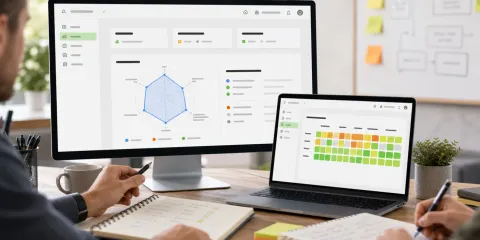
Team health checks are especially valuable for Scrum Masters because they make soft factors measurable: trust, psychological safety, focus, role clarity, technical excellence, or decision-making ability. Especially when AI increases the team’s speed, such early indicators become more important.
Echometer is a good fit when health checks are to be translated directly into retrospectives and action items. It suits Scrum Masters who don’t just want to measure mood, but want to facilitate concrete improvements.
TeamRetro is a strong agile alternative with health check radars, trend tracking, and AI summaries.
There are of course also HR and engagement platforms like Culture Amp and Workleap Officevibe: good for larger organizations, but often further removed from sprint routines and team retros.
Methodologically, the Atlassian Team Health Monitor is a helpful reference point, because it describes team health as a regular reflection on delivery capability and collaboration. (Atlassian Team Health Monitor, TeamRetro Health Checks, Culture Amp Engage)
More concrete templates can be found here: Team Health Check Agile: proven templates and Spotify Health Check.
3. 1:1 meeting tools for coaching and employee development 💬
Regular 1:1s with team members, product owners, or stakeholders are often crucial for identifying blockers, conflicts, and development needs early.
Echometer is particularly suitable here for agile teams, because 1:1s can be linked with health-check questions, notes, and coaching templates. This helps Scrum Masters connect qualitative signals from one-on-one conversations with team development.
Fellow is stronger when it comes to AI-assisted meeting notes, transcripts, and summaries. Lattice and Leapsome are stronger in performance management and the HR context. They can make sense if 1:1s are closely tied to goal setting, reviews, and employee development within the company. For Scrum Masters in engineering teams, however, they are often heavier than necessary.
Official product pages: Echometer 1:1 Meeting Software, Fellow, Lattice 1:1s, Leapsome Meetings
If you want to start directly with questions, this article is a good fit: Scrum Master One-on-One: good questions and tips.
If you don’t want to maintain retros, team health checks, and 1:1s in three separate tools, Echometer is the most obvious choice as a foundation for Scrum Masters.
Try Echometer for free4. Agile delivery insights and engineering intelligence ⚙️
Scrum Masters should not mistake delivery metrics for a control instrument. Used correctly, however, they help make bottlenecks visible: long cycle times, blocked pull requests, unclear priorities, too much work in progress, or poor predictability.
Jellyfish, Plandek, Swarmia, and DX are strong examples of engineering intelligence tools. They combine data from Jira, GitHub, GitLab, CI/CD, and surveys to make delivery flow, investment allocation, and developer experience visible. Some of these tools now offer AI assistants that answer questions about engineering data or distill patterns in delivery metrics.
This category does not replace a retrospective. With objective data, it rather provides valuable raw material for better retrospectives: “Where are we losing time?”, “Which dependencies are slowing us down?” or “Which improvements are making an impact?”
Official product pages: Jellyfish, Plandek, Swarmia, DX
If you’re more interested in delivery metrics and flow, this article is a good deep dive: Agile Delivery Flow.
5. Agile project management and sprint tracking ✅
Project management tools are usually not optional for Scrum Masters. Backlog, sprint board, burndown, roadmap, and ticket history are often the shared basis of work.
Jira is still the standard in many larger organizations. With Atlassian Intelligence, or Rovo, AI features are being added that can summarize work, create tickets, prepare status updates, or use context from the Atlassian ecosystem.
Linear is attractive for modern product and engineering teams that prefer a faster, leaner tool. ClickUp is broader in scope and can make sense if agile work, documentation, task management, and reporting are all meant to come together in one work management platform.
Official product pages: Jira AI, Linear, ClickUp Agile Project Management
For Scrum Masters, the boundary is important: Jira or Linear show what is happening. Echometer, retrospectives and 1:1s help uncover why it is happening and what the team wants to change.
6. Planning Poker and effort estimation 🃏
Planning Poker tools are smaller than many other categories, but they solve a specific problem: teams can submit estimates in parallel, anonymously, and in a structured way. This is especially helpful when dominant voices would otherwise skew the estimation or when estimating remotely.
Since the tools all work similarly in terms of features, the choice of tool is likely to depend largely on integrations with project management tools.
“Planning Poker Online” is also available as a Jira app, for example. “Scrumpy Planning Poker” is interesting for teams that need integrations with Jira, Azure DevOps, GitHub, GitLab or Slack. Parabol Sprint Poker is a good fit if estimation and agile meetings already take place in Parabol.
Kollabe as a Planning Poker tool is suitable for teams looking for a lean solution for estimation meetings. Kollabe also offers integrations with Jira, GitHub, Azure DevOps and Linear.
However, a voting feature in the existing project management or meeting tool is often enough.
Official product pages: Planning Poker Online, Scrumpy Planning Poker, Parabol Sprint Poker, Kollabe Planning Poker
In this category, AI is less decisive than good facilitation. A tool can structure discussions, but it should not replace the joint clarification of uncertainty.
7. Asynchronous daily standups and status updates 💬
Asynchronous standup tools help move status updates out of meetings. This can make sense when teams are spread across time zones or when daily scrums have become pure reporting meetings.
Geekbot and DailyBot are well-known examples of standups based in Slack and Microsoft Teams. They collect responses, send automatic reminders, and make blockers visible. Standuply is another option that combines asynchronous standups, surveys and reports.
Official product pages: Geekbot, DailyBot, Standuply
The boundary is important: an asynchronous update does not automatically replace a daily scrum. If the team needs real coordination, the Scrum Master should not just cancel the meeting, but deliberately decide which alignment needs to remain synchronous.
8. Whiteboards for agile workshops ✏️
Whiteboards are valuable for Scrum Masters when workshops are open, visual and collaborative: brainstorming, user story mapping, root cause analyses and team canvas. They are classic Agile coach tools for visual techniques and workshop designs. Whiteboard tools are also often used for prioritization or retrospectives – however, for that we would rather recommend dedicated tools.
Miro is the comprehensive standard for digital whiteboards. AI features now help with structuring, grouping, summarizing and generating workshop content. FigJam is attractive for teams that already do a lot of work in Figma. However, both are relatively expensive in our view, and it is worth evaluating whether you really need such extensive whiteboards.
Otherwise, our favorite in the team is actually Excalidraw, because Excalidraw is more reduced in features and therefore easier to use. Another plus: Excalidraw is open source.
Official product pages: Miro AI, FigJam, Excalidraw Plus
For Scrum Masters, the rule is: a whiteboard is a space, not a process. If actions, health checks and follow-ups are important, the whiteboard should be embedded in a clear workflow and not create extra administrative overhead.
9. Documentation and knowledge management 📚
Many agile teams do not fail because of missing meetings, but because of missing context: decisions cannot be found, onboarding takes too long, architecture decisions disappear in Slack, and sprint learnings are not reused.
Notion is a true all-rounder and strong for flexible team wikis, databases, and lightweight documentation. Confluence is particularly useful if a team is already working within the Atlassian ecosystem. Both platforms have AI features for summarizing, rephrasing, searching, and creating content.
Here too, there are several open-source alternatives such as AppFlowy or Docmost. Since we use Notion ourselves, however, we have not yet gained any experience with these alternatives.
Official product pages: Notion AI, Confluence AI, AppFlowy, Docmost
10. AI meeting assistants for Scrum events 🎙️
AI meeting assistants are the most obvious new category for Scrum Masters. They can transcribe, summarize, and extract action items from Sprint Reviews, Refinements, Scrum-of-Scrums, stakeholder meetings, or retrospectives.
tl;dv, Fathom, Fireflies.ai, and Otter.ai are well-known examples. However, it is worth critically checking whether the integrated meeting summaries in Google Meet or MS Teams are not sufficient for your own purposes. If so, you do not necessarily need a separate AI tool.
Official product pages: tl;dv, Fathom, Fireflies.ai, Otter.ai
Regardless of whether a separate AI tool is used or not, this category should be handled with sensitivity: In retrospectives and 1:1s, automatic recording can change the atmosphere and damage trust. Scrum Masters should therefore clearly distinguish: For status, review, and stakeholder meetings, an AI assistant can be very useful. For psychologically safe team reflections, restraint is often better.
In Echometer’s 1:1 tool, the use of the AI meeting assistant is therefore optional.
Comparison: Which tools does a Scrum Master really need?
A good Scrum Master setup is rarely the sum of all the best individual tools. In practice, it is usually leaner and combines a few AI tools with proven Agile coach techniques:
| Need | Useful tool category | Typical tools |
|---|---|---|
| Improve team | Retrospectives, health checks, measures | Echometer, TeamRetro, Parabol |
| Coach individuals | 1:1 meetings, notes, development questions | Echometer, Lattice, Leapsome |
| Make work visible | Sprint board, backlog, roadmap | Jira, Linear, ClickUp |
| Identify delivery bottlenecks | Engineering Intelligence | Jellyfish, Swarmia, DX |
| Coordinate remotely | Async standups, meeting notes, whiteboards | Geekbot, tl;dv, Miro |
| Secure knowledge | Wiki, decisions, documentation | Notion, Confluence |
Echometer as an all-in-one basis for Scrum Masters
If Scrum Masters do not want to introduce ten different tools, Echometer is a strong basis, especially for coaching-related tasks:
- Retrospectives online, hybrid, and on-site
- Team health checks and pulse checks
- Action item tracking for continuous improvement
- 1:1 meetings and coaching conversations
- Surveys and team development data
Echometer does not cover every category. For backlog management, for example, Jira or Linear remain useful. For deep engineering intelligence, Jellyfish, Swarmia, or DX can complement.
The advantage of an all-in-one approach is that Scrum Masters do not have to distribute the most important team development routines across multiple silos.
If you want to combine retrospectives, health checks, and 1:1s with optional AI support for your agile team, you can try Echometer directly:
Conclusion: The best Scrum Master tool setup is lean and integrable
In 2026, the best AI tools for Scrum Masters are those that offer practical added value: saving time, improving communication and interactions within the team, or, for example, simplifying documentation.
For many Scrum Masters, a lean combination makes sense: Echometer for retrospectives, health checks, and 1:1s; Jira or Linear for sprint tracking; optionally an engineering intelligence tool for delivery data.
The actual Scrum Master competence remains the same: tools provide signals. Value is only created when teams derive better decisions and behavioral changes from them.
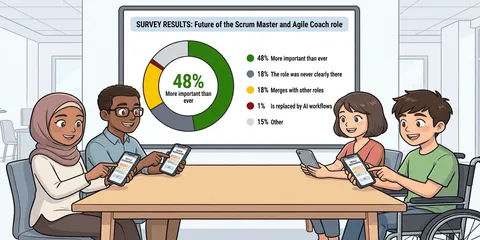
If you’re wondering how the role itself is changing through AI, this article is a good next step: Echometer Community Survey 2026 on AI in Agile Software Development.
FAQ: Scrum Master AI Tools in 2026
What AI tools does a Scrum Master really need?
A Scrum Master does not necessarily need a pure AI tool. More important is a good setup made up of a retrospective tool, team health check, 1:1 tool, project management system and, optionally, meeting or delivery intelligence.
AI is especially helpful when it makes summaries, pattern recognition, preparation or follow-ups easier.
Can AI replace Scrum Masters?
Probably not. AI can reduce administrative tasks, summarize meetings, or condense data.
But the core work of a Scrum Master remains human: building trust, moderating conflicts, promoting psychological safety, making organizational dynamics visible, and supporting teams through real change.
Which tool categories are most important for small agile teams?
Small teams should first cover retrospectives, action tracking, team health, and a clean sprint board.
Only then do additional tools for engineering intelligence, asynchronous standups, or meeting transcription become worthwhile. Too many tools quickly create more coordination effort than benefit.
When is an all-in-one tool like Echometer worthwhile for Scrum Masters and Agile Coaches?
An all-in-one tool is worthwhile when Scrum Masters do not want to manage retrospectives, health checks, action items, and 1:1s separately.
This is especially useful when team feedback should not only be collected, but regularly translated into concrete improvements.
What risks do AI tools have in agile teams?
The most important risks are incorrect summaries, data privacy issues, lack of trust in recordings, overinterpretation of metrics, and additional tool overhead.
Scrum Masters should therefore use AI results as a basis for discussion, not as automatic truth.
Best AI tools for Scrum Masters 2026
The best AI tools for Scrum Masters 2026 are not necessarily pure AI apps. A sensible setup consists of tools that support real Scrum Master tasks: retrospectives, team health checks, 1:1s, action item tracking, meeting summaries, and delivery insights.
Echometer is especially relevant when Scrum Masters want to connect retrospectives, health checks, action items, and 1:1s in one workflow. Depending on the team, Jira or Linear for sprint tracking, Miro or FigJam for workshops, and meeting assistants for status or stakeholder meetings can also be useful.
You can find a detailed overview here: The best AI tools for Scrum Masters and Agile Coaches in 2026