
AI maturity assessment template: Excel checklist for agile software delivery
The true level of AI maturity in agile software development is revealed by whether teams make better decisions and deliver valuable results faster. The problem: far too often, when it comes to AI maturity, people talk only about AI tools and their adoption.
This article presents a pragmatic AI maturity model for agile software development that focuses on real added value. You can use it to measure your team’s AI maturity, document the results as an assessment, and derive concrete improvements. In doing so, we do not cater to the AI hype, but follow common sense along the premise:
AI maturity in agile software delivery is reflected in whether AI accelerates and improves the value stream from problem understanding to user feedback.
Here you get 6 dimensions, each with 3 health check items for surveys and team retrospectives. At the end, you will also find an Excel template that summarizes all items as the basis for your maturity matrix.
TL;DR
- An AI maturity model for agile software development assesses concrete capabilities of product and engineering teams.
- The 6 dimensions cover goal clarity, knowledge context, verification, delivery system, collaboration, and continuous improvement.
- The best AI maturity measurement is not Excel reporting, but a foundation for team retrospectives and concrete improvements.
AI maturity assessment template: Excel checklist
This page is a practical AI maturity assessment template for teams working in agile software delivery. You will get:
- 18 concrete health-check items in 6 dimensions and 3 maturity levels,
- an Excel template for the maturity matrix, scores, and evidence,
- retro templates to derive concrete experiments and next steps from the assessment.
You can download the Excel template directly and then combine it with a team retrospective:
6 dimensions for AI maturity in agile software delivery
A useful model for agile software delivery must stay close to day-to-day team work. It does not assess how many AI tools a team uses, but whether AI improves delivery capability and supports the next team decision. Each dimension answers exactly one guiding question:
| Dimension | Guiding question | Function in the delivery system |
|---|---|---|
| Clarity of goals | Are we working on the right problems? | Direction |
| Shared knowledge context | Can AI understand our product and our domain? | Context |
| Verification & trust | Can we use AI results safely? | Trust |
| AI-adaptive delivery system | Does the team get better as a system? | Flow |
| Collaboration | Does AI become a team capability instead of individual optimization? | Alignment |
| Continuous Improvement & Governance | Do the organization and the rules get better with every iteration? | Learning loop |
The system behind it is simple:
- Goals determine what AI is used for.
- The knowledge context determines how well AI can work.
- Verification determines whether results are usable.
- The delivery system determines whether value is created faster as a result.
- Collaboration determines whether the team gets better together.
- Continuous improvement and governance determine whether improvements endure.
Logic of the AI maturity model: 6 dimensions and 3 levels for clear prioritization
For team retrospectives, I recommend 3 simple levels. Important: The levels do not first assess AI usage. They first assess the underlying delivery capability.
| Level | Meaning | Typical pattern |
|---|---|---|
| Level 1: Capability exists | The team basically masters the dimension. | Baseline |
| Level 2: Team practice established | The team has a shared practice for this dimension. | Repeatability |
| Level 3: AI integrated | AI systematically amplifies this capability. | AI-supported delivery impact |
How to use these levels: If Level 1 of a dimension is already problematic, first identify the problem with it and solve it. Once a healthy baseline has been established, you can move on to Level 2 and anchor the capability in the teams’ ways of working. Only when both Level 1 and 2 perform well does a focus on “AI integration” make sense. Of course, AI may already offer good solutions for Level 1 and 2, but AI should not yet be the mental focus there.
So here are the items for measuring the dimension, with the option to start the measurement directly with a retrospective in Echometer:
AI Maturity Assessment Template
Dimension 1: 🎯 Goal Clarity
This dimension checks whether AI improves work on the right problem. Many teams use AI for more output even though the problem, user need, or success criterion is vague. Then AI simply scales ambiguity.
AI maturity: 🎯 Goal clarity: How the retro works
Random Icebreaker (2-5 minutes)
Echometer provides you with a generator for random check-in questions.
Review of open actions (2-5 minutes)
Before starting with new topics, you should talk about what has become of the measures from past retrospectives to check their effectiveness. Echometer automatically lists all open action items from past retros.
Health Check
All team members can answer the health checks anonymously on a scale. Then go through the results of the health checks together and record any additional comments if necessary. If you use the same health checks in several retrospectives, you can also track trends over time in Echometer.
- Level 1: For our tasks, it is usually clear whether they have achieved their goal or not.
- Level 2: Before implementing topics, we always establish a shared understanding of the problem, solution, and success criterion.
- Level 3: AI systematically helps us understand user problems, weigh solution options, and define success criteria.
Discuss retro topics
Use the following open questions to collect your most important findings. First, everyone does it themselves, covered. Echometer allows you to reveal each column of the retro board individually in order to then present and group the feedback.
- What is currently holding us back in this dimension?
- What is the next best measure or next experiment to improve us in this dimension?
Catch-all question (Recommended)
So that other topics also have a place:
- What else would you like to talk about in the retro?
Prioritization / Voting (5 minutes)
On the retro board in Echometer, you can easily prioritize the feedback with voting. The voting is of course anonymous.
Define actions (10-20 minutes)
You can create a linked action via the plus symbol on a feedback. Not sure which measure would be the right one? Then open a whiteboard on the topic via the plus symbol instead to brainstorm root causes and possible measures.
Checkout / Closing (5 minutes)
Echometer enables you to collect anonymous feedback from the team on how helpful the retro was. This creates the ROTI score ("Return On Time Invested"), which you can track over time.
AI maturity: 🎯 Goal clarity
Health Check Questions (Scale)
Open questions

Good discussions often arise here around the question: “Which AI-accelerated work should we have never started in the first place?”
AI Maturity Assessment Template
Dimension 2: 🧠 Shared Knowledge Context
This dimension deliberately replaces the narrower term “data quality.” For agile delivery, it is not just about data, but about product knowledge, domain knowledge, architectural understanding, quality expectations, and shared decisions. AI can only do good work if this context is available and reliable.
AI maturity: 🧠 Shared knowledge context: How the retro works
Random Icebreaker (2-5 minutes)
Echometer provides you with a generator for random check-in questions.
Review of open actions (2-5 minutes)
Before starting with new topics, you should talk about what has become of the measures from past retrospectives to check their effectiveness. Echometer automatically lists all open action items from past retros.
Health Check
All team members can answer the health checks anonymously on a scale. Then go through the results of the health checks together and record any additional comments if necessary. If you use the same health checks in several retrospectives, you can also track trends over time in Echometer.
- Level 1: Relevant product and domain knowledge is readily available for my work.
- Level 2: As a team, we invest in a shared knowledge context that is up to date and usable for everyone.
- Level 3: AI helps us systematically identify knowledge gaps and ambiguities and improve context.
Discuss retro topics
Use the following open questions to collect your most important findings. First, everyone does it themselves, covered. Echometer allows you to reveal each column of the retro board individually in order to then present and group the feedback.
- What is currently holding us back in this dimension?
- What is the next best measure or next experiment to improve us in this dimension?
Catch-all question (Recommended)
So that other topics also have a place:
- What else would you like to talk about in the retro?
Prioritization / Voting (5 minutes)
On the retro board in Echometer, you can easily prioritize the feedback with voting. The voting is of course anonymous.
Define actions (10-20 minutes)
You can create a linked action via the plus symbol on a feedback. Not sure which measure would be the right one? Then open a whiteboard on the topic via the plus symbol instead to brainstorm root causes and possible measures.
Checkout / Closing (5 minutes)
Echometer enables you to collect anonymous feedback from the team on how helpful the retro was. This creates the ROTI score ("Return On Time Invested"), which you can track over time.
AI maturity: 🧠 Shared knowledge context
Health Check Questions (Scale)
Open questions

My opinion: For many teams, knowledge context is the underrated lever. Prompt training brings little value if team knowledge is scattered, outdated, or contradictory.
AI Maturity Assessment Template
Dimension 3: ✅ Verification & Trust
This dimension is at the core of AI maturity in software teams. AI can accelerate code, tests, acceptance criteria, analysis, and documentation. But only verifiable results may enter the value stream.
AI maturity: ✅ Verification & Trust: How the retro works
Random Icebreaker (2-5 minutes)
Echometer provides you with a generator for random check-in questions.
Review of open actions (2-5 minutes)
Before starting with new topics, you should talk about what has become of the measures from past retrospectives to check their effectiveness. Echometer automatically lists all open action items from past retros.
Health Check
All team members can answer the health checks anonymously on a scale. Then go through the results of the health checks together and record any additional comments if necessary. If you use the same health checks in several retrospectives, you can also track trends over time in Echometer.
- Level 1: I can reliably assess the quality of my work.
- Level 2: As a team, we have an established standard for good work that everyone adheres to.
- Level 3: With AI, we identify risks, errors, and quality gaps earlier and fix them faster.
Discuss retro topics
Use the following open questions to collect your most important findings. First, everyone does it themselves, covered. Echometer allows you to reveal each column of the retro board individually in order to then present and group the feedback.
- What is currently holding us back in this dimension?
- What is the next best measure or next experiment to improve us in this dimension?
Catch-all question (Recommended)
So that other topics also have a place:
- What else would you like to talk about in the retro?
Prioritization / Voting (5 minutes)
On the retro board in Echometer, you can easily prioritize the feedback with voting. The voting is of course anonymous.
Define actions (10-20 minutes)
You can create a linked action via the plus symbol on a feedback. Not sure which measure would be the right one? Then open a whiteboard on the topic via the plus symbol instead to brainstorm root causes and possible measures.
Checkout / Closing (5 minutes)
Echometer enables you to collect anonymous feedback from the team on how helpful the retro was. This creates the ROTI score ("Return On Time Invested"), which you can track over time.
AI maturity: ✅ Verification & Trust
Health Check Questions (Scale)
Open questions

A mature team does not ask: “Are we allowed to use AI for this?” It asks: “What evidence do we need in order to use this result responsibly?”
AI Maturity Assessment Template
Dimension 4: 🔁 AI-adaptive Delivery System
This dimension checks whether AI improves the value stream. Individual people may be faster while the overall system hardly improves at all. Then AI remains individual optimization. Maturity only emerges when the team adapts its way of working to the new possibilities.
AI maturity: 🔁 AI-adaptive delivery system: How the retro works
Random Icebreaker (2-5 minutes)
Echometer provides you with a generator for random check-in questions.
Review of open actions (2-5 minutes)
Before starting with new topics, you should talk about what has become of the measures from past retrospectives to check their effectiveness. Echometer automatically lists all open action items from past retros.
Health Check
All team members can answer the health checks anonymously on a scale. Then go through the results of the health checks together and record any additional comments if necessary. If you use the same health checks in several retrospectives, you can also track trends over time in Echometer.
- Level 1: Our team regularly delivers increments that are usable for customers.
- Level 2: Feedback loops with customers and the analysis of usage data are a fixed part of our team's value stream.
- Level 3: We actively use AI to turn usage data and user feedback into impact faster.
Discuss retro topics
Use the following open questions to collect your most important findings. First, everyone does it themselves, covered. Echometer allows you to reveal each column of the retro board individually in order to then present and group the feedback.
- What is currently holding us back in this dimension?
- What is the next best measure or next experiment to improve us in this dimension?
Catch-all question (Recommended)
So that other topics also have a place:
- What else would you like to talk about in the retro?
Prioritization / Voting (5 minutes)
On the retro board in Echometer, you can easily prioritize the feedback with voting. The voting is of course anonymous.
Define actions (10-20 minutes)
You can create a linked action via the plus symbol on a feedback. Not sure which measure would be the right one? Then open a whiteboard on the topic via the plus symbol instead to brainstorm root causes and possible measures.
Checkout / Closing (5 minutes)
Echometer enables you to collect anonymous feedback from the team on how helpful the retro was. This creates the ROTI score ("Return On Time Invested"), which you can track over time.
AI maturity: 🔁 AI-adaptive delivery system
Health Check Questions (Scale)
Open questions

The practical test: If AI disappeared from your work, would the value stream get worse or only the perceived productivity?
AI Maturity Assessment Template
Dimension 5: 🤝 Collaboration
This dimension is the blind spot of many AI maturity models. Agile software development lives on shared understanding, communication, decisions, and ownership. If AI is used only individually, it can even weaken teamwork: less shared context, less discussion, more parallel individual optimization.
AI maturity: 🤝 Collaboration: How the retro works
Random Icebreaker (2-5 minutes)
Echometer provides you with a generator for random check-in questions.
Review of open actions (2-5 minutes)
Before starting with new topics, you should talk about what has become of the measures from past retrospectives to check their effectiveness. Echometer automatically lists all open action items from past retros.
Health Check
All team members can answer the health checks anonymously on a scale. Then go through the results of the health checks together and record any additional comments if necessary. If you use the same health checks in several retrospectives, you can also track trends over time in Echometer.
- Level 1: I have a good overview of what is currently happening in the team.
- Level 2: Our communication within the team enables everyone to work effectively and stay up to date.
- Level 3: AI helps distribute relevant knowledge to the right people and reduces unnecessary information overhead.
Discuss retro topics
Use the following open questions to collect your most important findings. First, everyone does it themselves, covered. Echometer allows you to reveal each column of the retro board individually in order to then present and group the feedback.
- What is currently holding us back in this dimension?
- What is the next best measure or next experiment to improve us in this dimension?
Catch-all question (Recommended)
So that other topics also have a place:
- What else would you like to talk about in the retro?
Prioritization / Voting (5 minutes)
On the retro board in Echometer, you can easily prioritize the feedback with voting. The voting is of course anonymous.
Define actions (10-20 minutes)
You can create a linked action via the plus symbol on a feedback. Not sure which measure would be the right one? Then open a whiteboard on the topic via the plus symbol instead to brainstorm root causes and possible measures.
Checkout / Closing (5 minutes)
Echometer enables you to collect anonymous feedback from the team on how helpful the retro was. This creates the ROTI score ("Return On Time Invested"), which you can track over time.
AI maturity: 🤝 Collaboration
Health Check Questions (Scale)
Open questions

An agile AI maturity model must measure whether AI makes the team better, not just individual specialists.
AI Maturity Assessment Template
Dimension 6: ☯️ Continuous Improvement & Governance
Governance is important, but it must not swallow everything. In this model, governance means: the team can make responsible decisions, make risks visible, and improve rules based on real experiences. Continuous improvement and governance belong together because rigid rules quickly become outdated in such a dynamic field.
AI maturity: ☯️ Continuous Improvement & Governance: How the retro works
Random Icebreaker (2-5 minutes)
Echometer provides you with a generator for random check-in questions.
Review of open actions (2-5 minutes)
Before starting with new topics, you should talk about what has become of the measures from past retrospectives to check their effectiveness. Echometer automatically lists all open action items from past retros.
Health Check
All team members can answer the health checks anonymously on a scale. Then go through the results of the health checks together and record any additional comments if necessary. If you use the same health checks in several retrospectives, you can also track trends over time in Echometer.
- Level 1: For my work, responsibilities and risk boundaries are clear at all times.
- Level 2: As a team, we regularly adapt the way we work based on new insights and lessons learned from experience.
- Level 3: AI helps us systematically question and further develop the way we work.
Discuss retro topics
Use the following open questions to collect your most important findings. First, everyone does it themselves, covered. Echometer allows you to reveal each column of the retro board individually in order to then present and group the feedback.
- What is currently holding us back in this dimension?
- What is the next best measure or next experiment to improve us in this dimension?
Catch-all question (Recommended)
So that other topics also have a place:
- What else would you like to talk about in the retro?
Prioritization / Voting (5 minutes)
On the retro board in Echometer, you can easily prioritize the feedback with voting. The voting is of course anonymous.
Define actions (10-20 minutes)
You can create a linked action via the plus symbol on a feedback. Not sure which measure would be the right one? Then open a whiteboard on the topic via the plus symbol instead to brainstorm root causes and possible measures.
Checkout / Closing (5 minutes)
Echometer enables you to collect anonymous feedback from the team on how helpful the retro was. This creates the ROTI score ("Return On Time Invested"), which you can track over time.
AI maturity: ☯️ Continuous Improvement & Governance
Health Check Questions (Scale)
Open questions

The goal is neither maximum freedom nor maximum control. The goal is a system in which teams can learn quickly without suppressing risks.
Tip: Simple AI maturity radar chart and heatmap with Echometer
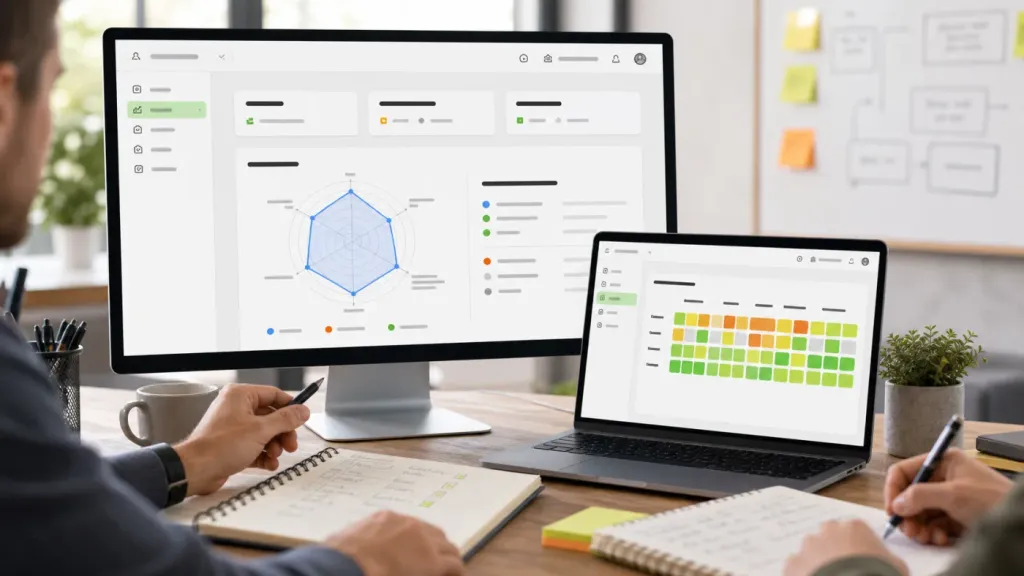
Once you have covered all items with your team, you can prepare and visualize the data. Echometer even does that automatically for you:
If you conduct the AI maturity assessment for several teams, Echometer even provides a suitable AI maturity evaluation as a matrix / heatmap for the organization:
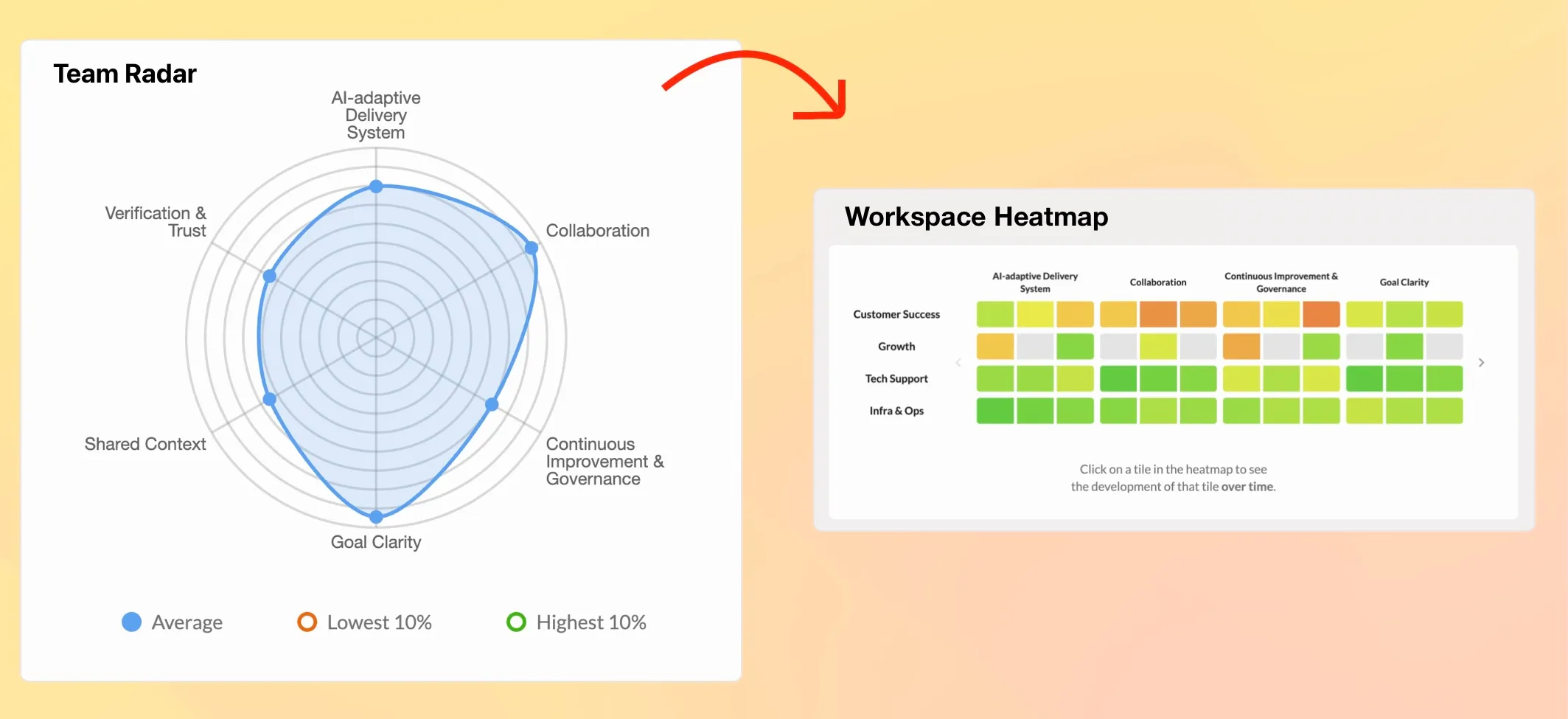
Therefore, my recommendation is: Instead of manual surveys and Excel, use Echometer so that you can benefit not only from professional analyses and trend analyses at the push of a button, but also from optimal support for facilitation and action tracking.
Excel checklist: AI maturity assessment matrix and template
If you are looking for an Excel template for your AI maturity model, you can use this checklist directly as a matrix for your assessment:
| Dimension | Level | Survey item | Score 1-5 | Evidence | Biggest blocker | Next experiment | Owner | Review date |
|---|---|---|---|---|---|---|---|---|
| Clarity of goals | 1 | For our tasks, it is usually clear whether they have achieved their goal or not. | ||||||
| … |
Checklist: How to use the AI maturity assessment template for agile software delivery
Don’t start with all 18 items in one huge assessment. Start with one dimension where you currently feel friction.
Each item is formulated as a simple agreement statement. If a team disagrees with Level 1, the basic capability is not yet stable. If Level 1 is true but Level 2 is not, a reliable team practice is missing. If Level 2 is true but Level 3 is not, AI is not yet a systematic amplifier of this capability.
So, here is your checklist for a smooth process:
- Choose one dimension that currently seems most relevant to you or your team. Focusing on all dimensions at once only leads to one thing: chaos.
- Have the team assess the three level items anonymously. For example, directly in Echometer’s retro tool.
- When evaluating, don’t discuss the average, but the deviations in your opinions. This reveals insights and makes opportunities visible.
- Also answer the two open questions in the retro template to develop a shared picture of blockers and possible measures.
- Formulate an experiment for 2 to 4 weeks. Agree on regular check-ins to ensure progress.
- After implementing the measure and an appropriate testing period, measure the same dimension again.
In addition to the checklist, a note on what you should definitely avoid is also allowed: If you compare multiple teams, compare patterns, not scores. A platform team, a product team, and a legacy team have different starting conditions. Maturity measurement becomes dangerous when it turns into a ranking.
More on this: Why agile maturity assessments often fail.
Conclusion: Measuring AI maturity is only useful if it also leads to improvements
A practical AI maturity model for agile delivery should be translated into concrete capabilities of agile teams and lead to concrete measures. To that end, this article provides compact items, retrospective questions, and an Excel matrix that can be used directly within the team.
My recommendation: use Excel for overview, but use retrospectives for change. A team that honestly discusses one dimension and starts a good improvement (or even a good experiment) is further along than an organization with a perfect matrix and an extensive heatmap but no follow-through.
If you are looking for more input on AI in agile software development, these articles are a good next step:
FAQ on the AI maturity assessment template for agile software delivery
What is an AI maturity assessment template for agile software teams?
An AI maturity assessment template for agile software teams evaluates how well a team translates AI into goal clarity, knowledge context, verification, the delivery system, collaboration, and continuous improvement. It measures not only tool usage, but whether AI improves the team’s value creation and learning ability.
Why is the model tailored to agile teams?
The model looks at AI maturity from the perspective of product and engineering teams. It combines concrete delivery capabilities with team practices and retrospective questions so that the measurement directly leads to the next improvements.
Should I start with Excel or with a retrospective for an AI maturity assessment?
Start with a retrospective if you want to change behavior. Excel makes sense for documenting items, scores, evidence, and experiments. But the real insight comes from the conversation about blockers, risks, and the next small improvement step.
Why does the maturity model contain only three maturity levels?
Three levels are understandable and action-oriented for team retrospectives: capability present, team practice established, and AI integrated. A fourth level such as AI-native organization is useful as a vision in individual cases, but for many teams it is currently too distant to derive good, concrete measures.