
What Does AI-Augmented Agile Software Development Look Like in the Future? (Guide for CTOs)
AI is already accelerating parts of agile software development today. But the crucial question is no longer whether teams become faster with AI, but whether that speed also results in customer value and how AI usage can be managed sensibly in the future.
For CTOs, that is the real management question behind the AI hype. More output brings little benefit if you can no longer reliably assess whether the right problem is being worked on or whether the code will remain viable in the long term. Here we provide a guide for orientation.
If you want to view the question more broadly as agile transformation rather than just as a software delivery topic, this supplementary article is worthwhile: AI exposes agile transformation.
TL;DR
- AI only increases development speed as far as human judgment, engineering practices, and organizational feedback loops can keep up.
- The biggest levers therefore lie not in maximally using AI by individual employees in the short term, but in accountability, harness, delivery, observability, and a culture of learning.
Where AI Optimists See the Future of Agile Software Development
AI-augmented programming is long since more than just “Vibe Coding”. While Vibe Coding is often associated with rapid prototypes and low maintainability, current approaches go further. They aim to secure production-ready results through better specification, tests, and iteration.
New opportunities are also emerging in product management. Tools like Linear are already articulating the vision of a system that translates conversations from Slack or Microsoft Teams into structured work, prioritizes them, and hands them off to coding agents.
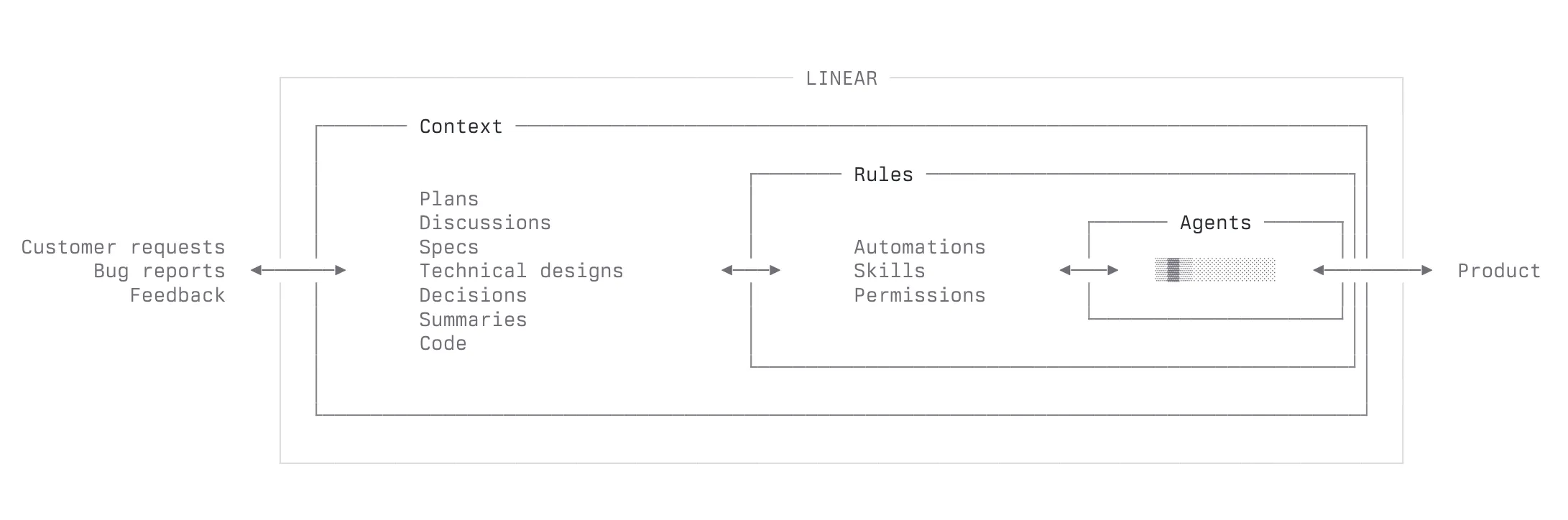
Source: Issue tracking is dead (Karri Saarinen, Linear CEO)
The mistake of AI optimists is often to jump to the premature conclusion that human judgment will soon lose its value. In reality, it becomes more valuable.
Where AI-Centered Visions of the Future Break Down in Practice
Many views on the future of AI-augmented software development are driven by interests. Providers of foundation models, consultancies, coaches, and build-in-public creators all benefit from portraying the reach and impact of AI as as large as possible. That does not mean their theses are wrong. It just means that leaders should read them as marketing, not as neutral operating instructions.
The tension becomes especially clear in very aggressive productivity visions. Galen Hunt of Microsoft wrote on LinkedIn:
Our guiding principle is: ‘1 developer, 1 month, 1 million lines of code’.

Such statements reveal the core question: Who can still meaningfully understand, review, and take responsibility for that amount of artifacts? If the answer is “no one,” then the vision is not scaled productivity, but scaled blind flight.
The “AI Agile Manifesto” puts the counterpoint in one sentence:
If intelligence grows without human judgment, AI Agile considers it failure, not progress.
Source: AI Agile Manifesto Org
From our point of view, this is the realistic forecast for the future: AI shifts tasks, but it does not replace the need for sound product judgment, sound architecture decisions, and sound organizational systems.
The Real Bottleneck Is Trust, Not Token Speed
Many discussions about AI-augmented agile software development revolve around model quality, agents, or productivity metrics. In practice, however, organizations usually fail earlier: due to a lack of trust in AI-generated code, unclear responsibility, and weak control mechanisms.
Kent Beck describes exactly this point in his blog post Trust Factory: Tests, reviews, refactoring, pairing, observability, and incremental delivery are not just techniques for code quality, but mechanisms for building trust.
This applies even more strongly to AI-augmented development. As soon as code is created faster than teams can understand, test, and take responsibility for it, the speed gain turns into the opposite.
When you ship code faster than engineers can read it, in domains where nobody has full context, you are making withdrawals from a trust account that took years to build.

In our view, this is precisely the central limit of AI in agile software development: AI is an amplifier. It amplifies good systems, but also poor judgment, bad processes, and weak team coordination.
How pronounced the gap between individual productivity and organizational maturity still is today is also shown by our summary of the state of the research: State of the research 2026 on AI in agile software development.
If you’d prefer to understand this gap through concrete dysfunctional patterns, you’ll find the right addition here, with clear examples for managers: Why AI fails in agile software delivery.
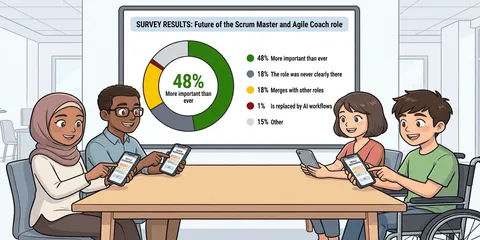
How this gap becomes visible in our own community is shown by the results of our June 2026 survey: Community survey on AI in Agile.
This leads to the following guide for AI-augmented agile software development for CTOs and Engineering Managers.
Guide: AI-Augmented Agile Software Development
The 5 Most Important Levers for CTOs and Engineering Managers
1. Keep Responsibility Clearly with Humans
Teams need a clear red line: AI may support decisions, but it must not take responsibility. This applies to architecture, prioritization, security risks, and product-relevant trade-offs.
The old IBM principle feels surprisingly modern here:
A computer can never be held accountable, therefore, a computer must never make a management decision.
Source: IBM Post: AI decision-making
For leaders, this means in practical terms: do not set unrealistic productivity targets, do not encourage the illusion of full autonomy, and do not allow responsibility to be dispersed.
2. Build a Strong Engineering Harness
The more AI-generated code is produced, the more important precise specifications, isolated work environments, automated tests, and controlled feedback loops become. That is why approaches such as Spec-Driven Development or Agentic Harness Engineering are gaining relevance.
- Spec-Driven Development: Specifications become a shared working artifact between humans and AI. Examples: OpenSpec and GitHub Spec Kit
- Agentic / Closed-Loop Engineering: Agents iteratively improve their solutions in a controlled environment based on analyses and tests. See Agentic Harness Engineering (AHE)
So the management question is not only: “Which model are we using?” But rather: “Under what technical and procedural conditions is this model allowed to work autonomously at all?”
3. Accelerate Agile Delivery and Feedback Loops with Customers
AI shortens the path from prompt to code. If the path from code to real user feedback remains slow, only local output is created instead of real value creation.
That is why Continuous Agile Delivery in an AI world is even more important than before. Small, frequent increments reduce risk, shorten learning cycles, and prevent large amounts of unnecessary features and changes from disappearing into the system.
4. Upgrade Observability and Product Analytics
Anyone developing software faster with AI must also recognize just as quickly when something goes wrong. Technical observability and product analytics are therefore essential for trust in AI-augmented software development.
This is explicitly not just about monitoring errors, but also about analyzing the usage of new features and their benefits (e.g. through A/B tests). Because with AI, the temptation is strong to simply develop every conceivable feature without first sufficiently validating customer value.
Productivity doesn’t matter if you’re working on the wrong thing.

5. Strengthen a Learning Culture Instead of a Blind Focus on Productivity
An organization that wants to use AI well needs the ability to learn and adapt quickly. Pair programming, retrospectives, and iterative process improvement thus become part of the AI strategy.
Individual problems will increasingly no longer be solvable with one-off solutions at speed. What is needed is an adaptable organization that can find the right systemic solutions for recurring problems.
Jez Humble sums up the management problem succinctly:
The paradox is that when managers focus on productivity, long-term improvements are rarely made. On the other hand, when managers focus on quality, productivity improves continuously.

The same applies to AI transformations: those who measure output get more output in the short term. Those who strengthen process quality and learning capability get the organization that is more successful in the long term.
Conclusion: AI Only Accelerates as Far as the Organization Can Keep Up
The most exciting future question is therefore not when AI will “take over” agile software development. The more interesting question is how organizations adapt their systems in order to use AI successfully and responsibly.
If trust, delivery, observability, and learning culture are weak, AI will primarily create more uncertainty and more hard-to-maintain artifacts. If these foundations are strong, AI can be a real enrichment.
For CTOs and engineering managers, this leads to a clear guideline:
- Clarify responsibility and quality standards.
- Strengthen engineering harness, tests, and reviews.
- Accelerate delivery, observability, and learning loops.
FAQ on AI-Augmented Agile Software Development
What Is AI-Augmented Agile Software Development?
AI-augmented agile software development describes the use of AI throughout the entire agile delivery process, not just in coding. This includes, for example, specification, implementation, testing, documentation, reviews, and feedback analysis. The key is that AI complements human judgment, but does not replace responsibility.
What Is the Most Important Lever for CTOs When It Comes to AI in Software Development?
The most important lever is not simply using more tools, but a robust system of responsibility, tests, reviews, observability, and rapid feedback loops. Only when these fundamentals are in place can AI be scaled productively and responsibly in agile software development.
Do Teams with AI Need Fewer Agile Rituals?
Partly, yes. AI can condense manual status synchronization, ticket decomposition, or certain types of meetings. But agile principles such as learning, customer proximity, short iterations, and continuous improvement become even more important as a result. If you are looking for the state of research on this, you can find it here: State of the research 2026 on AI in agile software development.
How Can Trust in AI-Generated Code Be Built?
Trust is created through clear responsibilities, good specifications, automated tests, strong reviews, and controlled delivery processes. It is precisely these mechanisms that form the engineering harness that makes the use of AI viable in practice. Without this safeguard, output often increases, but quality does not reliably improve.
What Makes Agentic Delivery Successful in the Long Term?
In the long term, the organization’s ability to learn and adapt is crucial.
The biggest problems with agentic delivery rarely lie solely at the level of individual prompts or AI tools, but rather in the interplay of responsibility, decision paths, quality criteria, and feedback loops. Retrospectives help organizations make these patterns systematically visible and derive sustainable process adjustments from them.
For CTOs, they are therefore not just a nice agile ritual, but a central mechanism for organizational learning that enables teams to continuously adapt their collaboration to the new reality of AI-augmented software development.