
AI in agile transformation: AI reveals true progress
The agile transformation is not yet properly complete or has stalled, and suddenly AI comes into play. What does AI do to agile transformations? What opportunities arise, and where do you need to be careful?
Current figures on AI, hybrid work models, and the transformation of Scrum are categorized in Scrum Statistics 2026: 20+ current figures, trends, and facts one.
AI is changing some fundamental assumptions of agile transformations quite significantly. Teams are generating requirements, code, tests, analyses, and decision options faster. At the same time, the effort required for review, coordination, and the importance of clear responsibility are increasing.
The danger is that the agile transformation ends up chasing a target picture that will become obsolete in the near future because it no longer fits an AI-supported way of working.
That is why IT leaders must not now be distracted by short-term initiatives such as AI licenses, token budgets, AI guidelines, and prompt workshops. They need to address the central question: How will the agile organization deliver value through AI in the future and adapt to the AI future?
TL;DR
- AI-driven acceleration exposes the true level of maturity of agile organizations: clarity of goals, quality assurance, speed of feedback, and team health.
- The strongest lever for a successful agile transformation in the AI era lies in redesigning workflows, responsibilities, validation, and learning loops.
- Agile coaches, Scrum Masters, and leaders must once again do more systems work without relying on established frameworks.
How agile transformations change through AI
In the first generation of agile transformations, roughly up to 2024, the time-consuming coding itself was often the bottleneck. Agile methods such as Scrum aimed to avoid building the wrong increments and to think in small bets, i.e. sprints. These sprints come with a certain overhead of meetings for coordination and alignment. In some cases, this friction is positive because the discussions can provide important insights.
Even in the AI era, it remains crucial that teams work on the right features. However, the time required for clearly defined programming tasks can decrease significantly: In a controlled GitHub Copilot experiment, developers completed a JavaScript task with Copilot 55.8 percent faster than the control group.
Source: The Impact of AI on Developer Productivity: Evidence from GitHub Copilot
As a result, the commonly two-week sprint cycles seem less appropriate, since review and feedback loops could run much faster.
While before AI it seemed acceptable to release a new version only at the end of the sprint in order to gather feedback, in the AI era Continuous Delivery (CD) becomes more important. If teams generate code faster, build, test, review, and release processes must be able to reliably keep pace at the same speed.
A 2026 analysis on the State of DevOps Modernization shows this tension: 45 percent of developers who use AI coding tools several times a day deploy to production daily or more often. Among occasional AI users, the figure is only 15 percent. At the same time, 69 percent of very frequent AI users report regular deployment problems with AI-generated code.
Source: TechRadar Pro: AI has slashed coding time in 2026, but it’s sacrificed software stability
Many larger initiatives that previously would have required extensive alignment rounds and prioritization workshops can now be developed, published, and tested with customers more quickly. Since programming as part of development can become less costly, ideas can be implemented and tested earlier.
Why AI makes agile transformation even more important
Classic digitization often sped up processes or made them more transparent. AI itself generates knowledge work: requirements, code, tests, meeting summaries, decision options.
This shifts the focus of transformation. More artifacts in less time require stronger mechanisms for meaning, quality, and responsibility.
In its State of AI study 2025, McKinsey describes this gap: Almost nine in ten respondents report regular AI use in their organizations. But material enterprise value is created primarily where companies redesign workflows, clarify leadership ownership, define human validation, and use agile product delivery processes.
Source: McKinsey State of AI 2025
For agile transformations, AI is thus a stress test of the organizational operating system.
Typical breakpoints:
- Unclear goals lead to faster work on the wrong problem.
- Weak quality culture leads to more review workload and more risk.
- Long decision paths also slow down AI-supported teams.
- Low psychological safety prevents errors, doubts, and risks from becoming visible early.
- Silo structures block the translation of local AI gains into customer value.
The thesis from our previous AI-in-Agile articles therefore remains central: in 2026, AI works primarily in organizations with resilient feedback loops.
On the state of the studies: AI in agile software development: state of research 2026.
The misconception: “We need an AI strategy”
Companies need AI guardrails: data protection, security, compliance, tool selection, budget, training, governance. Nevertheless, an isolated AI strategy remains too narrow.
The misconception: AI is treated as an additional capability alongside the existing organization. This creates programs with little connection to value creation:
- an AI Center of Excellence without direct connection to value creation
- Prompt training without changing work processes
- Tool approvals without a quality and review system
- Productivity targets without customer value metrics
- Governance rules without learning loops from actual use
These measures are not wrong. They just rarely go deep enough. An agile transformation with AI must change work systems, roles, decision rights, and feedback cycles.
Precisely for that reason, Scrum KPIs and agile metrics are becoming more important. However, they must show more than tool usage or output. Good metrics make visible whether flow, quality, team health, and customer value are truly improving. You can find concrete guidance here: Scrum KPI: Metrics and Examples.
The DORA study on AI-assisted software development formulates the same core idea: successful AI adoption is a systems problem. Local productivity gains must be translated into measurable product and organizational performance through value stream management.
Source: 2025 DORA State of AI-assisted Software Development Report
The transformation: What AI changes in agile organizations
1. The bottleneck shifts from implementation to orientation
As implementation becomes cheaper, orientation becomes scarcer. Teams can build prototypes faster, test variants, and implement backlog items. Poor prioritization therefore also scales faster.
Product owners, product managers, and leaders therefore need better problem clarity:
- Which user problems are truly relevant?
- Which assumptions are critical?
- Which decision needs more evidence?
- Which features contribute to a measurable outcome?
Roadmaps become prioritized hypotheses. Backlogs need a tighter connection to user problems, business goals, and learning questions.
If you are looking for the classic transformation framework for this, this addition makes sense.
More on this: Agile Transformation Roadmap: 5 models and their commonalities.
2. The bottleneck shifts from creation to verification
AI produces content quickly. That does not mean it is true, secure, useful, or maintainable.
A randomized study with experienced open-source developers even found higher completion times in 2025 due to AI use. The developers expected time savings, but in practice had to check, understand, and correct more.
Source: Measuring the Impact of Early-2025 AI on Experienced Open-Source Developer Productivity
The practical takeaway: the benefits of AI depend heavily on context. Weak specifications, incomplete tests, superficial reviews, and unclear architecture decisions turn AI output into manual verification and correction work.
We described exactly this pattern in our article on typical failure patterns.
More on this: Why AI Fails in Agile Software Delivery.
3. The bottleneck shifts from roles to responsibilities
AI blurs role boundaries. Developers write product copy. Product managers build prototypes. Executives independently evaluate usage data and analytics.
That expands the room to act while also increasing the risk of diffusion of responsibility. Clarifying questions become more important:
- Who decides?
- Who reviews?
- Who bears subject-matter responsibility?
- Who stops a change when there is risk?
- Who learns from bad decisions?
This does not necessarily make roles more rigid. Only the boundaries of responsibility and overlaps should become more explicit.
4. The bottleneck shifts from meetings to learning systems
AI can summarize status updates, write minutes, and condense information. Some meetings therefore lose importance.
The demanding agile work remains: shared understanding of customers and goals, conflict resolution, prioritization, learning from mistakes, and adapting collaboration.
Teams with a lot of “Doing Agile” and little learning will call many rituals into question. Teams with true “Being Agile” are more likely to use AI for faster experiments and better reflection.
For distinction: Doing Agile vs. Being Agile.
The new roadmap: AI as part of agile transformation
A sensible roadmap for AI in agile transformation starts with the value stream and the organization’s learning capability.
Step 1: Analyze the value stream, not the tool landscape
Start with a bottleneck question: Where are we currently losing the most time, quality, or customer proximity in the value stream?
Typical points are:
- unclear requirements
- slow decisions
- manual handoffs
- long review cycles
- poor test coverage
- low transparency about team health
- delayed customer feedback
AI should be applied where it reduces a real bottleneck. Otherwise, local efficiency increases while the system’s delivery performance remains unchanged.
Step 2: Formulate AI use cases as change hypotheses
Treat AI use cases like experiments with clear benefit and risk hypotheses.
A good hypothesis sounds like this, for example:
If we use AI to draft acceptance criteria first, rework in refinement will decrease without the error rate in stories increasing.
Or:
If we use AI to prepare retrospectives, recurring blockers will become visible earlier and action items more concrete.
Seen this way, the organization assesses benefit and risk together. Superficial tool usage rates remain secondary.
Step 3: Deliberately design human validation
Many AI programs write human responsibility into policy. In day-to-day work, it often remains unclear how this responsibility is actually exercised.
Relevant AI use requires clear validation patterns:
- Low risk: AI may make suggestions, humans review by spot check.
- Medium risk: AI creates drafts, a human reviews completely.
- High risk: AI supports analysis and options, but decision and approval remain explicitly human.
McKinsey identifies defined processes for human validation of model outputs as one factor that distinguishes AI high performers.
Source: McKinsey State of AI 2025
Step 4: Adapt team rituals to AI speed
More AI output does not require more frequent rituals. It requires better learning and quality questions.
In practical terms, that means:
- Planning: more clarity on goals, explicit assumptions about risk.
- Refinement: more context, better acceptance criteria, higher testability.
- Review: more user impact, less pure feature demo.
- Retrospective: more analysis of systemic patterns.
Good retro questions under AI conditions:
- Where is AI really speeding things up?
- Where are we being flooded with AI output?
- Are we still meeting our standards for AI verification and human accountability?
- Where is shared understanding declining?
- What quality risks do we see sooner or later than before?
For Scrum Masters and Agile Coaches, this is a major leverage point: they help teams continuously recalibrate their operating system under AI conditions.
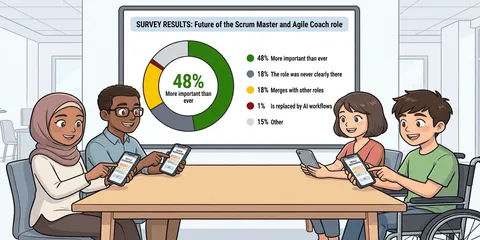
In line with that, we took a closer look at the role of Agile Coaches and Scrum Masters in our community survey.
More on this: Echometer community survey on AI in agile software development.
Spoiler: The role of Agile Coaches and Scrum Masters will become even more important in the future.
Step 5: Take team health seriously as leadership information
AI transformations create uncertainty: roles change, expectations rise, skills must grow, review effort shifts.
Team health, psychological safety, and workload therefore belong in governance. They are early warning systems, not soft side metrics.
If people do not speak up about mistakes, doubts, or overwhelm, AI risks often only become visible once they have already scaled: as quality issues, loss of trust, or declining team morale.
For deeper insight, this article fits well: Error culture in companies.
If you want to translate this maturity perspective into a compact assessment with matrix and team retro, this guide is a good fit: AI maturity model for agile delivery.
Step 6: Lead transformation as a portfolio of experiments
A perfect target state ages quickly in AI transformations. A portfolio of controlled experiments is more sensible.
- 30 days: tool and workflow experiments in individual teams.
- 60 to 90 days: measurable changes in review, testing, or refinement.
- Quarterly: decisions on which practices are scaled, adapted, or stopped.
- Regularly: retrospectives at team, department, and leadership level.
This allows the organization to learn faster without committing early to a rigid operating model.
In my view, a good source of inspiration for the idea of “transformation as a portfolio of experiments” is the OpenSpace Agility Handbook.
Source: The OpenSpace Agility Handbook
Three anti-patterns for AI in agile transformation
Anti-pattern 1: Tokenmaxxing as a transformation strategy
When leadership mainly measures AI usage, symbolic productivity emerges. Teams optimize tool usage instead of value creation.
The better question is: Which bottlenecks in the value stream can be demonstrably reduced by AI?
Anti-pattern 2: Centralization out of fear
AI brings real risks. Data protection, security, and compliance need clear guardrails. Complete centralization quickly turns this into new bureaucracy.
A better approach is a guardrail model: clear red lines, approved risk classes, transparent learning loops, and decentralized experiments within defined boundaries.
Anti-pattern 3: Turning Agile Coaches into tool trainers
Agile Coaches and Scrum Masters should understand AI and use it meaningfully. Prompt training, however, is only a small part of the job.
What matters more is role clarity, psychological safety, decision quality, conflict resolution, learning rhythm, and system improvement.
If you are looking for concrete tool categories for this role, you will find an overview here.
More on this: AI tools for Scrum Masters and Agile Coaches in 2026.
What does this mean for leaders?
Leaders should not sell AI in agile transformation as a pure efficiency program. That quickly creates resistance and narrows the focus to output.
A more sustainable message:
We use AI to learn faster, make better decisions, and reduce repetitive work. At the same time, we make responsibility, quality, and team health more explicit.
Concrete leadership tasks:
- Formulate goals in terms of customer value and learning progress, not just output.
- Give teams room for controlled AI experiments.
- Establish validation, data protection, and quality as shared working standards.
- Involve leaders themselves in AI use and reflection.
- Read resistance as a signal of unresolved risks, fears, or conflicting goals.
That very last point is crucial. AI transformation is change management under high uncertainty. Resistance often shows where the change has not yet been understood, secured, or made compatible.
This fits: Resistance in change management.
Conclusion: AI makes agile transformation more honest
AI increases the pressure to take agile transformation seriously. Organizations that understand agility primarily as a process model run into limits more quickly. More output helps little when goal clarity, quality culture, and feedback speed are weak.
Organizations with genuine learning capability can use AI as an amplifier: better specifications, faster experiments, shorter feedback cycles, better reflection, clearer decisions.
The most important thesis:
AI in agile transformation is the next maturity test for organizations that truly want to be agile.
If you want to go deeper into the software development perspective, this guide is the right next step.
More on this: Guide to the future of AI-supported agile software development.
FAQ on AI in agile transformation
What does AI in agile transformation mean?
AI in agile transformation means: Artificial intelligence changes ways of working, roles, decision-making processes, and feedback loops. What matters is whether the organization becomes more capable of learning and closer to customers. Faster-generated artifacts alone are not yet transformation progress.
Why is a tool rollout not enough?
A tool rollout usually only changes access to technology. The real benefit emerges when teams adapt their workflows, quality standards, responsibilities, and learning loops. Without this adaptation, output often increases while review effort, risk, and coordination problems also grow.
What role do Scrum Masters and Agile Coaches play in AI transformations?
Scrum Masters and Agile Coaches become more important when AI accelerates work. Their role shifts more toward system design, role clarification, team health, psychological safety, and continuous improvement. They help teams integrate AI meaningfully into their collaboration.
How do you get started pragmatically with AI in an agile transformation?
Start with a bottleneck in the value stream, not with a tool. Formulate a clear hypothesis, limit the experiment to a few weeks, define quality and validation rules, and then reflect as a team on whether the bottleneck really became smaller. After that, the practice can be adapted, scaled, or stopped. Scrum Masters and Agile Coaches can be good facilitators for this.
What risks does AI pose in agile transformations?
The biggest risks are unclear responsibility, blind trust in AI outputs, declining shared understanding, more review burden, data protection issues, and an one-sided focus on output. These risks can be reduced through clear guardrails, human validation, good engineering practices, team retrospectives, and transparent leadership.