
Scrum Statistics 2026: 20+ Current Figures, Trends and Facts
What is Scrum’s standing in 2026? Many people have a clear opinion on that, but what about the facts? The current data shows no disappearance of the Scrum framework, but a changed agile practice: AI has arrived in software development, executives expect measurable results, and teams adapt Scrum to their context.
This post compiles Scrum statistics from studies from 2025. Older data appear only in explicitly marked comparisons. Unfortunately, there is no global, annually repeated, representative Scrum survey.
Global Scrum trend 2026: Agile ahead of Scrum, Kanban far behind
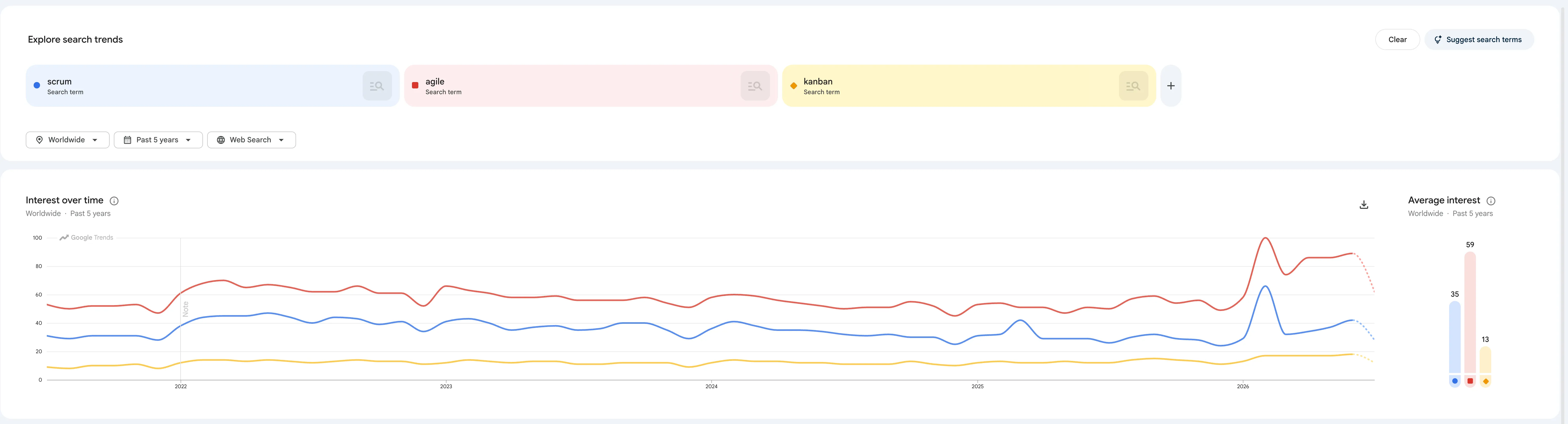
The worldwide Google Trends analysis over five years clearly classifies the three terms: Agile leads in average relative search interest with a score of 59, Scrum with a score of 35, and Kanban with a score of 13. After the spikes around 2022, all three terms are moving at a lower but still steady and historically strong level. Agile remains by far the broader search term throughout.
That alone is not proof of a framework’s adoption, but it is a good starting point for the question of how Scrum is searched for and discussed within broader agile practice.
Source: Google Trends worldwide: Scrum, Agile and Kanban over five years.
The most important Scrum statistics 2026 at a glance
| Percent | Statistic |
|---|---|
| 90 % | of the nearly 5,000 DORA respondents used AI in their work in 2025. |
| 79 % | felt pressure to do more with fewer resources. |
| 78 % | had difficulty adapting to repeated leadership or structural changes. |
| 76 % | experienced more pressure to demonstrate the concrete value of agile ways of working. |
| 65 % | relied heavily on AI in software development. |
| 61 % | actively implemented AI tools across teams in their agile work in 2025. |
| 48 % | worked with a hybrid or mixed agile model in 2025. |
| 33 % | of a Scrum.org practice survey named leadership or management as their biggest Agile frustration. |
| 30 % | trusted AI outputs only a little or not at all. |
Sources: 18th State of Agile Report by Digital.ai, full 18th State of Agile Report (PDF), Google: DORA Report 2025, Scrum.org practice survey 2025.
Scrum in 2026 under pressure: from rituals to measurable results
The most striking Scrum statistic for 2026 is not about Dailies or Story Points: in the “18th State of Agile Report,” 76% said that proving the concrete value of agile work has become more important. 29% link agile work to business outcomes, 26% influence product and portfolio planning.
This changes the role of Scrum Masters, Product Owners and Engineering Leads: a well-maintained Sprint board is not enough. Teams must show which business problem they are solving and how their increments have an impact.
Source: 18th State of Agile Report: Outcomes, Value and Adaptability. The percentages mentioned are taken from reporting on the study. IT Pro: Results of the 18th State of Agile Report.
Scrum, Scrumban or Freestyle Agile: 48% use hybrid agile models in 2026
48% of respondents use hybrid or mixed agile models; another 26% work with a self-developed approach.
That means 74% of the agile teams in this survey do not use “textbook Scrum.” This is not a rejection of Scrum, but a signal against unreflective framework loyalty: teams supplement it with Kanban, continuous discovery, DevOps or their own decision-making routines.
For practice, therefore, the more important question is not “Are we doing Scrum by the book?” but: What can demonstrably help us learn faster, ensure quality, and deliver customer value?
Source: 18th State of Agile Report: Working models and AI use (PDF).
Scrum and AI 2026: High AI adoption meets a trust gap
The 2025 DORA Report is based on nearly 5,000 technology professionals worldwide: 90% use AI at work, and 65% rely on it at least moderately in software development. On average, they work with AI for two hours a day.
Source: Google: DORA Report 2025, sample and AI use.
| DORA statistics 2025 |
|---|
| > over 80% report higher productivity |
| 59% see a positive impact on code quality |
| 30% trust AI little or not at all |
| 24% trust AI a lot or very much |
The DORA report describes AI as an amplifier: in cohesive organizations it increases efficiency, in fragmented ones it makes weaknesses more visible. For Scrum 2026, this means: AI does not replace collaboration, product clarity, or technical excellence.
More on this: AI in agile software development in 2026.
Source: DORA 2025 on productivity and the role of AI as a “mirror and multiplier”.
How Scrum changed in 2026: Scrum statistics compared with previous years
This section deliberately uses older figures only for comparison. It does not show that every team experienced the same development, but it does make the direction of the latest studies visible.
| Topic | Previous year | Current status 2025 | What has changed |
|---|---|---|---|
| AI use in an agile context | 64% in the State of Agile Report 2024 | 61% actively implemented AI tools across teams in 2025 | The questions and samples are not directly comparable; in 2025, the figure explicitly refers to cross-team implementation. |
| AI use in software development | 76% in the DORA Report 2024 | 90% in the DORA Report 2025 | AI has become significantly more widespread in professional software development. |
| Trust in AI | 39% trusted AI little or not at all in 2024 | 30% trusted AI little or not at all in 2025 | The trust gap is shrinking, but it remains relevant for almost a third. |
| Scrum adoption | 66% of agile teams used Scrum in 2023 | The State of Agile Report 2025 does not publish a directly comparable framework ranking | The current discourse measures outcome, AI, and adaptability more strongly than Scrum usage alone. |
The data do not suggest that AI will replace Scrum. Rather, they point to a new benchmark: Scrum practices must be more strongly linked to product impact, engineering systems, and responsible AI use.
Current sources: 18th State of Agile Report by Digital.ai, Google DORA Report 2025. Comparative values: 17th State of Agile Report by Digital.ai and DORA 2024 Executive Summary.
What puts pressure on Scrum teams in 2026
The current State of Agile study shows that the change is not just technological:
| Statistic from 2025 | Possible implications for Scrum teams |
|---|---|
| 79% are being asked to do more with fewer resources | Less context switching, clear priorities, and small increments are becoming more important than a fuller Sprint Backlog. |
| 77% feel more pressure to accelerate innovation | Teams need room for discovery, experiments, and reliable customer feedback. |
| 78% struggle with repeated leadership or structural changes | Stability in the target vision, responsibilities, and team composition is becoming a delivery factor. |
| 41% have increased their investments in agile work over the past two years | Organizations continue to invest, but at the same time they expect a clearer impact. |
Source: Classification of the 18th State of Agile figures on pressure, structural change, and investment.
A smaller Scrum.org practice survey adds to the picture: Of 165 Agile practitioners, 33% named leadership or management as their biggest frustration, and 12% each named a lack of product vision or cultural resistance. The open survey is not representative, but it does provide teams with a plausible diagnostic aid for their own obstacles.
Source: Scrum.org: Methodology and Results of the 2025 Practice Survey.
Which Scrum metrics really help in 2026
Current studies shift the focus away from activity metrics and toward impact and delivery capability. No single KPI describes a team adequately. A small, jointly interpreted set is meaningful.
| Metric | Question it is meant to answer | Unsuitable use |
|---|---|---|
| Lead Time / Cycle Time | Where is work waiting, and which dependency is slowing it down? | Ranking individual people or teams against each other |
| Deployment Frequency | Can we deliver valuable changes safely? | As many deployments as possible for their own sake |
| Change Failure Rate | Which changes cause disruptions or rework? | Hiding problems to protect the rate |
| Product Goal | Have we solved a relevant problem for users? | Only shipped features count |
| Team Health | What is hindering focus, trust, and collaboration? | Using sentiment scores as a performance evaluation |
The current State of Agile Report explicitly describes the shift as moving away from pure activity metrics toward value-based measurement. DORA complements this with the software delivery perspective: High AI usage is only progress once the team also gets quality, feedback, and stability under control.
Sources: Digital.ai: Value-based measurement in the 18th State of Agile Report, Google: DORA Report 2025.
If you want to establish metrics as a learning tool rather than a control tool, our practical templates can help you: Use Scrum KPIs and metrics sensibly and Make agile metrics visible in the team.
For the next sprint, you can translate the insights directly into a retro: With the Keep-Stop-Start template in Echometer, you secure working practices, identify blockers, and agree on concrete next steps for your Scrum 2026.
Keep Stop Start Retro: How the retro works
Random Icebreaker (2-5 minutes)
Echometer provides you with a generator for random check-in questions.
Review of open actions (2-5 minutes)
Before starting with new topics, you should talk about what has become of the measures from past retrospectives to check their effectiveness. Echometer automatically lists all open action items from past retros.
Discuss retro topics
Use the following open questions to collect your most important findings. First, everyone does it themselves, covered. Echometer allows you to reveal each column of the retro board individually in order to then present and group the feedback.
- Keep: What should we keep?
- Stop: What should we stop doing?
- Start: What should we start doing?
Catch-all question (Recommended)
So that other topics also have a place:
- What else would you like to talk about in the retro?
Prioritization / Voting (5 minutes)
On the retro board in Echometer, you can easily prioritize the feedback with voting. The voting is of course anonymous.
Define actions (10-20 minutes)
You can create a linked action via the plus symbol on a feedback. Not sure which measure would be the right one? Then open a whiteboard on the topic via the plus symbol instead to brainstorm root causes and possible measures.
Checkout / Closing (5 minutes)
Echometer enables you to collect anonymous feedback from the team on how helpful the retro was. This creates the ROTI score ("Return On Time Invested"), which you can track over time.
Keep Stop Start Retro

Regional trends: Scrum in India, the USA, China, Europe, and Germany 2026
For these regions there is no uniform, current, and comparable Scrum survey. That is why we do not look at “market shares,” but at activity signals: conferences, topics, and community discussions. They show what practitioners are talking and investing in - not how many teams are using Scrum in compliance with the rules.
Google Trends 2026: Interest in Scrum, Agile, and Kanban in regional comparison
The four Google Trends analyses compare Scrum, Agile, and Kanban over five years. Google Trends normalizes the values by region, time period, and search term on a scale from 0 to 100. The charts therefore show ranking, gaps, and trends within a region - not absolute search volumes or Scrum adoption rates. Patterns can be compared between countries, not the absolute level of interest.
Sources: Google Trends: Germany – Scrum, Agile, and Kanban, Google Trends: USA – Scrum, Agile, and Kanban, Google Trends: India – Scrum, Agile, and Kanban, Google Trends: China – Scrum, Agile, and Kanban.
Germany: Scrum and Agile are close together
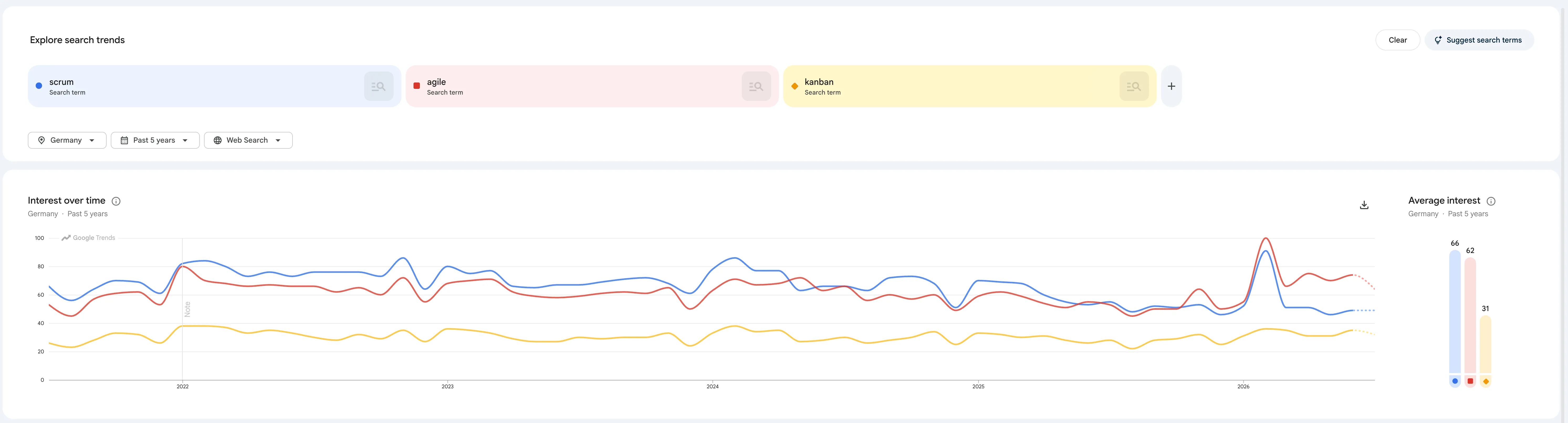
In Germany, Scrum and Agile run close together over much of the period; recently, Scrum often slightly leads the more general term Agile. Kanban remains clearly below this, but shows a consistently visible baseline of interest. In the comparison of the four screenshots, Germany is the region where Scrum comes closest to the term Agile - an indication of a comparatively specific Scrum search, not of higher national usage.
USA: Agile dominates, Scrum remains the more specialized term
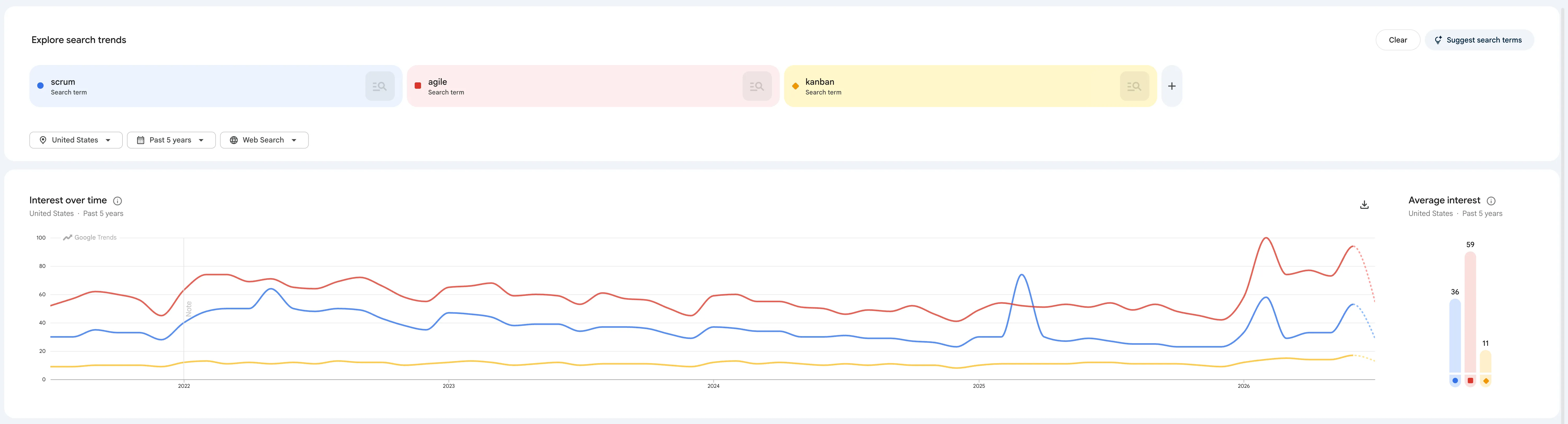
In the USA, Agile clearly leads Scrum throughout the entire period; both lines decline compared with the 2022 peaks, while Kanban remains more stable at a low level. Compared with Germany, the gap between the broad search term Agile and Scrum is much larger. This suggests that searchers are more likely to classify Scrum as one of several agile methods.
India: Strong interest in Agile, declining Scrum searches
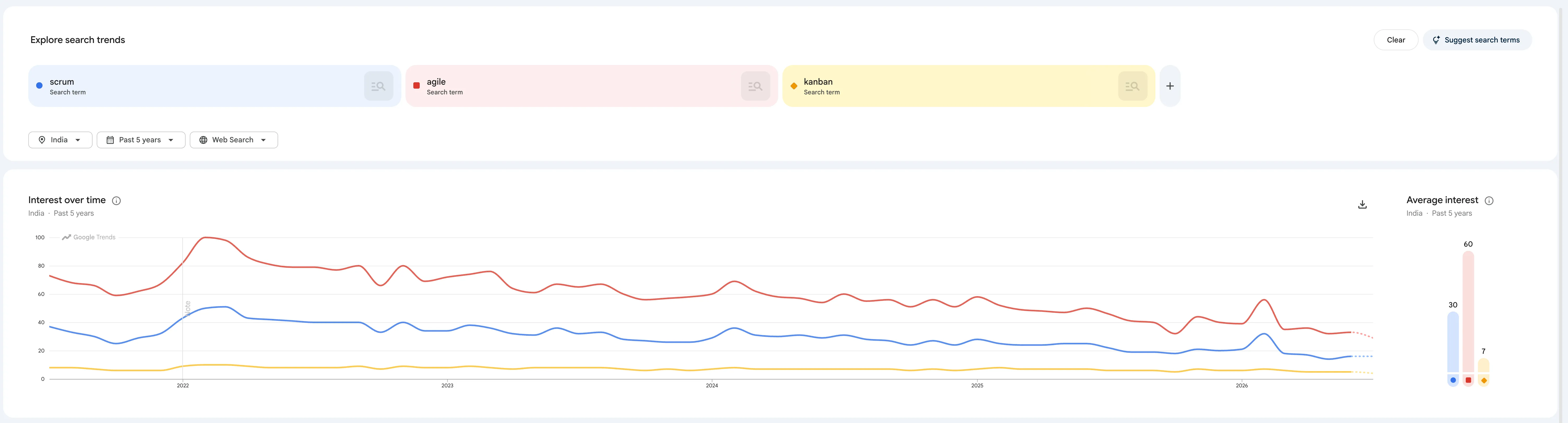
In India, Agile dominates particularly clearly and fluctuates more strongly than in the other three analyses. Scrum is in a clear second place and tends to decline after peaking at the beginning of the period; Kanban remains a small, relatively stable search niche. Together with the visible community activity, this fits a market in which the broad term Agile is more important for orientation and training than the isolated search for a single framework.
China: Agile ahead of Scrum, with special caution in interpretation
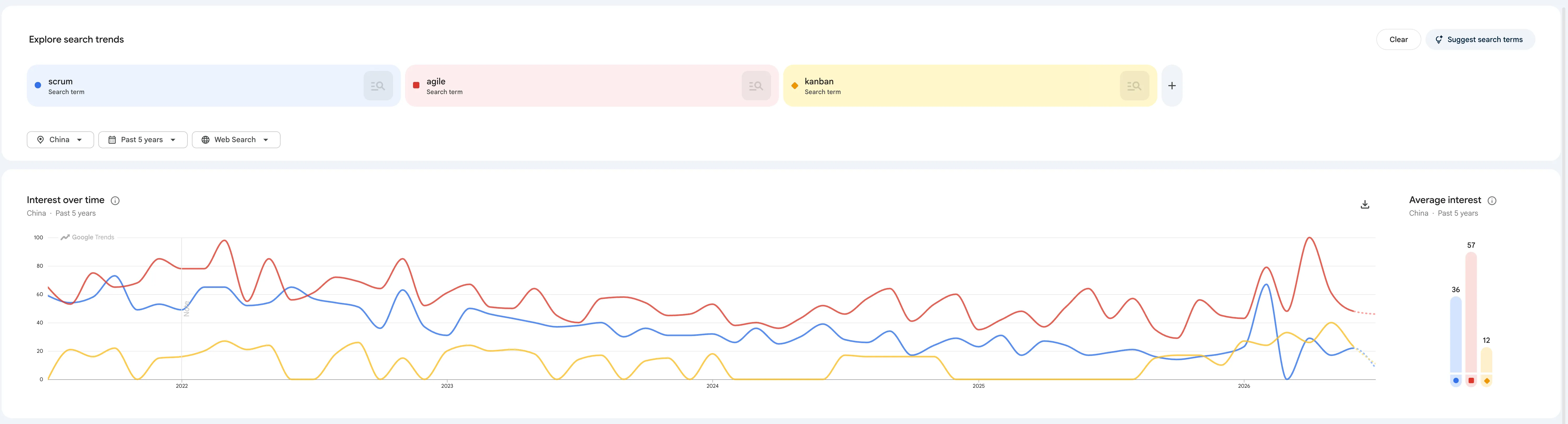
In the China analysis, Agile also leads, Scrum follows at a greater distance, and Kanban remains low and more volatile. Over time, Scrum declines more sharply than in Germany. This chart should be read with particular caution: it measures only Google searches and is therefore not a complete indicator of search or adoption behavior in the Chinese market.
| Comparison of the four Google Trends screenshots | Statement for the regional classification |
|---|---|
| Germany: Scrum and Agile almost neck and neck | Here, Scrum is positioned most strongly relative to the broad Agile term. |
| USA, India and China: Agile clearly ahead of Scrum | The broad term Agile shapes search behavior more strongly than the individual framework Scrum. |
| Kanban lagging in all four regions | Kanban is searched for much less frequently as a search term; this says nothing about how often teams additionally use Kanban practices. |
| Fewer peaks everywhere than in 2022 | Interest is normalizing; from the search trend alone, neither an “end of Scrum” nor a reliable adoption rate can be inferred. |
| Region | Visible activity signal 2025/2026 | Classification for Scrum 2026 |
|---|---|---|
| India | Agile India hosted a three-day community event in 2025; Scrum Day India 2025 and 2026 place AI, product development, and Scrum at the center. | The community is visibly active; the focus is shifting from foundational training to AI-supported delivery. |
| USA | Agile2025 took place as a three-day conference; Scrum Day Madison held a regional Scrum event in 2025. | There is an active professional community, but no reliable current US-wide Scrum adoption rate. |
| China | Scrum Day China 2025 covered Scrum in smart vehicles, hardware, finance, and organization-wide efficiency. | Scrum is discussed in a broader industrial and innovation context; a current nationwide adoption rate is lacking. |
| Europe | The Global Scrum Gathering 2025 took place in Munich; for 2025, Scrum Alliance reports more than 4,000 event participants across six continents and 40 countries. | Europe is an important meeting place for the international community; however, the global number of participants is not a Europe statistic. |
| Germany | The Scrum Day Germany 2025 offered 15 in-depth workshops on leadership, product development, organizational design, and delivery. | The German-language discourse focuses more strongly on concrete organizational and delivery problems than on Scrum basics. |
Scrum in India 2026: Large community, critical view of practice
In India, several current events show an active Scrum and Agile community: Agile India hosted a three-day event in 2025, and Scrum Day India addressed AI-supported collaboration, planning, and delivery. The formats announced for 2026 continue to combine Agile, AI, and product development.
That does not prove a nationwide Scrum adoption rate, but it does point to a strongly AI-shaped delivery discussion. In a much-discussed Reddit thread, practitioners also report a gap between the label “Agile” and actual freedom to make decisions or product orientation. This is not a survey, but a useful hypothesis for international delivery organizations.
Sources: Agile India 2025, Scrum Day India 2025 at Scrum.org, Scrum Day India 2026, Discussion on lived agility in India on Reddit.
Scrum in the USA 2026: community activity, but no current overall rate
In the USA, Scrum in 2026 is visible mainly through conferences and training. Agile2025 was held for the first time over three days, and Scrum Day Madison was another regional community event. Scrum Alliance also reported in 2025 worldwide more than 82,000 new members, more than 100,000 credentials, and 10,000 participants in user groups.
These figures document global organizational activity, not adoption in the USA. The clearest classification is: the USA remains a central community and training market, but there is no current representative usage rate.
Sources: Agile2025 archive of the Agile Alliance, Scrum Day Madison 2025, Scrum Alliance Annual Report 2025.
Scrum in China 2026: focus on industry, hardware, and finance
Scrum Day China 2025 is a concrete signal of activity. The event covered intelligent vehicles and hardware, agile work in finance, personal Scrum, and organization-wide efficiency. Scrum is therefore also being discussed there in the context of physical products and large organizations.
There is no publicly available, methodologically sound adoption statistic for 2025 or 2026. The conference therefore does not allow any conclusions about market share, but it does demonstrate a visible Scrum community with close ties to industry and innovation.
Source: Program and topics of Scrum Day China 2025.
Scrum in Europe 2026: international community, hybrid practice
Europe hosted the Global Scrum Gathering in Munich in 2025. Scrum Alliance describes the event as international and reports in its annual report on more than 4,000 participants at its own events in 40 countries.
That is an activity indicator, not a European adoption figure. Relevant for practice: 48% of respondents to the State of Agile Report 2025 use hybrid models, and another 26% use their own approach. Scrum is therefore often combined with flow, product, or engineering practices.
Sources: Scrum Alliance Annual Report 2025, 18th State of Agile Report by Digital.ai, complete study report on work models (PDF).
Scrum in Germany 2026: from certification to delivery and organizational issues
The Scrum Day Germany has been held since 2007 and in 2025 offered 15 workshops on leadership, faster products, organizational design, and delivery. This signals what the German-speaking Scrum community is dealing with: less with dailies, more with leadership, product, and delivery obstacles.
Here too, conference activity does not replace a national adoption statistic. However, it aligns with the Scrum.org practice survey, in which leadership, a missing product vision, and cultural resistance are central frustrations. The 165 responses are not representative and are not a Germany rate.
Sources: Scrum Day Germany 2025, Scrum.org practice survey on Agile obstacles 2025.
Conclusion: Scrum is changing in 2026 — but certainly not at an end
The Scrum statistics for 2026 show above all three things:
- AI has meanwhile become standard in software development,
- verifiable product and business impact from Scrum is becoming more important, and
- teams are pragmatically adapting agile ways of working to their context (and AI).
Agile working and Scrum are by no means dead in 2026; they are evolving in a vibrant way. And that is exactly how it should be. Because agility does not work through perfectly executed Scrum rituals, but through short learning cycles, open reflection, and a high degree of adaptability. AI primarily increases speed and thereby also increases the need for organizations to be truly adaptable.
If you are looking for a structured format for this, you will find suitable methods here: Retrospective methods for Scrum teams. For a continuous view of collaboration and blockers, an agile team health check always helps: Agile Team Health Check.
FAQs on agility, Scrum, Kanban & co in 2026
Is Scrum dead in 2026?
No. A current, globally comparable usage rate specifically for Scrum is no longer published by the State of Agile Report 2025. However, the study explicitly describes agility as adaptable rather than declining: 74% of respondents use hybrid or self-developed agile models. Scrum is therefore more often combined with other practices instead of being broadly replaced.
Source: 18th State of Agile Report by Digital.ai and Classification of the 2025 study results.
Which frameworks are replacing Scrum in 2026?
There is no single framework successor to Scrum in 2026. Common alternatives or additions are Kanban for continuous workflow, Scrumban for a combination of sprint goals and flow principles, and Extreme Programming (XP) for technical engineering practices. The 18th State of Agile Report shows above all a trend toward hybrid and context-dependent models, not a single replacement.
Source: Classification of the 18th State of Agile study with the Hybrid Agile figure.
What is a Scrum alternative in 2026?
For teams with unpredictable requests and a continuous flow of work, Kanban is often a good Scrum alternative. For product development with regular learning goals, Scrum can still be a fit; supplemented with Kanban practices, Scrumban often emerges. What matters is not the name of the framework, but whether it improves prioritization, quality, feedback, and continuous improvement for the specific context.
The current trend is toward hybrid approaches: 74% of respondents in the State of Agile Report 2025 use mixed or self-developed agile models.
When is Kanban better than Scrum?
Kanban often fits better when work arrives continuously and is difficult to bundle into reliable sprint goals — for example in support, operations, incident response, or many small, unplanned tasks. In that case, a visible flow, limited parallel work, and short lead times help more than a fixed sprint cadence.
Scrum remains useful when a stable, cross-functional product team works toward a common goal in short cycles. A switch to Kanban should solve a concrete problem, not just reduce meetings.
Is Scrumban a good Scrum alternative?
Scrumban can be a good alternative if a team still needs clear product goals and regular reflection, but wants to manage the workflow more flexibly. Typical elements are a Kanban board, WIP limits, and pull principles, supplemented by suitable planning, review, and retro routines.
Scrumban is not automatically better than Scrum. It is worthwhile if it better solves a specific problem such as too much carry-over, long waiting times, or frequent unplanned work, and if the team reviews its impact using lead time, quality, and customer value.
Is Scrum more common in large companies or small firms in 2026?
There is no reliable rate by company size. However, Scrum is often more visible and more formally organized in large companies, while small firms more often use agile practices pragmatically or in a hybrid way.
In large organizations, the need for coordination, scaling approaches, and dedicated Scrum Master roles promotes stronger institutionalization. Small product teams, on the other hand, can introduce Scrum more easily and often adapt it flexibly. What matters is not the size of the company, but whether the team has clear responsibility, short feedback cycles, and manageable dependencies.
Source: 18th State of Agile Report 2025.
Will AI replace Scrum in 2026?
No. AI can accelerate work, condense information, and support software development. But it replaces neither clear product goals nor collaboration, quality assurance, or continuous improvement.
The DORA Report 2025 therefore describes AI as an amplifier: In well-functioning organizations, it can increase efficiency; in fragmented ones, it makes existing weaknesses more visible. Source: Google: DORA Report 2025.
Why do Scrum teams use hybrid models in 2026?
Hybrid models help teams adapt Scrum to their delivery context. For example, they complement it with Kanban for workflow, continuous discovery, or technical engineering practices.
In the 18th State of Agile Report, 48% of respondents used hybrid or mixed models and another 26% used a self-developed approach. This is not a plea against Scrum, but against unreflective framework loyalty. Source: 18th State of Agile Report by Digital.ai.
How do Scrum teams demonstrate product impact?
Scrum teams should not just count delivered features. More meaningful is the combination of a clear product goal, customer feedback, and a few delivery metrics such as lead time, deployment frequency, and change failure rate.
The numbers are not a control instrument. They help the team understand whether it is solving a relevant problem, whether it can deliver safely, and where learning or delivery bottlenecks lie. Source: Google: DORA Report 2025.
How do you measure Scrum Master performance sensibly?
Scrum Master performance is not measured sensibly with a single KPI, but with a combination of delivery metrics, team health, retrospective effectiveness, action tracking, and qualitative observations.
What is important is that the numbers are not used as a control instrument. They should serve as a starting point for conversation: Where is the team losing focus? Which blockers keep recurring? Which actions really lead to better collaboration?
More context can be found here: Scrum Master performance KPIs
What risks do AI tools have in agile teams?
The most important risks are incorrect summaries, data privacy issues, lack of trust in recordings, overinterpretation of metrics, and additional tool overhead.
Scrum Masters should therefore use AI results as a basis for discussion, not as automatic truth.
Sources and methodology
- Digital.ai: 18th State of Agile Report – current study on outcome orientation, AI, and adaptability in agile work.
- IT Pro: Report on the figures from the 18th State of Agile Report – cited percentages from the study published in 2025.
- Google: DORA Report 2025 – survey of nearly 5,000 technology professionals on AI-assisted software development.
- Scrum.org: Agile’s Quarter-Century Crisis – non-representative practical survey of 165 agile practitioners from 2025.
- Digital.ai: 17th State of Agile Report – used exclusively for the historical comparison of Scrum adoption from 2023.
- Google DORA: 2024 Executive Summary – used exclusively for comparing AI usage and trust with the 2025 status.