
Agile Team Health Check: Questions, Process, and Templates
An agile team health check makes collaboration measurable: teams regularly assess what strengthens them, slows them down, or should be improved. This turns gut feelings into concrete conversations and actions.
In this guide, you’ll find a concise process, tried-and-tested health check questions, and templates for agile teams, team psychology, and departments.
What is a team health check?
A team health check is a regular, structured review of collaboration. Team members rate statements on topics such as trust, customer value, or workflows — and then discuss the most important results.
A good health check helps you to
- identify strengths and risks early,
- make changes visible over time,
- discuss different perceptions within the team openly, and
- derive concrete improvement measures.
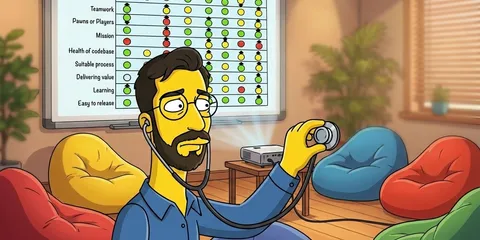
A well-known example is the Spotify Team Health Check. Teams reflect on their previous collaboration using indicators such as:
- collaboration,
- value of what is delivered
- fun at work and
- learning experience.
Health checks are especially effective as part of a retrospective: first understand together, then agree on a concrete change. You can find out more in the guide to the Spotify Health Check and in the instructions for a Spotify Health Check Retrospective.
Want to get started right away? You can open this template in the retro tool without login :
Spotify Health Check – Delivering: How the retro works
Random Icebreaker (2-5 minutes)
Echometer provides you with a generator for random check-in questions.
Review of open actions (2-5 minutes)
Before starting with new topics, you should talk about what has become of the measures from past retrospectives to check their effectiveness. Echometer automatically lists all open action items from past retros.
Health Check
All team members can answer the health checks anonymously on a scale. Then go through the results of the health checks together and record any additional comments if necessary. If you use the same health checks in several retrospectives, you can also track trends over time in Echometer.
- We deliver great results! We are proud of that and our stakeholders are very satisfied.
- Our way of working fits us perfectly.
- We get things done really quickly. No waiting, no delays.
Discuss retro topics
Use the following open questions to collect your most important findings. First, everyone does it themselves, covered. Echometer allows you to reveal each column of the retro board individually in order to then present and group the feedback.
- Which topics did not bring the hoped-for benefit?
- What is bothering us about the way we work?
- Which requirements or stories got stuck?
Catch-all question (Recommended)
So that other topics also have a place:
- What else would you like to talk about in the retro?
Prioritization / Voting (5 minutes)
On the retro board in Echometer, you can easily prioritize the feedback with voting. The voting is of course anonymous.
Define actions (10-20 minutes)
You can create a linked action via the plus symbol on a feedback. Not sure which measure would be the right one? Then open a whiteboard on the topic via the plus symbol instead to brainstorm root causes and possible measures.
Checkout / Closing (5 minutes)
Echometer enables you to collect anonymous feedback from the team on how helpful the retro was. This creates the ROTI score ("Return On Time Invested"), which you can track over time.
Spotify Health Check – Delivering
Health Check Questions (Scale)
Open questions

Team Health Check: The key topic areas
An Agile Team Health Check can shed light on collaboration, culture, and processes. For a meaningful start, three topic areas are enough:
Agile maturity level
The agile maturity level shows how consistently teams apply agile principles in everyday work — and where they still need support.
Decisive indicators for the agile maturity level are
- agile values,
- team autonomy,
- customer focus,
- agile events and
- planning.
Team psychology
Team psychology shows whether teams can address challenges openly, learn from one another, and work together effectively.
- Task design,
- Innovation,
- Motivators,
- team cohesion, and
- work environment.
Functional areas and operating business
Add questions for specific areas to the team health check if needed. This will help you identify where processes, collaboration, or leadership need support:
- finance & controlling
- human resources (HR)
- Marketing
- purchasing
- sales department
- Software development
- Leadership teams
- strategy
In this video, you’ll learn about the Spotify Team Health Check and get six tips for your agile maturity check:
Conducting an Agile Team Health Check: 3-step process
Keep the process deliberately simple: select questions, evaluate together, implement improvements.
1. Select suitable health check questions
Choose statements that fit your current goal — for example, collaboration, customer value, or team culture. Focus on a few clearly formulated questions instead of a long checklist.
2. Evaluate and discuss results
Have the team members rate each statement on a consistent scale. For a quick start, a traffic-light system is suitable:
- green (things are going very well),
- yellow (there are some problems) and
- red (things are going very wrong).
Alternatively, use an agreement scale:
- Strongly disagree
- Disagree
- Somewhat disagree
- Neither agree nor disagree
- Somewhat agree
- Agree
- Strongly agree
Visualized results make differences in perception visible. Don’t discuss all statements for the same amount of time; instead, focus on the topics with the greatest impact or the largest deviations.
3. Agree on a concrete action
Derive an actionable measure from the discussion: with clear ownership and a date for review. The next health check will then show whether collaboration has actually improved.
Team Health Check questions for practice
Use the following statements as a starting point and adapt them to your language, goals, and way of working. Important: Each statement should address only one aspect of collaboration.
Questions on agile maturity
With these questions, you can assess how well agile values, customer value, and events are anchored in everyday work.
Agile values
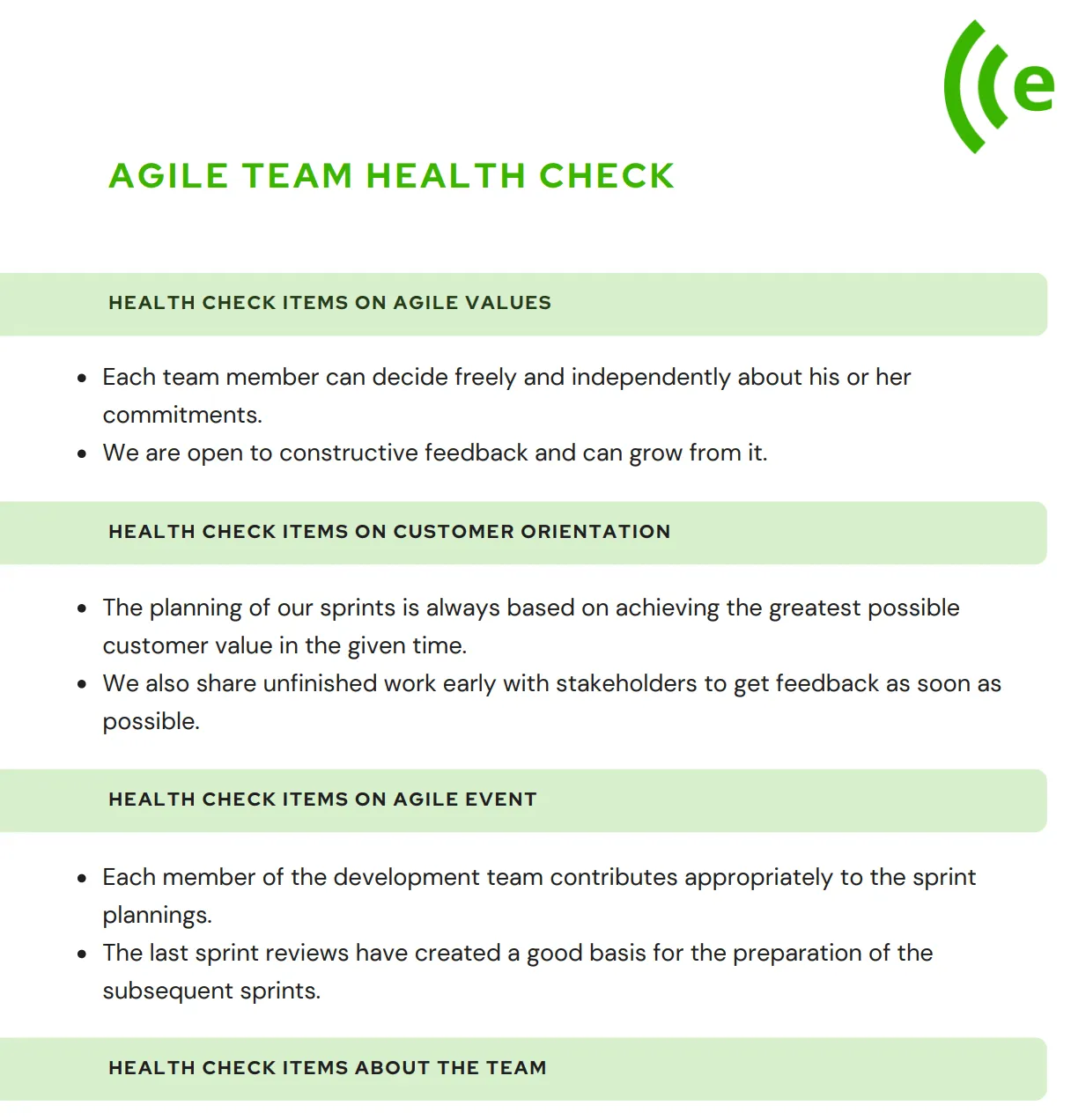
1) Each team member can decide freely and independently about his or her commitments.
2) We are open to constructive feedback and can grow from it.
Customer orientation
1) The planning of our sprints is always based on achieving the greatest possible customer value in the given time.
2) We also share unfinished work early with stakeholders to get feedback as soon as possible.
Agile events
1) Each member of the development team contributes appropriately to the sprint plannings.
2) The last sprint reviews have created a good basis for the preparation of the subsequent sprints.
You can open this template on agile values directly without logging in:
5 Agile Values Health Check 5️⃣: How the retro works
Random Icebreaker (2-5 minutes)
Echometer provides you with a generator for random check-in questions.
Review of open actions (2-5 minutes)
Before starting with new topics, you should talk about what has become of the measures from past retrospectives to check their effectiveness. Echometer automatically lists all open action items from past retros.
Health Check
All team members can answer the health checks anonymously on a scale. Then go through the results of the health checks together and record any additional comments if necessary. If you use the same health checks in several retrospectives, you can also track trends over time in Echometer.
- Courage: We value people showing courage.
- Respect: We value each other’s ideas, even when disagreeing.
- Commitment: Every team member is committed to follow through on what they have promised.
- Focus: We don’t allow ourselves to be distracted from reaching the sprint goal.
- Openness: We are open to constructive feedback and grow from it.
Discuss retro topics
Use the following open questions to collect your most important findings. First, everyone does it themselves, covered. Echometer allows you to reveal each column of the retro board individually in order to then present and group the feedback.
Catch-all question (Recommended)
So that other topics also have a place:
- What else would you like to talk about in the retro?
Prioritization / Voting (5 minutes)
On the retro board in Echometer, you can easily prioritize the feedback with voting. The voting is of course anonymous.
Define actions (10-20 minutes)
You can create a linked action via the plus symbol on a feedback. Not sure which measure would be the right one? Then open a whiteboard on the topic via the plus symbol instead to brainstorm root causes and possible measures.
Checkout / Closing (5 minutes)
Echometer enables you to collect anonymous feedback from the team on how helpful the retro was. This creates the ROTI score ("Return On Time Invested"), which you can track over time.
5 Agile Values Health Check 5️⃣
Health Check Questions (Scale)

Note: This retrospective format asks for agreement with the given Health Check items on a scale.

Questions on team psychology
Questions on team psychology are particularly helpful when
- a team has only been working together for a short time, or
- you want to check whether your team works proactively and strives for improvements in the processes.
The following examples cover team cohesion, innovation, and motivators:
Team cohesion
1) I regularly get useful feedback on how well I am performing and how I can improve.
2) In our team, I am not afraid to ask “stupid” questions.
innovation
1) I have to do things in my work that should actually be done differently.
2) We have a constructive exchange of knowledge between newer and experienced colleagues.
motivators
1) I am free to schedule my work as it suits me.
2) The results of my work have great significance for the company.
You can open this team spirit template directly without logging in:
Team Morale Health Check: How the retro works
Random Icebreaker (2-5 minutes)
Echometer provides you with a generator for random check-in questions.
Review of open actions (2-5 minutes)
Before starting with new topics, you should talk about what has become of the measures from past retrospectives to check their effectiveness. Echometer automatically lists all open action items from past retros.
Health Check
All team members can answer the health checks anonymously on a scale. Then go through the results of the health checks together and record any additional comments if necessary. If you use the same health checks in several retrospectives, you can also track trends over time in Echometer.
- Appreciation: My colleagues appreciate my contribution to the team.
- Team Spirit: There is a trusting working atmosphere in our team.
- Transparency: Everyone in my team knows who is currently working on what.
- Recovery & Breaks: I have enough room for breaks in which I can draw new energy.
- Meeting culture: Our meetings are well structured, yet leave room for creativity and new ideas.
- Support: In my team, each team member passes on their individual knowledge and experience.
Discuss retro topics
Use the following open questions to collect your most important findings. First, everyone does it themselves, covered. Echometer allows you to reveal each column of the retro board individually in order to then present and group the feedback.
Catch-all question (Recommended)
So that other topics also have a place:
- What else would you like to talk about in the retro?
Prioritization / Voting (5 minutes)
On the retro board in Echometer, you can easily prioritize the feedback with voting. The voting is of course anonymous.
Define actions (10-20 minutes)
You can create a linked action via the plus symbol on a feedback. Not sure which measure would be the right one? Then open a whiteboard on the topic via the plus symbol instead to brainstorm root causes and possible measures.
Checkout / Closing (5 minutes)
Echometer enables you to collect anonymous feedback from the team on how helpful the retro was. This creates the ROTI score ("Return On Time Invested"), which you can track over time.
Team Morale Health Check
Health Check Questions (Scale)

Note: This retrospective format asks for agreement with the given Health Check items on a scale.
Questions for functional areas
With area-specific questions, you make optimization potential in processes and interfaces visible. Examples for HR, leadership and software development:
Human resources
1) We ensure that our corporate and leadership principles are also lived out in the teams’ everyday lives.
2) We make sure that new colleagues always feel welcome.
Leadership teams
1) We encourage our teams to make decisions independently.
2) Hierarchies do not hinder direct exchange between teams.
Software development
1) We take pride in the software we develop.
2) Releasing our software is easy, safe, painless and largely automated.
Download PDF - Team Health Check Questions
Team health check template from Echometer
Echometer combines health checks with retrospectives. You can use questions about agility, team psychology and specialist areas on a recurring basis and track development over time – at team or leadership level.
This way, you not only see project progress, but also how collaboration is developing and which measures are effective. This is how team and organizational development works with Echometer.
This video also shows how you can carry out the Spotify Health Check online for free in eight steps:
Using team health checks in one-on-one conversations
Retrospectives are ideal for evaluating team health checks together. However, individual topics can also be explored in more depth in regular one-on-one conversations.
For this, pick up one statement every one to two months, rate it on a scale and discuss the reasons behind the assessment. Repeated ratings make personal trends visible – without comparing employees with one another.
The following template contains statements on personal development and can be tried out directly in Echometer’s 1:1 tool:

⁉️ Health Check (Agreement from 1-7): Personal Development
- "My work tasks generally progress very quickly, even if external feedback is necessary."
- "When I observe suboptimal behavior, I know how to constructively point it out to colleagues."
- "I receive constructive feedback on both my work and my personal development."
- "I see an attractive career path ahead of me in the company." #Growth
- "In the last few weeks, I have very often been able to use my strengths at work."
This is what this survey looks like in Echometer:

4 tips for an effective team health check
These four principles turn results into real improvements:
1. Adapt questions to the team and objective
Choose statements that fit your work culture and your current goal. Only relevant questions provide insights that you can act on.
2. Cover multiple perspectives
Combine questions about collaboration, working methods and impact. This helps you avoid individual problems dominating the overall view of the team.
3. Ask a few precise questions
Too many or duplicate questions make evaluation more difficult. Phrase each statement so that it asks about exactly one aspect, and focus on the most important topics.
4. Properly classify subjective data
Health check results are personal assessments, not objective performance metrics. Use them as a conversation starter and observe developments within the same team over time. They are not suitable for comparisons between teams.
Conclusion: Team health checks create clarity and change
An agile team health check makes visible what strengthens teams and what slows them down. What matters is not the perfect scale, but the next joint step: discuss insights, agree on a measure and review its impact later.
You can find more inspiration in the free eBook with twelve team workshops and in the comparison of the best online retro boards.