
AI in Agile Software Development: Echometer Community Survey 2026
In our community, AI has arrived in agile software development. But is it really already changing the way teams work? Or are individual team members merely optimizing their programming so far, while reviews and quality assurance can become new bottlenecks?
Exactly for this purpose, we conducted a very recent Echometer community survey in June 2026. 66 people from our newsletter and our community answered how AI is changing their agile software development. The results are not a representative market study. They are rather a snapshot of the sentiment from the bubble surrounding agile, often remote-working software development teams.
This article is a data-based supplement to our previous posts:
- AI in agile software development: state of the evidence 2026
- Scrum Statistics 2026: 20+ Current Figures, Trends, and Facts
- Guide to the future of AI-supported agile software development
- Why AI fails in agile software delivery
Here is a brief preview of the highlights from the survey results:

45%
Use AI individually: Team members experiment with AI on their own initiative, without defined workflows or guidelines.
Source: Echometer Community Survey, June 2026
36%
No change in day-to-day work: Despite AI, meetings and coordination still take just as much time as before.
Source: Echometer Community Survey, June 2026
48%
See the role of Scrum Masters and Agile Coaches as more important than ever in the age of AI.
Source: Echometer Community Survey, June 2026
56%
Management does not understand team health and performance blockers at all, or only imprecisely most of the time.
Source: Echometer Community Survey, June 2026
52%
Error culture is context-dependent: critical issues are voiced within the team, but people fall silent when management is present.
Source: Echometer Community Survey, June 2026
Who Took Part in the Survey?
The sample of 66 participants is clearly shaped by agile roles. This is important for the interpretation: The answers do not reflect a general developer study, but primarily the perspective of an agile software development community.
- 50%Scrum Master / Agile Coaches
- 24%Engineering Leaders
- 14%Team Member
- 5%Product Owner / Product Manager
- 7%Other
How standardized is AI usage in teams? 🤖
The first content-related question shows a central pattern: AI is mostly used by individual team members as an individual experiment:
- 45%Individual experimentation
- 33%Guided use with simple rules
- 10%Highly standardized / AI-First
- 12%Other
45% report that team members try out AI independently, without defined team workflows or shared guidelines. Another 33% have at least basic processes and agreements in place. Only 10% describe their ways of working as “AI First”.
This fits a thesis from our summary of the current state of research: In 2026, AI has the strongest impact at the individual level, while the team and organizational levels are catching up more slowly. About the state of the evidence on AI in agile software development
What does AI really change in everyday work? 🧑💻
The answers regarding daily routine are a good reference point against exaggerated productivity promises.
- 36%No change
- 36%More review effort
- 10%More deep work
- 10%Higher delivery pressure
- 8%Other
The big surprise for AI enthusiasts is likely that 36% see no change in their everyday lives despite using AI.
Another 36% produce results faster, but spend significantly more time reviewing AI output. This is one of the most important findings of the survey. AI does not automatically reduce coordination costs. It often shifts work: less initial implementation, more verification, more context building, more quality responsibility.
We described exactly this pattern in the article on typical anti-patterns: More code can lead to less understanding if the team cannot keep up with review and verification. See: Why AI fails in agile software delivery
Only 10% report more deep work because AI takes over routine tasks. This is not insignificant, but it is far from the narrative that AI is already eliminating admin overhead, coordination effort, and monotonous, repetitive tasks across the board.
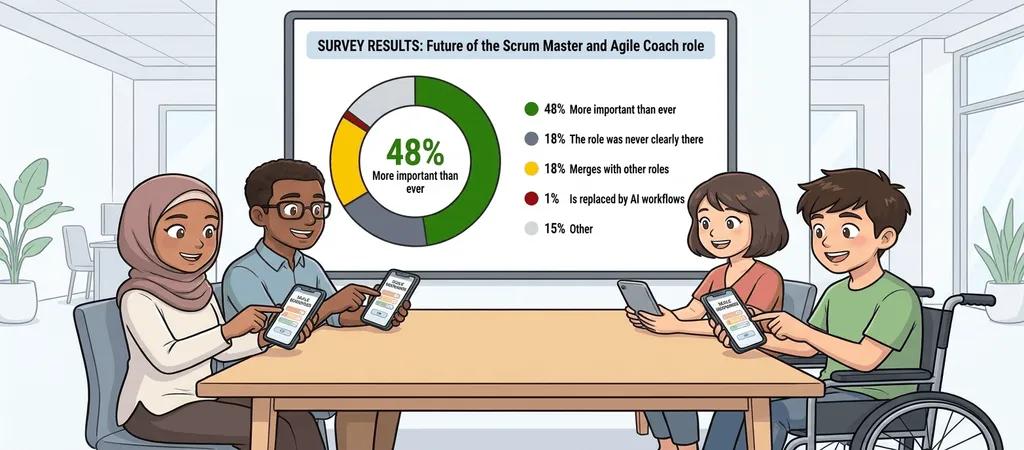
What happens to Scrum Masters and Agile Coaches? 👀
The provocative question is: If AI supports or partially automates more and more development work, are Scrum Masters and Agile Coaches still needed?
The community’s answer is surprisingly clear:
- 48%More important than ever
- 18%The role was never clearly there
- 18%Merges with other roles
- 1%Is replaced by AI workflows
- 15%Other
48% say that the role is becoming more important than ever because the focus is shifting even more toward human dynamics. If team members create more output faster through AI, every misunderstanding, every unclear requirement, every differing understanding of quality can have an impact more quickly.
Among the leadership responses, this figure is as high as 56%: This is important because it at least puts the obvious bias into perspective. In this subgroup, it is not just Scrum Masters and Agile Coaches defending their own role. Executives also apparently see that acceleration through AI does not automatically create better collaboration.
Only 1% expect that the roles can be replaced by AI-driven workflows. This does not mean that the role is not changing. On the contrary: It will probably not stop at process moderation alone. The skills of Agile Coaches and Scrum Masters that AI does not automatically provide will become more valuable:
- Perceiving and addressing interpersonal dynamics (mood, tensions, psychological safety, team health)
- Make power and organizational structures visible and challenge them (decision-making paths, responsibilities, political dynamics)
- Promote reflection and learning (questioning assumptions, opinions, processes, and behavioral patterns)
- Enable constructive collaboration (moderating discussions, handling conflicts, strengthening feedback and learning culture)
The insight that the Scrum Master / Agile Coach role will become even more important fits the guide for CTOs and Engineering Managers: AI only scales sensibly when human judgment, engineering practices, and organizational feedback loops keep pace. See: Guide to AI-supported agile software development
If you want to derive concrete tool decisions from this, you’ll find a curated overview here: AI tools for Scrum Masters and Agile Coaches in 2026.
How well does management understand team health and blockers? 🚧
When AI accelerates development, blind spots in management can become more critical. More output is of little help if leaders do not understand where teams are mentally overloaded and where real performance blockers lie.
- 34%Somewhat accurate
- 31%Complete blind spot
- 25%Mostly inaccurate
- 6%Very accurate
What I find alarming is that 56% consider their management to be out of touch with reality:
- 31% speak of a complete blind spot, where problems only become visible during major crises such as burnout or resignations.
- Another 25% consider the management’s assessment to be mostly wrong.
Only 6% say that management is in the loop and identifies problems proactively and accurately.
This is not a side issue in AI in Agile. It is a core risk. If AI increases the frequency of change, but leaders do not see team state, workload, and friction, the likelihood of poor steering increases.
The data thus fits an uncomfortable feeling that is not new: there needs to be a better perception of the social and organizational system at leadership levels. Otherwise, there is at least the risk that increasing productivity pressure will burden employee engagement, health, innovative capacity, and agility.
💡 Tip for leaders
If team health and performance blockers in management remain invisible too often, regular 1:1s with all team members help to identify early signals and reduce blind spots.
Explore 1:1 toolWhat will be the most important performance lever? ⚙️
The answers about the most important lever for the next 12 months show that teams do not view AI in isolation. They see several bottlenecks at the same time.
- 31%Sharper alignment
- 27%Better infrastructure
- 22%Human-centered adaptation
- 12%Less overhead
- 8%Other
31% see sharper alignment as the most important lever: when production speeds up, it becomes more critical to be working on the right product. 27% mention better infrastructure, i.e. CI/CD, automated tests, and technical systems that have to keep up with AI speed.
This fits well with the idea of the engineering harness: AI tools alone are not enough. Teams need clear goals, quality standards, delivery pipelines, and feedback mechanisms that enable and support faster changes.
22% name human-centered adaptation—meaning cohesion, trust, and teamwork—as the most important performance lever for the AI future. Only 12% see the most important lever in reducing classic meeting overhead. The actual task is more demanding: better alignment, better technical foundations, and better team adaptivity.
How openly can teams talk about mistakes? 💩
Psychological safety does not become less important because of AI. If AI increases output, errors, risks, and doubts must become visible earlier.
- 52%Depends on the context
- 22%Extremely easy
- 18%Rather difficult
- 4%Not possible at all
The largest group, at 52%, says: openness is possible among close colleagues, but as soon as management is present, it becomes quieter.
Only 22% describe a truly open error culture. 18% formulate criticism cautiously to avoid conflict, and 4% even see criticism as a career risk.
This is perhaps the culturally most important result of the survey. AI in Agile increases the need for rapid correction and open feedback. But if critical information disappears in the presence of management, leaders lose exactly the signals they need for responsible AI governance.
In short: psychological safety is not a soft side issue. It is a feedback and control mechanism for high-performance organizations and delivery systems.
What does AI change in retrospectives? 💬
Interpersonal topics seem to remain relevant even in the AI era. Therefore, the question arises whether AI changes retrospectives much at all: will we soon be reflecting on the sprint together with our AI agents and discussing our prompts?
So far, at least, the topics in retrospectives have changed only limitedly due to AI:
- 63%Topics unchanged
- 13%Human-AI collaboration
- 13%Changed team dynamics
- 11%Other
63% say the retro topics have hardly changed at all. Only 13% each discuss more human-AI collaboration or changed team dynamics.
Even before AI, topics such as review effort, role understanding, psychological safety, and alignment were reflected upon in retrospectives. While AI significantly changes the content of discussions in 13% of cases, many fundamental issues in teams remain similar.
If you don’t just want to try AI individually, but reflect on it as a team and use it systematically, our retro template “Harnessing AI Opportunities” is a good fit. It helps you make relief potential, quick wins, barriers, and experiments concrete.
Retro template: Harnessing AI Opportunities: How the retro works
Random Icebreaker (2-5 minutes)
Echometer provides you with a generator for random check-in questions.
Review of open actions (2-5 minutes)
Before starting with new topics, you should talk about what has become of the measures from past retrospectives to check their effectiveness. Echometer automatically lists all open action items from past retros.
Discuss retro topics
Use the following open questions to collect your most important findings. First, everyone does it themselves, covered. Echometer allows you to reveal each column of the retro board individually in order to then present and group the feedback.
- 😩 Relief: What would be a huge relief if AI could take this task off your hands?
- ⚡ Quick wins: Where could we quickly achieve value with little effort through AI or automation?
- 🧱 Barriers & risks: What is keeping us from using AI more—missing processes, data, trust, quality concerns, or something else?
- 🧪 Experimental: If you had a whole week available—which AI tool or which idea would you like to explore further?
Catch-all question (Recommended)
So that other topics also have a place:
- What else would you like to talk about in the retro?
Prioritization / Voting (5 minutes)
On the retro board in Echometer, you can easily prioritize the feedback with voting. The voting is of course anonymous.
Define actions (10-20 minutes)
You can create a linked action via the plus symbol on a feedback. Not sure which measure would be the right one? Then open a whiteboard on the topic via the plus symbol instead to brainstorm root causes and possible measures.
Checkout / Closing (5 minutes)
Echometer enables you to collect anonymous feedback from the team on how helpful the retro was. This creates the ROTI score ("Return On Time Invested"), which you can track over time.
Retro template: Harnessing AI Opportunities

What dashboard insights do engineering organizations need? 🔢
The last question was deliberately broader: if you had to build a dashboard to improve your engineering organization, which insights would be most important?
Multiple answers were possible here. Therefore, the values do not add up to 100%:
- 52%Workflow bottlenecks
- 46%Team health and burnout risk
- 40%Code quality and technical debt
- 37%AI tool impact and ROI
- 34%Collaboration friction and alignment
- 28%Psychological safety and trust
- 28%DORA and Delivery Speed
- 10%No new dashboard needed
The result was also particularly interesting for us at Echometer, to see whether any feature ideas for our 1:1 tool, health check tool, or retro tool could be derived from it.
The most important are workflow bottlenecks at 52%, team health and burnout risk at 46%, as well as code quality and technical debt at 40%. Only then comes “AI tool impact and ROI” at 37%.
Conclusion: A call to leaders in agile software development 👋
One key takeaway, in my view, is that leaders are called upon:
- 52% experience error and feedback culture as context-dependent: openness is easier among close colleagues than in the presence of management
- At the same time, a majority of respondents see gaps in management’s understanding of team health and performance blockers
- Teams see future AI value levers primarily in better alignment, better infrastructure, and a better team and work culture.
For leaders, this is the most important implication: anyone who treats AI only as a productivity tool is optimizing too narrowly. Anyone who understands AI as a stress test for the entire delivery system and builds a feedback culture across hierarchies will see more clearly where the major improvement potential for AI lies.
| Perspective | Wording |
|---|---|
| ❌ Wrong question | “How do we get everyone to use AI more?” |
| ✅ Right question | “What capabilities do our teams and our organization need to develop so that AI truly improves our agile software development?” |
Of course, we also have an opinion on how leaders can make that happen: CTO guide to AI-supported agile software development
The most important insights to share 👇
I hope you were able to take away some interesting or inspiring insights from the survey.
If so, I’d be happy if you also shared the content yourself!
45%
Use AI individually: Team members experiment with AI on their own initiative, without defined workflows or guidelines.
Source: Echometer Community Survey, June 2026
36%
No change in day-to-day work: Despite AI, meetings and coordination still take just as much time as before.
Source: Echometer Community Survey, June 2026
48%
See the role of Scrum Masters and Agile Coaches as more important than ever in the age of AI.
Source: Echometer Community Survey, June 2026
56%
Management does not understand team health and performance blockers at all, or only imprecisely most of the time.
Source: Echometer Community Survey, June 2026
52%
Error culture is context-dependent: critical issues are voiced within the team, but people fall silent when management is present.
Source: Echometer Community Survey, June 2026
FAQ on the Community Survey About AI in Agile Software Development
Is the Echometer community survey representative?
No. The survey was conducted in June 2026 among Echometer users and people from our newsletter. The 66 responses are a valuable pulse check from the agile, often remote-working software development community, but not a representative market study.
What is the most important finding of the survey?
The most important finding is that AI adoption and organizational adaptation are still moving at different speeds. Many teams are experimenting with AI, but review, alignment, team health, psychological safety, and management transparency remain key bottlenecks.
Will Scrum Masters and Agile Coaches be replaced by AI?
The survey clearly argues against that. 48% see Scrum Masters and Agile Coaches as more important than ever, and among leadership responses even 56%. But the role will change: less pure process facilitation, more focus on team dynamics, psychological safety, and organizational learning ability.
Which metrics are particularly important for AI in Agile?
The responses show that pure AI usage metrics are not enough. Especially important are workflow bottlenecks, team health and burnout risk, code quality, alignment, psychological safety, and only then also AI tool impact and ROI.
How are agile software teams using AI today?
In our survey, experimentation still dominates: 45% report individual AI use without clear team workflows. Another 33% have simple guidelines. Only 10% describe their way of working as truly AI-first.
Is AI already saving time in agile teams?
Not automatically. 36% see no noticeable change in day-to-day work, and another 36% do gain speed in results, but invest significantly more time in reviewing AI output.
What is a common bottleneck in AI in software development?
A common bottleneck is not writing code, but review, alignment, and quality assurance. When AI generates more output, teams need to check faster, prioritize faster, and understand together what is truly valuable.
Why does psychological safety remain important with AI?
Because mistakes and false assumptions can have an impact more quickly. 52% say that critical topics are only addressed openly depending on the context, especially when management is present. That is exactly where important early warning signals are lost.
Does AI change retrospectives in agile teams?
So far only to a limited extent. 63% discuss similar topics in retrospectives as before AI. Only 13% each talk more about human-AI collaboration or changed team dynamics.
What should engineering leaders measure now?
The most important are workflow bottlenecks, team health, burnout risk, code quality, technical debt, and alignment. AI impact is relevant, but without these context data, productivity remains difficult to interpret.