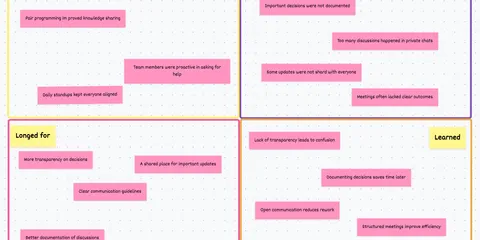

Should I do retrospectives in non-agile teams or projects without Scrum?
Only a few companies work in a truly agile way.
However, most companies usually only have individual areas or projects in which they work more or less “agilely.”
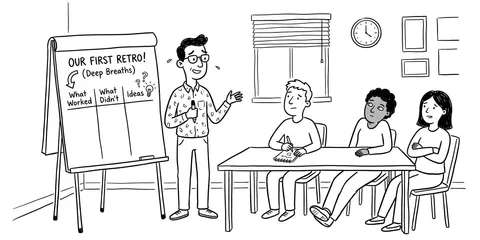
Perhaps you are also working on a semi-agile project and are asking yourself: Should I do retrospectives here?
Should I do retrospectives?
Should I do retrospectives in projects without Scrum?
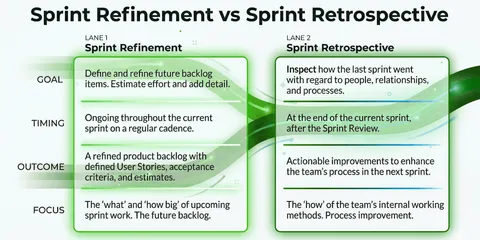
Retrospectives are an integral part of Scrum for good reason. See also: Scrum Guide
However, retrospectives are also often used independently of Scrum in projects and teams. If you do not yet have any experience with retrospectives, take a look here: Quick guide for retrospectives
The advantages of retrospectives in project teams without Scrum are:
- Ensuring regular reflection on the collaboration
- Strengthen team spirit and trust in the team
- Continuous process improvements
With a retrospective tool such as Echometer, it is also very easy to carry out a retrospective in a structured and goal-oriented manner in project teams without Scrum.
You can simply try it out for free and evaluate whether it has helped your project team at the end of the retro via the team feedback on the “Return On Time Invested” (ROTI for short).
Retro to try out - Psychological safety Retro:
Psychological safety Health Check: How the retro works
Random Icebreaker (2-5 minutes)
Echometer provides you with a generator for random check-in questions.
Review of open actions (2-5 minutes)
Before starting with new topics, you should talk about what has become of the measures from past retrospectives to check their effectiveness. Echometer automatically lists all open action items from past retros.
Health Check
All team members can answer the health checks anonymously on a scale. Then go through the results of the health checks together and record any additional comments if necessary. If you use the same health checks in several retrospectives, you can also track trends over time in Echometer.
- I regularly receive useful feedback on how good my performance is and how I can improve.
- If a team member makes a mistake, they are not judged for it.
- You're allowed to not know things in our team.
- In conflicts, we talk on a factual level, so that no one feels personally attacked or judged.
Discuss retro topics
Use the following open questions to collect your most important findings. First, everyone does it themselves, covered. Echometer allows you to reveal each column of the retro board individually in order to then present and group the feedback.
- What else do we want to talk about?
Catch-all question (Recommended)
So that other topics also have a place:
- What else would you like to talk about in the retro?
Prioritization / Voting (5 minutes)
On the retro board in Echometer, you can easily prioritize the feedback with voting. The voting is of course anonymous.
Define actions (10-20 minutes)
You can create a linked action via the plus symbol on a feedback. Not sure which measure would be the right one? Then open a whiteboard on the topic via the plus symbol instead to brainstorm root causes and possible measures.
Checkout / Closing (5 minutes)
Echometer enables you to collect anonymous feedback from the team on how helpful the retro was. This creates the ROTI score ("Return On Time Invested"), which you can track over time.
Psychological safety Health Check
Health Check Questions (Scale)
Open questions

Should I also use retrospectives in non-agile teams?
Although retrospectives are an agile format, they can be used in virtually any non-agile team.
After all, every team should have a routine in which they critically reflect on their collaboration and initiate improvements.
See also: The unexpected added value of retrospectives
Some teams already have routines such as “Team Meeting”, “Team Weekly” or “Team Jour Fixe”.
Supporting these regular meetings with the structure of a classic retrospective can lead to better results and more commitment from the team:
- Meetings follow a clear retrospective structure
- The retrospective’s ice-breaker lightens the mood
- All team members have their say and share their feedback
- Measures are recorded (ideally in the retro tool) and are not lost
So if you want more team engagement in your team meetings, you should definitely try out retrospectives in a non-agile team.
Echometer offers you a very simple retro tool suitable for beginners, with which you can also try out retrospectives in non-agile teams free of charge.
Retro to try out - the battery retrospective:
Battery retrospective: How the retro works
Random Icebreaker (2-5 minutes)
Echometer provides you with a generator for random check-in questions.
Review of open actions (2-5 minutes)
Before starting with new topics, you should talk about what has become of the measures from past retrospectives to check their effectiveness. Echometer automatically lists all open action items from past retros.
Discuss retro topics
Use the following open questions to collect your most important findings. First, everyone does it themselves, covered. Echometer allows you to reveal each column of the retro board individually in order to then present and group the feedback.
- How full is your personal battery as a percentage right now?
- What has drained your battery recently?
- What has recharged your battery recently?
- What would help you to save energy over the next few weeks?
Catch-all question (Recommended)
So that other topics also have a place:
- What else would you like to talk about in the retro?
Prioritization / Voting (5 minutes)
On the retro board in Echometer, you can easily prioritize the feedback with voting. The voting is of course anonymous.
Define actions (10-20 minutes)
You can create a linked action via the plus symbol on a feedback. Not sure which measure would be the right one? Then open a whiteboard on the topic via the plus symbol instead to brainstorm root causes and possible measures.
Checkout / Closing (5 minutes)
Echometer enables you to collect anonymous feedback from the team on how helpful the retro was. This creates the ROTI score ("Return On Time Invested"), which you can track over time.
Battery retrospective