
54 Fun Retrospective Templates That Spark Fresh Insights
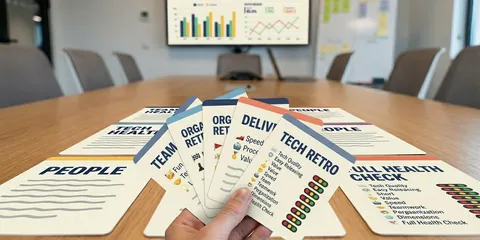
Explore a variety of fun retrospective templates - and the best part? You can try them all for free using our online retro board software.
Click here on the category that fits best and let’s go:
What should be part of every retrospective? It should reflect on the work from a different angle. Have you ever had a retro with extremely low energy levels? Where there was practically no feedback? Exactly - nobody wants that. That’s why you need new perspectives regularly. And that’s why you’ll find a range of retrospective methods in this article that you didn’t know about yet: If you want to challenge your team morale, do the “Team Morale Health Check”. If you need a fresh perspective, do the 7 Dwarfs Retrospective. Or is everyone on vacation? Then go with the vacation method. The formats will tickle your team’s creative veins - and definitely maximize the probability of one: Valuable Action Items . Let’s start with some hints and tips before diving deeper into our fun retro ideas.
Sprint Retrospective Meeting: A few hints before we start🚦
If you don’t have any experience with agile retrospectives or with retro templates, you can read through our short and crisp guide: Retrospectives - Everything you need to know Good to know: A Scrum retrospective usually lasts between 45 (up to 5 team members) and 90 minutes (up to 12 team members). If possible, you should allow even more time. In any case, you should actively timebox in each of the retro phases. If you are not familiar with these, you can find out more about them here: The 5 phases of a retrospective. If you often have problems with timeboxing, here are some tips for you: How to conduct a short retrospective. With this in mind: Moderating the retrospective under time pressure is no fun and may even be harmful. So prepare your questions, notes and working materials well. If the retro method takes place in a distributed team, you might ask yourself: How can you conduct a retrospective online? You can find an answer to this here: retro board tool comparison. But to make it short: Our recommendation for this is our tool: Echometer. You will find a button next to each of the retrospective methods that leads to our tool. If you are looking for a template for a sprint retrospective ppt (i.e. a PowerPoint presentation), you can also simply copy the questions and the image of the respective method into a PowerPoint presentation. However, it would be even easier if you simply click on the button - whichever you prefer :)
Scrum Retrospective Meeting: How to start a retrospective meeting 🏁
Before we get to the main part of this post: How do you start a retrospective? If we look back again (The 5 phases of a retrospective), this is quite easy to answer. You start with an icebreaker, with retro check-in questions. If you need some inspiration, just have a look here: The best retro check-ins for any context. “Setting the stage” after the check-in questions is an important foundation for the retrospective formats that follow.
The Best Retrospective Templates: Classics
Let’s start with the best retrospective methods - or at least the five most common. These are particularly well suited for beginners or for teams that don’t have much retro experience yet. Further down are the methods for retrospective pros, which will also help against retro fatigue.
Let’s start with the classics: I’m talking about the retrospective method “Start Stop Keep” (also known as “Start Stop Continue”), the retrospective “Loved Learned longed for” (also known as “Retro Loved Learned liked Longed For” or 4l retrospective), the Scrum retrospective with the 3 central questions “What went well”, the sailboat retrospective, the “mad sad glad” retrospective and “Thumbs up, thumbs down, new ideas and recognition”. You can find more about this below!
Classics: Project Retrospective Template 1
The What Went Well Retro 👍
The “What Went Well” retrospective is probably the most popular or well-known of all the ideas for retrospectives. It is based on the pattern that we find in many other retrospectives, but simply without all the frills. With a view to the last sprint cycle, these 3 questions are asked. ( You can find more advantages of the “What went well” retrospective here… )
What went well Retro 👍: How the retro works
-
Random Icebreaker (2-5 minutes)
Echometer provides you with a generator for random check-in questions.
-
Review of open actions (2-5 minutes)
Before starting with new topics, you should talk about what has become of the measures from past retrospectives to check their effectiveness. Echometer automatically lists all open action items from past retros.
-
Discuss retro topics
Use the following open questions to collect your most important findings. First, everyone does it themselves, covered. Echometer allows you to reveal each column of the retro board individually in order to then present and group the feedback.
- What went well?
- What went not so well?
- How can we improve?
-
Catch-all question (Recommended)
So that other topics also have a place:
- What else would you like to talk about in the retro?
-
Prioritization / Voting (5 minutes)
On the retro board in Echometer, you can easily prioritize the feedback with voting. The voting is of course anonymous.
-
Define actions (10-20 minutes)
You can create a linked action via the plus symbol on a feedback. Not sure which measure would be the right one? Then open a whiteboard on the topic via the plus symbol instead to brainstorm root causes and possible measures.
-
Checkout / Closing (5 minutes)
Echometer enables you to collect anonymous feedback from the team on how helpful the retro was. This creates the ROTI score ("Return On Time Invested"), which you can track over time.
What went well Retro 👍

Open questions
Classic Retrospective Method 2
The Mad Sad Glad retrospective 😯
The “Mad Sad Glad” retrospective method has a similar pattern, but uses three typical emotions to make it a little more interesting for the team. It’s your decision whether you want to use the English or German terms.
Mad Sad Glad Retro 😯: How the retro works
-
Random Icebreaker (2-5 minutes)
Echometer provides you with a generator for random check-in questions.
-
Review of open actions (2-5 minutes)
Before starting with new topics, you should talk about what has become of the measures from past retrospectives to check their effectiveness. Echometer automatically lists all open action items from past retros.
-
Discuss retro topics
Use the following open questions to collect your most important findings. First, everyone does it themselves, covered. Echometer allows you to reveal each column of the retro board individually in order to then present and group the feedback.
- What made you mad? 😤
- What made you sad? 😢
- What made you glad? 🤩
-
Catch-all question (Recommended)
So that other topics also have a place:
- What else would you like to talk about in the retro?
-
Prioritization / Voting (5 minutes)
On the retro board in Echometer, you can easily prioritize the feedback with voting. The voting is of course anonymous.
-
Define actions (10-20 minutes)
You can create a linked action via the plus symbol on a feedback. Not sure which measure would be the right one? Then open a whiteboard on the topic via the plus symbol instead to brainstorm root causes and possible measures.
-
Checkout / Closing (5 minutes)
Echometer enables you to collect anonymous feedback from the team on how helpful the retro was. This creates the ROTI score ("Return On Time Invested"), which you can track over time.
Mad Sad Glad Retro 😯

Open questions
Classics: Project Retrospective Template 3
The Scrum retrospective Start Stop Keep 🔖
The Scrum Retrospective Start Stop Keep is also known as the Start Stop Continue Retrospective. I highly recommend making it a “Keep Stop Start” retro (in that order) because you start with something positive and end with ideas for new action items:
Keep stop start retro: How the retro works
-
Random Icebreaker (2-5 minutes)
Echometer provides you with a generator for random check-in questions.
-
Review of open actions (2-5 minutes)
Before starting with new topics, you should talk about what has become of the measures from past retrospectives to check their effectiveness. Echometer automatically lists all open action items from past retros.
-
Discuss retro topics
Use the following open questions to collect your most important findings. First, everyone does it themselves, covered. Echometer allows you to reveal each column of the retro board individually in order to then present and group the feedback.
- Keep: What should we keep?
- Stop: What should we stop doing?
- Start: What should we start doing?
-
Catch-all question (Recommended)
So that other topics also have a place:
- What else would you like to talk about in the retro?
-
Prioritization / Voting (5 minutes)
On the retro board in Echometer, you can easily prioritize the feedback with voting. The voting is of course anonymous.
-
Define actions (10-20 minutes)
You can create a linked action via the plus symbol on a feedback. Not sure which measure would be the right one? Then open a whiteboard on the topic via the plus symbol instead to brainstorm root causes and possible measures.
-
Checkout / Closing (5 minutes)
Echometer enables you to collect anonymous feedback from the team on how helpful the retro was. This creates the ROTI score ("Return On Time Invested"), which you can track over time.
Keep stop start retro

Open questions
Classics: Sprint Retrospective Template 1
The retrospective liked learned lacked longed for 📘
The “Retrospective liked learned lacked longed for” is called 4l retrospective because the 4 key questions are each made up of a word that starts with “l” - obviously. When we look at the last few weeks:
4L-Retro 📘: How the retro works
-
Random Icebreaker (2-5 minutes)
Echometer provides you with a generator for random check-in questions.
-
Review of open actions (2-5 minutes)
Before starting with new topics, you should talk about what has become of the measures from past retrospectives to check their effectiveness. Echometer automatically lists all open action items from past retros.
-
Discuss retro topics
Use the following open questions to collect your most important findings. First, everyone does it themselves, covered. Echometer allows you to reveal each column of the retro board individually in order to then present and group the feedback.
- Like: What did you like?
- Learned: What did you learn?
- Lacked: What did you lack?
- Longed for: What did you long for?
-
Catch-all question (Recommended)
So that other topics also have a place:
- What else would you like to talk about in the retro?
-
Prioritization / Voting (5 minutes)
On the retro board in Echometer, you can easily prioritize the feedback with voting. The voting is of course anonymous.
-
Define actions (10-20 minutes)
You can create a linked action via the plus symbol on a feedback. Not sure which measure would be the right one? Then open a whiteboard on the topic via the plus symbol instead to brainstorm root causes and possible measures.
-
Checkout / Closing (5 minutes)
Echometer enables you to collect anonymous feedback from the team on how helpful the retro was. This creates the ROTI score ("Return On Time Invested"), which you can track over time.
4L-Retro 📘

Open questions
Classics: Sprint Retrospective Template 5
Sprint Retrospective Template: The Sailboat retrospective ⛵️
Now, with this retrospective idea we are getting more creative making use of a metaphor: The sailboat. Imagine your team or your last sprint as a sailboat.
Sailboat Retro ⛵️: How the retro works
-
Random Icebreaker (2-5 minutes)
Echometer provides you with a generator for random check-in questions.
-
Review of open actions (2-5 minutes)
Before starting with new topics, you should talk about what has become of the measures from past retrospectives to check their effectiveness. Echometer automatically lists all open action items from past retros.
-
Discuss retro topics
Use the following open questions to collect your most important findings. First, everyone does it themselves, covered. Echometer allows you to reveal each column of the retro board individually in order to then present and group the feedback.
- ⚓️ Your anchor: What holds us back?
- 🦈🧊 Your shark/iceberg: Which dangers or obstacles approach us?
- 💨 Your tailwind: What drives us forward?
- 🏝💰 Your paradise: What achievement or milestones are we working towards?
-
Catch-all question (Recommended)
So that other topics also have a place:
- What else would you like to talk about in the retro?
-
Prioritization / Voting (5 minutes)
On the retro board in Echometer, you can easily prioritize the feedback with voting. The voting is of course anonymous.
-
Define actions (10-20 minutes)
You can create a linked action via the plus symbol on a feedback. Not sure which measure would be the right one? Then open a whiteboard on the topic via the plus symbol instead to brainstorm root causes and possible measures.
-
Checkout / Closing (5 minutes)
Echometer enables you to collect anonymous feedback from the team on how helpful the retro was. This creates the ROTI score ("Return On Time Invested"), which you can track over time.
Sailboat Retro ⛵️

Open questions
Classics: Sprint Retrospective Template 6
DAKI (Drop Add Keep Improve) Retrospective ✂️
The DAKI retrospective, standing for the English words “Drop Add Keep Improve”, is a simple acronym that is also classically used as a retrospective method. (More detailed information about the DAKI retrospective: 2 tips for the DAKI retrospective incl. examples )
DAKI Retro: How the retro works
-
Random Icebreaker (2-5 minutes)
Echometer provides you with a generator for random check-in questions.
-
Review of open actions (2-5 minutes)
Before starting with new topics, you should talk about what has become of the measures from past retrospectives to check their effectiveness. Echometer automatically lists all open action items from past retros.
-
Discuss retro topics
Use the following open questions to collect your most important findings. First, everyone does it themselves, covered. Echometer allows you to reveal each column of the retro board individually in order to then present and group the feedback.
- Drop: What should we drop?
- Add: What should we add?
- Keep: What should we keep?
- Improve: What should we improve?
-
Catch-all question (Recommended)
So that other topics also have a place:
- What else would you like to talk about in the retro?
-
Prioritization / Voting (5 minutes)
On the retro board in Echometer, you can easily prioritize the feedback with voting. The voting is of course anonymous.
-
Define actions (10-20 minutes)
You can create a linked action via the plus symbol on a feedback. Not sure which measure would be the right one? Then open a whiteboard on the topic via the plus symbol instead to brainstorm root causes and possible measures.
-
Checkout / Closing (5 minutes)
Echometer enables you to collect anonymous feedback from the team on how helpful the retro was. This creates the ROTI score ("Return On Time Invested"), which you can track over time.
DAKI Retro

Open questions
Classics: Sprint Retrospective Template 7
Three Little Pigs Retro 🐷
The “The Three Little Pigs” retrospective is based on the fairy tale of the same name, in which 3 pigs build three houses from completely different materials. Of course, the three houses are built with different levels of robustness. The question is - what material are the results in your team built from?
Three Little Pigs Retro 🐷: How the retro works
-
Random Icebreaker (2-5 minutes)
Echometer provides you with a generator for random check-in questions.
-
Review of open actions (2-5 minutes)
Before starting with new topics, you should talk about what has become of the measures from past retrospectives to check their effectiveness. Echometer automatically lists all open action items from past retros.
-
Discuss retro topics
Use the following open questions to collect your most important findings. First, everyone does it themselves, covered. Echometer allows you to reveal each column of the retro board individually in order to then present and group the feedback.
- House of straw: What do we do that is just holding together, but could topple over at any moment? 🌱
- House of sticks: What do we do that is relatively stable, but could be improved?\n 🪵
- House of bricks: What do we do that is rock solid? 🪨
-
Catch-all question (Recommended)
So that other topics also have a place:
- What else would you like to talk about in the retro?
-
Prioritization / Voting (5 minutes)
On the retro board in Echometer, you can easily prioritize the feedback with voting. The voting is of course anonymous.
-
Define actions (10-20 minutes)
You can create a linked action via the plus symbol on a feedback. Not sure which measure would be the right one? Then open a whiteboard on the topic via the plus symbol instead to brainstorm root causes and possible measures.
-
Checkout / Closing (5 minutes)
Echometer enables you to collect anonymous feedback from the team on how helpful the retro was. This creates the ROTI score ("Return On Time Invested"), which you can track over time.
Three Little Pigs Retro 🐷

Open questions
Classics: Sprint Retrospective Template 8
The Starfish Sprint Retrospective ⭐️
The Starfish Sprint Retrospective is particularly visually interesting: 5 questions are asked, which can be optimally divided into the columns of a starfish. The “Starfish” Sprint Retrospective tends to take a little longer with 5 questions.
Starfish Retro ⭐️: How the retro works
-
Random Icebreaker (2-5 minutes)
Echometer provides you with a generator for random check-in questions.
-
Review of open actions (2-5 minutes)
Before starting with new topics, you should talk about what has become of the measures from past retrospectives to check their effectiveness. Echometer automatically lists all open action items from past retros.
-
Discuss retro topics
Use the following open questions to collect your most important findings. First, everyone does it themselves, covered. Echometer allows you to reveal each column of the retro board individually in order to then present and group the feedback.
- Keep: [Optional: Looking at the last sprint / weeks] What should we keep doing, keep as it is?
- Stop: What should we stop doing?
- Start: What should we start doing?
- More: What should we do more of?
- Less: What should we do less of?
-
Catch-all question (Recommended)
So that other topics also have a place:
- What else would you like to talk about in the retro?
-
Prioritization / Voting (5 minutes)
On the retro board in Echometer, you can easily prioritize the feedback with voting. The voting is of course anonymous.
-
Define actions (10-20 minutes)
You can create a linked action via the plus symbol on a feedback. Not sure which measure would be the right one? Then open a whiteboard on the topic via the plus symbol instead to brainstorm root causes and possible measures.
-
Checkout / Closing (5 minutes)
Echometer enables you to collect anonymous feedback from the team on how helpful the retro was. This creates the ROTI score ("Return On Time Invested"), which you can track over time.
Starfish Retro ⭐️

Open questions
Classics: Sprint Retrospective Template 10
Thumbs up, Thumbs down, new ideas and recognition 👍👎
The “What Went Well” retrospective is probably the most popular or well-known of all the retrospective ideas. It is based on the pattern that we find in many other retrospectives, but simply without all the frills. Looking at the last sprint cycle, these 3 questions are asked:
Thumbs Up/Down Retro: How the retro works
-
Random Icebreaker (2-5 minutes)
Echometer provides you with a generator for random check-in questions.
-
Review of open actions (2-5 minutes)
Before starting with new topics, you should talk about what has become of the measures from past retrospectives to check their effectiveness. Echometer automatically lists all open action items from past retros.
-
Discuss retro topics
Use the following open questions to collect your most important findings. First, everyone does it themselves, covered. Echometer allows you to reveal each column of the retro board individually in order to then present and group the feedback.
- What do you give a "thumbs up" to?
- What do you give a "thumbs down" for?
- Which new ideas do you have?
- Who or what do you want to recognize, highlight positively?
-
Catch-all question (Recommended)
So that other topics also have a place:
- What else would you like to talk about in the retro?
-
Prioritization / Voting (5 minutes)
On the retro board in Echometer, you can easily prioritize the feedback with voting. The voting is of course anonymous.
-
Define actions (10-20 minutes)
You can create a linked action via the plus symbol on a feedback. Not sure which measure would be the right one? Then open a whiteboard on the topic via the plus symbol instead to brainstorm root causes and possible measures.
-
Checkout / Closing (5 minutes)
Echometer enables you to collect anonymous feedback from the team on how helpful the retro was. This creates the ROTI score ("Return On Time Invested"), which you can track over time.
Thumbs Up/Down Retro

Open questions
So, thumbs up for these classics? If it’s more of a “thumbs down”, you might like the following retrospective ideas, which are even more focused on fun and creativity. There are some somewhat playful retrospective methods, but also a few health checks (more on Agile team health checks here).
Fun Sprint Retrospective Templates: 5 Health-Check-Radar Templates
A radar chart is a nice overview to show the results of Team Health Check’s - and as we are developing a retrospective tool that focuses on continuous health checks based on psychology, we can help with that. Here you can find a few retrospective ideas including radar charts.
Health Check: Best Retrospective Questions 1
Health Check Retro: Spotify Squad Health Check 👩🏻💻
The Spotify Health Check (based on the Spotify model) is one of the classics when it comes to frameworks to scale agile. The nice thing about it: The Spotify Health Check Retrospective can be carried out in tribes (several teams) as well as in individual teams.
Spotify Health Check 👩🏻💻: How the retro works
-
Random Icebreaker (2-5 minutes)
Echometer provides you with a generator for random check-in questions.
-
Review of open actions (2-5 minutes)
Before starting with new topics, you should talk about what has become of the measures from past retrospectives to check their effectiveness. Echometer automatically lists all open action items from past retros.
-
Health Check
All team members can answer the health checks anonymously on a scale. Then go through the results of the health checks together and record any additional comments if necessary. If you use the same health checks in several retrospectives, you can also track trends over time in Echometer.
- Speed: We get stuff done really quickly. No waiting, no delays.
- Tech Quality: We’re proud of the quality of our code! It is clean, easy to read, and has great test coverage.
- Learning: We’re learning lots of interesting stuff all the time!
- Mission: We know exactly why we are here and can be enthusiastic about it.
-
Discuss retro topics
Use the following open questions to collect your most important findings. First, everyone does it themselves, covered. Echometer allows you to reveal each column of the retro board individually in order to then present and group the feedback.
-
Catch-all question (Recommended)
So that other topics also have a place:
- What else would you like to talk about in the retro?
-
Prioritization / Voting (5 minutes)
On the retro board in Echometer, you can easily prioritize the feedback with voting. The voting is of course anonymous.
-
Define actions (10-20 minutes)
You can create a linked action via the plus symbol on a feedback. Not sure which measure would be the right one? Then open a whiteboard on the topic via the plus symbol instead to brainstorm root causes and possible measures.
-
Checkout / Closing (5 minutes)
Echometer enables you to collect anonymous feedback from the team on how helpful the retro was. This creates the ROTI score ("Return On Time Invested"), which you can track over time.
Spotify Health Check 👩🏻💻
Health Check Questions (Scale)

Health Check: Best Retrospective Questions 2
Health Check Retro: The 5 Agile Values 5️⃣
The agile values and principles belong to the basics of a Scrum course. Only when you live up to them, you can reach higher agile maturity levels reach. This health check helps you to reflect on the 5 agile Scrum values from a different perspective with your team and make them measurable - see below for an insight.
5 Agile Values Health Check 5️⃣: How the retro works
-
Random Icebreaker (2-5 minutes)
Echometer provides you with a generator for random check-in questions.
-
Review of open actions (2-5 minutes)
Before starting with new topics, you should talk about what has become of the measures from past retrospectives to check their effectiveness. Echometer automatically lists all open action items from past retros.
-
Health Check
All team members can answer the health checks anonymously on a scale. Then go through the results of the health checks together and record any additional comments if necessary. If you use the same health checks in several retrospectives, you can also track trends over time in Echometer.
- Courage: We value people showing courage.
- Respect: We value each other’s ideas, even when disagreeing.
- Commitment: Every team member is committed to follow through on what they have promised.
- Focus: We don’t allow ourselves to be distracted from reaching the sprint goal.
- Openness: We are open to constructive feedback and grow from it.
-
Discuss retro topics
Use the following open questions to collect your most important findings. First, everyone does it themselves, covered. Echometer allows you to reveal each column of the retro board individually in order to then present and group the feedback.
-
Catch-all question (Recommended)
So that other topics also have a place:
- What else would you like to talk about in the retro?
-
Prioritization / Voting (5 minutes)
On the retro board in Echometer, you can easily prioritize the feedback with voting. The voting is of course anonymous.
-
Define actions (10-20 minutes)
You can create a linked action via the plus symbol on a feedback. Not sure which measure would be the right one? Then open a whiteboard on the topic via the plus symbol instead to brainstorm root causes and possible measures.
-
Checkout / Closing (5 minutes)
Echometer enables you to collect anonymous feedback from the team on how helpful the retro was. This creates the ROTI score ("Return On Time Invested"), which you can track over time.
5 Agile Values Health Check 5️⃣
Health Check Questions (Scale)

Health Check: Best Retrospective Questions 3
Health Check Retro: Netflix Culture 🎥
Netflix has created a unique corporate culture created, which is known for its innovative capacity. And “speed of innovation is the only thing that matters in the long term,” as Elon Musk puts it. In this respect, feel free to do a Health Check Retrospective inspired by Netfli , to check your innovation “health”.
Netflix Culture Health Check 🎥: How the retro works
-
Random Icebreaker (2-5 minutes)
Echometer provides you with a generator for random check-in questions.
-
Review of open actions (2-5 minutes)
Before starting with new topics, you should talk about what has become of the measures from past retrospectives to check their effectiveness. Echometer automatically lists all open action items from past retros.
-
Health Check
All team members can answer the health checks anonymously on a scale. Then go through the results of the health checks together and record any additional comments if necessary. If you use the same health checks in several retrospectives, you can also track trends over time in Echometer.
- Iterative: With every idea my colleagues have, I have the opportunity to contribute my feedback and criticism at an early stage.
- Feedback culture: I like to share my feedback and criticism on ideas from my colleagues.
- Ideagineering: Our internal feedback is of great help in further developing ideas at an early stage.
-
Discuss retro topics
Use the following open questions to collect your most important findings. First, everyone does it themselves, covered. Echometer allows you to reveal each column of the retro board individually in order to then present and group the feedback.
-
Catch-all question (Recommended)
So that other topics also have a place:
- What else would you like to talk about in the retro?
-
Prioritization / Voting (5 minutes)
On the retro board in Echometer, you can easily prioritize the feedback with voting. The voting is of course anonymous.
-
Define actions (10-20 minutes)
You can create a linked action via the plus symbol on a feedback. Not sure which measure would be the right one? Then open a whiteboard on the topic via the plus symbol instead to brainstorm root causes and possible measures.
-
Checkout / Closing (5 minutes)
Echometer enables you to collect anonymous feedback from the team on how helpful the retro was. This creates the ROTI score ("Return On Time Invested"), which you can track over time.
Netflix Culture Health Check 🎥
Health Check Questions (Scale)

Health Check: Best Retrospective Questions 4
Health Check Retro: Growth Mindset 🧠
“Agile Being over Agile Doing” or “it’s about the agile mindset not the agile processes” - we often hear something like that from Agile Coaches (which, by the way, should be questioned - more on that in our eBook “ 12 workshops on team flow & mindset change ”). With this retro, you can start to promote the right growth mindset.
Growth-Mindset Health Check 🧠: How the retro works
-
Random Icebreaker (2-5 minutes)
Echometer provides you with a generator for random check-in questions.
-
Review of open actions (2-5 minutes)
Before starting with new topics, you should talk about what has become of the measures from past retrospectives to check their effectiveness. Echometer automatically lists all open action items from past retros.
-
Health Check
All team members can answer the health checks anonymously on a scale. Then go through the results of the health checks together and record any additional comments if necessary. If you use the same health checks in several retrospectives, you can also track trends over time in Echometer.
- Purpose: The results of my work are of great importance to our clients.
- Personal development: I feel like I am improving myself every day at work.
- Goals: My goals are aligned with the goals of my colleagues.
-
Discuss retro topics
Use the following open questions to collect your most important findings. First, everyone does it themselves, covered. Echometer allows you to reveal each column of the retro board individually in order to then present and group the feedback.
-
Catch-all question (Recommended)
So that other topics also have a place:
- What else would you like to talk about in the retro?
-
Prioritization / Voting (5 minutes)
On the retro board in Echometer, you can easily prioritize the feedback with voting. The voting is of course anonymous.
-
Define actions (10-20 minutes)
You can create a linked action via the plus symbol on a feedback. Not sure which measure would be the right one? Then open a whiteboard on the topic via the plus symbol instead to brainstorm root causes and possible measures.
-
Checkout / Closing (5 minutes)
Echometer enables you to collect anonymous feedback from the team on how helpful the retro was. This creates the ROTI score ("Return On Time Invested"), which you can track over time.
Growth-Mindset Health Check 🧠
Health Check Questions (Scale)

Health Check: Best Retrospective Questions 5
Health Check Retro: Psychological Safety👮🏼♀️
Since Project Aristotle is from Google Psychological safety known to correlate closely with team success. There are concrete behavioral anchors that will help you measure and discuss psychological safety in your team - good luck!
Psychological safety Health Check: How the retro works
-
Random Icebreaker (2-5 minutes)
Echometer provides you with a generator for random check-in questions.
-
Review of open actions (2-5 minutes)
Before starting with new topics, you should talk about what has become of the measures from past retrospectives to check their effectiveness. Echometer automatically lists all open action items from past retros.
-
Health Check
All team members can answer the health checks anonymously on a scale. Then go through the results of the health checks together and record any additional comments if necessary. If you use the same health checks in several retrospectives, you can also track trends over time in Echometer.
- If a team member makes a mistake, they are not judged for it.
- You're allowed to not know things in our team.
- In conflicts, we talk on a factual level, so that no one feels personally attacked or judged.
- I regularly receive useful feedback on how good my performance is and how I can improve.
-
Discuss retro topics
Use the following open questions to collect your most important findings. First, everyone does it themselves, covered. Echometer allows you to reveal each column of the retro board individually in order to then present and group the feedback.
-
Catch-all question (Recommended)
So that other topics also have a place:
- What else would you like to talk about in the retro?
-
Prioritization / Voting (5 minutes)
On the retro board in Echometer, you can easily prioritize the feedback with voting. The voting is of course anonymous.
-
Define actions (10-20 minutes)
You can create a linked action via the plus symbol on a feedback. Not sure which measure would be the right one? Then open a whiteboard on the topic via the plus symbol instead to brainstorm root causes and possible measures.
-
Checkout / Closing (5 minutes)
Echometer enables you to collect anonymous feedback from the team on how helpful the retro was. This creates the ROTI score ("Return On Time Invested"), which you can track over time.
Psychological safety Health Check
Health Check Questions (Scale)

Retrospective idea: Team Health Check 6
Health Check Retro: Team spirit 😇
You may be satisfied in the team - but what does that look like when you go into a little more detail regarding team spirit? This retro helps to illuminate it a little more objectively from different perspectives. So that you can focus on creative action items without much effort. You could say it is food for your team maturation process.
Team-Moral Health Check 😇: How the retro works
-
Random Icebreaker (2-5 minutes)
Echometer provides you with a generator for random check-in questions.
-
Review of open actions (2-5 minutes)
Before starting with new topics, you should talk about what has become of the measures from past retrospectives to check their effectiveness. Echometer automatically lists all open action items from past retros.
-
Health Check
All team members can answer the health checks anonymously on a scale. Then go through the results of the health checks together and record any additional comments if necessary. If you use the same health checks in several retrospectives, you can also track trends over time in Echometer.
- Appreciation: My colleagues appreciate my contribution to the team.
- Team Spirit: There is a trusting working atmosphere in our team.
- Transparency: Everyone in my team knows who is currently working on what.
- Recovery & Breaks: I have enough room for breaks in which I can draw new energy.
- Meeting culture: Our meetings are well structured, yet leave room for creativity and new ideas.
- Support: In my team, each team member passes on their individual knowledge and experience.
-
Discuss retro topics
Use the following open questions to collect your most important findings. First, everyone does it themselves, covered. Echometer allows you to reveal each column of the retro board individually in order to then present and group the feedback.
-
Catch-all question (Recommended)
So that other topics also have a place:
- What else would you like to talk about in the retro?
-
Prioritization / Voting (5 minutes)
On the retro board in Echometer, you can easily prioritize the feedback with voting. The voting is of course anonymous.
-
Define actions (10-20 minutes)
You can create a linked action via the plus symbol on a feedback. Not sure which measure would be the right one? Then open a whiteboard on the topic via the plus symbol instead to brainstorm root causes and possible measures.
-
Checkout / Closing (5 minutes)
Echometer enables you to collect anonymous feedback from the team on how helpful the retro was. This creates the ROTI score ("Return On Time Invested"), which you can track over time.
Team-Moral Health Check 😇
Health Check Questions (Scale)

Retrospective idea: Team Health Check 7
Health Check Retro: Kanban Method 📝
Kanban is one of the best-known and most effective agile frameworks alongside Scrum. Often the implementation seems simple - but really mastering the method is really difficult. Although it’s worth it! Check in the Kanban health check retrospectiv e you can reflect how good you actually are.
Kanban Health Check 📝: How the retro works
-
Random Icebreaker (2-5 minutes)
Echometer provides you with a generator for random check-in questions.
-
Review of open actions (2-5 minutes)
Before starting with new topics, you should talk about what has become of the measures from past retrospectives to check their effectiveness. Echometer automatically lists all open action items from past retros.
-
Health Check
All team members can answer the health checks anonymously on a scale. Then go through the results of the health checks together and record any additional comments if necessary. If you use the same health checks in several retrospectives, you can also track trends over time in Echometer.
- Kanban Planning: Our team has a great predictability.
- Kanban Process: Our Kanban board reflects the latest status of all our work.
- Kanban Metrics: We inspect our flow metrics to identify room for improvement.
- Improvement: In our team we implement meaningful continuous improvements.
-
Discuss retro topics
Use the following open questions to collect your most important findings. First, everyone does it themselves, covered. Echometer allows you to reveal each column of the retro board individually in order to then present and group the feedback.
-
Catch-all question (Recommended)
So that other topics also have a place:
- What else would you like to talk about in the retro?
-
Prioritization / Voting (5 minutes)
On the retro board in Echometer, you can easily prioritize the feedback with voting. The voting is of course anonymous.
-
Define actions (10-20 minutes)
You can create a linked action via the plus symbol on a feedback. Not sure which measure would be the right one? Then open a whiteboard on the topic via the plus symbol instead to brainstorm root causes and possible measures.
-
Checkout / Closing (5 minutes)
Echometer enables you to collect anonymous feedback from the team on how helpful the retro was. This creates the ROTI score ("Return On Time Invested"), which you can track over time.
Kanban Health Check 📝
Health Check Questions (Scale)

Retrospective idea: Health Check Radar 8
Health Check Retro: Scrum Framework 🦾
Approximately 75% of IT teams use Scrum or a Scrum-inspired development process. But it is not that easy to implement the framework successfully (see Zombie Scrum). We don’t want you to become Zombie’s which is why we created the Scrum Health Check retrospective in the Our tool the Scrum Health Check Retro - have fun reflecting!
Scrum Health Check 🦾: How the retro works
-
Random Icebreaker (2-5 minutes)
Echometer provides you with a generator for random check-in questions.
-
Review of open actions (2-5 minutes)
Before starting with new topics, you should talk about what has become of the measures from past retrospectives to check their effectiveness. Echometer automatically lists all open action items from past retros.
-
Health Check
All team members can answer the health checks anonymously on a scale. Then go through the results of the health checks together and record any additional comments if necessary. If you use the same health checks in several retrospectives, you can also track trends over time in Echometer.
- Planning: Backlog refinement in our team is efficient and effective.
- Customer orientation: The planning of our sprints is always based on achieving the greatest possible customer benefit in the given time.
- Understanding of roles: Team members, Product Owner and Scrum Master share the same understanding of their respective roles in the team.
- Scrum Events: Lately, every daily in the team has been worthwhile.
-
Discuss retro topics
Use the following open questions to collect your most important findings. First, everyone does it themselves, covered. Echometer allows you to reveal each column of the retro board individually in order to then present and group the feedback.
-
Catch-all question (Recommended)
So that other topics also have a place:
- What else would you like to talk about in the retro?
-
Prioritization / Voting (5 minutes)
On the retro board in Echometer, you can easily prioritize the feedback with voting. The voting is of course anonymous.
-
Define actions (10-20 minutes)
You can create a linked action via the plus symbol on a feedback. Not sure which measure would be the right one? Then open a whiteboard on the topic via the plus symbol instead to brainstorm root causes and possible measures.
-
Checkout / Closing (5 minutes)
Echometer enables you to collect anonymous feedback from the team on how helpful the retro was. This creates the ROTI score ("Return On Time Invested"), which you can track over time.
Scrum Health Check 🦾
Health Check Questions (Scale)

Playful Agile Retrospective Templates Based on Games
Now you know perhaps the best or at least most common retrospective methods. Since agile teams usually like to use a new method regularly (or at least their Scrum Masters or Agile Coaches 😉), you will find one or two newly developed, playful retrospective questions below - fun guaranteed.
Everyone loves games. Why not use some retrospective scrum games to trigger interesting new thoughts in your team? Of course, you should make sure that everyone knows the games that our retrospective scrum games are based on.
Playful Retrospective Idea 1: Best Online Retrospective Games
Not satisfied with your velocity? The Mario Kart Retro 🚗
Racing is as unpredictable as today’s work. Use this fun scrum retrospective meeting template to analyze what lays ahead of you - in a Mario style!
As a retrospective
Mario Kart Retro 🚗: How the retro works
-
Random Icebreaker (2-5 minutes)
Echometer provides you with a generator for random check-in questions.
-
Review of open actions (2-5 minutes)
Before starting with new topics, you should talk about what has become of the measures from past retrospectives to check their effectiveness. Echometer automatically lists all open action items from past retros.
-
Discuss retro topics
Use the following open questions to collect your most important findings. First, everyone does it themselves, covered. Echometer allows you to reveal each column of the retro board individually in order to then present and group the feedback.
- What shortcuts helped us win?
- Which bananas did we slip on?
- What was the powerup that gave us an edge?
-
Catch-all question (Recommended)
So that other topics also have a place:
- What else would you like to talk about in the retro?
-
Prioritization / Voting (5 minutes)
On the retro board in Echometer, you can easily prioritize the feedback with voting. The voting is of course anonymous.
-
Define actions (10-20 minutes)
You can create a linked action via the plus symbol on a feedback. Not sure which measure would be the right one? Then open a whiteboard on the topic via the plus symbol instead to brainstorm root causes and possible measures.
-
Checkout / Closing (5 minutes)
Echometer enables you to collect anonymous feedback from the team on how helpful the retro was. This creates the ROTI score ("Return On Time Invested"), which you can track over time.
Mario Kart Retro 🚗

Open questions
As a future perspective
Mario Kart Futurespective 🚗: How the retro works
-
Random Icebreaker (2-5 minutes)
Echometer provides you with a generator for random check-in questions.
-
Review of open actions (2-5 minutes)
Before starting with new topics, you should talk about what has become of the measures from past retrospectives to check their effectiveness. Echometer automatically lists all open action items from past retros.
-
Discuss retro topics
Use the following open questions to collect your most important findings. First, everyone does it themselves, covered. Echometer allows you to reveal each column of the retro board individually in order to then present and group the feedback.
- What bananas on the track do we have to look out for?
- What’s an upcoming shortcut we could take advantage of?
- What powerup could we pick up to ensure our win?
-
Catch-all question (Recommended)
So that other topics also have a place:
- What else would you like to talk about in the retro?
-
Prioritization / Voting (5 minutes)
On the retro board in Echometer, you can easily prioritize the feedback with voting. The voting is of course anonymous.
-
Define actions (10-20 minutes)
You can create a linked action via the plus symbol on a feedback. Not sure which measure would be the right one? Then open a whiteboard on the topic via the plus symbol instead to brainstorm root causes and possible measures.
-
Checkout / Closing (5 minutes)
Echometer enables you to collect anonymous feedback from the team on how helpful the retro was. This creates the ROTI score ("Return On Time Invested"), which you can track over time.
Mario Kart Futurespective 🚗
Open questions
Playful Retrospective Idea 2: Best Online Retrospective Games
Respect for all the challenges? The Pacman Retro 🟡
Perhaps some have vivid memories of playing Pacman. Let’s use them to take a fresh perspective on our teamwork - with these retro questions:
Pacman Retro 🟡: How the retro works
-
Random Icebreaker (2-5 minutes)
Echometer provides you with a generator for random check-in questions.
-
Review of open actions (2-5 minutes)
Before starting with new topics, you should talk about what has become of the measures from past retrospectives to check their effectiveness. Echometer automatically lists all open action items from past retros.
-
Discuss retro topics
Use the following open questions to collect your most important findings. First, everyone does it themselves, covered. Echometer allows you to reveal each column of the retro board individually in order to then present and group the feedback.
- What ghosts were hunting you in the last sprint?
- What allowed us to turn from hunted to hunter?
- What new tactics might lead us to winning in the future?
-
Catch-all question (Recommended)
So that other topics also have a place:
- What else would you like to talk about in the retro?
-
Prioritization / Voting (5 minutes)
On the retro board in Echometer, you can easily prioritize the feedback with voting. The voting is of course anonymous.
-
Define actions (10-20 minutes)
You can create a linked action via the plus symbol on a feedback. Not sure which measure would be the right one? Then open a whiteboard on the topic via the plus symbol instead to brainstorm root causes and possible measures.
-
Checkout / Closing (5 minutes)
Echometer enables you to collect anonymous feedback from the team on how helpful the retro was. This creates the ROTI score ("Return On Time Invested"), which you can track over time.
Pacman Retro 🟡

Open questions
Playful Retrospective Idea 3: Best Online Retrospective Games
Need to level up? The RPG retro👨🏼💻
Work often feels like a game: With every level (sprint), things get harder. But equally, the game character (our team) develops their strengths to rise up to the challenge.
Role-playing Retro 👨🏼💻: How the retro works
-
Random Icebreaker (2-5 minutes)
Echometer provides you with a generator for random check-in questions.
-
Review of open actions (2-5 minutes)
Before starting with new topics, you should talk about what has become of the measures from past retrospectives to check their effectiveness. Echometer automatically lists all open action items from past retros.
-
Discuss retro topics
Use the following open questions to collect your most important findings. First, everyone does it themselves, covered. Echometer allows you to reveal each column of the retro board individually in order to then present and group the feedback.
- What character class is the hero of the last sprint?
- What’s our superpower as a team?
- Looking at recent challenges: Which characteristics & skills should we level up as soon as possible?
- What’s our next game milestone (e.g., villain to tackle)?
- Optional: Who recently rolled a Nat 20 and saved the team?
-
Catch-all question (Recommended)
So that other topics also have a place:
- What else would you like to talk about in the retro?
-
Prioritization / Voting (5 minutes)
On the retro board in Echometer, you can easily prioritize the feedback with voting. The voting is of course anonymous.
-
Define actions (10-20 minutes)
You can create a linked action via the plus symbol on a feedback. Not sure which measure would be the right one? Then open a whiteboard on the topic via the plus symbol instead to brainstorm root causes and possible measures.
-
Checkout / Closing (5 minutes)
Echometer enables you to collect anonymous feedback from the team on how helpful the retro was. This creates the ROTI score ("Return On Time Invested"), which you can track over time.
Role-playing Retro 👨🏼💻

Open questions
Playful Retrospective Idea 3: Best Online Retrospective Games
Need more team spirit? Your team pet 🙉
Retro game on the online whiteboard
Duration: 10-15 minutes | Goal: Getting to know each other, team spirit
The basic idea: If your team had a pet, what would it be (see pictures)? What name would you give it?
Detailed facilitation instructions
- The team can look at six different pets on a digital whiteboard. A picture and some facts about the animal are given (if necessary, download the picture or open it in Echometer).
- Time frame 5-10 minutes: Based on this information, the team should now choose one of these animals as their pet. Which animal best suits our team spirit, our way of working, etc.? Is it more important for us that it is an intelligent animal, or that it is fun to play with?
- What you can add: The team can decide for themselves how to approach this decision. Do you want a democratic vote? Does everyone first collect clear arguments for themselves as to why they would choose a particular animal? Should only the two people who have the relevant skills decide: those who already have pets?
- [Optional step] Time frame 5 minutes: Of course, the team can also give the pet a nice name that perfectly matches its wonderful character.
- Depending on the intensity of the discussions, you can also save a picture of the pet with its name on your shared team page. Wow, now you have a mascot!
At this point, a quick note: If you don’t know where to start with all these ideas and games for retrospectives, check out the following video. There, our co-founder and psychologist Christian develops a ranking of the best retrospective templates - a top 10, in which there are major differences.
Playful Retrospective Idea 4: Best Online Retrospective Games
Your sprint is difficult to describe? Songs will help 🎹
Retro game on the online whiteboard
Duration: 5-15 minutes | Goal: Setting the stage
The basic idea: If our last sprint was a song, what would the title be? Let the team choose from pre-defined songs or invent their own titles.
Detailed facilitation instructions
- You give the instructions.
- 1-2 minute time window: Everyone chooses a song title from the given list of songs (see screenshot of the whiteboard or below) or takes a different title.
Everyone is free to change the title of a song. For example, someone could change the title "Eye of the tiger" by Survivor to "Eye of the customer" (e.g. because they met the actual customer for the first time). - The person who made a decision first starts to explain their choice and passes it on to the next person until everyone has given feedback.
Possible song titles
- "Something Just Like This" by The Chainsmokers and Coldplay
- "I Took a Pill in Ibiza" by Mike Posner
- "Rolling in the Deep" by Adele
- “The Twist” by Chubby Checker
- "Yes Sir, I Can Boogie" by Baccara
- "Party Rock Anthem" by LMFAO
- "Bad Romance" by Lady Gaga
- "Shape of You" by Ed Sheeran
- "Rock Around the Clock" by Bill Haley & His Comets
- "Wind of Change" by Scorpions
- "Silent Night" by Bing Crosby
- "I Gotta Feeling" by Black Eyed Peas
- "Uptown Funk" by Mark Ronson (featuring Bruno Mars)
- "Call Me Maybe" by Carly Rae Jepsen
- "Time to Say Goodbye" by Andrea Bocelli and Sarah Brightman
- "I Don't Care" by Ed Sheeran and Justin Bieber
- Deine Ergänzung...
Playful Retrospective Idea 5: Best Online Retrospective Games
Looking for the missing piece? The tetris retro 👾
Tetris is a fun computer game with the goal to puzzle under pressure. Sounds like work? Well, it kind of is.
Tetris Retro: How the retro works
-
Random Icebreaker (2-5 minutes)
Echometer provides you with a generator for random check-in questions.
-
Review of open actions (2-5 minutes)
Before starting with new topics, you should talk about what has become of the measures from past retrospectives to check their effectiveness. Echometer automatically lists all open action items from past retros.
-
Discuss retro topics
Use the following open questions to collect your most important findings. First, everyone does it themselves, covered. Echometer allows you to reveal each column of the retro board individually in order to then present and group the feedback.
- Which piece fit perfectly into the puzzle in the last sprint?
- Which piece did not fit at all?
- How many uncleared rows have already accumulated?
- When was the last time we cleared multiple rows at once?
- What new piece could we invent to fill a gap we have right now?
-
Catch-all question (Recommended)
So that other topics also have a place:
- What else would you like to talk about in the retro?
-
Prioritization / Voting (5 minutes)
On the retro board in Echometer, you can easily prioritize the feedback with voting. The voting is of course anonymous.
-
Define actions (10-20 minutes)
You can create a linked action via the plus symbol on a feedback. Not sure which measure would be the right one? Then open a whiteboard on the topic via the plus symbol instead to brainstorm root causes and possible measures.
-
Checkout / Closing (5 minutes)
Echometer enables you to collect anonymous feedback from the team on how helpful the retro was. This creates the ROTI score ("Return On Time Invested"), which you can track over time.
Tetris Retro

If these retrospective ideas don’t fit into your team Tetris puzzle, then I have a few more pieces for you.
But before we continue, here’s a quick reference to our last video. Ultimately, one of the main goals of regular retros is to improve your team’s performance. But how do you actually achieve this holistically? I explain an important mental model to answer this question in part two of our free People Development Online Training course:
Fun Retrospective Questions for different Times of the Year
Sometimes it’s scalding hot outside, or bitterly cold. This inevitably changes the atmosphere in which one works. The most beautiful are the retrospectives that match the mood of the year. That’s why we have developed retrospective templates for the 4 seasons especially for you.
Retrospectives for the summer
Seasonal Retrospective Templates 1
Too hot in the office? The Summer retro ⛱☀️
In the best case, your team scrum sprint feels like how you imagine summer. A positive vibe everywhere, everything is working smoothly. Although there are some things that make you sweat. This template for retrospective meeting is the right one for the summer:
Summer Retrospective: How the retro works
-
Random Icebreaker (2-5 minutes)
Echometer provides you with a generator for random check-in questions.
-
Review of open actions (2-5 minutes)
Before starting with new topics, you should talk about what has become of the measures from past retrospectives to check their effectiveness. Echometer automatically lists all open action items from past retros.
-
Discuss retro topics
Use the following open questions to collect your most important findings. First, everyone does it themselves, covered. Echometer allows you to reveal each column of the retro board individually in order to then present and group the feedback.
- What was the ice cream, your favorite moment?
- What made you sweat?
- What could be a treat to cope with the summer heat in the future?
-
Catch-all question (Recommended)
So that other topics also have a place:
- What else would you like to talk about in the retro?
-
Prioritization / Voting (5 minutes)
On the retro board in Echometer, you can easily prioritize the feedback with voting. The voting is of course anonymous.
-
Define actions (10-20 minutes)
You can create a linked action via the plus symbol on a feedback. Not sure which measure would be the right one? Then open a whiteboard on the topic via the plus symbol instead to brainstorm root causes and possible measures.
-
Checkout / Closing (5 minutes)
Echometer enables you to collect anonymous feedback from the team on how helpful the retro was. This creates the ROTI score ("Return On Time Invested"), which you can track over time.
Summer Retrospective

Seasonal Sprint Retrospective Templates 2
Everyone on vacation? The Vacation retro 🏖🗺
Many of your colleagues were or will be on vacation? Then a retrospective question in this regard might be the right fit. Because even leisure time can be stressful. Let’s view our last sprint like vacation time…
Vacation Retro: How the retro works
-
Random Icebreaker (2-5 minutes)
Echometer provides you with a generator for random check-in questions.
-
Review of open actions (2-5 minutes)
Before starting with new topics, you should talk about what has become of the measures from past retrospectives to check their effectiveness. Echometer automatically lists all open action items from past retros.
-
Discuss retro topics
Use the following open questions to collect your most important findings. First, everyone does it themselves, covered. Echometer allows you to reveal each column of the retro board individually in order to then present and group the feedback.
- Which positive memory of your vacation will stay with you?
- What part of our vacation plan turned out to be the biggest disappointment?
- Which things did we forget to pack for our vacation?
- What learnings will we take into the next vacation planning?
-
Catch-all question (Recommended)
So that other topics also have a place:
- What else would you like to talk about in the retro?
-
Prioritization / Voting (5 minutes)
On the retro board in Echometer, you can easily prioritize the feedback with voting. The voting is of course anonymous.
-
Define actions (10-20 minutes)
You can create a linked action via the plus symbol on a feedback. Not sure which measure would be the right one? Then open a whiteboard on the topic via the plus symbol instead to brainstorm root causes and possible measures.
-
Checkout / Closing (5 minutes)
Echometer enables you to collect anonymous feedback from the team on how helpful the retro was. This creates the ROTI score ("Return On Time Invested"), which you can track over time.
Vacation Retro

Seasonal Sprint Retrospective Templates 3
Not in the flow? The Surfer’s retro 🏄🏽♀️ 🌊
Salty water, sun, waiting for the next wave. Surfing can be a lot of fun and look so effortless. How did your team catch the last wave? Are you prepared to catch the next one and ride it all the way to the beach?
Surf Retro: How the retro works
-
Random Icebreaker (2-5 minutes)
Echometer provides you with a generator for random check-in questions.
-
Review of open actions (2-5 minutes)
Before starting with new topics, you should talk about what has become of the measures from past retrospectives to check their effectiveness. Echometer automatically lists all open action items from past retros.
-
Discuss retro topics
Use the following open questions to collect your most important findings. First, everyone does it themselves, covered. Echometer allows you to reveal each column of the retro board individually in order to then present and group the feedback.
- What made you fall?
- When have you been able to show your skills?
- What keeps you balanced?
- How can you maximize the chances to catch the next wave even better?
-
Catch-all question (Recommended)
So that other topics also have a place:
- What else would you like to talk about in the retro?
-
Prioritization / Voting (5 minutes)
On the retro board in Echometer, you can easily prioritize the feedback with voting. The voting is of course anonymous.
-
Define actions (10-20 minutes)
You can create a linked action via the plus symbol on a feedback. Not sure which measure would be the right one? Then open a whiteboard on the topic via the plus symbol instead to brainstorm root causes and possible measures.
-
Checkout / Closing (5 minutes)
Echometer enables you to collect anonymous feedback from the team on how helpful the retro was. This creates the ROTI score ("Return On Time Invested"), which you can track over time.
Surf Retro

Seasonal Fun Sprint Retrospective Templates 2
A difficult path ahead? The Roadtrip Retro 🛣
A road trip all the way to… well, the destination. The main thing is to arrive. Right? Is it just about the destination, or is the journey somehow the destination too? Reflect on your last stage or sprint with the agile road trip retrospective.
Roadtrip Retro: How the retro works
-
Random Icebreaker (2-5 minutes)
Echometer provides you with a generator for random check-in questions.
-
Review of open actions (2-5 minutes)
Before starting with new topics, you should talk about what has become of the measures from past retrospectives to check their effectiveness. Echometer automatically lists all open action items from past retros.
-
Discuss retro topics
Use the following open questions to collect your most important findings. First, everyone does it themselves, covered. Echometer allows you to reveal each column of the retro board individually in order to then present and group the feedback.
- What superfluous luggage do we have with us?
- What is the mood of the music playing in the background of our vehicle?
- When did we (almost) have a flat tire?
- Which destination are we particularly looking forward to?
-
Catch-all question (Recommended)
So that other topics also have a place:
- What else would you like to talk about in the retro?
-
Prioritization / Voting (5 minutes)
On the retro board in Echometer, you can easily prioritize the feedback with voting. The voting is of course anonymous.
-
Define actions (10-20 minutes)
You can create a linked action via the plus symbol on a feedback. Not sure which measure would be the right one? Then open a whiteboard on the topic via the plus symbol instead to brainstorm root causes and possible measures.
-
Checkout / Closing (5 minutes)
Echometer enables you to collect anonymous feedback from the team on how helpful the retro was. This creates the ROTI score ("Return On Time Invested"), which you can track over time.
Roadtrip Retro

Seasonal Fun Sprint Retrospective Templates 5
Missing a crucial ingredient? The Barbecue Retro 🍗
Grilling outdoors in the fresh air - that’s what you imagine summer to be like. But creating the perfect grilling experience requires a few things. If your team likes to grill, then the following questions will spark creative thoughts.
Grill Retro: How the retro works
-
Random Icebreaker (2-5 minutes)
Echometer provides you with a generator for random check-in questions.
-
Review of open actions (2-5 minutes)
Before starting with new topics, you should talk about what has become of the measures from past retrospectives to check their effectiveness. Echometer automatically lists all open action items from past retros.
-
Discuss retro topics
Use the following open questions to collect your most important findings. First, everyone does it themselves, covered. Echometer allows you to reveal each column of the retro board individually in order to then present and group the feedback.
- What is our secret sauce that makes everything better?
- Where have we burned our fingers?
- What side dishes are we still missing for our barbecue feast?
-
Catch-all question (Recommended)
So that other topics also have a place:
- What else would you like to talk about in the retro?
-
Prioritization / Voting (5 minutes)
On the retro board in Echometer, you can easily prioritize the feedback with voting. The voting is of course anonymous.
-
Define actions (10-20 minutes)
You can create a linked action via the plus symbol on a feedback. Not sure which measure would be the right one? Then open a whiteboard on the topic via the plus symbol instead to brainstorm root causes and possible measures.
-
Checkout / Closing (5 minutes)
Echometer enables you to collect anonymous feedback from the team on how helpful the retro was. This creates the ROTI score ("Return On Time Invested"), which you can track over time.
Grill Retro

Fall Retrospectives
One thing in advance: Find 5 creative Halloween retrospective templates right here ! 🎃
Seasonal Fun Sprint Retrospective Templates 6
Times have changed? The autumn Retro 🍁
After summer inevitably comes autumn. A time of change, but also of new beginnings and gratitude. It’s best to make sure you’re prepared for all eventualities early on.
Autumn Retro: How the retro works
-
Random Icebreaker (2-5 minutes)
Echometer provides you with a generator for random check-in questions.
-
Review of open actions (2-5 minutes)
Before starting with new topics, you should talk about what has become of the measures from past retrospectives to check their effectiveness. Echometer automatically lists all open action items from past retros.
-
Discuss retro topics
Use the following open questions to collect your most important findings. First, everyone does it themselves, covered. Echometer allows you to reveal each column of the retro board individually in order to then present and group the feedback.
- 🌧🍂 On which slippery wet paths did we (almost) slip?
- 🌧🌈 What was your rainbow moment (favorite moment of the sprint)?
- 🥜🐿 What do we need to prepare to get well through the winter? (Like squirrels prepare nuts for winter)
-
Catch-all question (Recommended)
So that other topics also have a place:
- What else would you like to talk about in the retro?
-
Prioritization / Voting (5 minutes)
On the retro board in Echometer, you can easily prioritize the feedback with voting. The voting is of course anonymous.
-
Define actions (10-20 minutes)
You can create a linked action via the plus symbol on a feedback. Not sure which measure would be the right one? Then open a whiteboard on the topic via the plus symbol instead to brainstorm root causes and possible measures.
-
Checkout / Closing (5 minutes)
Echometer enables you to collect anonymous feedback from the team on how helpful the retro was. This creates the ROTI score ("Return On Time Invested"), which you can track over time.
Autumn Retro

Seasonal Fun Sprint Retrospective Templates 7
Lack of creative will? The Farming Retrospective 👩🏻🌾
“Fools rush in, wise men wait, clever men go into the garden” - as various writers have put it. Tending a garden is a complex matter. Pruning the shoots at the right time, planting seeds, harvesting roots is an art. Similar to successful teamwork.
Gardener Retro: How the retro works
-
Random Icebreaker (2-5 minutes)
Echometer provides you with a generator for random check-in questions.
-
Review of open actions (2-5 minutes)
Before starting with new topics, you should talk about what has become of the measures from past retrospectives to check their effectiveness. Echometer automatically lists all open action items from past retros.
-
Discuss retro topics
Use the following open questions to collect your most important findings. First, everyone does it themselves, covered. Echometer allows you to reveal each column of the retro board individually in order to then present and group the feedback.
- 🌱 What seeds were sown? (new started topics)
- 🌾 What has already been harvested? (milestones or goals already achieved)
- 🐞 Which bugs did we have to be careful of? (potential hazards)
- 🌪 How has the weather affected our harvest?🌪 (external factors that are not under our control)
-
Catch-all question (Recommended)
So that other topics also have a place:
- What else would you like to talk about in the retro?
-
Prioritization / Voting (5 minutes)
On the retro board in Echometer, you can easily prioritize the feedback with voting. The voting is of course anonymous.
-
Define actions (10-20 minutes)
You can create a linked action via the plus symbol on a feedback. Not sure which measure would be the right one? Then open a whiteboard on the topic via the plus symbol instead to brainstorm root causes and possible measures.
-
Checkout / Closing (5 minutes)
Echometer enables you to collect anonymous feedback from the team on how helpful the retro was. This creates the ROTI score ("Return On Time Invested"), which you can track over time.
Gardener Retro

Seasonal Fun Sprint Retrospective Templates 8
Want to bloom? The “Rose, Bud, Thorne” Retrospective 🌹
You can’t look at things one-dimensionally. This is nicely illustrated by the example of the rose: It may look beautiful, but it can also hurt quite a bit. The perfect sprint increment also creates a balance between requirements and possibilities.
Rose/Bud/Thorn Retro 🌹: How the retro works
-
Random Icebreaker (2-5 minutes)
Echometer provides you with a generator for random check-in questions.
-
Review of open actions (2-5 minutes)
Before starting with new topics, you should talk about what has become of the measures from past retrospectives to check their effectiveness. Echometer automatically lists all open action items from past retros.
-
Discuss retro topics
Use the following open questions to collect your most important findings. First, everyone does it themselves, covered. Echometer allows you to reveal each column of the retro board individually in order to then present and group the feedback.
- Rose: What are positive results and successes? 🥀
- Bud: What are things that are waiting to blossom? 🌼
- Thorns: What are challenges that (might) cause us pain? 🌵
-
Catch-all question (Recommended)
So that other topics also have a place:
- What else would you like to talk about in the retro?
-
Prioritization / Voting (5 minutes)
On the retro board in Echometer, you can easily prioritize the feedback with voting. The voting is of course anonymous.
-
Define actions (10-20 minutes)
You can create a linked action via the plus symbol on a feedback. Not sure which measure would be the right one? Then open a whiteboard on the topic via the plus symbol instead to brainstorm root causes and possible measures.
-
Checkout / Closing (5 minutes)
Echometer enables you to collect anonymous feedback from the team on how helpful the retro was. This creates the ROTI score ("Return On Time Invested"), which you can track over time.
Rose/Bud/Thorn Retro 🌹

Retrospectives for the winter
Seasonal Fun Sprint Retrospective Templates 9
Team is behaving too cold? The Winter Retro 🥶
Winter can be a long, hard, cold time. Or it can be a time of coziness and winter sports. So it offers a lot of potential for creative questions that help you reflect on your agile sprint.
By the way, if you’re already approaching February, our Valentine’s Day retros might be something for you (The post: 3 fun Valentine’s Day retrospectives ).
Winter Retro: How the retro works
-
Random Icebreaker (2-5 minutes)
Echometer provides you with a generator for random check-in questions.
-
Review of open actions (2-5 minutes)
Before starting with new topics, you should talk about what has become of the measures from past retrospectives to check their effectiveness. Echometer automatically lists all open action items from past retros.
-
Discuss retro topics
Use the following open questions to collect your most important findings. First, everyone does it themselves, covered. Echometer allows you to reveal each column of the retro board individually in order to then present and group the feedback.
- Snow: What have we almost forgotten under the snow blanket?
- Ice: Where do we have to be careful not to slip?
- Stove: What warms us up?
- Anticipation: What can we hardly wait for?
-
Catch-all question (Recommended)
So that other topics also have a place:
- What else would you like to talk about in the retro?
-
Prioritization / Voting (5 minutes)
On the retro board in Echometer, you can easily prioritize the feedback with voting. The voting is of course anonymous.
-
Define actions (10-20 minutes)
You can create a linked action via the plus symbol on a feedback. Not sure which measure would be the right one? Then open a whiteboard on the topic via the plus symbol instead to brainstorm root causes and possible measures.
-
Checkout / Closing (5 minutes)
Echometer enables you to collect anonymous feedback from the team on how helpful the retro was. This creates the ROTI score ("Return On Time Invested"), which you can track over time.
Winter Retro

Seasonal Fun Sprint Retrospective Templates 11
The situation seems unstable? The Snowman Retro ☃️
It can be quite tedious to build a snowman iteratively, step by step, ball by ball, sprint by sprint. And then there’s not even any guarantee that it will actually hold together. Let alone whether it looks as friendly as we imagined.
Snowman Retro ⛄️: How the retro works
-
Random Icebreaker (2-5 minutes)
Echometer provides you with a generator for random check-in questions.
-
Review of open actions (2-5 minutes)
Before starting with new topics, you should talk about what has become of the measures from past retrospectives to check their effectiveness. Echometer automatically lists all open action items from past retros.
-
Discuss retro topics
Use the following open questions to collect your most important findings. First, everyone does it themselves, covered. Echometer allows you to reveal each column of the retro board individually in order to then present and group the feedback.
- Lower ball: What is the base on which we can build?
- Middle ball: What holds us together?
- Head: In which direction do we want to look? What do we want to keep in mind?
- Hat: What nice-to-haves would be great?
-
Catch-all question (Recommended)
So that other topics also have a place:
- What else would you like to talk about in the retro?
-
Prioritization / Voting (5 minutes)
On the retro board in Echometer, you can easily prioritize the feedback with voting. The voting is of course anonymous.
-
Define actions (10-20 minutes)
You can create a linked action via the plus symbol on a feedback. Not sure which measure would be the right one? Then open a whiteboard on the topic via the plus symbol instead to brainstorm root causes and possible measures.
-
Checkout / Closing (5 minutes)
Echometer enables you to collect anonymous feedback from the team on how helpful the retro was. This creates the ROTI score ("Return On Time Invested"), which you can track over time.
Snowman Retro ⛄️

Seasonal Agile Retrospective Templates 12
On a wild ride? The Sleigh retro 🛷
Sledding is a lot of fun… as long as you’re fit, can see enough, know the route, and the sled holds up. Do you feel like the last few sprints have been pretty much zigzagging? Then the agile toboggan retrospective might be for you.
Sledding Retro: How the retro works
-
Random Icebreaker (2-5 minutes)
Echometer provides you with a generator for random check-in questions.
-
Review of open actions (2-5 minutes)
Before starting with new topics, you should talk about what has become of the measures from past retrospectives to check their effectiveness. Echometer automatically lists all open action items from past retros.
-
Discuss retro topics
Use the following open questions to collect your most important findings. First, everyone does it themselves, covered. Echometer allows you to reveal each column of the retro board individually in order to then present and group the feedback.
- Ascent: Where was it worth pulling up the sleigh?
- Elevator: When would we have liked to have had a lift for support?
- Sledding: Which sleigh ride was the most fun?
- Obstacle: Where did we have to be careful not to fall over?
-
Catch-all question (Recommended)
So that other topics also have a place:
- What else would you like to talk about in the retro?
-
Prioritization / Voting (5 minutes)
On the retro board in Echometer, you can easily prioritize the feedback with voting. The voting is of course anonymous.
-
Define actions (10-20 minutes)
You can create a linked action via the plus symbol on a feedback. Not sure which measure would be the right one? Then open a whiteboard on the topic via the plus symbol instead to brainstorm root causes and possible measures.
-
Checkout / Closing (5 minutes)
Echometer enables you to collect anonymous feedback from the team on how helpful the retro was. This creates the ROTI score ("Return On Time Invested"), which you can track over time.
Sledding Retro

Spring Retrospectives
Seasonal Agile Retrospective Templates 13
Mixed perceptions? The Rose-colored Glasses Retro 🤓
In spring, everything is suddenly so beautiful again, so fresh. Apparently, the perception changes, you fall in love with everything anew. It’s like putting on rose-colored glasses. But what if you put on other glasses as well?
If you like the metaphor, our Valentine’s Day retrospective methods or “love retros” might also be something for you (to the article: 3 fun Valentine’s Day retrospectives ).
Rose-Colored Glasses Retro: How the retro works
-
Random Icebreaker (2-5 minutes)
Echometer provides you with a generator for random check-in questions.
-
Review of open actions (2-5 minutes)
Before starting with new topics, you should talk about what has become of the measures from past retrospectives to check their effectiveness. Echometer automatically lists all open action items from past retros.
-
Discuss retro topics
Use the following open questions to collect your most important findings. First, everyone does it themselves, covered. Echometer allows you to reveal each column of the retro board individually in order to then present and group the feedback.
- Let's take off our rose-colored glasses: Where should we face the facts? 🤕
- Even without rose-colored glasses: What went well? 💖
- This time, sunglasses are necessary: Where could we use a clearer view? 😎
-
Catch-all question (Recommended)
So that other topics also have a place:
- What else would you like to talk about in the retro?
-
Prioritization / Voting (5 minutes)
On the retro board in Echometer, you can easily prioritize the feedback with voting. The voting is of course anonymous.
-
Define actions (10-20 minutes)
You can create a linked action via the plus symbol on a feedback. Not sure which measure would be the right one? Then open a whiteboard on the topic via the plus symbol instead to brainstorm root causes and possible measures.
-
Checkout / Closing (5 minutes)
Echometer enables you to collect anonymous feedback from the team on how helpful the retro was. This creates the ROTI score ("Return On Time Invested"), which you can track over time.
Rose-Colored Glasses Retro

Seasonal Agile Retrospective Templates 14
The Hot Air Balloon Retrospective 🎈
The Hot Air Balloon Retrospective is one of the creative classics in the retro toolkit. It fits well in the spring, when you ride a balloon for the first time again - but of course also in other seasons.
Hot Air Balloon Retro: How the retro works
-
Random Icebreaker (2-5 minutes)
Echometer provides you with a generator for random check-in questions.
-
Review of open actions (2-5 minutes)
Before starting with new topics, you should talk about what has become of the measures from past retrospectives to check their effectiveness. Echometer automatically lists all open action items from past retros.
-
Discuss retro topics
Use the following open questions to collect your most important findings. First, everyone does it themselves, covered. Echometer allows you to reveal each column of the retro board individually in order to then present and group the feedback.
- Sunny skies: What positive things can we be happy about? ☀️
- Sandbags: What slows us down? ⚖️
- Hot air: What drives us? 💭
- Storm clouds: What challenges and dangers are lurking us? 🌪
-
Catch-all question (Recommended)
So that other topics also have a place:
- What else would you like to talk about in the retro?
-
Prioritization / Voting (5 minutes)
On the retro board in Echometer, you can easily prioritize the feedback with voting. The voting is of course anonymous.
-
Define actions (10-20 minutes)
You can create a linked action via the plus symbol on a feedback. Not sure which measure would be the right one? Then open a whiteboard on the topic via the plus symbol instead to brainstorm root causes and possible measures.
-
Checkout / Closing (5 minutes)
Echometer enables you to collect anonymous feedback from the team on how helpful the retro was. This creates the ROTI score ("Return On Time Invested"), which you can track over time.
Hot Air Balloon Retro

Seasonal Agile Retrospective Templates 15
No more order? The Spring Cleaning Retro 🌼
Quarterly retrospective, project milestones, retrospective annual review, the retrospective retrospective: With Marie Kondō, we didn’t just start cleaning up our living room and kitchen. We can also take her to our workplace to bring order to the chaos - with these retro questions:
Spring Cleaning Retro: How the retro works
-
Random Icebreaker (2-5 minutes)
Echometer provides you with a generator for random check-in questions.
-
Review of open actions (2-5 minutes)
Before starting with new topics, you should talk about what has become of the measures from past retrospectives to check their effectiveness. Echometer automatically lists all open action items from past retros.
-
Discuss retro topics
Use the following open questions to collect your most important findings. First, everyone does it themselves, covered. Echometer allows you to reveal each column of the retro board individually in order to then present and group the feedback.
- What sparkles joy, which item should we keep?
- What can we throw in the bin?
- What can we recycle and reuse - maybe this time for a different challenge?
-
Catch-all question (Recommended)
So that other topics also have a place:
- What else would you like to talk about in the retro?
-
Prioritization / Voting (5 minutes)
On the retro board in Echometer, you can easily prioritize the feedback with voting. The voting is of course anonymous.
-
Define actions (10-20 minutes)
You can create a linked action via the plus symbol on a feedback. Not sure which measure would be the right one? Then open a whiteboard on the topic via the plus symbol instead to brainstorm root causes and possible measures.
-
Checkout / Closing (5 minutes)
Echometer enables you to collect anonymous feedback from the team on how helpful the retro was. This creates the ROTI score ("Return On Time Invested"), which you can track over time.
Spring Cleaning Retro

Creative Retrospective Templates for your Agile Scrum Sprint
Scrum teams that have been doing retrospectives forever sometimes need a bit of variety to get them going again. See: Retro fatigue . With these creative retrospective ideas, you’re sure to get a smile from your team members - and probably also creative ideas and new perspectives!
Once again, recommended: Feel free to change the remote retrospective format, leave some of the questions out and adapt them to your specific needs and context! The more the virtual agile retrospective ideas fit your context, the better.
Creative Retrospective Questions 1
Wrong team lineup? The soccer retro ⚽️
Soccer is all about good teamwork. The right people have to be on the pitch. And yet, sometimes you just have a bad day. If your team has some soccer fans, this agile sprint retrospective fits the bill. ( More information about this fun retrospective can be found here… )
Football Retro: How the retro works
-
Random Icebreaker (2-5 minutes)
Echometer provides you with a generator for random check-in questions.
-
Review of open actions (2-5 minutes)
Before starting with new topics, you should talk about what has become of the measures from past retrospectives to check their effectiveness. Echometer automatically lists all open action items from past retros.
-
Discuss retro topics
Use the following open questions to collect your most important findings. First, everyone does it themselves, covered. Echometer allows you to reveal each column of the retro board individually in order to then present and group the feedback.
- Double pass: Where did we play particularly well together?
- Free kick: What chances did we have?
- Foul play: When did we break the rules?
- Goal: Where did we hit the bull's eye?
-
Catch-all question (Recommended)
So that other topics also have a place:
- What else would you like to talk about in the retro?
-
Prioritization / Voting (5 minutes)
On the retro board in Echometer, you can easily prioritize the feedback with voting. The voting is of course anonymous.
-
Define actions (10-20 minutes)
You can create a linked action via the plus symbol on a feedback. Not sure which measure would be the right one? Then open a whiteboard on the topic via the plus symbol instead to brainstorm root causes and possible measures.
-
Checkout / Closing (5 minutes)
Echometer enables you to collect anonymous feedback from the team on how helpful the retro was. This creates the ROTI score ("Return On Time Invested"), which you can track over time.
Football Retro

Creative Retrospective Questions 2
Need a fresh start? The Escape Room Retro 🕵🏼
Escape Rooms have just the right balance of “pressure” and “fun”, like a good retrospective. If the team feels like it’s somehow stuck, it’s worth trying to break out of its own situation. Like in an escape game.
Escape Room Retro: How the retro works
-
Random Icebreaker (2-5 minutes)
Echometer provides you with a generator for random check-in questions.
-
Review of open actions (2-5 minutes)
Before starting with new topics, you should talk about what has become of the measures from past retrospectives to check their effectiveness. Echometer automatically lists all open action items from past retros.
-
Discuss retro topics
Use the following open questions to collect your most important findings. First, everyone does it themselves, covered. Echometer allows you to reveal each column of the retro board individually in order to then present and group the feedback.
- What puzzles do we still have to solve?
- Where are we running out of time?
- Where could communication in the team have been better?
- Which challenge did we master pretty well?
-
Catch-all question (Recommended)
So that other topics also have a place:
- What else would you like to talk about in the retro?
-
Prioritization / Voting (5 minutes)
On the retro board in Echometer, you can easily prioritize the feedback with voting. The voting is of course anonymous.
-
Define actions (10-20 minutes)
You can create a linked action via the plus symbol on a feedback. Not sure which measure would be the right one? Then open a whiteboard on the topic via the plus symbol instead to brainstorm root causes and possible measures.
-
Checkout / Closing (5 minutes)
Echometer enables you to collect anonymous feedback from the team on how helpful the retro was. This creates the ROTI score ("Return On Time Invested"), which you can track over time.
Escape Room Retro

Creative Retrospective Questions 3
Would you like 7 new perspectives? The 7 Dwarfs Retro ⛏
This has nothing to do with the fairy tale of the Seven Dwarfs, but the results can still be fabulously good: Each team member takes 7 different perspectives and is thus virtually forced to empathize: Because each of the 7 dwarfs has an emotional slant from which they view the status quo (e.g. the last Scrum Sprint):
7 Dwarfs Retro: How the retro works
-
Random Icebreaker (2-5 minutes)
Echometer provides you with a generator for random check-in questions.
-
Review of open actions (2-5 minutes)
Before starting with new topics, you should talk about what has become of the measures from past retrospectives to check their effectiveness. Echometer automatically lists all open action items from past retros.
-
Discuss retro topics
Use the following open questions to collect your most important findings. First, everyone does it themselves, covered. Echometer allows you to reveal each column of the retro board individually in order to then present and group the feedback.
- Joy: Why is the joyful dwarf joyful considering our situation?
- Anger: Why is the angry dwarf angry considering our situation?
- Sadness: Why is the sad dwarf sad considering our situation?
- Surprise: Why is the surprised dwarf surprised considering our situation?
- Fear: Why is the fearful dwarf afraid, given our situation?
- Compassion: Given our situation, why does the compassionate dwarf have compassion?
- Optimism: Given our situation, why is the optimistic dwarf optimistic?
-
Catch-all question (Recommended)
So that other topics also have a place:
- What else would you like to talk about in the retro?
-
Prioritization / Voting (5 minutes)
On the retro board in Echometer, you can easily prioritize the feedback with voting. The voting is of course anonymous.
-
Define actions (10-20 minutes)
You can create a linked action via the plus symbol on a feedback. Not sure which measure would be the right one? Then open a whiteboard on the topic via the plus symbol instead to brainstorm root causes and possible measures.
-
Checkout / Closing (5 minutes)
Echometer enables you to collect anonymous feedback from the team on how helpful the retro was. This creates the ROTI score ("Return On Time Invested"), which you can track over time.
7 Dwarfs Retro

Fun Project Retrospective Template 4
Work feels like theater? The Theater retro 🎭
Sometimes, work is like theater. There is so much drama involved, people play a role instead of being themselves. Let’s view work from a theater perspective by starting with this retrospective question:
Theater Retro: How the retro works
-
Random Icebreaker (2-5 minutes)
Echometer provides you with a generator for random check-in questions.
-
Review of open actions (2-5 minutes)
Before starting with new topics, you should talk about what has become of the measures from past retrospectives to check their effectiveness. Echometer automatically lists all open action items from past retros.
-
Discuss retro topics
Use the following open questions to collect your most important findings. First, everyone does it themselves, covered. Echometer allows you to reveal each column of the retro board individually in order to then present and group the feedback.
- Who was the (tragic?) hero in the last sprint and why?
- At which point of the storyline did you get lost?
- In which situation did you have stage fright?
- Where would a prompter have been helpful?
- Which role would you like to play in the future?
-
Catch-all question (Recommended)
So that other topics also have a place:
- What else would you like to talk about in the retro?
-
Prioritization / Voting (5 minutes)
On the retro board in Echometer, you can easily prioritize the feedback with voting. The voting is of course anonymous.
-
Define actions (10-20 minutes)
You can create a linked action via the plus symbol on a feedback. Not sure which measure would be the right one? Then open a whiteboard on the topic via the plus symbol instead to brainstorm root causes and possible measures.
-
Checkout / Closing (5 minutes)
Echometer enables you to collect anonymous feedback from the team on how helpful the retro was. This creates the ROTI score ("Return On Time Invested"), which you can track over time.
Theater Retro

Fun Project Retrospective Template 5
Not sure if you are sick? The Doctor’s retro 👩🏽⚕️🩺
Everyone has to go to a doctor at some time for a health check. Doesn’t matter if you are sick or not. In this template for a retrospective meeting, we imagine our last sprint is a doctor’s patient.
If you are looking for a classical team health check including agile metrics and radar chart, I recommend checking out our ‘team health check kit.
Doctor's Visit Retro: How the retro works
-
Random Icebreaker (2-5 minutes)
Echometer provides you with a generator for random check-in questions.
-
Review of open actions (2-5 minutes)
Before starting with new topics, you should talk about what has become of the measures from past retrospectives to check their effectiveness. Echometer automatically lists all open action items from past retros.
-
Discuss retro topics
Use the following open questions to collect your most important findings. First, everyone does it themselves, covered. Echometer allows you to reveal each column of the retro board individually in order to then present and group the feedback.
- What kind of doctor's visit is this - Is Sprint sick or is it just a routine check?
- What are the patients' obvious symptoms?
- Which medications did the patients try in the past?
- What medications have been tried in the past - or should be tried?
-
Catch-all question (Recommended)
So that other topics also have a place:
- What else would you like to talk about in the retro?
-
Prioritization / Voting (5 minutes)
On the retro board in Echometer, you can easily prioritize the feedback with voting. The voting is of course anonymous.
-
Define actions (10-20 minutes)
You can create a linked action via the plus symbol on a feedback. Not sure which measure would be the right one? Then open a whiteboard on the topic via the plus symbol instead to brainstorm root causes and possible measures.
-
Checkout / Closing (5 minutes)
Echometer enables you to collect anonymous feedback from the team on how helpful the retro was. This creates the ROTI score ("Return On Time Invested"), which you can track over time.
Doctor's Visit Retro

Fun Project Retrospective Example Sample 6
Team out of rhythm? The band Retro 🎸
A good team is like a band - perfectly coordinated, in rhythm, knowing exactly what the audience loves. Let’s say you’ve been practicing a certain piece in the last sprint.
Band Retro: How the retro works
-
Random Icebreaker (2-5 minutes)
Echometer provides you with a generator for random check-in questions.
-
Review of open actions (2-5 minutes)
Before starting with new topics, you should talk about what has become of the measures from past retrospectives to check their effectiveness. Echometer automatically lists all open action items from past retros.
-
Discuss retro topics
Use the following open questions to collect your most important findings. First, everyone does it themselves, covered. Echometer allows you to reveal each column of the retro board individually in order to then present and group the feedback.
- What is the mood of the song - minor or major, negative or positive?
- What was your favorite moment so far?
- What is the tuning of the song - minor or major, positive or negative?
- How could we improve the sense of rhythm within the band?
-
Catch-all question (Recommended)
So that other topics also have a place:
- What else would you like to talk about in the retro?
-
Prioritization / Voting (5 minutes)
On the retro board in Echometer, you can easily prioritize the feedback with voting. The voting is of course anonymous.
-
Define actions (10-20 minutes)
You can create a linked action via the plus symbol on a feedback. Not sure which measure would be the right one? Then open a whiteboard on the topic via the plus symbol instead to brainstorm root causes and possible measures.
-
Checkout / Closing (5 minutes)
Echometer enables you to collect anonymous feedback from the team on how helpful the retro was. This creates the ROTI score ("Return On Time Invested"), which you can track over time.
Band Retro

Fun Project Retrospective Example Sample 7
Having a creative breakdown? The Writer’s retro 📜 🖊
Writing requires creativity, patience and many feedback loops until the masterpiece is finished. Let’s use one feedback loop, your sprint, and have a look at the progress of your project by starting with this retrospective question:
Author*innen Retro: How the retro works
-
Random Icebreaker (2-5 minutes)
Echometer provides you with a generator for random check-in questions.
-
Review of open actions (2-5 minutes)
Before starting with new topics, you should talk about what has become of the measures from past retrospectives to check their effectiveness. Echometer automatically lists all open action items from past retros.
-
Discuss retro topics
Use the following open questions to collect your most important findings. First, everyone does it themselves, covered. Echometer allows you to reveal each column of the retro board individually in order to then present and group the feedback.
- What is the common thread we should never forget?
- What has blocked us from writing?
- Where do you want to have your lecturer's opinion?
- Which passage did you really like and why?
-
Catch-all question (Recommended)
So that other topics also have a place:
- What else would you like to talk about in the retro?
-
Prioritization / Voting (5 minutes)
On the retro board in Echometer, you can easily prioritize the feedback with voting. The voting is of course anonymous.
-
Define actions (10-20 minutes)
You can create a linked action via the plus symbol on a feedback. Not sure which measure would be the right one? Then open a whiteboard on the topic via the plus symbol instead to brainstorm root causes and possible measures.
-
Checkout / Closing (5 minutes)
Echometer enables you to collect anonymous feedback from the team on how helpful the retro was. This creates the ROTI score ("Return On Time Invested"), which you can track over time.
Author*innen Retro

Fun Project Retrospective Example Sample 8
Don’t like what the team served? The Chef’s retro 👨🏾🍳 🍳
Are you professionals? A chef’s restaurant runs smoothly like a machine. Every dish is served perfectly, with optimal timing and a consistently fresh taste. Make your retro like a Chef de Cuisine - delicious:
Kitchen Retro: How the retro works
-
Random Icebreaker (2-5 minutes)
Echometer provides you with a generator for random check-in questions.
-
Review of open actions (2-5 minutes)
Before starting with new topics, you should talk about what has become of the measures from past retrospectives to check their effectiveness. Echometer automatically lists all open action items from past retros.
-
Discuss retro topics
Use the following open questions to collect your most important findings. First, everyone does it themselves, covered. Echometer allows you to reveal each column of the retro board individually in order to then present and group the feedback.
- What special spices gave our last sprint a positive flavor?
- Which were the missing ingredients that we had to subsidize?
- When did the kitchen team ignore the instructions of their omnipotent chef?
-
Catch-all question (Recommended)
So that other topics also have a place:
- What else would you like to talk about in the retro?
-
Prioritization / Voting (5 minutes)
On the retro board in Echometer, you can easily prioritize the feedback with voting. The voting is of course anonymous.
-
Define actions (10-20 minutes)
You can create a linked action via the plus symbol on a feedback. Not sure which measure would be the right one? Then open a whiteboard on the topic via the plus symbol instead to brainstorm root causes and possible measures.
-
Checkout / Closing (5 minutes)
Echometer enables you to collect anonymous feedback from the team on how helpful the retro was. This creates the ROTI score ("Return On Time Invested"), which you can track over time.
Kitchen Retro

Fun Project Retrospective Example Sample 9
Fires everywhere? The Firefighter’s retro👨🏽🚒🚒
The last thing you want is to put out unforeseen flames at work and be pulled away from your core tasks. But it still happens regularly. Let’s prevent it by starting with this retrospective question:
Fire Department Retro: How the retro works
-
Random Icebreaker (2-5 minutes)
Echometer provides you with a generator for random check-in questions.
-
Review of open actions (2-5 minutes)
Before starting with new topics, you should talk about what has become of the measures from past retrospectives to check their effectiveness. Echometer automatically lists all open action items from past retros.
-
Discuss retro topics
Use the following open questions to collect your most important findings. First, everyone does it themselves, covered. Echometer allows you to reveal each column of the retro board individually in order to then present and group the feedback.
- When have we been able to make use of our powerful equipment to solve the daily struggles of the citizens we serve?
- What was the biggest emergency in your last sprint?
- Which preventive measures can we implement to have less emergencies in the future?
-
Catch-all question (Recommended)
So that other topics also have a place:
- What else would you like to talk about in the retro?
-
Prioritization / Voting (5 minutes)
On the retro board in Echometer, you can easily prioritize the feedback with voting. The voting is of course anonymous.
-
Define actions (10-20 minutes)
You can create a linked action via the plus symbol on a feedback. Not sure which measure would be the right one? Then open a whiteboard on the topic via the plus symbol instead to brainstorm root causes and possible measures.
-
Checkout / Closing (5 minutes)
Echometer enables you to collect anonymous feedback from the team on how helpful the retro was. This creates the ROTI score ("Return On Time Invested"), which you can track over time.
Fire Department Retro

Fun Project Retrospective Example Sample 10
Too much drama? The Book Retro 📖
Every sprint tells a little story - with ups and downs. This retro method is not just for bookworms.
Book Retro: How the retro works
-
Random Icebreaker (2-5 minutes)
Echometer provides you with a generator for random check-in questions.
-
Review of open actions (2-5 minutes)
Before starting with new topics, you should talk about what has become of the measures from past retrospectives to check their effectiveness. Echometer automatically lists all open action items from past retros.
-
Discuss retro topics
Use the following open questions to collect your most important findings. First, everyone does it themselves, covered. Echometer allows you to reveal each column of the retro board individually in order to then present and group the feedback.
- If the last sprint was a book, which genre was it?
- What were the happiest moments of our protagonist?
- What made your book dramatic?
- What is necessary for the positive plot-twist you desperately wish for?
-
Catch-all question (Recommended)
So that other topics also have a place:
- What else would you like to talk about in the retro?
-
Prioritization / Voting (5 minutes)
On the retro board in Echometer, you can easily prioritize the feedback with voting. The voting is of course anonymous.
-
Define actions (10-20 minutes)
You can create a linked action via the plus symbol on a feedback. Not sure which measure would be the right one? Then open a whiteboard on the topic via the plus symbol instead to brainstorm root causes and possible measures.
-
Checkout / Closing (5 minutes)
Echometer enables you to collect anonymous feedback from the team on how helpful the retro was. This creates the ROTI score ("Return On Time Invested"), which you can track over time.
Book Retro

Fun Project Retrospective Example Sample 11
Too many things to cope with? The President’s retro🤴🏽
A president has a lot to deal with. It comes from all sides, but you always have to keep calm - and preferably keep a visionary future in mind. Let’s put ourselves in the “Yes, we can” mentality.
Presidency Retro: How the retro works
-
Random Icebreaker (2-5 minutes)
Echometer provides you with a generator for random check-in questions.
-
Review of open actions (2-5 minutes)
Before starting with new topics, you should talk about what has become of the measures from past retrospectives to check their effectiveness. Echometer automatically lists all open action items from past retros.
-
Discuss retro topics
Use the following open questions to collect your most important findings. First, everyone does it themselves, covered. Echometer allows you to reveal each column of the retro board individually in order to then present and group the feedback.
- Yes, we can: What did we do very well in the last weeks?
- Which lobby, external factors negatively influenced us?
- Which scandals did we have to cope with?
- What should we try out in the next term?
-
Catch-all question (Recommended)
So that other topics also have a place:
- What else would you like to talk about in the retro?
-
Prioritization / Voting (5 minutes)
On the retro board in Echometer, you can easily prioritize the feedback with voting. The voting is of course anonymous.
-
Define actions (10-20 minutes)
You can create a linked action via the plus symbol on a feedback. Not sure which measure would be the right one? Then open a whiteboard on the topic via the plus symbol instead to brainstorm root causes and possible measures.
-
Checkout / Closing (5 minutes)
Echometer enables you to collect anonymous feedback from the team on how helpful the retro was. This creates the ROTI score ("Return On Time Invested"), which you can track over time.
Presidency Retro

Fun Scrum Retrospective Example Sample 12
Need some energy? The atomic retro ☢️
You can create incredible energies through nuclear power. But it is a fragile process. Let’s make sure we keep it under control and deliver the positive green energy we are aiming for. If we look at our last sprint as if it were such a fragile process, what do we find?
Nuclear Power Retro: How the retro works
-
Random Icebreaker (2-5 minutes)
Echometer provides you with a generator for random check-in questions.
-
Review of open actions (2-5 minutes)
Before starting with new topics, you should talk about what has become of the measures from past retrospectives to check their effectiveness. Echometer automatically lists all open action items from past retros.
-
Discuss retro topics
Use the following open questions to collect your most important findings. First, everyone does it themselves, covered. Echometer allows you to reveal each column of the retro board individually in order to then present and group the feedback.
- What are our fuel rods, what gives energy?
- What were our control rods, what slowed our process down?
- How heated did the surrounding coolant become? Was there a critical moment?
- What can we do to generate as much energy as possible - without promoting a meltdown?
-
Catch-all question (Recommended)
So that other topics also have a place:
- What else would you like to talk about in the retro?
-
Prioritization / Voting (5 minutes)
On the retro board in Echometer, you can easily prioritize the feedback with voting. The voting is of course anonymous.
-
Define actions (10-20 minutes)
You can create a linked action via the plus symbol on a feedback. Not sure which measure would be the right one? Then open a whiteboard on the topic via the plus symbol instead to brainstorm root causes and possible measures.
-
Checkout / Closing (5 minutes)
Echometer enables you to collect anonymous feedback from the team on how helpful the retro was. This creates the ROTI score ("Return On Time Invested"), which you can track over time.
Nuclear Power Retro

Fun Scrum Retrospective Example Sample 12
Wish you could go back? The Time Travel retro🕰
Everyone has dreamed of time travel. Either to meet an interesting historical figure - or to change history. Let’s change our last sprint - at least theoretically:
Time Travel Retro: How the retro works
-
Random Icebreaker (2-5 minutes)
Echometer provides you with a generator for random check-in questions.
-
Review of open actions (2-5 minutes)
Before starting with new topics, you should talk about what has become of the measures from past retrospectives to check their effectiveness. Echometer automatically lists all open action items from past retros.
-
Discuss retro topics
Use the following open questions to collect your most important findings. First, everyone does it themselves, covered. Echometer allows you to reveal each column of the retro board individually in order to then present and group the feedback.
- To which point in time (of your sprint) would you travel back to prevent a recent setback or failure of your team?
- To which point in time (of your sprint) would you travel back to experience it again, because it simply felt good?
- At what point in the future would you travel to learn something we don't yet know?
- What did we do differently to get to that point?
-
Catch-all question (Recommended)
So that other topics also have a place:
- What else would you like to talk about in the retro?
-
Prioritization / Voting (5 minutes)
On the retro board in Echometer, you can easily prioritize the feedback with voting. The voting is of course anonymous.
-
Define actions (10-20 minutes)
You can create a linked action via the plus symbol on a feedback. Not sure which measure would be the right one? Then open a whiteboard on the topic via the plus symbol instead to brainstorm root causes and possible measures.
-
Checkout / Closing (5 minutes)
Echometer enables you to collect anonymous feedback from the team on how helpful the retro was. This creates the ROTI score ("Return On Time Invested"), which you can track over time.
Time Travel Retro

Alright, did you come back to the future? I mean, into the present? Hopefully, some of these retrospective meeting techniques triggered some visionary thoughts. Now let’s dive into some formats that will help to reflect on a different level.
Agile Project Retrospective Templates: Zooming out & Milestones
The sprint retrospective formats we just gave you are all focused on facilitating retros about the last scrum sprint. But how about quarterly retrospective ideas or a release retrospective meeting?
Or how about interesting retrospective ideas for new agile teams? In short, formats that will help you reflect on a bigger picture level, for example after a 3 to 6 month project milestone. There are so many different use cases (I did not even mention the retrospective meeting in testing).
Don’t worry - we’ve prepared some retro ideas for just that. We recommend adapting these retro questions to your needs and context.
Retrospective Questions Format 1
Having some turbulence? The Pilot retro 🧑🏿✈️🛫
Project Kick-Off, the Retrospective Retrospective: We are pilots. On a journey - and each sprint is the next flight. We are specialists, highly qualified for our job. And we should make sure that we can always land safely. With these retro questions:
Pilot Retro: How the retro works
-
Random Icebreaker (2-5 minutes)
Echometer provides you with a generator for random check-in questions.
-
Review of open actions (2-5 minutes)
Before starting with new topics, you should talk about what has become of the measures from past retrospectives to check their effectiveness. Echometer automatically lists all open action items from past retros.
-
Discuss retro topics
Use the following open questions to collect your most important findings. First, everyone does it themselves, covered. Echometer allows you to reveal each column of the retro board individually in order to then present and group the feedback.
- What’s our travel destiny (our most important short term goal)?
- What is our entertainment program (things that give us joy and energy)?
- What turbulence has there been lately (things that did not go so well)?
- What are our safety measures that we should check regularly (e.g., things we are good at)?
-
Catch-all question (Recommended)
So that other topics also have a place:
- What else would you like to talk about in the retro?
-
Prioritization / Voting (5 minutes)
On the retro board in Echometer, you can easily prioritize the feedback with voting. The voting is of course anonymous.
-
Define actions (10-20 minutes)
You can create a linked action via the plus symbol on a feedback. Not sure which measure would be the right one? Then open a whiteboard on the topic via the plus symbol instead to brainstorm root causes and possible measures.
-
Checkout / Closing (5 minutes)
Echometer enables you to collect anonymous feedback from the team on how helpful the retro was. This creates the ROTI score ("Return On Time Invested"), which you can track over time.
Pilot Retro

Retrospective Questions Format 2
Don’t know anyone? The First Date retro👩❤️👨
Project Kick-Off, Teambuilding: Are you looking for a retrospective method for new agile teams? Then you’ve just found it. At the beginning of a team’s lifecycle, everything is so new. There are so many thoughts going through our heads, emotions running through our bodies. Let’s try to structure them. Let’s see what we can make of it - with these retro questions:
First Date Retro: How the retro works
-
Random Icebreaker (2-5 minutes)
Echometer provides you with a generator for random check-in questions.
-
Review of open actions (2-5 minutes)
Before starting with new topics, you should talk about what has become of the measures from past retrospectives to check their effectiveness. Echometer automatically lists all open action items from past retros.
-
Discuss retro topics
Use the following open questions to collect your most important findings. First, everyone does it themselves, covered. Echometer allows you to reveal each column of the retro board individually in order to then present and group the feedback.
- What would make you fall in love with the team?
- What are common values that you are searching for?
- What would be red flags that are bad signals for a healthy relationship?
- What would the dream future look like?
-
Catch-all question (Recommended)
So that other topics also have a place:
- What else would you like to talk about in the retro?
-
Prioritization / Voting (5 minutes)
On the retro board in Echometer, you can easily prioritize the feedback with voting. The voting is of course anonymous.
-
Define actions (10-20 minutes)
You can create a linked action via the plus symbol on a feedback. Not sure which measure would be the right one? Then open a whiteboard on the topic via the plus symbol instead to brainstorm root causes and possible measures.
-
Checkout / Closing (5 minutes)
Echometer enables you to collect anonymous feedback from the team on how helpful the retro was. This creates the ROTI score ("Return On Time Invested"), which you can track over time.
First Date Retro

Retro Questions Format 3
On a long journey? The Marathon Retro 🏃♂️
Quarterly retrospective idea, Project Milestone, Project ending, Release retrospective format: Sometimes, work is like a marathon. You did not train for the bad weather and the goal still feels far away. Use this retrospective meeting format in case you are on a long journey:
Marathon Retro: How the retro works
-
Random Icebreaker (2-5 minutes)
Echometer provides you with a generator for random check-in questions.
-
Review of open actions (2-5 minutes)
Before starting with new topics, you should talk about what has become of the measures from past retrospectives to check their effectiveness. Echometer automatically lists all open action items from past retros.
-
Discuss retro topics
Use the following open questions to collect your most important findings. First, everyone does it themselves, covered. Echometer allows you to reveal each column of the retro board individually in order to then present and group the feedback.
- What has been the most important preparation for the race day?
- What did we fail to prepare for, leading to some challenges?
- Which competitors can we use for orientation?
- What’s our banana station, giving us new energy?
-
Catch-all question (Recommended)
So that other topics also have a place:
- What else would you like to talk about in the retro?
-
Prioritization / Voting (5 minutes)
On the retro board in Echometer, you can easily prioritize the feedback with voting. The voting is of course anonymous.
-
Define actions (10-20 minutes)
You can create a linked action via the plus symbol on a feedback. Not sure which measure would be the right one? Then open a whiteboard on the topic via the plus symbol instead to brainstorm root causes and possible measures.
-
Checkout / Closing (5 minutes)
Echometer enables you to collect anonymous feedback from the team on how helpful the retro was. This creates the ROTI score ("Return On Time Invested"), which you can track over time.
Marathon Retro

Retro Questions Format 4
Are you designing a masterpiece? The Michelangelo Retro 🧑🏾🎨 🖼
Quarterly retrospective idea, Project Milestone, Release retrospective Scrum: Michelangelo was a great artist, known for his beautiful paintings. You as a team are basically drawing a picture as well. How do you make sure your work will be a masterpiece?
Michelangelo Retro: How the retro works
-
Random Icebreaker (2-5 minutes)
Echometer provides you with a generator for random check-in questions.
-
Review of open actions (2-5 minutes)
Before starting with new topics, you should talk about what has become of the measures from past retrospectives to check their effectiveness. Echometer automatically lists all open action items from past retros.
-
Discuss retro topics
Use the following open questions to collect your most important findings. First, everyone does it themselves, covered. Echometer allows you to reveal each column of the retro board individually in order to then present and group the feedback.
- What is the big picture we are working on?
- Which details should we focus on in the next weeks?
- Where do we have difficulties finding the right color?
- Which new brush should we use, which new approaches should we try out in the next few weeks?
-
Catch-all question (Recommended)
So that other topics also have a place:
- What else would you like to talk about in the retro?
-
Prioritization / Voting (5 minutes)
On the retro board in Echometer, you can easily prioritize the feedback with voting. The voting is of course anonymous.
-
Define actions (10-20 minutes)
You can create a linked action via the plus symbol on a feedback. Not sure which measure would be the right one? Then open a whiteboard on the topic via the plus symbol instead to brainstorm root causes and possible measures.
-
Checkout / Closing (5 minutes)
Echometer enables you to collect anonymous feedback from the team on how helpful the retro was. This creates the ROTI score ("Return On Time Invested"), which you can track over time.
Michelangelo Retro

All right, Michelangelo. Did you have a good release retrospective meeting? Or a juicy retrospective meeting in testing? Anyway, I hope you are happy with your artwork.
By the way, if you want to develop your team holistically, then you also need to improve psychological safety in the team. In this video, our co-founder Christian explains 4 team and one-to-one exercises you can do to increase psychological safety.
Fun Sprint Retrospective Templates: Conclusion
Once again, what should a retrospective include? It should include the 5 phases I mentioned above - best case with a creative and interesting retrospective idea. We hope that you will try out some of the mentioned agile team retrospective ideas. Once again: If you are searching for a sprint retrospective template ppt (i.e., powerpoint), feel free to copy every retrospective question into powerpoint.
You should now know at least the best (or most well-known) agile retrospective ideas: Start Stop Keep (also known as “Start Stop Continue”), the Liked Learned Lacked retrospective (also known as the 4l retrospective), the sailboat retrospective, and the Mad Sad Glad retrospective.
Scrum Retrospective Meeting: Some last hints
If you have any more retrospective examples or ideas for an agile team retrospective, or would like to give us feedback after going through each retrospective method - just write to us. In case you are generally new to retrospectives (a beginner Scrum Master or Agile Coach), I highly recommend having a look at our free eBook: 20+ tips for really successful retrospectives .
And if you’re looking for a free online tool for retrospectives, you may have seen that Echometer is just that.
Have fun trying out the different retro methods in our tool 😄🙌

"Many team members are afraid to speak up!"
Solve this challenge
"We discover too many unexpected issues & bugs at a late stage!"
Solve this challenge
"Why does it sometimes take me hours to prepare a simple retrospective?"
Solve this challenge