
3 creative retrospective methods to combat retro fatigue
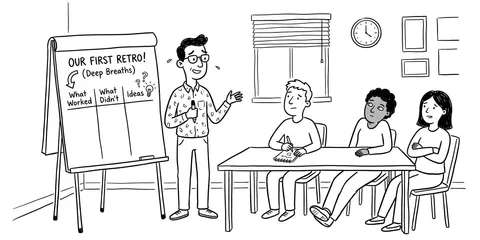
Has your team already run the sailboat retro for the umpteenth time, and the retro format no longer feels as fresh as it did at the beginning? When participation drops, a bigger toolbox of methods often doesn’t help—what helps is a new perspective on collaboration.
Here you’ll find three creative retrospective methods that use simple nature and energy metaphors to spark new conversations: the Battery, Tree, and Gardener retrospectives. Each template includes concrete questions and can be started directly and free of charge in Echometer’s online retro tool.
Which creative retro format suits your team?
Choose a format based on the problem. Not on the prettiest image. That saves time and makes the discussion more concrete.
| Retro format | Fits especially well when … | Duration | Result |
|---|---|---|---|
| Battery retro | Energy, focus, or workload in the team are unclear | 30–45 minutes | A concrete source of energy or relief |
| Tree retro | Habits and collaboration feel stuck | 45–60 minutes | One habit the team changes |
| Gardener retro | A project phase, risks, or framework conditions are the focus | 45–60 minutes | A prioritized experiment for the next phase |
The process for all three formats is the same: First gather feedback, then group similar points, then prioritize. In the end, decide on just one measure (and at most 3 measures). Measures need a responsible person and a date for review.
Source: EXPERT: Retrospective methods with questions and areas of use.
Creative retrospective method 1
The Battery Retrospective 🔋
Is your team currently low on energy, motivation, or focus? The Battery Retrospective creates a safe space to make burdens and sources of energy visible. It is especially suitable after intense sprints, before vacation periods, or when the team seems unusually quiet.
Battery Retrospective 🔋: How the retro works
Random Icebreaker (2-5 minutes)
Echometer provides you with a generator for random check-in questions.
Review of open actions (2-5 minutes)
Before starting with new topics, you should talk about what has become of the measures from past retrospectives to check their effectiveness. Echometer automatically lists all open action items from past retros.
Discuss retro topics
Use the following open questions to collect your most important findings. First, everyone does it themselves, covered. Echometer allows you to reveal each column of the retro board individually in order to then present and group the feedback.
- How full is your personal battery right now in percent?
- What has drained your battery lately?
- What has charged your battery lately?
- What would help you conserve energy over the next few weeks?
Catch-all question (Recommended)
So that other topics also have a place:
- What else would you like to talk about in the retro?
Prioritization / Voting (5 minutes)
On the retro board in Echometer, you can easily prioritize the feedback with voting. The voting is of course anonymous.
Define actions (10-20 minutes)
You can create a linked action via the plus symbol on a feedback. Not sure which measure would be the right one? Then open a whiteboard on the topic via the plus symbol instead to brainstorm root causes and possible measures.
Checkout / Closing (5 minutes)
Echometer enables you to collect anonymous feedback from the team on how helpful the retro was. This creates the ROTI score ("Return On Time Invested"), which you can track over time.
Battery Retrospective 🔋

Moderation tip: Have everyone note things down quietly on their own first. Then discuss patterns without evaluating individual answers. At the end, agree on a concrete action that saves energy or deliberately creates new energy.
Creative retrospective method 2
The Tree Retrospective 🌳
The Tree Retrospective makes team dynamics tangible: the trunk stands for stability, rotten branches for burdensome habits, and buds for opportunities. The format is a good fit when you want to further develop your collaboration without immediately jumping into problem statements.
Tree Retrospective 🌳: How the retro works
Random Icebreaker (2-5 minutes)
Echometer provides you with a generator for random check-in questions.
Review of open actions (2-5 minutes)
Before starting with new topics, you should talk about what has become of the measures from past retrospectives to check their effectiveness. Echometer automatically lists all open action items from past retros.
Discuss retro topics
Use the following open questions to collect your most important findings. First, everyone does it themselves, covered. Echometer allows you to reveal each column of the retro board individually in order to then present and group the feedback.
- 🌳 What is our strong trunk that holds us together as a team?
- 🪵 Which rotten branches – patterns of behavior or routines – should we get rid of?
- 🌱 Which new buds should we let grow?
Catch-all question (Recommended)
So that other topics also have a place:
- What else would you like to talk about in the retro?
Prioritization / Voting (5 minutes)
On the retro board in Echometer, you can easily prioritize the feedback with voting. The voting is of course anonymous.
Define actions (10-20 minutes)
You can create a linked action via the plus symbol on a feedback. Not sure which measure would be the right one? Then open a whiteboard on the topic via the plus symbol instead to brainstorm root causes and possible measures.
Checkout / Closing (5 minutes)
Echometer enables you to collect anonymous feedback from the team on how helpful the retro was. This creates the ROTI score ("Return On Time Invested"), which you can track over time.
Tree Retrospective 🌳

To turn the metaphor into real improvement, you prioritize one bud or one rotten branch at the end. From that, formulate a small, testable experiment for the next sprint.
Creative retrospective method 3
The Gardener Retrospective 👩🏻🌾
The Gardener Retrospective is suitable when you want to look at progress, risks, and external influences together. It helps teams not only look at the last result, but also at the conditions that make good work possible.
Gardener Retrospective 👩🏻🌾: How the retro works
Random Icebreaker (2-5 minutes)
Echometer provides you with a generator for random check-in questions.
Review of open actions (2-5 minutes)
Before starting with new topics, you should talk about what has become of the measures from past retrospectives to check their effectiveness. Echometer automatically lists all open action items from past retros.
Discuss retro topics
Use the following open questions to collect your most important findings. First, everyone does it themselves, covered. Echometer allows you to reveal each column of the retro board individually in order to then present and group the feedback.
- 🌱 What seeds were sown? (new started topics)
- 🌾 What has already been harvested? (achieved milestones or goals)
- 🐞 Which bugs did we have to be careful of? (potential hazards)
- 🌪 How has the weather influenced our harvest? (external factors we cannot control)
Catch-all question (Recommended)
So that other topics also have a place:
- What else would you like to talk about in the retro?
Prioritization / Voting (5 minutes)
On the retro board in Echometer, you can easily prioritize the feedback with voting. The voting is of course anonymous.
Define actions (10-20 minutes)
You can create a linked action via the plus symbol on a feedback. Not sure which measure would be the right one? Then open a whiteboard on the topic via the plus symbol instead to brainstorm root causes and possible measures.
Checkout / Closing (5 minutes)
Echometer enables you to collect anonymous feedback from the team on how helpful the retro was. This creates the ROTI score ("Return On Time Invested"), which you can track over time.
Gardener Retrospective 👩🏻🌾

This format is particularly strong in project or quarterly retrospectives: You acknowledge successes, recognize early warning signs, and discuss which prerequisites you can actively shape in the next phase.
Which creative retrospective method is right for your team?
Choose the Battery Retro when energy, motivation, or strain are the main focus. The Tree Retro is a good fit when you want to reflect on habits and opportunities for development. For a broader view of progress, risks, and framework conditions, the Gardener Retro is the right choice.
Regardless of the format, one thing applies: Plan enough time for selecting and following up on measures. A creative retrospective is valuable when it leads to a concrete change in everyday work. You can find a step-by-step guide to this in our article about effective retrospective actions.
Creative retro formats on click
If you’d like even more varied questions for your retrospectives, take a look at our overview with 54 retrospective methods, ideas, formats, and templates. There you’ll find, among others, the Mario Kart, Marathon, and Team Morale retrospectives.
Regularly choosing new perspectives keeps retrospectives varied and makes it easier for the team to address even difficult topics.
With Echometer, you can start these templates directly in the browser, invite your team, and follow up on actions after the retro. In addition, continuous team health checks provide insight into team development and make progress measurable.
Try Echometer for freeHave you had good experiences with other creative retro formats? Then write to us [email protected].
We look forward to hearing about your experiences and suggestions!
At last, one of the most effective ways to sustainably develop the agile mindset of teams, is, incidentally, a regular agile health check. Our free team health check toolkit helps you ask the right questions.

"Many team members are afraid to speak up!"
Solve this challenge
"We discover too many unexpected issues & bugs at a late stage!"
Solve this challenge
"Why does it sometimes take me hours to prepare a simple retrospective?"
Solve this challenge