
7 Agile Retrospective Questions in a SAFe context
Are you searching for SAFe agile retrospective questions? Great, because I have some for you!
Safe Agile Retrospective Questions (Scaled Agile)
The SAFe iteration retrospective
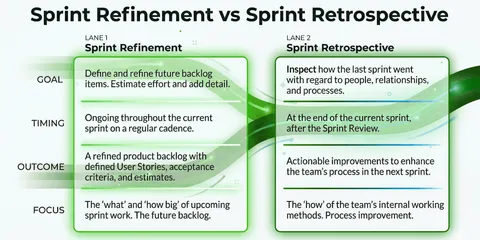
There is one special retrospective in the Scaled Agile Framework SAFethat is called the iteration retrospective. There are some differences to an ordinary Scrum Team Sprint Retrospective, which should not be the focus of this post.
In my view and opinion, overall it is still very similar to a classical retrospective.
An obvious difference here is that you as a team apparently work in a scaled agile context. This means, there are potentially a lot more team’s involved and the agile processes probably are a little more complex compared to individual teams.

This naturally changes the nature of the retrospective. And it leads me to a few SAFe agile retrospective questions that will help you to reflect on your team’s performance.
Some health check items for SAFe teams
The following questions are basically best practices of successful SAFe Scaled Agile Framework teams. They are designed to help you reflect on how well you are doing - and perhaps even measure your subjective progress over time.
Typically, every team member anonymously answers the following questions on a scale from 1 (Disagree completely) and 7 (Agree Completely).
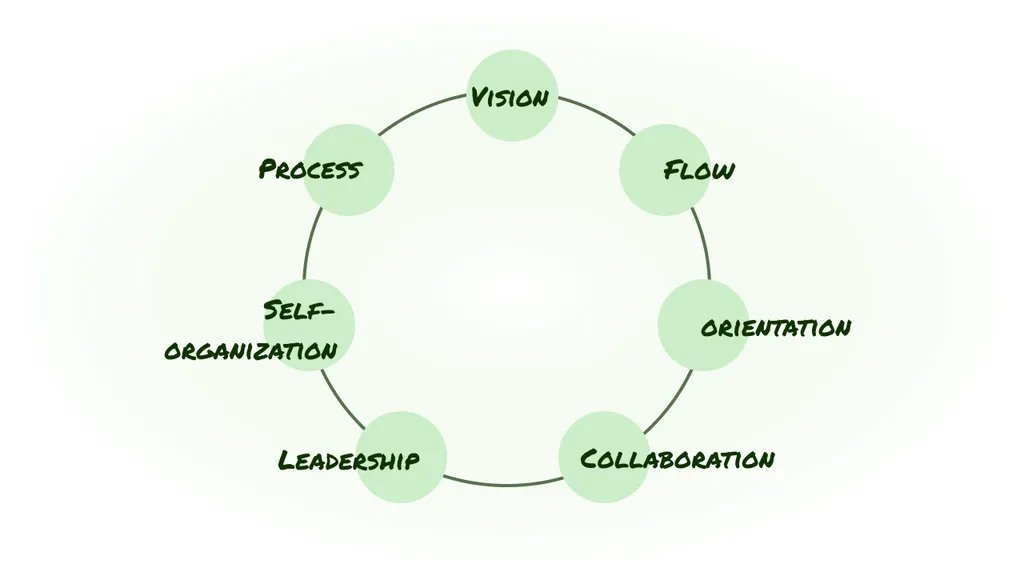
- Vision: “As a team, we know exactly what our value contribution to the product vision is.”
- Flow of information: “As a team, we receive all the necessary information to achieve our goals.”
- Ü-collaboration: “We also work cross-functionally and successfully across team or department boundaries.”
- Customer orientation: “We know the challenges and problems of our customers.”
- Leadership & Management: “Our direct managers trust us as a team to solve problems independently.”
- Self-organisation: “As a team, we have enough freedom to organize our work independently.”
- Process: “Our iteration length is just right.”
The (initially anonymous) results to these SAFe retrospective questions are then reflected upon. After you have shown the results of each question, you can ask the group: “How do you explain the results? Feel free to make your own answer transparent.”
Some health check items for SAFe teams: How the retro works
Random Icebreaker (2-5 minutes)
Echometer provides you with a generator for random check-in questions.
Review of open actions (2-5 minutes)
Before starting with new topics, you should talk about what has become of the measures from past retrospectives to check their effectiveness. Echometer automatically lists all open action items from past retros.
Health Check
All team members can answer the health checks anonymously on a scale. Then go through the results of the health checks together and record any additional comments if necessary. If you use the same health checks in several retrospectives, you can also track trends over time in Echometer.
- Vision: As a team, we know exactly what our contribution to the product vision is.
- Information flow: As a team, we receive all the necessary information to achieve our goals.
- Cross-functional collaboration: We also work together successfully across functions and beyond team or department boundaries.
- Customer orientation: We know our customers' challenges and problems.
- Leadership & management: Our direct managers trust us as a team to solve problems independently.
- Self-organization: As a team, we have enough freedom to organize our work independently.
- Process: Our iteration length is just right.
Discuss retro topics
Use the following open questions to collect your most important findings. First, everyone does it themselves, covered. Echometer allows you to reveal each column of the retro board individually in order to then present and group the feedback.
Catch-all question (Recommended)
So that other topics also have a place:
- What else would you like to talk about in the retro?
Prioritization / Voting (5 minutes)
On the retro board in Echometer, you can easily prioritize the feedback with voting. The voting is of course anonymous.
Define actions (10-20 minutes)
You can create a linked action via the plus symbol on a feedback. Not sure which measure would be the right one? Then open a whiteboard on the topic via the plus symbol instead to brainstorm root causes and possible measures.
Checkout / Closing (5 minutes)
Echometer enables you to collect anonymous feedback from the team on how helpful the retro was. This creates the ROTI score ("Return On Time Invested"), which you can track over time.
Some health check items for SAFe teams
Health Check Questions (Scale)
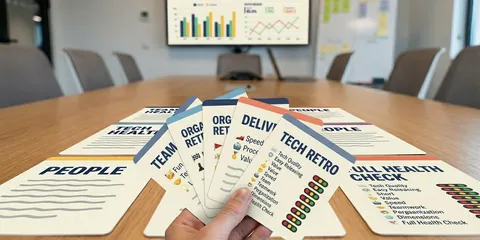
By the way - a standard format for agile retrospectives that works in scaled agile contexts is the Spotify Health Check Retrospective (more info under the link). Here you have an insight into some of the possible questions - and can use the Retro without login in Echometer without registering:
Spotify Health Check Retrospective: How the retro works
Random Icebreaker (2-5 minutes)
Echometer provides you with a generator for random check-in questions.
Review of open actions (2-5 minutes)
Before starting with new topics, you should talk about what has become of the measures from past retrospectives to check their effectiveness. Echometer automatically lists all open action items from past retros.
Health Check
All team members can answer the health checks anonymously on a scale. Then go through the results of the health checks together and record any additional comments if necessary. If you use the same health checks in several retrospectives, you can also track trends over time in Echometer.
- Speed: We get stuff done really quickly. No waiting, no delays.
- Processes: Our way of working suits us perfectly.
- Value: We deliver great stuff! We’re proud of it and our stakeholders are really happy.
Discuss retro topics
Use the following open questions to collect your most important findings. First, everyone does it themselves, covered. Echometer allows you to reveal each column of the retro board individually in order to then present and group the feedback.
Catch-all question (Recommended)
So that other topics also have a place:
- What else would you like to talk about in the retro?
Prioritization / Voting (5 minutes)
On the retro board in Echometer, you can easily prioritize the feedback with voting. The voting is of course anonymous.
Define actions (10-20 minutes)
You can create a linked action via the plus symbol on a feedback. Not sure which measure would be the right one? Then open a whiteboard on the topic via the plus symbol instead to brainstorm root causes and possible measures.
Checkout / Closing (5 minutes)
Echometer enables you to collect anonymous feedback from the team on how helpful the retro was. This creates the ROTI score ("Return On Time Invested"), which you can track over time.
Spotify Health Check Retrospective
Health Check Questions (Scale)

Advantage of this approach
The great thing about including some of these health check items or sentences in your retrospective and measuring them: You can ask the same questions again a few months later and see how you have developed - in numbers!
Of course, these numbers are just based on subjective perceptions. But still, they are able to create a regular feeling of accomplishment which is great to foster the agile mindset in teams.

"Many team members are afraid to speak up!"
Solve this challenge
"We discover too many unexpected issues & bugs at a late stage!"
Solve this challenge
"Why does it sometimes take me hours to prepare a simple retrospective?"
Solve this challengeConclusion - Questions for SAFe Retrospectives
The given SAFE Agile Retrospective Questions are obviously some of many foci you might set in our iteration retrospective. I recommend to research for more approaches and regularly iterate on it.
If you are searching for some more retrospective ideas, feel free to have a look at our 32 kickass retrospective formats there - there are also more examples of questions and health check retrospectives (see above).