
What Are Retrospectives and What Are They Good For? (Simply Explained)
Retrospectives have been widely used for years, especially in agile software development teams. But what exactly are retrospectives and what are they good for? In this article, we explain retrospectives and their purpose in simple terms, even for non-software developers.
What are retrospectives? In simple terms
Quite simply: Retrospectives are regular team meetings in which teams reflect on their collaboration and derive measures to improve it.
Among Scrum teams and teams with agile working methods, the retrospective format is extremely widespread and well established:
Agile teams take an average of around 60 minutes for a retrospective and do this at least every two weeks or weekly.
– See: Analysis of 30,000 retrospectives
What are retrospectives good for?
The purpose of retrospectives is for teams to learn how to develop their collaboration independently. The manager alone should not take responsibility for ensuring that the team runs smoothly. Retrospectives help teams to resolve conflicts more independently and implement ideas for improvement from within the team.
Teams that have established retrospectives as a routine will benefit from the following effective factors:
- Higher self-efficacy – i.e. the feeling of being able to make a difference as a team
- Greater team cohesion – greater cohesion and trust within the team
- Continuous improvement of processes
- Better conflict resolution
- Faster learning and adaptation
- Long-term increase in team performance due to the previous effects
For modern managers, retrospectives are therefore a key tool for enabling their teams to organize themselves and perform at their best.
If you adopt only one agile practice, let it be retrospectives. Everything else will follow.
– Woody Zuill
How do you carry out retrospectives easily?
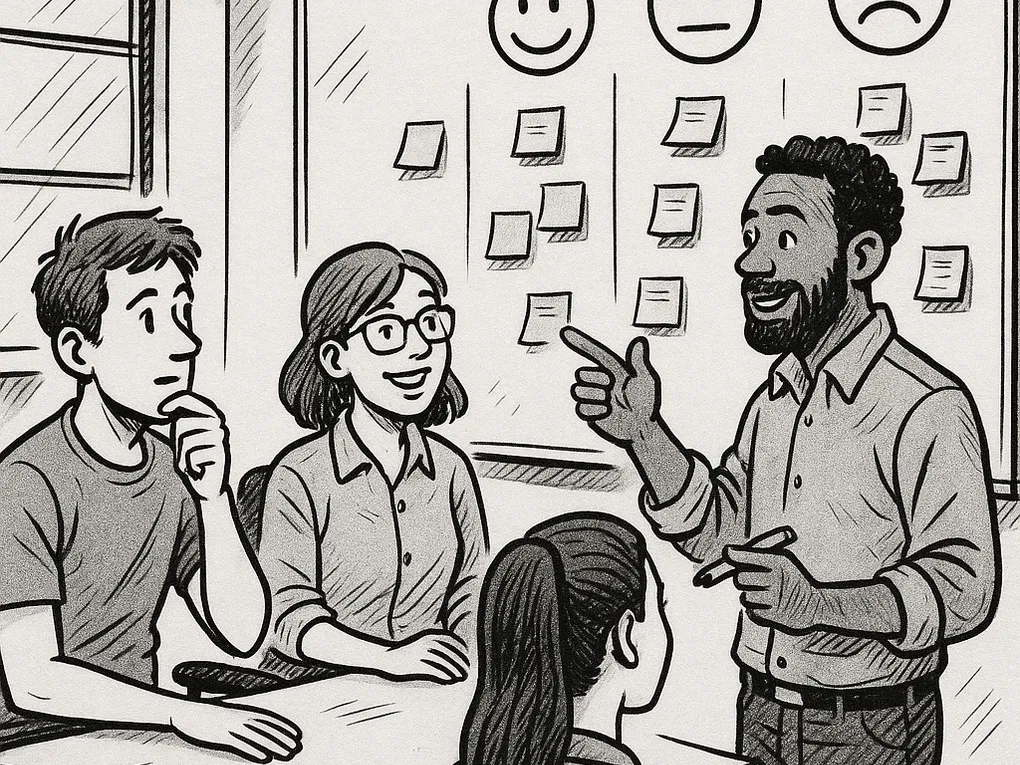
There are various formats for retrospectives. A very simple and effective format is the keep-stop-start retrospective:
- Keep: What should we continue to do as a team?
- Stop: What should we stop doing as a team?
- Start: What should we start doing as a team, or at least try out?
With these 3 questions, the team can easily and effectively reflect on the collaboration of the last few weeks.
Especially for your first retrospective, I can warmly recommend the Keep-Stop-Start-Retro due to its simplicity.
Here you can open the Keep-Stop-Start-Retrospective directly in Echometer:
Open Keep-Stop-Start RetroIf teams are already well practiced in retrospectives, you can also regularly adapt the format of the retrospective to introduce more variety. We have prepared over 50 retrospective methods for you in Echometer.
How does a retrospective work?
According to the classic model, a retrospective consists of 5 phases:
- Arrive: The icebreaker so that all participants are activated
- Collect data: In particular, feedback from the team
- Gain insights: Grouping feedback and data to identify patterns and their root causes
- Decisions & measures: Agree on concrete follow-ups
- Conclusion: Short final round with feedback and summary of next steps
If you want to delve deeper into the optimal process of a retrospective, I recommend taking a look at the “Double Diamond” model from Design Thinking, which can also be applied excellently to retrospectives:
“Double Diamond” phases of the retrospectiveConclusion: Retrospectives as the easy way to top performance
In practice, it has long been proven that retrospectives are an enormously important method for establishing modern team leadership.
Of course, it takes some initial commitment from the team to establish the method – but the effort is worth it. After all, hardly any other method has so much potential to improve teams in the long term and sustainably.
If you have little or no experience with retrospectives, Echometer is the perfect software to easily establish best practices around agile retrospectives in your team.
So the best thing to do is to try out the Keep-Stop-Start retrospective in Echometer:
Keep stop start retro: How the retro works
-
Random Icebreaker (2-5 minutes)
Echometer provides you with a generator for random check-in questions.
-
Review of open actions (2-5 minutes)
Before starting with new topics, you should talk about what has become of the measures from past retrospectives to check their effectiveness. Echometer automatically lists all open action items from past retros.
-
Discuss retro topics
Use the following open questions to collect your most important findings. First, everyone does it themselves, covered. Echometer allows you to reveal each column of the retro board individually in order to then present and group the feedback.
- Keep: What should we continue to do as a team?
- Stop: What should we stop doing as a team?
- Start: What should we start doing as a team, or at least try out?
-
Catch-all question (Recommended)
So that other topics also have a place:
- What else would you like to talk about in the retro?
-
Prioritization / Voting (5 minutes)
On the retro board in Echometer, you can easily prioritize the feedback with voting. The voting is of course anonymous.
-
Define actions (10-20 minutes)
You can create a linked action via the plus symbol on a feedback. Not sure which measure would be the right one? Then open a whiteboard on the topic via the plus symbol instead to brainstorm root causes and possible measures.
-
Checkout / Closing (5 minutes)
Echometer enables you to collect anonymous feedback from the team on how helpful the retro was. This creates the ROTI score ("Return On Time Invested"), which you can track over time.
Keep stop start retro