
My 7 All-Time Favorite Agile Retrospective Templates
In my team, we conduct an agile retrospective more often than average: every Friday, i.e. once a week. And you won’t believe it - thanks to the many super agile retrospective templates, among other things, it’s time well invested every week.
And for the die-hards among you, I can also confirm that I’m sure we can see an effect on our team’s key success metrics (see also: 25 Agile Metrics - Just one KPI is enough).
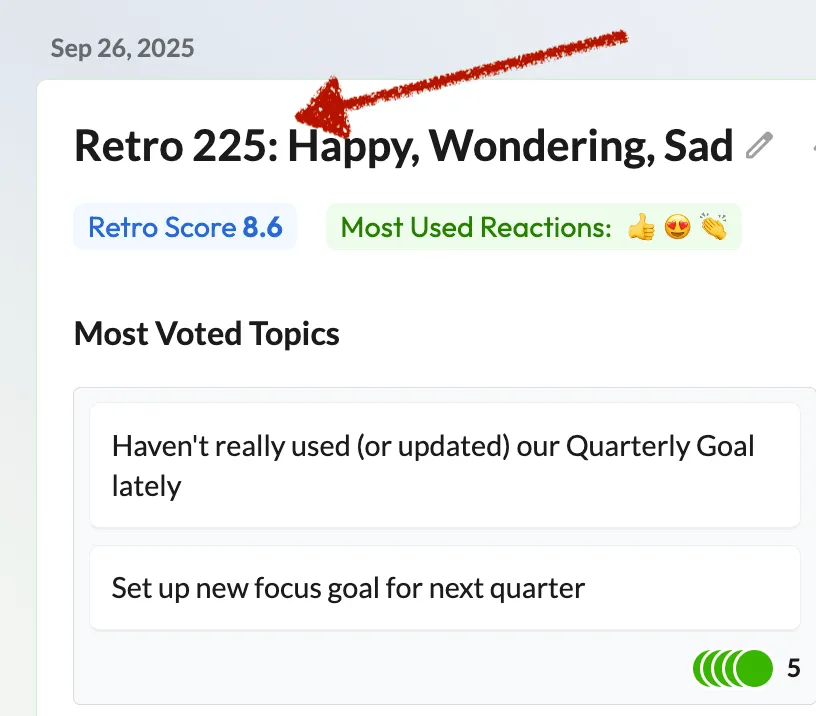
We have already conducted several hundred retrospectives in our agile team, as you can see in the screenshot on the right. I was therefore able to form an opinion as to which sprint retrospective templates work well and which templates work rather poorly.
That’s why I’d like to present my 7 favorite retrospective templates for agile retrospectives in this post. Please don’t forget one thing: In the end, you should leave retrospectives with good measures (read more: 10 tips for good measures in retrospectives).
My 7 Favorite Retrospective Templates for Agile Teams
The 7 retrospective ideas are consistently not classics. For example, I deliberately left out the “Mad Sad Glad”, “What went well” or “Start Stop Continue” retrospective, simply because I don’t like them as much.
Instead, I’d like to recommend 7 agile retrospective templates that your team probably hasn’t done yet, but which are sure to make for a good retrospective. Here is an overview with my rating for each.
| Agile Retrospective template | Rating | Context |
| Drive & Brake Retrospective | ✅ Good | Better than the “What went well” retro, because “what slowed you down” is easier to answer than “what went badly?” - the template is underrated! |
| Battery Retrospective | ✅🚀 Very good | A great metaphor that every software developer will understand in an IT context. It’s fun to answer the 4 questions. |
| CEO Retrospective | ✅ Good | The questions can open up a new interesting perspective that other retrospectives can’t - highly recommended! |
| Sherlock Retrospective Template | ✅ Good | Everyone knows Sherlock, so everyone enjoys answering these questions - more than with most other retros. |
| Futurespective template | ✅🚀 Very good | Especially in teams that sometimes find it difficult to “look back”, it can be very wise to use this template to focus on the future for a sprint retro. |
| DORA KPI Retrospective | ✅🚀 Very good | It gets a little more technical here, but you also have a very high probability of deriving good measures: You reflect on your subjective perception of the DORA key figures. |
| Spotify Health Check Retro | ✅🚀 Very good | Spotify’s probably best-known team health check has been carried out in too few teams - a clear recommendation to go through all 11 questions once. |
Just to emphasize this again: Whether these agile retrospective templates work for you obviously depends heavily on your team. However, in my experience, all 7 retrospective techniques are likely to work very well in teams that are open to something like this. Before we move on, let’s briefly establish a common understanding of the core purpose of retrospectives.
What is the purpose of an agile retrospective?
Good question - why do we actually do retrospectives? I have discussed this question in detail in my blog article on the subject: 5 Sprint retrospective Output vs. outcomes.
To cut a long story short, I would say that the retrospective has two core objectives:
- a) Derive measures to continuously improve your team and your processes
- b) Creating more team spirit and psychological safety, especially in remote teams
Many software development teams work together remotely or virtually these days, which is why the second aspect is also very important to me. Okay, let’s get started with the templates for agile retrospectives.
Agile Retrospective templates, questions & techniques #1
Drive & Drag Retrospective 👍
Normally you just ask “What went well, what went badly” in a retrospective. Experience shows, however, that you get more answers if you ask these two questions - try out the retro template!
Drive & Brake Retrospective: How the retro works
Random Icebreaker (2-5 minutes)
Echometer provides you with a generator for random check-in questions.
Review of open actions (2-5 minutes)
Before starting with new topics, you should talk about what has become of the measures from past retrospectives to check their effectiveness. Echometer automatically lists all open action items from past retros.
Discuss retro topics
Use the following open questions to collect your most important findings. First, everyone does it themselves, covered. Echometer allows you to reveal each column of the retro board individually in order to then present and group the feedback.
- What has been driving you recently?
- What has slowed you down recently?
Catch-all question (Recommended)
So that other topics also have a place:
- What else would you like to talk about in the retro?
Prioritization / Voting (5 minutes)
On the retro board in Echometer, you can easily prioritize the feedback with voting. The voting is of course anonymous.
Define actions (10-20 minutes)
You can create a linked action via the plus symbol on a feedback. Not sure which measure would be the right one? Then open a whiteboard on the topic via the plus symbol instead to brainstorm root causes and possible measures.
Checkout / Closing (5 minutes)
Echometer enables you to collect anonymous feedback from the team on how helpful the retro was. This creates the ROTI score ("Return On Time Invested"), which you can track over time.
Drive & Brake Retrospective

Agile Retrospective templates, questions & techniques #2
Battery Retrospective template 🔋
Does everyone charge their cell phone battery every day, but also their personal battery? In my experience, the metaphor of this retro template here resonates with every team and leads to new answers that provide a great basis for deriving effective measures in an agile retrospective.
Battery retrospective: How the retro works
Random Icebreaker (2-5 minutes)
Echometer provides you with a generator for random check-in questions.
Review of open actions (2-5 minutes)
Before starting with new topics, you should talk about what has become of the measures from past retrospectives to check their effectiveness. Echometer automatically lists all open action items from past retros.
Discuss retro topics
Use the following open questions to collect your most important findings. First, everyone does it themselves, covered. Echometer allows you to reveal each column of the retro board individually in order to then present and group the feedback.
- How full is your personal battery as a percentage right now?
- What has drained your battery recently?
- What has recharged your battery recently?
- What would help you to save energy over the next few weeks?
Catch-all question (Recommended)
So that other topics also have a place:
- What else would you like to talk about in the retro?
Prioritization / Voting (5 minutes)
On the retro board in Echometer, you can easily prioritize the feedback with voting. The voting is of course anonymous.
Define actions (10-20 minutes)
You can create a linked action via the plus symbol on a feedback. Not sure which measure would be the right one? Then open a whiteboard on the topic via the plus symbol instead to brainstorm root causes and possible measures.
Checkout / Closing (5 minutes)
Echometer enables you to collect anonymous feedback from the team on how helpful the retro was. This creates the ROTI score ("Return On Time Invested"), which you can track over time.
Battery retrospective

Agile Retrospective templates, questions & techniques #3
CEO Retrospective Template 👩💼
The first question in particular gives your team members the space to address things that they might not otherwise put on the agenda. I can therefore highly recommend the acronym or this agile retrospective template.
CEO Retrospective: How the retro works
Random Icebreaker (2-5 minutes)
Echometer provides you with a generator for random check-in questions.
Review of open actions (2-5 minutes)
Before starting with new topics, you should talk about what has become of the measures from past retrospectives to check their effectiveness. Echometer automatically lists all open action items from past retros.
Discuss retro topics
Use the following open questions to collect your most important findings. First, everyone does it themselves, covered. Echometer allows you to reveal each column of the retro board individually in order to then present and group the feedback.
- Chief: Imagine you were allowed to decide something on your own that would move the team forward - what would that be?
- Executive: Where do we need to deliver more or better?
- Officer: When did we fully live up to our role and can be satisfied?
Catch-all question (Recommended)
So that other topics also have a place:
- What else would you like to talk about in the retro?
Prioritization / Voting (5 minutes)
On the retro board in Echometer, you can easily prioritize the feedback with voting. The voting is of course anonymous.
Define actions (10-20 minutes)
You can create a linked action via the plus symbol on a feedback. Not sure which measure would be the right one? Then open a whiteboard on the topic via the plus symbol instead to brainstorm root causes and possible measures.
Checkout / Closing (5 minutes)
Echometer enables you to collect anonymous feedback from the team on how helpful the retro was. This creates the ROTI score ("Return On Time Invested"), which you can track over time.
CEO Retrospective

Agile Retrospective templates, questions & techniques #4
Sherlock Retrospective Template 🔍
Sherlock Holmes is a very popular story, which is why the protagonists are well suited to take a slightly different look at your last agile project sprint. You can of course find this agile retrospective template - like all the others - in our retrospective software tool Echometer.
Sherlock Holmes Retrospective: How the retro works
Random Icebreaker (2-5 minutes)
Echometer provides you with a generator for random check-in questions.
Review of open actions (2-5 minutes)
Before starting with new topics, you should talk about what has become of the measures from past retrospectives to check their effectiveness. Echometer automatically lists all open action items from past retros.
Discuss retro topics
Use the following open questions to collect your most important findings. First, everyone does it themselves, covered. Echometer allows you to reveal each column of the retro board individually in order to then present and group the feedback.
- What obstacles has Professor Moriarty put in our way this time?
- What support did we get from our time-honored friends Dr. Watson and Inspector Lestrade, so how did we face these stones as a team?
- Which clue should we follow up?
- As Sherlock Holmes, we foresee more devious plans from Professor Moriarty. What difficulties could these be in the coming weeks?
Catch-all question (Recommended)
So that other topics also have a place:
- What else would you like to talk about in the retro?
Prioritization / Voting (5 minutes)
On the retro board in Echometer, you can easily prioritize the feedback with voting. The voting is of course anonymous.
Define actions (10-20 minutes)
You can create a linked action via the plus symbol on a feedback. Not sure which measure would be the right one? Then open a whiteboard on the topic via the plus symbol instead to brainstorm root causes and possible measures.
Checkout / Closing (5 minutes)
Echometer enables you to collect anonymous feedback from the team on how helpful the retro was. This creates the ROTI score ("Return On Time Invested"), which you can track over time.
Sherlock Holmes Retrospective

Agile Retrospective templates, questions & techniques #5
Futurespective Retrospective Template 🔍
Especially in teams that sometimes find it difficult to “look back”, it can be very wise to use this template to focus on the future for a sprint retro. This is a common method in coaching and psychology, so why not in the retrospective?
🔮 Futurespective: How the retro works
Random Icebreaker (2-5 minutes)
Echometer provides you with a generator for random check-in questions.
Review of open actions (2-5 minutes)
Before starting with new topics, you should talk about what has become of the measures from past retrospectives to check their effectiveness. Echometer automatically lists all open action items from past retros.
Discuss retro topics
Use the following open questions to collect your most important findings. First, everyone does it themselves, covered. Echometer allows you to reveal each column of the retro board individually in order to then present and group the feedback.
- What is the most important milestone you would like to see us achieve as a team in the next week(s)?
- Which hurdle should we focus on overcoming in the coming weeks?
- What would you be particularly grateful for in the coming week(s)?
Catch-all question (Recommended)
So that other topics also have a place:
- What else would you like to talk about in the retro?
Prioritization / Voting (5 minutes)
On the retro board in Echometer, you can easily prioritize the feedback with voting. The voting is of course anonymous.
Define actions (10-20 minutes)
You can create a linked action via the plus symbol on a feedback. Not sure which measure would be the right one? Then open a whiteboard on the topic via the plus symbol instead to brainstorm root causes and possible measures.
Checkout / Closing (5 minutes)
Echometer enables you to collect anonymous feedback from the team on how helpful the retro was. This creates the ROTI score ("Return On Time Invested"), which you can track over time.
🔮 Futurespective

Agile Retrospective templates, questions & techniques #6
DORA DevOps Retrospective Template
Hopefully you know the four DORA DevOps key metrics - if not: Here is an overview of the 4 DORA KPIs. In short, the four KPIs can be used to measure how good your software team really is - there are even benchmarks for it. This agile retrospective technique, in turn, uses the 4 metrics as a basis for reflecting on your last sprint.
DORA Metrics Retrospective: How the retro works
Random Icebreaker (2-5 minutes)
Echometer provides you with a generator for random check-in questions.
Review of open actions (2-5 minutes)
Before starting with new topics, you should talk about what has become of the measures from past retrospectives to check their effectiveness. Echometer automatically lists all open action items from past retros.
Health Check
All team members can answer the health checks anonymously on a scale. Then go through the results of the health checks together and record any additional comments if necessary. If you use the same health checks in several retrospectives, you can also track trends over time in Echometer.
- Deployment Frequency: I am very happy with how often we deploy code to Prod.
- Lead Time for Changes: After the first code has been committed, we can implement it very quickly on Prod.
- Change Failure Rate: Our code implementations very rarely lead to errors on Prod.
- Time to Restore Service: If an error occurs on Prod, we can fix it very quickly.
Discuss retro topics
Use the following open questions to collect your most important findings. First, everyone does it themselves, covered. Echometer allows you to reveal each column of the retro board individually in order to then present and group the feedback.
- What would improve our deployment frequency?
- What is our bottleneck to implement tasks faster on Prod?
- What would make our deployments less error-prone?
- What helps us to quickly rectify errors on Prod?
Catch-all question (Recommended)
So that other topics also have a place:
- What else would you like to talk about in the retro?
Prioritization / Voting (5 minutes)
On the retro board in Echometer, you can easily prioritize the feedback with voting. The voting is of course anonymous.
Define actions (10-20 minutes)
You can create a linked action via the plus symbol on a feedback. Not sure which measure would be the right one? Then open a whiteboard on the topic via the plus symbol instead to brainstorm root causes and possible measures.
Checkout / Closing (5 minutes)
Echometer enables you to collect anonymous feedback from the team on how helpful the retro was. This creates the ROTI score ("Return On Time Invested"), which you can track over time.
DORA Metrics Retrospective
Health Check Questions (Scale)
Open questions

Agile Retrospective templates, questions & techniques #7
Health Check Retro: Spotify Squad Health Check 👩🏻💻
Whether you work in a scaled agile framework or are just a single software development team, the Spotify Health Check with a total of 11 questions will help you reflect on your team performance holistically (read more: Spotify Health Check). There is also a video of the template below.
Spotify Health Check 👩🏻💻: How the retro works
Random Icebreaker (2-5 minutes)
Echometer provides you with a generator for random check-in questions.
Review of open actions (2-5 minutes)
Before starting with new topics, you should talk about what has become of the measures from past retrospectives to check their effectiveness. Echometer automatically lists all open action items from past retros.
Health Check
All team members can answer the health checks anonymously on a scale. Then go through the results of the health checks together and record any additional comments if necessary. If you use the same health checks in several retrospectives, you can also track trends over time in Echometer.
- Speed: We get stuff done really quickly. No waiting, no delays.
- Tech Quality: We’re proud of the quality of our code! It is clean, easy to read, and has great test coverage.
- Learning: We’re learning lots of interesting stuff all the time!
- Mission: We know exactly why we are here and can be enthusiastic about it.
Discuss retro topics
Use the following open questions to collect your most important findings. First, everyone does it themselves, covered. Echometer allows you to reveal each column of the retro board individually in order to then present and group the feedback.
Catch-all question (Recommended)
So that other topics also have a place:
- What else would you like to talk about in the retro?
Prioritization / Voting (5 minutes)
On the retro board in Echometer, you can easily prioritize the feedback with voting. The voting is of course anonymous.
Define actions (10-20 minutes)
You can create a linked action via the plus symbol on a feedback. Not sure which measure would be the right one? Then open a whiteboard on the topic via the plus symbol instead to brainstorm root causes and possible measures.
Checkout / Closing (5 minutes)
Echometer enables you to collect anonymous feedback from the team on how helpful the retro was. This creates the ROTI score ("Return On Time Invested"), which you can track over time.
Spotify Health Check 👩🏻💻
Health Check Questions (Scale)

More information about the Spotify Team Health Check Retro
If you want to improve your agile team holistically, the Spotify Team Health Check is a great way to do this in a systematic way.
Because we like the format so much, I’ve even recorded a video in which I present the retrospective template in more detail - feel free to check it out.
Conclusion - The best templates for agile retrospectives
If you don’t like any of these seven agile retrospective templates, I would be quite surprised. Feel free to write to me and I’ll try to give you a tip that’s tailored to your team.
Alternatively, you can also take a look at our blog article with even more retrospective templates: 54 Retrospective templates for ambitious agile teams.
FAQ - Templates for agile retrospectives
Which retrospective templates work well in “difficult” agile teams?
That’s a good question - in that case, I would start with the “Drive & Drag” retrospective template. At the same time, however, you should have one-on-one conversations and get a feel for the psychological safety in the team in order to find out the causes of your team’s “difficult” behavior.
When conducting the very first retrospective with the team, which template is particularly suitable?
If you are conducting your first retrospective in a team, I would rather choose a classic such as the Starfish Retrospective or the 4L “Loved Learned Longed” Retrospective. They should help to introduce the team to the basic principles of retrospectives without deterring them with creative metaphors.
How do I ensure that quiet or introverted team members also say something in retrospectives?
Good question, a simple answer: As a moderator, you are certainly allowed to actively address team members and ask for their opinion - I would even recommend it.
If you don’t want to single out just one person, then turn the tables: just ask EVERY team member explicitly for a comment. Yes, you can do that. After all, your team members are paid for their expertise.
Finally, a reference to my other article on today’s topic: 5 sprint retrospective ideas that are guaranteed to please your team.

"Many team members are afraid to speak up!"
Solve this challenge
"We discover too many unexpected issues & bugs at a late stage!"
Solve this challenge
"Why does it sometimes take me hours to prepare a simple retrospective?"
Solve this challenge