
4 tips for retrospectives in hybrid teams
Many teams worked completely remotely or in the home office during the Corona pandemic. Some companies are slowly going “back to office” or into a hybrid working model: some are on site, others in the home office. Since the timing and “how” is often unclear, the retro formats in hybrid teams are also difficult to plan. So how can Agile Coaches and Scrum Masters best design retrospectives in hybrid, on-site or remote setups?
Here we summarize the main differences and tips for the retro methods and formats.
🔮 The numbers & outlook for hybrid work in agile teams
But first, a quick look at the question: Is distributed work in agile teams a model for the future at all? Especially in the area of “knowledge work,” they work According to Gartner, half of the world’s 1 billion workers are already remote. This naturally raises the question of how this “remote setup” will develop after Corona, whether teams will work completely “on-site” again, or rather in a hybrid model. According to the surveys among agile teams, “State of Agile” study show clear results:
- Only 3 % say they plan to return to the office full-time
- 25 % respondents say they will continue to work fully remotely even in a post-COVID world
- 56 % prefer a hybrid approach, returning to the office regularly but not daily
Since we have a strong employee market, especially in the area of knowledge work, companies could be forced to respond to these employee requests in order to remain competitive in the labor market and not lose talent. It is therefore worthwhile to deal with distributed and hybrid work models. So here are our tips for hybrid retrospectives:

Simply effective retros - whether from a laptop or smartphone
Share live reactions 👋, participate in votes 🎚, write feedback 💬, vote on topics 👍 , & more

☝️ Tip 1: Clarify the setup of the retro in advance
What many are not aware of, but has proven itself again and again in traditional hybrid remote organizations like Gitlab: The best setup for “hybrid working” is to set up all communication “remote first”.
So if you have a team with members who work remote, it pays off to do all of the communication and documentation “remote first” right away. This may seem costly in the short term, but it pays off in the long run.
So if your team decides to go hybrid, make sure you do it right. For an agile team, this means that the retrospectives must also meet this “remote first” claim.
But what if some colleagues are on site at the retros and others are remote?
☝️ Tip 2: Equal interaction for remote and on-site participants
The aim of a retrospective is always to give all participants the same, lowest possible hurdles to participate in the conversation. Experience has shown that there are two different methods for hybrid retrospectives to achieve this:
Retro Method 1: All participants dial in separately
In this retro method, all team members simply participate separately in the online meeting - even the team members who are in the office on site and who could theoretically meet together in a room. This ensures the same setup for all participants. Why shouldn’t you put all the colleagues in the office in a conference room? Because that creates a two-class dynamic in which the remote colleagues are excluded from many interactions in the room. Anyone who has tried this setup “partly in the room, partly via video conference” knows what we are talking about.
Retro method 2: Use digital channel also for on-site colleagues
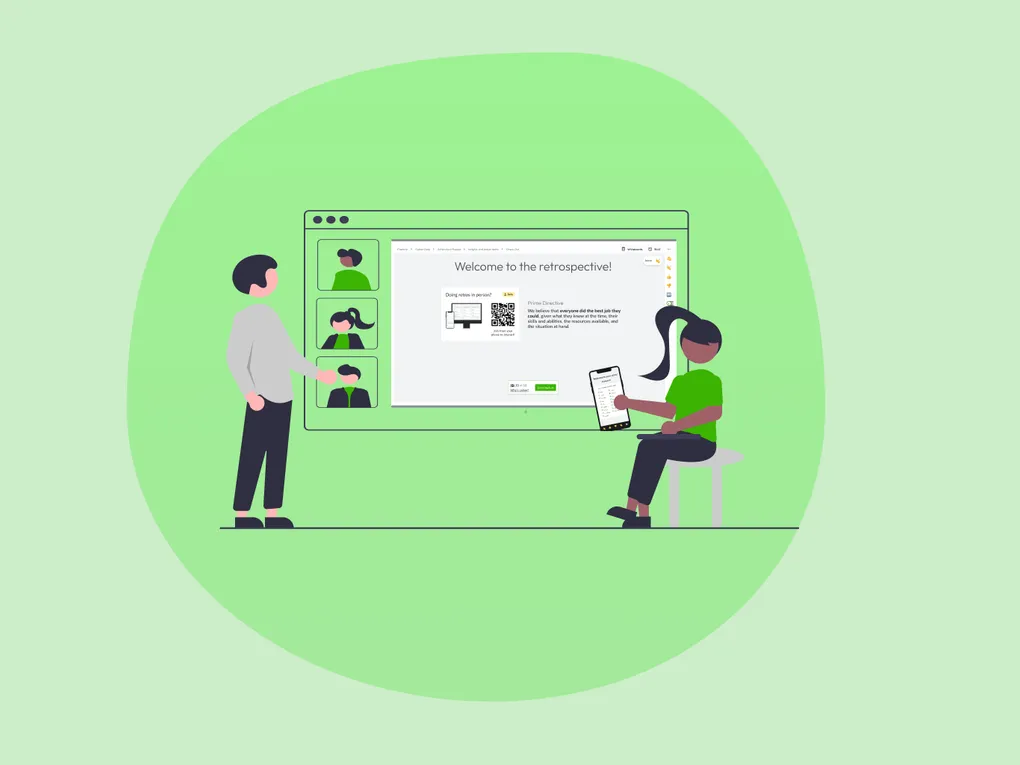
Even if method 1 is the preferred variant according to the “remote first” logic, we at least don’t want to deprive you of method 2: If you have part of the team together in one room, it is at least important to make the interaction as equal as possible for everyone. A physical whiteboard is therefore unsuitable for this. The better alternatives are online whiteboards (like Miro), live engagement tools (like Mentimeter), or simply Echometer - which combines whiteboard and live engagement functionalities. In principle, care should of course also be taken to ensure that the retro format (“Keep, Stop, Start”, etc.) is conceivable for a distributed team. Here you can find more corresponding, creative retrospective methods such as Skribbl or the Johari window.
☝️ Tip 3 for retrospectives in hybrid teams: involve the team in the design
This tip is obvious, but is often neglected: simply ask the team openly how they imagine the hybrid retrospectives to be. As a Scrum Master or Agile Coach, you are not solely responsible for the retro method, but the team as a whole.
What works great in this context in both remote, hybrid and on-site retrospectives: In the check-out of the retrospective, ask the “Return on Time Invest” (ROTI for short) on a scale from 0 (very poorly invested time) to 10 ( time well spent) and ask why the rating was given. In this way you create a framework right at the end of the retro to take in the fresh impressions of the team.

"Many team members are afraid to speak up!"
Solve this challenge
"We discover too many unexpected issues & bugs at a late stage!"
Solve this challenge
"Why does it sometimes take me hours to prepare a simple retrospective?"
Solve this challenge☝️ Tip 4: One platform for all retro setups (remote, hybrid and on-site)
In the spirit of “remote first”, there should be a digital retro archive that all colleagues can access.
This should document on-site retros, hybrid retros, and complete remote retros alike.
This documentation will be very helpful to visualize the development of the team over time. Frequently after viewing older retros we have heard things like “Wow, that was really our biggest challenge a year ago?”
Corresponding moments of success have a great effect on making the added value of agile methods tangible and thus increasing the commitment to retros.
With Echometer there is a platform that supports all hybrid retro formats from preparation, implementation to post-processing.
With Echometer you can:
- Get feedback via a survey in advance and asynchronously to the retrospective 💬
- Get live feedback and start votes during the retro - NEW: this is now even possible for participants via their smartphone 📲
- You automatically get a ROTI for every retrospective and see how the quality of the different formats is perceived 📊
- And last but not least, you have a uniform documentation of all your retrospectives included at the push of a button 😮💨
The uniform platform makes team development more transparent for everyone involved and the team only has one holistic solution for continuous team development instead of different tools. 🚀
By the way, you can run a retro with our tool without a login from you or your team and just try it out. You can use this button to run a retro on the 5 agile Scrum values, for example:

Note: This retrospective format asks for agreement with the given Health Check items on a scale.

- Courage: We value people showing courage.
- Respect: We value each other’s ideas, even when disagreeing.
- Commitment: Every team member is committed to follow through on what they have promised.
- Focus: We don’t allow ourselves to be distracted from reaching the sprint goal.
- Openness: We are open to constructive feedback and grow from it.
If you are searching for fun retrospective ideas, check out our post on 54 Kickass Retrospective Ideas for Agile Teams (including the Mario Kart Retro & the Team Morale Health Check).
By the way, one of the best methods of sustainably developing the agile mindset of team members is to implement an agile health check. Our free team health check kit can help you ask the right questions - just click through.