12 Best Ideas for Sprint Retrospectives After 200 Retros
I have now moderated and participated in more than 200 agile retrospectives. And if I’m honest: not every retro was good.
Some meetings were sluggish. Some were loud but without results. And some were nice, but nothing had changed by the next sprint.
That’s exactly why I’m sharing my best ideas for Sprint Retrospectives here: formats that are fun and lead to real improvements at the same time.
What are good ideas for Sprint Retrospectives?
Good ideas for Sprint Retrospectives are formats that fit your team’s problem and ultimately lead to clear measures. In my practice, Start-Stop-Continue, 4Ls, Mad-Sad-Glad, Sailboat, and Starfish work particularly well.
How do I make a retrospective exciting?
I make retros exciting by changing the format regularly, starting with a short check-in, and only deepening the top topics. This keeps the energy high and we don’t get lost in side discussions.
What do I write under “What went well” in the Sprint Retrospective?
I write down concrete things that we want to repeat, for example, clear agreements, fast reviews, good team help, or stable handovers. Important: always with an example from the sprint, not just general statements.
Why many retros fail
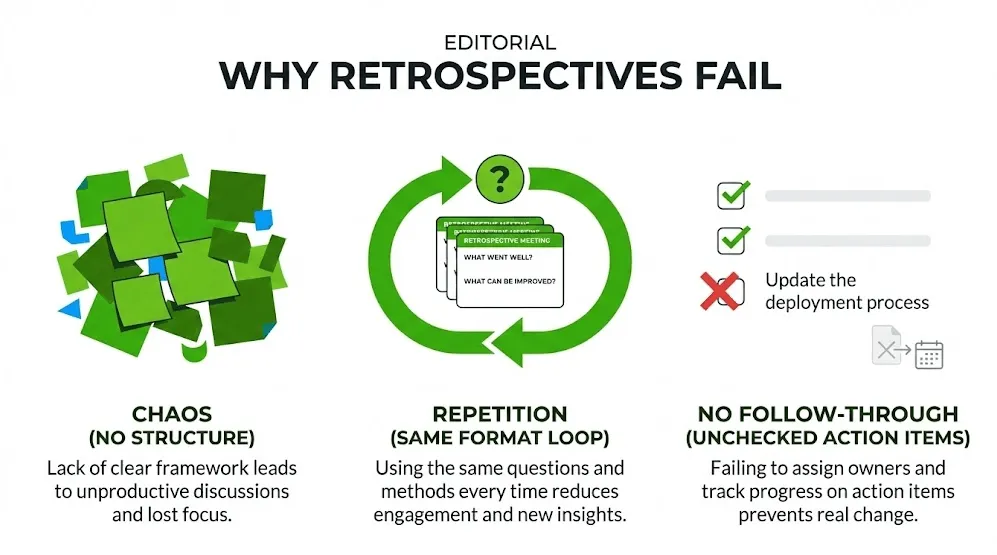
In my experience, retros usually fail because of three things:
- too little structure
- always the same format
- no clear measures with responsible persons
My goal is therefore no longer more entertainment, but more impact with better energy in the team.
How to read the following retro templates
To help you find the right format quickly, I describe each idea briefly according to the same pattern:
When to use? | Duration | Team size | Risk | First measure afterwards
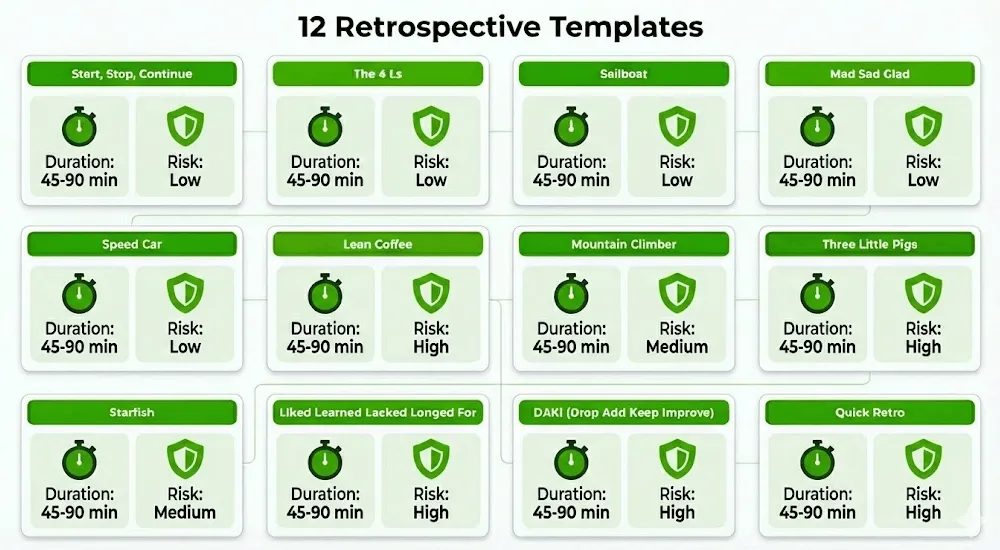
Overview of 12 template ideas
- Start-Stop-Continue: clear focus in a short time.
- 4Ls: make learning and improvement visible at the same time.
- Mad-Sad-Glad: translate emotions productively into measures.
- Sailboat: organize blockers and drivers in complex sprints.
- Starfish: differentiated improvement instead of black and white.
- Hot Air Balloon: discuss lift and ballast strategically.
- Happy-Wondering-Sad: gentle entry into reflection.
- Good vs. Bad: get straight to the point when time is short.
- Racing Game: bring energy and dynamics back into the team.
- Battery Retro: explicitly measure and protect team energy.
- Drive & Drag: clearly separate accelerators and brakes.
- Tetrominos Retro: patterns, gaps, and fit in the sprint picture.
Echometer Retro Templates (clearly separated template format)
1) Start-Stop-Continue
Start-Stop-Continue: How the retro works
-
Random Icebreaker (2-5 minutes)
Echometer provides you with a generator for random check-in questions.
-
Review of open actions (2-5 minutes)
Before starting with new topics, you should talk about what has become of the measures from past retrospectives to check their effectiveness. Echometer automatically lists all open action items from past retros.
-
Discuss retro topics
Use the following open questions to collect your most important findings. First, everyone does it themselves, covered. Echometer allows you to reveal each column of the retro board individually in order to then present and group the feedback.
- What should we start in the next sprint?
- What should we stop?
- What should we definitely keep?
-
Catch-all question (Recommended)
So that other topics also have a place:
- What else would you like to talk about in the retro?
-
Prioritization / Voting (5 minutes)
On the retro board in Echometer, you can easily prioritize the feedback with voting. The voting is of course anonymous.
-
Define actions (10-20 minutes)
You can create a linked action via the plus symbol on a feedback. Not sure which measure would be the right one? Then open a whiteboard on the topic via the plus symbol instead to brainstorm root causes and possible measures.
-
Checkout / Closing (5 minutes)
Echometer enables you to collect anonymous feedback from the team on how helpful the retro was. This creates the ROTI score ("Return On Time Invested"), which you can track over time.
Start-Stop-Continue

2) 4Ls (Liked, Learned, Lacked, Longed for)
4Ls Retrospective: How the retro works
-
Random Icebreaker (2-5 minutes)
Echometer provides you with a generator for random check-in questions.
-
Review of open actions (2-5 minutes)
Before starting with new topics, you should talk about what has become of the measures from past retrospectives to check their effectiveness. Echometer automatically lists all open action items from past retros.
-
Discuss retro topics
Use the following open questions to collect your most important findings. First, everyone does it themselves, covered. Echometer allows you to reveal each column of the retro board individually in order to then present and group the feedback.
- What did we particularly like in the last sprint?
- What did we learn?
- What was missing?
- What did we long for?
-
Catch-all question (Recommended)
So that other topics also have a place:
- What else would you like to talk about in the retro?
-
Prioritization / Voting (5 minutes)
On the retro board in Echometer, you can easily prioritize the feedback with voting. The voting is of course anonymous.
-
Define actions (10-20 minutes)
You can create a linked action via the plus symbol on a feedback. Not sure which measure would be the right one? Then open a whiteboard on the topic via the plus symbol instead to brainstorm root causes and possible measures.
-
Checkout / Closing (5 minutes)
Echometer enables you to collect anonymous feedback from the team on how helpful the retro was. This creates the ROTI score ("Return On Time Invested"), which you can track over time.
4Ls Retrospective

3) Mad-Sad-Glad
Mad-Sad-Glad: How the retro works
-
Random Icebreaker (2-5 minutes)
Echometer provides you with a generator for random check-in questions.
-
Review of open actions (2-5 minutes)
Before starting with new topics, you should talk about what has become of the measures from past retrospectives to check their effectiveness. Echometer automatically lists all open action items from past retros.
-
Discuss retro topics
Use the following open questions to collect your most important findings. First, everyone does it themselves, covered. Echometer allows you to reveal each column of the retro board individually in order to then present and group the feedback.
- What made us mad?
- What made us sad?
- What made us glad?
-
Catch-all question (Recommended)
So that other topics also have a place:
- What else would you like to talk about in the retro?
-
Prioritization / Voting (5 minutes)
On the retro board in Echometer, you can easily prioritize the feedback with voting. The voting is of course anonymous.
-
Define actions (10-20 minutes)
You can create a linked action via the plus symbol on a feedback. Not sure which measure would be the right one? Then open a whiteboard on the topic via the plus symbol instead to brainstorm root causes and possible measures.
-
Checkout / Closing (5 minutes)
Echometer enables you to collect anonymous feedback from the team on how helpful the retro was. This creates the ROTI score ("Return On Time Invested"), which you can track over time.
Mad-Sad-Glad
4) Sailboat Retrospective
Sailboat Retrospective: How the retro works
-
Random Icebreaker (2-5 minutes)
Echometer provides you with a generator for random check-in questions.
-
Review of open actions (2-5 minutes)
Before starting with new topics, you should talk about what has become of the measures from past retrospectives to check their effectiveness. Echometer automatically lists all open action items from past retros.
-
Discuss retro topics
Use the following open questions to collect your most important findings. First, everyone does it themselves, covered. Echometer allows you to reveal each column of the retro board individually in order to then present and group the feedback.
- Our Anchor: What is holding us up or back?
- Our Shark/Iceberg: What dangers or obstacles are coming our way?
- Our Tailwind: What gives us drive?
- Our Treasure Island: What successes or milestones are coming up?
-
Catch-all question (Recommended)
So that other topics also have a place:
- What else would you like to talk about in the retro?
-
Prioritization / Voting (5 minutes)
On the retro board in Echometer, you can easily prioritize the feedback with voting. The voting is of course anonymous.
-
Define actions (10-20 minutes)
You can create a linked action via the plus symbol on a feedback. Not sure which measure would be the right one? Then open a whiteboard on the topic via the plus symbol instead to brainstorm root causes and possible measures.
-
Checkout / Closing (5 minutes)
Echometer enables you to collect anonymous feedback from the team on how helpful the retro was. This creates the ROTI score ("Return On Time Invested"), which you can track over time.
Sailboat Retrospective

5) Starfish
Starfish Retrospective: How the retro works
-
Random Icebreaker (2-5 minutes)
Echometer provides you with a generator for random check-in questions.
-
Review of open actions (2-5 minutes)
Before starting with new topics, you should talk about what has become of the measures from past retrospectives to check their effectiveness. Echometer automatically lists all open action items from past retros.
-
Discuss retro topics
Use the following open questions to collect your most important findings. First, everyone does it themselves, covered. Echometer allows you to reveal each column of the retro board individually in order to then present and group the feedback.
- What should we do more of?
- What should we do less of?
- What should we start?
- What should we stop?
- What should we keep?
-
Catch-all question (Recommended)
So that other topics also have a place:
- What else would you like to talk about in the retro?
-
Prioritization / Voting (5 minutes)
On the retro board in Echometer, you can easily prioritize the feedback with voting. The voting is of course anonymous.
-
Define actions (10-20 minutes)
You can create a linked action via the plus symbol on a feedback. Not sure which measure would be the right one? Then open a whiteboard on the topic via the plus symbol instead to brainstorm root causes and possible measures.
-
Checkout / Closing (5 minutes)
Echometer enables you to collect anonymous feedback from the team on how helpful the retro was. This creates the ROTI score ("Return On Time Invested"), which you can track over time.
Starfish Retrospective

6) Hot Air Balloon Retrospective
Hot Air Balloon Retrospective: How the retro works
-
Random Icebreaker (2-5 minutes)
Echometer provides you with a generator for random check-in questions.
-
Review of open actions (2-5 minutes)
Before starting with new topics, you should talk about what has become of the measures from past retrospectives to check their effectiveness. Echometer automatically lists all open action items from past retros.
-
Discuss retro topics
Use the following open questions to collect your most important findings. First, everyone does it themselves, covered. Echometer allows you to reveal each column of the retro board individually in order to then present and group the feedback.
- What gives us lift?
- What is ballast and slows us down?
- Which direction do we want to take next?
-
Catch-all question (Recommended)
So that other topics also have a place:
- What else would you like to talk about in the retro?
-
Prioritization / Voting (5 minutes)
On the retro board in Echometer, you can easily prioritize the feedback with voting. The voting is of course anonymous.
-
Define actions (10-20 minutes)
You can create a linked action via the plus symbol on a feedback. Not sure which measure would be the right one? Then open a whiteboard on the topic via the plus symbol instead to brainstorm root causes and possible measures.
-
Checkout / Closing (5 minutes)
Echometer enables you to collect anonymous feedback from the team on how helpful the retro was. This creates the ROTI score ("Return On Time Invested"), which you can track over time.
Hot Air Balloon Retrospective

7) Happy-Wondering-Sad
Happy-Wondering-Sad: How the retro works
-
Random Icebreaker (2-5 minutes)
Echometer provides you with a generator for random check-in questions.
-
Review of open actions (2-5 minutes)
Before starting with new topics, you should talk about what has become of the measures from past retrospectives to check their effectiveness. Echometer automatically lists all open action items from past retros.
-
Discuss retro topics
Use the following open questions to collect your most important findings. First, everyone does it themselves, covered. Echometer allows you to reveal each column of the retro board individually in order to then present and group the feedback.
- What made us happy in the sprint?
- What makes us wonder?
- What made us sad?
-
Catch-all question (Recommended)
So that other topics also have a place:
- What else would you like to talk about in the retro?
-
Prioritization / Voting (5 minutes)
On the retro board in Echometer, you can easily prioritize the feedback with voting. The voting is of course anonymous.
-
Define actions (10-20 minutes)
You can create a linked action via the plus symbol on a feedback. Not sure which measure would be the right one? Then open a whiteboard on the topic via the plus symbol instead to brainstorm root causes and possible measures.
-
Checkout / Closing (5 minutes)
Echometer enables you to collect anonymous feedback from the team on how helpful the retro was. This creates the ROTI score ("Return On Time Invested"), which you can track over time.
Happy-Wondering-Sad

8) Good vs. Bad
Good vs. Bad: How the retro works
-
Random Icebreaker (2-5 minutes)
Echometer provides you with a generator for random check-in questions.
-
Review of open actions (2-5 minutes)
Before starting with new topics, you should talk about what has become of the measures from past retrospectives to check their effectiveness. Echometer automatically lists all open action items from past retros.
-
Discuss retro topics
Use the following open questions to collect your most important findings. First, everyone does it themselves, covered. Echometer allows you to reveal each column of the retro board individually in order to then present and group the feedback.
- Which 3 things have gone particularly well lately?
- Which 3 things have not gone so well lately?
-
Catch-all question (Recommended)
So that other topics also have a place:
- What else would you like to talk about in the retro?
-
Prioritization / Voting (5 minutes)
On the retro board in Echometer, you can easily prioritize the feedback with voting. The voting is of course anonymous.
-
Define actions (10-20 minutes)
You can create a linked action via the plus symbol on a feedback. Not sure which measure would be the right one? Then open a whiteboard on the topic via the plus symbol instead to brainstorm root causes and possible measures.
-
Checkout / Closing (5 minutes)
Echometer enables you to collect anonymous feedback from the team on how helpful the retro was. This creates the ROTI score ("Return On Time Invested"), which you can track over time.
Good vs. Bad

9) Racing Game Retro
Racing Game Retro: How the retro works
-
Random Icebreaker (2-5 minutes)
Echometer provides you with a generator for random check-in questions.
-
Review of open actions (2-5 minutes)
Before starting with new topics, you should talk about what has become of the measures from past retrospectives to check their effectiveness. Echometer automatically lists all open action items from past retros.
-
Discuss retro topics
Use the following open questions to collect your most important findings. First, everyone does it themselves, covered. Echometer allows you to reveal each column of the retro board individually in order to then present and group the feedback.
- Which shortcuts helped us to victory?
- Which banana skins did we slip on?
- Which power-ups gave us an advantage?
-
Catch-all question (Recommended)
So that other topics also have a place:
- What else would you like to talk about in the retro?
-
Prioritization / Voting (5 minutes)
On the retro board in Echometer, you can easily prioritize the feedback with voting. The voting is of course anonymous.
-
Define actions (10-20 minutes)
You can create a linked action via the plus symbol on a feedback. Not sure which measure would be the right one? Then open a whiteboard on the topic via the plus symbol instead to brainstorm root causes and possible measures.
-
Checkout / Closing (5 minutes)
Echometer enables you to collect anonymous feedback from the team on how helpful the retro was. This creates the ROTI score ("Return On Time Invested"), which you can track over time.
Racing Game Retro

10) Battery Retrospective
Battery Retrospective: How the retro works
-
Random Icebreaker (2-5 minutes)
Echometer provides you with a generator for random check-in questions.
-
Review of open actions (2-5 minutes)
Before starting with new topics, you should talk about what has become of the measures from past retrospectives to check their effectiveness. Echometer automatically lists all open action items from past retros.
-
Discuss retro topics
Use the following open questions to collect your most important findings. First, everyone does it themselves, covered. Echometer allows you to reveal each column of the retro board individually in order to then present and group the feedback.
- How full is your personal battery right now in percent?
- What has been draining your battery lately?
- What has been charging your battery lately?
- What would help you save energy in the coming weeks?
-
Catch-all question (Recommended)
So that other topics also have a place:
- What else would you like to talk about in the retro?
-
Prioritization / Voting (5 minutes)
On the retro board in Echometer, you can easily prioritize the feedback with voting. The voting is of course anonymous.
-
Define actions (10-20 minutes)
You can create a linked action via the plus symbol on a feedback. Not sure which measure would be the right one? Then open a whiteboard on the topic via the plus symbol instead to brainstorm root causes and possible measures.
-
Checkout / Closing (5 minutes)
Echometer enables you to collect anonymous feedback from the team on how helpful the retro was. This creates the ROTI score ("Return On Time Invested"), which you can track over time.
Battery Retrospective

11) Drive & Drag
Drive & Drag Retrospective: How the retro works
-
Random Icebreaker (2-5 minutes)
Echometer provides you with a generator for random check-in questions.
-
Review of open actions (2-5 minutes)
Before starting with new topics, you should talk about what has become of the measures from past retrospectives to check their effectiveness. Echometer automatically lists all open action items from past retros.
-
Discuss retro topics
Use the following open questions to collect your most important findings. First, everyone does it themselves, covered. Echometer allows you to reveal each column of the retro board individually in order to then present and group the feedback.
- What has been driving you lately?
- What has been slowing you down lately?
-
Catch-all question (Recommended)
So that other topics also have a place:
- What else would you like to talk about in the retro?
-
Prioritization / Voting (5 minutes)
On the retro board in Echometer, you can easily prioritize the feedback with voting. The voting is of course anonymous.
-
Define actions (10-20 minutes)
You can create a linked action via the plus symbol on a feedback. Not sure which measure would be the right one? Then open a whiteboard on the topic via the plus symbol instead to brainstorm root causes and possible measures.
-
Checkout / Closing (5 minutes)
Echometer enables you to collect anonymous feedback from the team on how helpful the retro was. This creates the ROTI score ("Return On Time Invested"), which you can track over time.
Drive & Drag Retrospective

12) Tetrominos Retro
Tetrominos Retro: How the retro works
-
Random Icebreaker (2-5 minutes)
Echometer provides you with a generator for random check-in questions.
-
Review of open actions (2-5 minutes)
Before starting with new topics, you should talk about what has become of the measures from past retrospectives to check their effectiveness. Echometer automatically lists all open action items from past retros.
-
Discuss retro topics
Use the following open questions to collect your most important findings. First, everyone does it themselves, covered. Echometer allows you to reveal each column of the retro board individually in order to then present and group the feedback.
- Which parts fit well together in our process?
- Where do we see gaps or friction?
- Which rearrangement will bring us the greatest effect in the next sprint?
-
Catch-all question (Recommended)
So that other topics also have a place:
- What else would you like to talk about in the retro?
-
Prioritization / Voting (5 minutes)
On the retro board in Echometer, you can easily prioritize the feedback with voting. The voting is of course anonymous.
-
Define actions (10-20 minutes)
You can create a linked action via the plus symbol on a feedback. Not sure which measure would be the right one? Then open a whiteboard on the topic via the plus symbol instead to brainstorm root causes and possible measures.
-
Checkout / Closing (5 minutes)
Echometer enables you to collect anonymous feedback from the team on how helpful the retro was. This creates the ROTI score ("Return On Time Invested"), which you can track over time.
Tetrominos Retro

My moderation process for productive retros
No matter which template I use, my process remains stable:
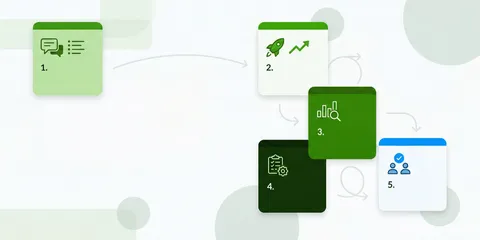
- Check-in
- Gathering
- Clustering
- Voting
- Defining measures
Without step 5, a retro is just a good conversation for me. With step 5, it becomes a lever for improvement.
For check-ins, measures, and moderation, I use these in-depth guides in my daily work:
- Retrospective Check-in: strong starts for more participation
- Retrospective Measures: how action items are implemented
- Retrospective Methods: overview of further formats
- Spotify Health Check: making team maturity visible
- Retrospective Games: more energy for remote teams
If you want to dive deeper into moderation, this eBook will help you in a very concrete way: eBook with moderation tips for retrospectives.
External classification
When I compare market standards, these resources are helpful:
FAQ: Ideas for Sprint Retrospectives
Which steps are part of a retrospective?
Typically, there are five phases for retrospectives: Set the stage, Gather data, Generate insights, Decide what to do, and Close. The exact process can vary, but it should always lead to concrete action items. In addition to the classic 5 phases of retrospectives, there is also the Double Diamond model for the phases of retrospectives , which provides facilitators of retrospectives with a more intuitive image for successful and result-oriented facilitation.
What mistakes should definitely be avoided during the first team retrospective?
Especially for teams with little or no experience of retrospectives, care should be taken to avoid the following mistakes:
- Mistake no. 1: Retrospective as a chat meeting. Not all feedback in a retrospective needs to be discussed. Only the topics that have been prioritized together deserve extra attention. All discussions about details before the voting should therefore be moderated and postponed until after the voting.
- Mistake no. 2: Retrospective as a blame game. The retrospective is not there to shift responsibility or blame others for negative events or developments. Improving the status quo is in the hands of all team members!
- Mistake no. 3: Retrospective as a gripe box. Retrospectives are not just about noting what is not working well. Most of the energy should be focused on thinking ahead and defining binding measures.
For the first retrospective, it is a good idea to use a dedicated retro tool for support. Echometer, with its intuitive and guided mode, is very well suited for inexperienced teams. You can try out a retrospective in Echometer here: https://my.echometerapp.com/retro-setup
How do you measure the success of a retrospective?
The success of retrospectives is reflected in the fact that agreed measures are implemented and measurable improvements are achieved. In addition to productivity indicators (which should be treated with caution), teams use, for example, the tracking of action items, trends on feedback scales in team health check / pulse check surveys.
Does the Echometer Retrospective Software Tool have the Start-Stop-Continue, 4Ls, Sailboat, Starfish and Hot Air Balloon Retrospective templates?
Yes, all these well-known retro formats are included in the tool, and many more that your team probably didn’t know about before.
Does Echometer have action tracking?
Yes, the online retrospective tool Echometer is one of the few retrospective software tools that also optimally supports the recording and tracking of measures:
- Integration: You can also record measures directly in Jira via an integration.
- Automatic follow-up: All open measures from past retros appear automatically in the measure review of the next retrospective for tracking purposes. This gives the team an overview of which measures are currently still open and creates a commitment to implementing the agreed measures.
- Reminders: Measures are assigned to a person responsible, who automatically receives a reminder email when the measure is created so that the measure is not forgotten. In addition, each participant can flexibly receive action reminders via email and manage the action status at any time in the Echometer Retro Tool.
With this, Echometer’s tool for team retrospectives has extensive and well-thought-out functions for action item tracking.
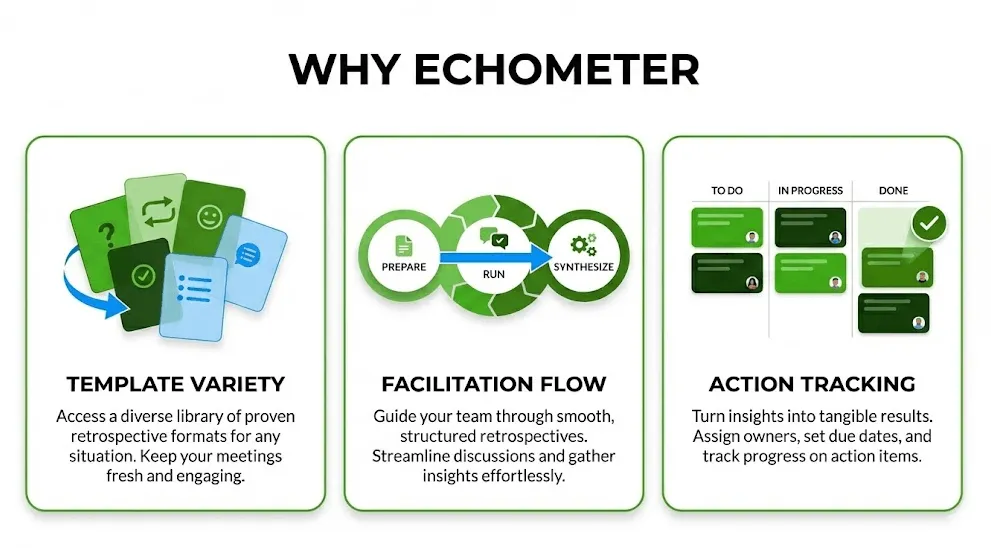
Why Echometer is ideal for productive agile retrospectives from my point of view
If I want to get a team into productive retros quickly, Echometer is the most pragmatic start for me:
- immediately usable templates instead of an empty whiteboard
- clear moderation process for focus
- grouping and voting without friction
- action item tracking for real implementation
- flexible use for remote, hybrid, and on-site
If you would like to compare first: