
The agile 'What went well' Retro: 3 Simple Examples
Are you searching for “Agile What Went Well examples” on Google? The search is over, because you’ve come to the right place🎉
I would like to explain how the “What Went Well” retrospective works and give you some examples🎁
Agile What Went Well Examples
What Went Well In Retrospective Examples
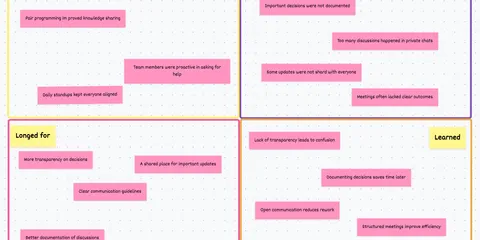
First things first: This retrospective gets its name “What Went Well” retrospective from the questions that are asked in the retrospective. You can see them here👀:
Agile What Went Well Examples
As simple as it is ingenious
You didn’t just come here for the questions, but also for some examples of “Agile What Went Well”. So let’s take a closer look at these questions and matching examples🔍
What went well retro 👍: How the retro works
-
Random Icebreaker (2-5 minutes)
Echometer provides you with a generator for random check-in questions.
-
Review of open actions (2-5 minutes)
Before starting with new topics, you should talk about what has become of the measures from past retrospectives to check their effectiveness. Echometer automatically lists all open action items from past retros.
-
Discuss retro topics
Use the following open questions to collect your most important findings. First, everyone does it themselves, covered. Echometer allows you to reveal each column of the retro board individually in order to then present and group the feedback.
- What went well?
- What went not so well?
- How can we improve?
-
Catch-all question (Recommended)
So that other topics also have a place:
- What else would you like to talk about in the retro?
-
Prioritization / Voting (5 minutes)
On the retro board in Echometer, you can easily prioritize the feedback with voting. The voting is of course anonymous.
-
Define actions (10-20 minutes)
You can create a linked action via the plus symbol on a feedback. Not sure which measure would be the right one? Then open a whiteboard on the topic via the plus symbol instead to brainstorm root causes and possible measures.
-
Checkout / Closing (5 minutes)
Echometer enables you to collect anonymous feedback from the team on how helpful the retro was. This creates the ROTI score ("Return On Time Invested"), which you can track over time.
What went well retro 👍

👍🏽What went well?👍🏽
The first question is pretty straight forward. Isn´t it? In fact, that is what makes this retrospective so popular. It simply straight farward. So we sinply want to know what went well in the retrospective for all the teammembers.
What went well in retrospect? - Examples:
💡During the sprint, I was very excited to implement the new feature in our software.
💡I had a one-on-one conversation with one of the team members, and although at first it felt like it wasn’t time well spent, it turned out to be very helpful for our teamwork over the last few days.
💡The pace of work in this sprint has felt very good, and looking back I’m very pleased with how much we’ve accomplished in the last two weeks.
👎🏽What did not go so well?👎🏽
The second question is not at all more complicated. We simply ask the counter question to the first question.
What didn’t go so well in retrospect? - Examples:
💡Due to my poor time management, I felt very stressed when it came to the amount of tasks I had to complete.
💡We introduced some new features that we didn’t know exactly what they were for. That was very frustrating.

"Many team members are afraid to speak up!"
Solve this challenge
"We discover too many unexpected issues & bugs at a late stage!"
Solve this challenge
"Why does it sometimes take me hours to prepare a simple retrospective?"
Solve this challenge🤔What can we improve?🤔
The last question gives us the opportunity not only to look into the past (retrospect), but to transfer what we have learned in the past into the future and improve the way we work.
What can we improve - Examples:
💡A clearer structure in communicating problems can ensure a higher standard of quality in implementation.
💡When problems arise between two team members, it is good to address them as soon as possible. That way, we can make sure that the problems don’t drag on and only cause more inconvenience.
Agile What Went Well Examples
Conclusion - What Went Well⚡
All in all, we can conclude that the retrospective of what went well is pretty straightforward. That makes this retrospective a good choice in almost every case. But from time to time, of course, it makes sense to add a little variety to the retrospectives.
If you want to try this retrospective or any of 50+ other templates for free, you can do so in our agile team continuous improvement tool🚀:
What went well retro 👍: How the retro works
-
Random Icebreaker (2-5 minutes)
Echometer provides you with a generator for random check-in questions.
-
Review of open actions (2-5 minutes)
Before starting with new topics, you should talk about what has become of the measures from past retrospectives to check their effectiveness. Echometer automatically lists all open action items from past retros.
-
Discuss retro topics
Use the following open questions to collect your most important findings. First, everyone does it themselves, covered. Echometer allows you to reveal each column of the retro board individually in order to then present and group the feedback.
- What went well?
- What went not so well?
- How can we improve?
-
Catch-all question (Recommended)
So that other topics also have a place:
- What else would you like to talk about in the retro?
-
Prioritization / Voting (5 minutes)
On the retro board in Echometer, you can easily prioritize the feedback with voting. The voting is of course anonymous.
-
Define actions (10-20 minutes)
You can create a linked action via the plus symbol on a feedback. Not sure which measure would be the right one? Then open a whiteboard on the topic via the plus symbol instead to brainstorm root causes and possible measures.
-
Checkout / Closing (5 minutes)
Echometer enables you to collect anonymous feedback from the team on how helpful the retro was. This creates the ROTI score ("Return On Time Invested"), which you can track over time.
What went well retro 👍