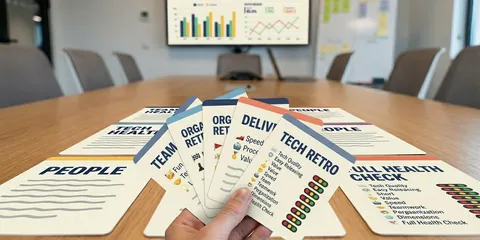
Agile Retrospective Excel Template Download
What is an Agile Retrospective and how can an Excel template help?
An agile retrospective is a meeting that takes place at the end of each iteration or sprint in an agile project. The purpose of an agile retrospective is to reflect on what went well, what went wrong and what can be improved in the next iteration. An agile retrospective helps the team to learn from its experiences, celebrate its successes, recognize its challenges and address them in a targeted manner.
One of the tools that can help when conducting an agile retrospective is an Excel template. An Excel template is a ready-made table that can be used again and again to support a retrospective in a targeted manner. An Excel template can specifically help you with the following points:
- Save time and effort by using a ready-made format and structure for your retrospectives
- Customize the template to your specific needs and preferences in no time at all
- Visualize and communicate your results and findings using graphs, tables and diagrams
- Track and monitor your progress and results over time using historical data
HERE I have prepared an Excel template for retrospectives for you. Please note that you cannot edit the original file. However, you can click “File” > “Download” > “Microsoft Excel (.xlsx)” to download the template and paste it into your own Excel sheet, where you can do whatever you want with it.
Attention: Before you use this template, read on to understand that Excel retrospective templates also have some drawbacks and how you can use a better retrospective template:
Agile Retrospective Excel Template
What are some limitations and disadvantages of Excel templates for agile retrospectives?
Before you decide to use an Excel template for agile retrospectives, you should also be aware of some of the limitations and disadvantages of using an Excel template for agile retrospectives. These are:
- An Excel template can be difficult to use and maintain if you have a large or remote team. There can be issues with file sharing, version control, data security, and data integrity.
- An Excel template can be boring and repetitive if you use the same format and structure for every retrospective. If you don’t vary your approach and methods, you may lose the interest and engagement of your team members.
- An Excel template can be misleading and inaccurate if you don’t collect and analyze your data properly. You can make incorrect assumptions or conclusions if you don’t validate your data sources, check your formulas, or interpret your charts correctly.
- An Excel template can cause a lot of extra work when it comes to analyzing the data from your agile retrospectives, especially if you run 50 - 100 retrospectives per year, as recommended in the agile manifesto.
We have analyzed over 30,000 agile retrospectives ourselves to prove this fact and gain further insight into what makes a good retrospective: Analysis of 30k retros: 4 tips for agile teams
Agile Retrospective Excel Template
A better alternative than Excel templates for agile retrospectives
If you’re looking for a better alternative, consider using a tool that is specifically designed for agile retrospectives and thus adapted to the needs of retros.
Echometer is an example of such a tool. With Echometer you can set up a retrospective in less than 2 minutes and share it with your entire team. You can also choose from over 50 retrospective templates and customize them to your needs.
A sample template from Echometer looks like this:
Keep stop start retro: How the retro works
-
Random Icebreaker (2-5 minutes)
Echometer provides you with a generator for random check-in questions.
-
Review of open actions (2-5 minutes)
Before starting with new topics, you should talk about what has become of the measures from past retrospectives to check their effectiveness. Echometer automatically lists all open action items from past retros.
-
Discuss retro topics
Use the following open questions to collect your most important findings. First, everyone does it themselves, covered. Echometer allows you to reveal each column of the retro board individually in order to then present and group the feedback.
- Keep: What should we keep?
- Stop: What should we stop doing?
- Start: What should we start doing?
-
Catch-all question (Recommended)
So that other topics also have a place:
- What else would you like to talk about in the retro?
-
Prioritization / Voting (5 minutes)
On the retro board in Echometer, you can easily prioritize the feedback with voting. The voting is of course anonymous.
-
Define actions (10-20 minutes)
You can create a linked action via the plus symbol on a feedback. Not sure which measure would be the right one? Then open a whiteboard on the topic via the plus symbol instead to brainstorm root causes and possible measures.
-
Checkout / Closing (5 minutes)
Echometer enables you to collect anonymous feedback from the team on how helpful the retro was. This creates the ROTI score ("Return On Time Invested"), which you can track over time.
Keep stop start retro

Agile Retrospective Excel Template
Conclusion:
A retrospective is a valuable practice that helps you learn from your project experiences and improve your team’s performance. You can use various tools to create and conduct your own project retrospectives, such as Excel or Echometer.
We hope this article has provided you with some useful information and resources for your retrospectives. If you have any questions or feedback, please let us know.
If you want to try any of the 50+ retrospective templates for free, you can do so for free in our Agile Team Continuous Improvement tool: