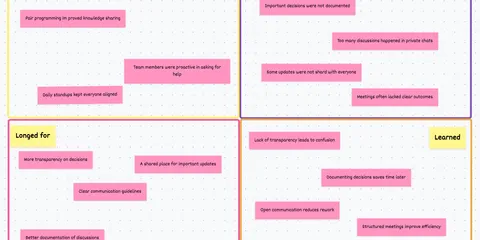

3 Sought After Sprint Retrospective Meeting Questions
Are you searching Google for “Sprint Retrospective Meeting Questions”? Then you’ve come to the right place. In this article, I will introduce you to some examples of Sprint Retrospective meetings that you can use for your retrospectives. The special thing about it: everything revolves around the number “3”. That’s why there are 3 popular retrospectives here, each with 3 questions:
Sprint Retrospective Meeting Questions
1. The Start Stop Keep Retrospective 🔖:
Let’s start with a classic method. In the Start-Stop-Keep retrospective, three simple questions are asked about what your team should start, stop, and keep doing at the next retrospective. Since we’ve found that it’s easiest to start the retrospective with the question “What should be kept”, we usually turn this retrospective into the “keep stop start” retrospective:
Keep Stop Start retrospective 🔖: How the retro works
Random Icebreaker (2-5 minutes)
Echometer provides you with a generator for random check-in questions.
Review of open actions (2-5 minutes)
Before starting with new topics, you should talk about what has become of the measures from past retrospectives to check their effectiveness. Echometer automatically lists all open action items from past retros.
Discuss retro topics
Use the following open questions to collect your most important findings. First, everyone does it themselves, covered. Echometer allows you to reveal each column of the retro board individually in order to then present and group the feedback.
- Keep: What should we keep?
- Stop: What should we stop doing?
- Start: What should we start doing?
Catch-all question (Recommended)
So that other topics also have a place:
- What else would you like to talk about in the retro?
Prioritization / Voting (5 minutes)
On the retro board in Echometer, you can easily prioritize the feedback with voting. The voting is of course anonymous.
Define actions (10-20 minutes)
You can create a linked action via the plus symbol on a feedback. Not sure which measure would be the right one? Then open a whiteboard on the topic via the plus symbol instead to brainstorm root causes and possible measures.
Checkout / Closing (5 minutes)
Echometer enables you to collect anonymous feedback from the team on how helpful the retro was. This creates the ROTI score ("Return On Time Invested"), which you can track over time.
Keep Stop Start retrospective 🔖

Sprint Retrospective Meeting Questions
2. The Mad Sad Glad Retrospective 😯:
The “mad sad glad” retrospective follows a similar pattern but uses three common emotions to encourage the team to answer your retrospective questions. A quite simple but fascinating retrospective format:
Mad Sad Glad retrospective 😯: How the retro works
Random Icebreaker (2-5 minutes)
Echometer provides you with a generator for random check-in questions.
Review of open actions (2-5 minutes)
Before starting with new topics, you should talk about what has become of the measures from past retrospectives to check their effectiveness. Echometer automatically lists all open action items from past retros.
Discuss retro topics
Use the following open questions to collect your most important findings. First, everyone does it themselves, covered. Echometer allows you to reveal each column of the retro board individually in order to then present and group the feedback.
- What made you mad? 😤
- What made you sad? 😢
- What made you glad? 🤩
Catch-all question (Recommended)
So that other topics also have a place:
- What else would you like to talk about in the retro?
Prioritization / Voting (5 minutes)
On the retro board in Echometer, you can easily prioritize the feedback with voting. The voting is of course anonymous.
Define actions (10-20 minutes)
You can create a linked action via the plus symbol on a feedback. Not sure which measure would be the right one? Then open a whiteboard on the topic via the plus symbol instead to brainstorm root causes and possible measures.
Checkout / Closing (5 minutes)
Echometer enables you to collect anonymous feedback from the team on how helpful the retro was. This creates the ROTI score ("Return On Time Invested"), which you can track over time.
Mad Sad Glad retrospective 😯

Sprint Retrospective Meeting Questions
3. The Campfire Retrospective 🔥:
Who doesn’t like sitting in front of a warm fire and reflecting on the past and the future? - I wouldn’t recommend lighting a fire in the office, but we’ve created this beautiful campfire retrospective for that purpose:
Campfire retrospective 🔥: How the retro works
Random Icebreaker (2-5 minutes)
Echometer provides you with a generator for random check-in questions.
Review of open actions (2-5 minutes)
Before starting with new topics, you should talk about what has become of the measures from past retrospectives to check their effectiveness. Echometer automatically lists all open action items from past retros.
Discuss retro topics
Use the following open questions to collect your most important findings. First, everyone does it themselves, covered. Echometer allows you to reveal each column of the retro board individually in order to then present and group the feedback.
- Warm fire: What made you feel comfortable in the last sprint?
- Turned to ashes: What did not work as desired and crumbled to ashes?
- The shooting star: What do you wish for the future?
Catch-all question (Recommended)
So that other topics also have a place:
- What else would you like to talk about in the retro?
Prioritization / Voting (5 minutes)
On the retro board in Echometer, you can easily prioritize the feedback with voting. The voting is of course anonymous.
Define actions (10-20 minutes)
You can create a linked action via the plus symbol on a feedback. Not sure which measure would be the right one? Then open a whiteboard on the topic via the plus symbol instead to brainstorm root causes and possible measures.
Checkout / Closing (5 minutes)
Echometer enables you to collect anonymous feedback from the team on how helpful the retro was. This creates the ROTI score ("Return On Time Invested"), which you can track over time.
Campfire retrospective 🔥

Conclusion - 3 Popular Sprint Retrospective Meeting Questions
In this article, I have selected the two popular retrospectives “start stop keep” and “mad sad glad” and added my own creation “The Campfire Retrospective”. I am quite sure that it will also be very popular in the future. Give it a try and you will see why 😉 .