
33 Fun Retrospectives Examples & Samples for Agile Teams
Are you looking for first-class examples of retrospectives? - Then you’ve come to the right place, because in this article I’m going to give you a lot of examples of simple retrospectives.
In total, there are more than 30 simple retrospective examples & samples that you can use as inspiration or try out directly if you are interested.
In addition to classic retrospective templates such as the “Keep Stop Start” or the “Mad Sad Glad” retrospective, I have also listed novel retrospectives. These retrospectives include the Tetris Retro, the Five Agile Values Retro, and the Four Seasons Retro.
But before we look at the examples and samples of retros, let’s take a brief look at what characterizes a successful retrospective method:
What makes great retrospectives?
Retrospective literally means “review”. In agile methodology, this means looking back on and analyzing a team’s past work period.
It is easier to say that you review what has happened and learn from your mistakes and successes.
No wonder, then, that one of the first and most popular retrospectives is the “What went well” retrospective, which asks these three simple questions:
- What went well?
- What went not so well?
- How can we improve?
Simple and effective retrospectives are therefore characterized by the fact that they offer a framework of questions that aim to learn from the work of the past few weeks. But this can go far beyond the simple “What Went Well” method:
- You can take a more playful approach, for example: The sailboat retrospective
- You can expand the questions: The starfish method
- Or you can shed light on more specific aspects of the work: The battery Retro
The variety of examples and samples of retrospectives is almost endless.
However, a first-class retrospective involves much more than just a valuable retro method. That’s why I’ve put together a few articles here to help you deepen your knowledge:
- An entry guide for retrospectives.
- How to define valuable “measures”.
- Our full retrospective agenda.
- “Psychological safety” for agile teams.
- The best retro check-ins for any situation.
And now let’s get started with the examples of retrospectives…
9 Simple retrospective Examples & Samples - the classics
Let’s start with the “best” retro techniques from the agile world - or at least the 9 most common:
Simple Retrospective Example & Sample #1
1. The ‘What Went Well’ Retrospective 👍
The “What Went Well” retrospective is the most used retro technique in our tool. It is simple and effective:
What went well Retro 👍: How the retro works
-
Random Icebreaker (2-5 minutes)
Echometer provides you with a generator for random check-in questions.
-
Review of open actions (2-5 minutes)
Before starting with new topics, you should talk about what has become of the measures from past retrospectives to check their effectiveness. Echometer automatically lists all open action items from past retros.
-
Discuss retro topics
Use the following open questions to collect your most important findings. First, everyone does it themselves, covered. Echometer allows you to reveal each column of the retro board individually in order to then present and group the feedback.
- What went well?
- What went not so well?
- How can we improve?
-
Catch-all question (Recommended)
So that other topics also have a place:
- What else would you like to talk about in the retro?
-
Prioritization / Voting (5 minutes)
On the retro board in Echometer, you can easily prioritize the feedback with voting. The voting is of course anonymous.
-
Define actions (10-20 minutes)
You can create a linked action via the plus symbol on a feedback. Not sure which measure would be the right one? Then open a whiteboard on the topic via the plus symbol instead to brainstorm root causes and possible measures.
-
Checkout / Closing (5 minutes)
Echometer enables you to collect anonymous feedback from the team on how helpful the retro was. This creates the ROTI score ("Return On Time Invested"), which you can track over time.
What went well Retro 👍

Simple Retrospective Example & Sample #2
2. The ‘Mad Sad Glad’ Retrospective 😯
The “Mad Sad Glad” retrospective technique has a similar pattern, but places more emphasis on considering the emotions of the individual team members.
Mad Sad Glad Retro 😯: How the retro works
-
Random Icebreaker (2-5 minutes)
Echometer provides you with a generator for random check-in questions.
-
Review of open actions (2-5 minutes)
Before starting with new topics, you should talk about what has become of the measures from past retrospectives to check their effectiveness. Echometer automatically lists all open action items from past retros.
-
Discuss retro topics
Use the following open questions to collect your most important findings. First, everyone does it themselves, covered. Echometer allows you to reveal each column of the retro board individually in order to then present and group the feedback.
- What made you mad? 😤
- What made you sad? 😢
- What made you glad? 🤩
-
Catch-all question (Recommended)
So that other topics also have a place:
- What else would you like to talk about in the retro?
-
Prioritization / Voting (5 minutes)
On the retro board in Echometer, you can easily prioritize the feedback with voting. The voting is of course anonymous.
-
Define actions (10-20 minutes)
You can create a linked action via the plus symbol on a feedback. Not sure which measure would be the right one? Then open a whiteboard on the topic via the plus symbol instead to brainstorm root causes and possible measures.
-
Checkout / Closing (5 minutes)
Echometer enables you to collect anonymous feedback from the team on how helpful the retro was. This creates the ROTI score ("Return On Time Invested"), which you can track over time.
Mad Sad Glad Retro 😯

Fun Retrospective Example & Sample #3
3. Start Stop Keep or Start Stop Continue 🔖
The retrospective technique “Start Stop Keep” is also known as the “Start Stop Continue” retrospective. I highly recommend making it the “Keep Stop Start” retro (pay attention to the order). This is how you start the retro with something positive. This has proven to be a good start:
Keep stop start retro: How the retro works
-
Random Icebreaker (2-5 minutes)
Echometer provides you with a generator for random check-in questions.
-
Review of open actions (2-5 minutes)
Before starting with new topics, you should talk about what has become of the measures from past retrospectives to check their effectiveness. Echometer automatically lists all open action items from past retros.
-
Discuss retro topics
Use the following open questions to collect your most important findings. First, everyone does it themselves, covered. Echometer allows you to reveal each column of the retro board individually in order to then present and group the feedback.
- Keep: What should we keep?
- Stop: What should we stop doing?
- Start: What should we start doing?
-
Catch-all question (Recommended)
So that other topics also have a place:
- What else would you like to talk about in the retro?
-
Prioritization / Voting (5 minutes)
On the retro board in Echometer, you can easily prioritize the feedback with voting. The voting is of course anonymous.
-
Define actions (10-20 minutes)
You can create a linked action via the plus symbol on a feedback. Not sure which measure would be the right one? Then open a whiteboard on the topic via the plus symbol instead to brainstorm root causes and possible measures.
-
Checkout / Closing (5 minutes)
Echometer enables you to collect anonymous feedback from the team on how helpful the retro was. This creates the ROTI score ("Return On Time Invested"), which you can track over time.
Keep stop start retro

Fun Retrospective Example & Sample #4
4. 4 L’s Retrospective technique 📘
The 4 L’s stand for “Liked, Learned, Lacked, Longed for”.
Rumor has it that people disagree on whether it’s called the 4L retrospective or the 4L’s retrospective.
By the way: You may notice from this retro that retrospective questions are also well suited for use in one-to-one discussions or coaching with employees. If you are also interested in this topic: Here you will find 129 one-to-one meeting (or appraisal interview) questions and Here are the 3 best one-on-one employee review tools in comparison .
4L-Retro 📘: How the retro works
-
Random Icebreaker (2-5 minutes)
Echometer provides you with a generator for random check-in questions.
-
Review of open actions (2-5 minutes)
Before starting with new topics, you should talk about what has become of the measures from past retrospectives to check their effectiveness. Echometer automatically lists all open action items from past retros.
-
Discuss retro topics
Use the following open questions to collect your most important findings. First, everyone does it themselves, covered. Echometer allows you to reveal each column of the retro board individually in order to then present and group the feedback.
- Like: What did you like?
- Learned: What did you learn?
- Lacked: What did you lack?
- Longed for: What did you long for?
-
Catch-all question (Recommended)
So that other topics also have a place:
- What else would you like to talk about in the retro?
-
Prioritization / Voting (5 minutes)
On the retro board in Echometer, you can easily prioritize the feedback with voting. The voting is of course anonymous.
-
Define actions (10-20 minutes)
You can create a linked action via the plus symbol on a feedback. Not sure which measure would be the right one? Then open a whiteboard on the topic via the plus symbol instead to brainstorm root causes and possible measures.
-
Checkout / Closing (5 minutes)
Echometer enables you to collect anonymous feedback from the team on how helpful the retro was. This creates the ROTI score ("Return On Time Invested"), which you can track over time.
4L-Retro 📘

Fun Retrospective Example & Sample #5
5. The Sailboat Retrospective ⛵️
The sailboat retrospective technique is one of the most popular symbolic retrospective techniques out there. I suppose it’s because of the adventure that comes with a boat trip:
Sailboat Retro ⛵️: How the retro works
-
Random Icebreaker (2-5 minutes)
Echometer provides you with a generator for random check-in questions.
-
Review of open actions (2-5 minutes)
Before starting with new topics, you should talk about what has become of the measures from past retrospectives to check their effectiveness. Echometer automatically lists all open action items from past retros.
-
Discuss retro topics
Use the following open questions to collect your most important findings. First, everyone does it themselves, covered. Echometer allows you to reveal each column of the retro board individually in order to then present and group the feedback.
- ⚓️ Your anchor: What holds us back?
- 🦈🧊 Your shark/iceberg: Which dangers or obstacles approach us?
- 💨 Your tailwind: What drives us forward?
- 🏝💰 Your paradise: What achievement or milestones are we working towards?
-
Catch-all question (Recommended)
So that other topics also have a place:
- What else would you like to talk about in the retro?
-
Prioritization / Voting (5 minutes)
On the retro board in Echometer, you can easily prioritize the feedback with voting. The voting is of course anonymous.
-
Define actions (10-20 minutes)
You can create a linked action via the plus symbol on a feedback. Not sure which measure would be the right one? Then open a whiteboard on the topic via the plus symbol instead to brainstorm root causes and possible measures.
-
Checkout / Closing (5 minutes)
Echometer enables you to collect anonymous feedback from the team on how helpful the retro was. This creates the ROTI score ("Return On Time Invested"), which you can track over time.
Sailboat Retro ⛵️

Fun Retrospective Example & Sample #6
6. DAKI(Drop Add Keep Improve) Retrospective ✂️
DAKI stands for “Drop Add Keep Improve”. A popular retro, which, in addition to the KALM retro (Keep, Add, Less, More), represents a simple acronym.
(Want to take a look at its twin, the KALM Retro? The KALM Retro with examples )
DAKI Retro: How the retro works
-
Random Icebreaker (2-5 minutes)
Echometer provides you with a generator for random check-in questions.
-
Review of open actions (2-5 minutes)
Before starting with new topics, you should talk about what has become of the measures from past retrospectives to check their effectiveness. Echometer automatically lists all open action items from past retros.
-
Discuss retro topics
Use the following open questions to collect your most important findings. First, everyone does it themselves, covered. Echometer allows you to reveal each column of the retro board individually in order to then present and group the feedback.
- Drop: What should we drop?
- Add: What should we add?
- Keep: What should we keep?
- Improve: What should we improve?
-
Catch-all question (Recommended)
So that other topics also have a place:
- What else would you like to talk about in the retro?
-
Prioritization / Voting (5 minutes)
On the retro board in Echometer, you can easily prioritize the feedback with voting. The voting is of course anonymous.
-
Define actions (10-20 minutes)
You can create a linked action via the plus symbol on a feedback. Not sure which measure would be the right one? Then open a whiteboard on the topic via the plus symbol instead to brainstorm root causes and possible measures.
-
Checkout / Closing (5 minutes)
Echometer enables you to collect anonymous feedback from the team on how helpful the retro was. This creates the ROTI score ("Return On Time Invested"), which you can track over time.
DAKI Retro

Fun Retrospective Example & Sample #7
7. The Three Little Pigs Retro 🐷
A retro technique based on a fable. Here, the three little pigs build different shelters to protect themselves from the evil wolf. How stable are your performances?
Three Little Pigs Retro 🐷: How the retro works
-
Random Icebreaker (2-5 minutes)
Echometer provides you with a generator for random check-in questions.
-
Review of open actions (2-5 minutes)
Before starting with new topics, you should talk about what has become of the measures from past retrospectives to check their effectiveness. Echometer automatically lists all open action items from past retros.
-
Discuss retro topics
Use the following open questions to collect your most important findings. First, everyone does it themselves, covered. Echometer allows you to reveal each column of the retro board individually in order to then present and group the feedback.
- House of straw: What do we do that is just holding together, but could topple over at any moment? 🌱
- House of sticks: What do we do that is relatively stable, but could be improved?\n 🪵
- House of bricks: What do we do that is rock solid? 🪨
-
Catch-all question (Recommended)
So that other topics also have a place:
- What else would you like to talk about in the retro?
-
Prioritization / Voting (5 minutes)
On the retro board in Echometer, you can easily prioritize the feedback with voting. The voting is of course anonymous.
-
Define actions (10-20 minutes)
You can create a linked action via the plus symbol on a feedback. Not sure which measure would be the right one? Then open a whiteboard on the topic via the plus symbol instead to brainstorm root causes and possible measures.
-
Checkout / Closing (5 minutes)
Echometer enables you to collect anonymous feedback from the team on how helpful the retro was. This creates the ROTI score ("Return On Time Invested"), which you can track over time.
Three Little Pigs Retro 🐷

Fun Retrospective Example & Sample #8
8th The Starfish Sprint Retrospective ⭐️
With its 5 questions, the starfish retro technique tends to take a little longer than other retrospective formats. It is ideal for small teams:
Starfish Retro ⭐️: How the retro works
-
Random Icebreaker (2-5 minutes)
Echometer provides you with a generator for random check-in questions.
-
Review of open actions (2-5 minutes)
Before starting with new topics, you should talk about what has become of the measures from past retrospectives to check their effectiveness. Echometer automatically lists all open action items from past retros.
-
Discuss retro topics
Use the following open questions to collect your most important findings. First, everyone does it themselves, covered. Echometer allows you to reveal each column of the retro board individually in order to then present and group the feedback.
- Keep: [Optional: Looking at the last sprint / weeks] What should we keep doing, keep as it is?
- Stop: What should we stop doing?
- Start: What should we start doing?
- More: What should we do more of?
- Less: What should we do less of?
-
Catch-all question (Recommended)
So that other topics also have a place:
- What else would you like to talk about in the retro?
-
Prioritization / Voting (5 minutes)
On the retro board in Echometer, you can easily prioritize the feedback with voting. The voting is of course anonymous.
-
Define actions (10-20 minutes)
You can create a linked action via the plus symbol on a feedback. Not sure which measure would be the right one? Then open a whiteboard on the topic via the plus symbol instead to brainstorm root causes and possible measures.
-
Checkout / Closing (5 minutes)
Echometer enables you to collect anonymous feedback from the team on how helpful the retro was. This creates the ROTI score ("Return On Time Invested"), which you can track over time.
Starfish Retro ⭐️

Fun Retrospective Example & Sample #9
9. Thumbs Up, Thumbs Down Retro🤙
An agile retrospective technique that focuses entirely on appreciation:
Thumbs Up/Down Retro: How the retro works
-
Random Icebreaker (2-5 minutes)
Echometer provides you with a generator for random check-in questions.
-
Review of open actions (2-5 minutes)
Before starting with new topics, you should talk about what has become of the measures from past retrospectives to check their effectiveness. Echometer automatically lists all open action items from past retros.
-
Discuss retro topics
Use the following open questions to collect your most important findings. First, everyone does it themselves, covered. Echometer allows you to reveal each column of the retro board individually in order to then present and group the feedback.
- What do you give a "thumbs up" to?
- What do you give a "thumbs down" for?
- Which new ideas do you have?
- Who or what do you want to recognize, highlight positively?
-
Catch-all question (Recommended)
So that other topics also have a place:
- What else would you like to talk about in the retro?
-
Prioritization / Voting (5 minutes)
On the retro board in Echometer, you can easily prioritize the feedback with voting. The voting is of course anonymous.
-
Define actions (10-20 minutes)
You can create a linked action via the plus symbol on a feedback. Not sure which measure would be the right one? Then open a whiteboard on the topic via the plus symbol instead to brainstorm root causes and possible measures.
-
Checkout / Closing (5 minutes)
Echometer enables you to collect anonymous feedback from the team on how helpful the retro was. This creates the ROTI score ("Return On Time Invested"), which you can track over time.
Thumbs Up/Down Retro

Echometer Originals
Fun retrospective techniques your team has never seen before…
These were the most popular retro techniques and samples from the agile world. But who always wants to hold the same retro?
Therefore, here are some more retrospectives that you certainly don’t know. The “Echometer Originals”:
Fun Retrospective Example & Sample #10
10. the meme retro 🤓
What used to be cartoons are now MEMEs. And with the birth of MEMEs, MEME faces were also born:
Pacman Retro 🟡: How the retro works
-
Random Icebreaker (2-5 minutes)
Echometer provides you with a generator for random check-in questions.
-
Review of open actions (2-5 minutes)
Before starting with new topics, you should talk about what has become of the measures from past retrospectives to check their effectiveness. Echometer automatically lists all open action items from past retros.
-
Discuss retro topics
Use the following open questions to collect your most important findings. First, everyone does it themselves, covered. Echometer allows you to reveal each column of the retro board individually in order to then present and group the feedback.
- Me Gusta: What did you like about the last sprint?
- 4 Real: When did you feel really pranked in the last sprint?
- I am watching you: What will you be on the lookout for in the future?
-
Catch-all question (Recommended)
So that other topics also have a place:
- What else would you like to talk about in the retro?
-
Prioritization / Voting (5 minutes)
On the retro board in Echometer, you can easily prioritize the feedback with voting. The voting is of course anonymous.
-
Define actions (10-20 minutes)
You can create a linked action via the plus symbol on a feedback. Not sure which measure would be the right one? Then open a whiteboard on the topic via the plus symbol instead to brainstorm root causes and possible measures.
-
Checkout / Closing (5 minutes)
Echometer enables you to collect anonymous feedback from the team on how helpful the retro was. This creates the ROTI score ("Return On Time Invested"), which you can track over time.
Pacman Retro 🟡

Fun Retrospective Example & Sample #11
11. The Mario Kart Retro 🚗
Not happy with your team’s velocity? Then head to the race track and see what you can get out of it. This time it’s both a “futurespective” and a retrospective:
Mario Kart Retro 🚗: How the retro works
-
Random Icebreaker (2-5 minutes)
Echometer provides you with a generator for random check-in questions.
-
Review of open actions (2-5 minutes)
Before starting with new topics, you should talk about what has become of the measures from past retrospectives to check their effectiveness. Echometer automatically lists all open action items from past retros.
-
Discuss retro topics
Use the following open questions to collect your most important findings. First, everyone does it themselves, covered. Echometer allows you to reveal each column of the retro board individually in order to then present and group the feedback.
- What bananas on the track do we have to look out for?
- What’s an upcoming shortcut we could take advantage of?
- What powerup could we pick up to ensure our win?
- What shortcuts helped us win?
- Which bananas did we slip on?
- What was the powerup that gave us an edge?
-
Catch-all question (Recommended)
So that other topics also have a place:
- What else would you like to talk about in the retro?
-
Prioritization / Voting (5 minutes)
On the retro board in Echometer, you can easily prioritize the feedback with voting. The voting is of course anonymous.
-
Define actions (10-20 minutes)
You can create a linked action via the plus symbol on a feedback. Not sure which measure would be the right one? Then open a whiteboard on the topic via the plus symbol instead to brainstorm root causes and possible measures.
-
Checkout / Closing (5 minutes)
Echometer enables you to collect anonymous feedback from the team on how helpful the retro was. This creates the ROTI score ("Return On Time Invested"), which you can track over time.
Mario Kart Retro 🚗

By the way, if you want to develop your team holistically, then you also need to improve psychological safety in the team. In this video, our co-founder Christian explains 4 team and one-to-one exercises you can do to increase psychological safety.
Fun Retrospective Example & Sample #12
12. The role-playing game Retro 👨🏼💻
Are you longing for a level-up? Then you could look at everything more like a game: With each level (sprint), things get more difficult. But the character (our team) also develops its strengths in order to master the challenges:
Role Playing Retro 👨🏼💻: How the retro works
-
Random Icebreaker (2-5 minutes)
Echometer provides you with a generator for random check-in questions.
-
Review of open actions (2-5 minutes)
Before starting with new topics, you should talk about what has become of the measures from past retrospectives to check their effectiveness. Echometer automatically lists all open action items from past retros.
-
Discuss retro topics
Use the following open questions to collect your most important findings. First, everyone does it themselves, covered. Echometer allows you to reveal each column of the retro board individually in order to then present and group the feedback.
- What’s our superpower as a team?
- What character class is the hero of the last sprint?
- Looking at recent challenges: Which characteristics & skills should we level up as soon as possible?
- What’s our next game milestone (e.g., villain to tackle)?
- Optional: Who recently rolled a Nat 20 and saved the team?
-
Catch-all question (Recommended)
So that other topics also have a place:
- What else would you like to talk about in the retro?
-
Prioritization / Voting (5 minutes)
On the retro board in Echometer, you can easily prioritize the feedback with voting. The voting is of course anonymous.
-
Define actions (10-20 minutes)
You can create a linked action via the plus symbol on a feedback. Not sure which measure would be the right one? Then open a whiteboard on the topic via the plus symbol instead to brainstorm root causes and possible measures.
-
Checkout / Closing (5 minutes)
Echometer enables you to collect anonymous feedback from the team on how helpful the retro was. This creates the ROTI score ("Return On Time Invested"), which you can track over time.
Role Playing Retro 👨🏼💻

Fun Retrospective Example & Sample #13
13. The Tetris Retro 👾
Still missing a puzzle piece for success? Tetris is a challenging arcade game with the aim of puzzling under pressure, so to speak. Sounds similar to work? It kind of is. The corresponding retrospective technique:
Tetris Retro: How the retro works
-
Random Icebreaker (2-5 minutes)
Echometer provides you with a generator for random check-in questions.
-
Review of open actions (2-5 minutes)
Before starting with new topics, you should talk about what has become of the measures from past retrospectives to check their effectiveness. Echometer automatically lists all open action items from past retros.
-
Discuss retro topics
Use the following open questions to collect your most important findings. First, everyone does it themselves, covered. Echometer allows you to reveal each column of the retro board individually in order to then present and group the feedback.
- Which piece fit perfectly into the puzzle in the last sprint?
- Which piece did not fit at all?
- How many uncleared rows have already accumulated?
- When was the last time we cleared multiple rows at once?
- What new piece could we invent to fill a gap we have right now?
-
Catch-all question (Recommended)
So that other topics also have a place:
- What else would you like to talk about in the retro?
-
Prioritization / Voting (5 minutes)
On the retro board in Echometer, you can easily prioritize the feedback with voting. The voting is of course anonymous.
-
Define actions (10-20 minutes)
You can create a linked action via the plus symbol on a feedback. Not sure which measure would be the right one? Then open a whiteboard on the topic via the plus symbol instead to brainstorm root causes and possible measures.
-
Checkout / Closing (5 minutes)
Echometer enables you to collect anonymous feedback from the team on how helpful the retro was. This creates the ROTI score ("Return On Time Invested"), which you can track over time.
Tetris Retro

Echometer Originals
Work-Life Balance Retrospectives Samples
Hard work is not everything. This is exactly what you can express with his retrospective techniques.
How about a relaxed round around the campfire or an escape room as a team-building activity?
Fun Retrospective Example & Sample #14
14. The campfire retro🔥
You can relax around the campfire and let your mind wander.
But a fire in the office is not a good idea! But that’s exactly why we developed the Campfire Retrospective:
Michelangelo Retro: How the retro works
-
Random Icebreaker (2-5 minutes)
Echometer provides you with a generator for random check-in questions.
-
Review of open actions (2-5 minutes)
Before starting with new topics, you should talk about what has become of the measures from past retrospectives to check their effectiveness. Echometer automatically lists all open action items from past retros.
-
Discuss retro topics
Use the following open questions to collect your most important findings. First, everyone does it themselves, covered. Echometer allows you to reveal each column of the retro board individually in order to then present and group the feedback.
- Warm fire: What made you feel good in the last sprint?
- Turned to ashes: What did not work as desired and crumbled to ashes?
- The shooting star: What do you wish for the future?
-
Catch-all question (Recommended)
So that other topics also have a place:
- What else would you like to talk about in the retro?
-
Prioritization / Voting (5 minutes)
On the retro board in Echometer, you can easily prioritize the feedback with voting. The voting is of course anonymous.
-
Define actions (10-20 minutes)
You can create a linked action via the plus symbol on a feedback. Not sure which measure would be the right one? Then open a whiteboard on the topic via the plus symbol instead to brainstorm root causes and possible measures.
-
Checkout / Closing (5 minutes)
Echometer enables you to collect anonymous feedback from the team on how helpful the retro was. This creates the ROTI score ("Return On Time Invested"), which you can track over time.
Michelangelo Retro

Fun Retrospective Example & Sample #15
15. The theater retro 🎭
Sometimes work is like a theater. There is so much drama! But what role did we play in it?
Theater Retro: How the retro works
-
Random Icebreaker (2-5 minutes)
Echometer provides you with a generator for random check-in questions.
-
Review of open actions (2-5 minutes)
Before starting with new topics, you should talk about what has become of the measures from past retrospectives to check their effectiveness. Echometer automatically lists all open action items from past retros.
-
Discuss retro topics
Use the following open questions to collect your most important findings. First, everyone does it themselves, covered. Echometer allows you to reveal each column of the retro board individually in order to then present and group the feedback.
- Who was the (tragic?) hero in the last sprint and why?
- At which point of the storyline did you get lost?
- In which situation did you have stage fright?
- Where would a prompter have been helpful?
- Which role would you like to play in the future?
-
Catch-all question (Recommended)
So that other topics also have a place:
- What else would you like to talk about in the retro?
-
Prioritization / Voting (5 minutes)
On the retro board in Echometer, you can easily prioritize the feedback with voting. The voting is of course anonymous.
-
Define actions (10-20 minutes)
You can create a linked action via the plus symbol on a feedback. Not sure which measure would be the right one? Then open a whiteboard on the topic via the plus symbol instead to brainstorm root causes and possible measures.
-
Checkout / Closing (5 minutes)
Echometer enables you to collect anonymous feedback from the team on how helpful the retro was. This creates the ROTI score ("Return On Time Invested"), which you can track over time.
Theater Retro

Sprint Retrospective Example & Sample #16
16. The escape room retro 🕵🏼
Escape rooms are a popular team building measure for a reason. They have just the right balance of “pressure” and “fun”.
So if the team feels as if it is somehow stuck, it is worth breaking out of its own situation. Just like in an escape game.
Escape Room Retro: How the retro works
-
Random Icebreaker (2-5 minutes)
Echometer provides you with a generator for random check-in questions.
-
Review of open actions (2-5 minutes)
Before starting with new topics, you should talk about what has become of the measures from past retrospectives to check their effectiveness. Echometer automatically lists all open action items from past retros.
-
Discuss retro topics
Use the following open questions to collect your most important findings. First, everyone does it themselves, covered. Echometer allows you to reveal each column of the retro board individually in order to then present and group the feedback.
- What puzzles do we still have to solve?
- Where are we running out of time?
- Where could communication in the team have been better?
- Which challenge did we master pretty well?
-
Catch-all question (Recommended)
So that other topics also have a place:
- What else would you like to talk about in the retro?
-
Prioritization / Voting (5 minutes)
On the retro board in Echometer, you can easily prioritize the feedback with voting. The voting is of course anonymous.
-
Define actions (10-20 minutes)
You can create a linked action via the plus symbol on a feedback. Not sure which measure would be the right one? Then open a whiteboard on the topic via the plus symbol instead to brainstorm root causes and possible measures.
-
Checkout / Closing (5 minutes)
Echometer enables you to collect anonymous feedback from the team on how helpful the retro was. This creates the ROTI score ("Return On Time Invested"), which you can track over time.
Escape Room Retro

Sprint Retrospective Example & Sample #17
17. The surfer retro 🏄🏽♀️ 🌊
When you think of surfing, you quickly think of Hawaii, sun and flow.
But did you know that mankind’s greatest achievements have all happened in a state of flow? Time to retrace it:
Surf Retro: How the retro works
-
Random Icebreaker (2-5 minutes)
Echometer provides you with a generator for random check-in questions.
-
Review of open actions (2-5 minutes)
Before starting with new topics, you should talk about what has become of the measures from past retrospectives to check their effectiveness. Echometer automatically lists all open action items from past retros.
-
Discuss retro topics
Use the following open questions to collect your most important findings. First, everyone does it themselves, covered. Echometer allows you to reveal each column of the retro board individually in order to then present and group the feedback.
- What made you fall?
- When have you been able to show your skills?
- What keeps you balanced?
- How can you maximize the chances to catch the next wave even better?
-
Catch-all question (Recommended)
So that other topics also have a place:
- What else would you like to talk about in the retro?
-
Prioritization / Voting (5 minutes)
On the retro board in Echometer, you can easily prioritize the feedback with voting. The voting is of course anonymous.
-
Define actions (10-20 minutes)
You can create a linked action via the plus symbol on a feedback. Not sure which measure would be the right one? Then open a whiteboard on the topic via the plus symbol instead to brainstorm root causes and possible measures.
-
Checkout / Closing (5 minutes)
Echometer enables you to collect anonymous feedback from the team on how helpful the retro was. This creates the ROTI score ("Return On Time Invested"), which you can track over time.
Surf Retro

Sprint Retrospective Example & Sample #18
18. The Michelangelo Retro 🧑🏾🎨 🖼
How can you ensure that your work becomes a masterpiece? Let’s just ask one of the greatest artists of our time:
Michelangelo Retro: How the retro works
-
Random Icebreaker (2-5 minutes)
Echometer provides you with a generator for random check-in questions.
-
Review of open actions (2-5 minutes)
Before starting with new topics, you should talk about what has become of the measures from past retrospectives to check their effectiveness. Echometer automatically lists all open action items from past retros.
-
Discuss retro topics
Use the following open questions to collect your most important findings. First, everyone does it themselves, covered. Echometer allows you to reveal each column of the retro board individually in order to then present and group the feedback.
- What is the big picture we are working on?
- Which details should we focus on in the next weeks?
- Where do we have difficulties finding the right color?
- Which new brush should we use, which new approaches should we try out in the next few weeks?
-
Catch-all question (Recommended)
So that other topics also have a place:
- What else would you like to talk about in the retro?
-
Prioritization / Voting (5 minutes)
On the retro board in Echometer, you can easily prioritize the feedback with voting. The voting is of course anonymous.
-
Define actions (10-20 minutes)
You can create a linked action via the plus symbol on a feedback. Not sure which measure would be the right one? Then open a whiteboard on the topic via the plus symbol instead to brainstorm root causes and possible measures.
-
Checkout / Closing (5 minutes)
Echometer enables you to collect anonymous feedback from the team on how helpful the retro was. This creates the ROTI score ("Return On Time Invested"), which you can track over time.
Michelangelo Retro

Echometer Originals
A Retrospective For Every Season!
Spring, summer, fall, winter. There are not only the right clothes for different seasons and weather, but also the right retrospective techniques:
Sprint Retrospective Example & Sample #19
19. Fancy a fresh start? The Spring Retro 🌼
A new season is dawning and definitely one of the better ones. The days are getting longer and you can slowly leave your jacket at home. In the best case, your team will blossom like the plants in front of the windows. - Find out with these retro questions:
Spring Cleaning Retro: How the retro works
-
Random Icebreaker (2-5 minutes)
Echometer provides you with a generator for random check-in questions.
-
Review of open actions (2-5 minutes)
Before starting with new topics, you should talk about what has become of the measures from past retrospectives to check their effectiveness. Echometer automatically lists all open action items from past retros.
-
Discuss retro topics
Use the following open questions to collect your most important findings. First, everyone does it themselves, covered. Echometer allows you to reveal each column of the retro board individually in order to then present and group the feedback.
- The first rays of sunshine: What makes us grow?
- Pollen count! What should we shake off?
- Not everything is a fresh start: what do we want to keep for the season?
-
Catch-all question (Recommended)
So that other topics also have a place:
- What else would you like to talk about in the retro?
-
Prioritization / Voting (5 minutes)
On the retro board in Echometer, you can easily prioritize the feedback with voting. The voting is of course anonymous.
-
Define actions (10-20 minutes)
You can create a linked action via the plus symbol on a feedback. Not sure which measure would be the right one? Then open a whiteboard on the topic via the plus symbol instead to brainstorm root causes and possible measures.
-
Checkout / Closing (5 minutes)
Echometer enables you to collect anonymous feedback from the team on how helpful the retro was. This creates the ROTI score ("Return On Time Invested"), which you can track over time.
Spring Cleaning Retro

Sprint Retrospective Example & Sample #20
20. Too Hot In The Office? The Summer Retro ⛱☀️
At its best, a sprint feels like what you imagine summer to be like. There’s a positive vibe, the trees are blooming magnificently, everything is working smoothly. Nevertheless, there are some things that can make us sweat:
Summer Retrospective: How the retro works
-
Random Icebreaker (2-5 minutes)
Echometer provides you with a generator for random check-in questions.
-
Review of open actions (2-5 minutes)
Before starting with new topics, you should talk about what has become of the measures from past retrospectives to check their effectiveness. Echometer automatically lists all open action items from past retros.
-
Discuss retro topics
Use the following open questions to collect your most important findings. First, everyone does it themselves, covered. Echometer allows you to reveal each column of the retro board individually in order to then present and group the feedback.
- What was the ice cream, your favorite moment?
- What made you sweat?
- What could be a treat to cope with the summer heat in the future?
-
Catch-all question (Recommended)
So that other topics also have a place:
- What else would you like to talk about in the retro?
-
Prioritization / Voting (5 minutes)
On the retro board in Echometer, you can easily prioritize the feedback with voting. The voting is of course anonymous.
-
Define actions (10-20 minutes)
You can create a linked action via the plus symbol on a feedback. Not sure which measure would be the right one? Then open a whiteboard on the topic via the plus symbol instead to brainstorm root causes and possible measures.
-
Checkout / Closing (5 minutes)
Echometer enables you to collect anonymous feedback from the team on how helpful the retro was. This creates the ROTI score ("Return On Time Invested"), which you can track over time.
Summer Retrospective

Agile Retrospective Example & Sample #21
21. Times Have Changed? The Autumn Retro 🍁
After summer inevitably comes autumn. A time of change, but also of new beginnings and gratitude. It’s best to make sure you’re prepared for all eventualities early on.
Autumn Retro: How the retro works
-
Random Icebreaker (2-5 minutes)
Echometer provides you with a generator for random check-in questions.
-
Review of open actions (2-5 minutes)
Before starting with new topics, you should talk about what has become of the measures from past retrospectives to check their effectiveness. Echometer automatically lists all open action items from past retros.
-
Discuss retro topics
Use the following open questions to collect your most important findings. First, everyone does it themselves, covered. Echometer allows you to reveal each column of the retro board individually in order to then present and group the feedback.
- 🌧🍂 On which slippery wet paths did we (almost) slip?
- 🌧🌈 What was your rainbow moment (favorite moment of the sprint)?
- 🥜🐿 What do we need to prepare to get well through the winter? (Like squirrels prepare nuts for winter)
-
Catch-all question (Recommended)
So that other topics also have a place:
- What else would you like to talk about in the retro?
-
Prioritization / Voting (5 minutes)
On the retro board in Echometer, you can easily prioritize the feedback with voting. The voting is of course anonymous.
-
Define actions (10-20 minutes)
You can create a linked action via the plus symbol on a feedback. Not sure which measure would be the right one? Then open a whiteboard on the topic via the plus symbol instead to brainstorm root causes and possible measures.
-
Checkout / Closing (5 minutes)
Echometer enables you to collect anonymous feedback from the team on how helpful the retro was. This creates the ROTI score ("Return On Time Invested"), which you can track over time.
Autumn Retro

Agile Retrospective Example & Sample #22
22. It Runs You Ice Cold Down The Spine? The Winter Retro 🥶
Winter can be a long, hard and cold time. Or it can be a time of coziness and winter sports. Thus, it offers a lot of potential for creative questions that help you reflect on your agile sprint.
Winter Retro: How the retro works
-
Random Icebreaker (2-5 minutes)
Echometer provides you with a generator for random check-in questions.
-
Review of open actions (2-5 minutes)
Before starting with new topics, you should talk about what has become of the measures from past retrospectives to check their effectiveness. Echometer automatically lists all open action items from past retros.
-
Discuss retro topics
Use the following open questions to collect your most important findings. First, everyone does it themselves, covered. Echometer allows you to reveal each column of the retro board individually in order to then present and group the feedback.
- Snow: What have we almost forgotten under the snow blanket?
- Ice: Where do we have to be careful not to slip?
- Stove: What warms us up?
- Anticipation: What can we hardly wait for?
-
Catch-all question (Recommended)
So that other topics also have a place:
- What else would you like to talk about in the retro?
-
Prioritization / Voting (5 minutes)
On the retro board in Echometer, you can easily prioritize the feedback with voting. The voting is of course anonymous.
-
Define actions (10-20 minutes)
You can create a linked action via the plus symbol on a feedback. Not sure which measure would be the right one? Then open a whiteboard on the topic via the plus symbol instead to brainstorm root causes and possible measures.
-
Checkout / Closing (5 minutes)
Echometer enables you to collect anonymous feedback from the team on how helpful the retro was. This creates the ROTI score ("Return On Time Invested"), which you can track over time.
Winter Retro

Echometer Originals
How is your team doing?
Find out with Health-Check Retros!
One of the most important indicators of good performance in a team is team satisfaction. This is precisely why it makes sense to regularly check well-being in addition to project progress:
Agile Retrospective Example & Sample #23
Agile Retrospective Example & Sample #23
The Spotify Health Check (based on the Spotify model) is one of the classics when it comes to frameworks to scale agile. The nice thing about it: The Spotify Health Check Retrospective can be carried out in tribes (several teams) as well as in individual teams.
Spotify Health Check 👩🏻💻: How the retro works
-
Random Icebreaker (2-5 minutes)
Echometer provides you with a generator for random check-in questions.
-
Review of open actions (2-5 minutes)
Before starting with new topics, you should talk about what has become of the measures from past retrospectives to check their effectiveness. Echometer automatically lists all open action items from past retros.
-
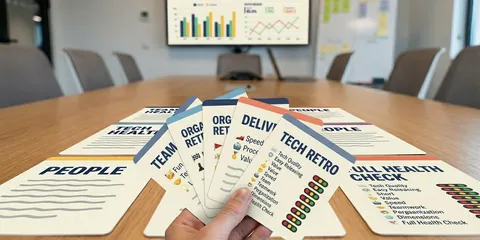
Health Check
All team members can answer the health checks anonymously on a scale. Then go through the results of the health checks together and record any additional comments if necessary. If you use the same health checks in several retrospectives, you can also track trends over time in Echometer.
- Speed: We get stuff done really quickly. No waiting, no delays.
- Tech Quality: We’re proud of the quality of our code! It is clean, easy to read, and has great test coverage.
- Learning: We’re learning lots of interesting stuff all the time!
- Mission: We know exactly why we are here, and we are really excited about it.
- Other items (customizable)
-
Discuss retro topics
Use the following open questions to collect your most important findings. First, everyone does it themselves, covered. Echometer allows you to reveal each column of the retro board individually in order to then present and group the feedback.
-
Catch-all question (Recommended)
So that other topics also have a place:
- What else would you like to talk about in the retro?
-
Prioritization / Voting (5 minutes)
On the retro board in Echometer, you can easily prioritize the feedback with voting. The voting is of course anonymous.
-
Define actions (10-20 minutes)
You can create a linked action via the plus symbol on a feedback. Not sure which measure would be the right one? Then open a whiteboard on the topic via the plus symbol instead to brainstorm root causes and possible measures.
-
Checkout / Closing (5 minutes)
Echometer enables you to collect anonymous feedback from the team on how helpful the retro was. This creates the ROTI score ("Return On Time Invested"), which you can track over time.
Spotify Health Check 👩🏻💻
Health Check Questions (Scale)

Scrum Retrospective Example & Sample #21
24. Health Check Retro: The 5 Agile Values
5 Agile Values Health Check 5️⃣: How the retro works
-
Random Icebreaker (2-5 minutes)
Echometer provides you with a generator for random check-in questions.
-
Review of open actions (2-5 minutes)
Before starting with new topics, you should talk about what has become of the measures from past retrospectives to check their effectiveness. Echometer automatically lists all open action items from past retros.
-
Health Check
All team members can answer the health checks anonymously on a scale. Then go through the results of the health checks together and record any additional comments if necessary. If you use the same health checks in several retrospectives, you can also track trends over time in Echometer.
- Courage: We value people showing courage.
- Respect: We value each other’s ideas, even when disagreeing.
- Commitment: Every team member is committed to follow through on what they have promised.
- Focus: We don’t allow ourselves to be distracted from reaching the sprint goal.
- Openness: We are open to constructive feedback and grow from it.
-
Discuss retro topics
Use the following open questions to collect your most important findings. First, everyone does it themselves, covered. Echometer allows you to reveal each column of the retro board individually in order to then present and group the feedback.
-
Catch-all question (Recommended)
So that other topics also have a place:
- What else would you like to talk about in the retro?
-
Prioritization / Voting (5 minutes)
On the retro board in Echometer, you can easily prioritize the feedback with voting. The voting is of course anonymous.
-
Define actions (10-20 minutes)
You can create a linked action via the plus symbol on a feedback. Not sure which measure would be the right one? Then open a whiteboard on the topic via the plus symbol instead to brainstorm root causes and possible measures.
-
Checkout / Closing (5 minutes)
Echometer enables you to collect anonymous feedback from the team on how helpful the retro was. This creates the ROTI score ("Return On Time Invested"), which you can track over time.
5 Agile Values Health Check 5️⃣
Health Check Questions (Scale)

Echometer Originals
7 Performance retrospective methods
Many retrospective methods are variations of the “What went well” retrospective. But even if these variations create a feeling of variety and demonstrably increase engagement, they bring little new insights. That’s exactly why we developed retrospectives that fix this problem.
Scrum Retrospective Example & Sample #25
25. Agile Delivery Retrospective ⚙️
Due to the massive cost savings that many companies are currently making, the topic of “Agile Delivery” is becoming increasingly important. Use this retro to check how your team is positioned in this regard.
If you want to find out more about this trending topic, take a look at this article: Increase your agility in 2024
⚙️ Agile Delivery Retrospective: How the retro works
-
Random Icebreaker (2-5 minutes)
Echometer provides you with a generator for random check-in questions.
-
Review of open actions (2-5 minutes)
Before starting with new topics, you should talk about what has become of the measures from past retrospectives to check their effectiveness. Echometer automatically lists all open action items from past retros.
-
Health Check
All team members can answer the health checks anonymously on a scale. Then go through the results of the health checks together and record any additional comments if necessary. If you use the same health checks in several retrospectives, you can also track trends over time in Echometer.
- We get things done really fast. No waiting, no delays.
- We are able to estimate exactly what we can deliver in a given cycle and with the given resources.
- Our sprint results do not require any post sprint rework to be delivered.
- We limit our 'work in progress' to be focused at all times.
-
Discuss retro topics
Use the following open questions to collect your most important findings. First, everyone does it themselves, covered. Echometer allows you to reveal each column of the retro board individually in order to then present and group the feedback.
- When has our way of working led to a suboptimal workflow? (e.g. unclear, unsuitable or unheeded guidelines)
- When has our way of working worked well?
- What are recent examples for an increment that wasn't working / shippable at the end of the cycle?
-
Catch-all question (Recommended)
So that other topics also have a place:
- What else would you like to talk about in the retro?
-
Prioritization / Voting (5 minutes)
On the retro board in Echometer, you can easily prioritize the feedback with voting. The voting is of course anonymous.
-
Define actions (10-20 minutes)
You can create a linked action via the plus symbol on a feedback. Not sure which measure would be the right one? Then open a whiteboard on the topic via the plus symbol instead to brainstorm root causes and possible measures.
-
Checkout / Closing (5 minutes)
Echometer enables you to collect anonymous feedback from the team on how helpful the retro was. This creates the ROTI score ("Return On Time Invested"), which you can track over time.
⚙️ Agile Delivery Retrospective
Health Check Questions (Scale)
Open questions

Scrum Retrospective Example & Sample #26
26. Team Commitments Retrospective 🤝
The current challenges require exceptional teamwork. Check whether your team is pulling together with this retro:
🤝Retro for Reflecting and Defining Team Commitments: How the retro works
-
Random Icebreaker (2-5 minutes)
Echometer provides you with a generator for random check-in questions.
-
Review of open actions (2-5 minutes)
Before starting with new topics, you should talk about what has become of the measures from past retrospectives to check their effectiveness. Echometer automatically lists all open action items from past retros.
-
Health Check
All team members can answer the health checks anonymously on a scale. Then go through the results of the health checks together and record any additional comments if necessary. If you use the same health checks in several retrospectives, you can also track trends over time in Echometer.
- As a team, we share a common understanding of what "good work" is.
-
Discuss retro topics
Use the following open questions to collect your most important findings. First, everyone does it themselves, covered. Echometer allows you to reveal each column of the retro board individually in order to then present and group the feedback.
- Handling of contradictory priorities: ‘When I encounter contradictory priorities, I …’
- Communication of blockers: ‘When I am stuck on a task, I announce this by …’
- Navigation of conflicts: ‘When I notice a conflict start to build up in our team, I …’
-
Catch-all question (Recommended)
So that other topics also have a place:
- What else would you like to talk about in the retro?
-
Prioritization / Voting (5 minutes)
On the retro board in Echometer, you can easily prioritize the feedback with voting. The voting is of course anonymous.
-
Define actions (10-20 minutes)
You can create a linked action via the plus symbol on a feedback. Not sure which measure would be the right one? Then open a whiteboard on the topic via the plus symbol instead to brainstorm root causes and possible measures.
-
Checkout / Closing (5 minutes)
Echometer enables you to collect anonymous feedback from the team on how helpful the retro was. This creates the ROTI score ("Return On Time Invested"), which you can track over time.
🤝Retro for Reflecting and Defining Team Commitments
Health Check Questions (Scale)
Open questions

Scrum Retrospective Example & Sample #27
27th Psychological Safety Retro 🧠
Especially in tough times, low-conflict collaboration is crucial. But for this to happen, everyone must also dare to talk about points of friction before they escalate. Having the security in the team to be able to express yourself at all times is also known as “psychological safety”. See how things are with you on this topic:
Psychological safety Health Check: How the retro works
-
Random Icebreaker (2-5 minutes)
Echometer provides you with a generator for random check-in questions.
-
Review of open actions (2-5 minutes)
Before starting with new topics, you should talk about what has become of the measures from past retrospectives to check their effectiveness. Echometer automatically lists all open action items from past retros.
-
Health Check
All team members can answer the health checks anonymously on a scale. Then go through the results of the health checks together and record any additional comments if necessary. If you use the same health checks in several retrospectives, you can also track trends over time in Echometer.
- I regularly receive useful feedback on how good my performance is and how I can improve.
- If a team member makes a mistake, they are not judged for it.
- You're allowed to not know things in our team.
- In conflicts, we talk on a factual level, so that no one feels personally attacked or judged.
-
Discuss retro topics
Use the following open questions to collect your most important findings. First, everyone does it themselves, covered. Echometer allows you to reveal each column of the retro board individually in order to then present and group the feedback.
- What else do we want to talk about?
-
Catch-all question (Recommended)
So that other topics also have a place:
- What else would you like to talk about in the retro?
-
Prioritization / Voting (5 minutes)
On the retro board in Echometer, you can easily prioritize the feedback with voting. The voting is of course anonymous.
-
Define actions (10-20 minutes)
You can create a linked action via the plus symbol on a feedback. Not sure which measure would be the right one? Then open a whiteboard on the topic via the plus symbol instead to brainstorm root causes and possible measures.
-
Checkout / Closing (5 minutes)
Echometer enables you to collect anonymous feedback from the team on how helpful the retro was. This creates the ROTI score ("Return On Time Invested"), which you can track over time.
Psychological safety Health Check
Health Check Questions (Scale)
Open questions

Scrum Retrospective Example & Sample #28
28. battery retrospective 🔋
Difficult times also put a strain on personal batteries. It is particularly important now to keep an eye on the team’s energy levels:
Battery retrospective: How the retro works
-
Random Icebreaker (2-5 minutes)
Echometer provides you with a generator for random check-in questions.
-
Review of open actions (2-5 minutes)
Before starting with new topics, you should talk about what has become of the measures from past retrospectives to check their effectiveness. Echometer automatically lists all open action items from past retros.
-
Discuss retro topics
Use the following open questions to collect your most important findings. First, everyone does it themselves, covered. Echometer allows you to reveal each column of the retro board individually in order to then present and group the feedback.
- How full is your personal battery as a percentage right now?
- What has drained your battery recently?
- What has recharged your battery recently?
- What would help you to save energy over the next few weeks?
-
Catch-all question (Recommended)
So that other topics also have a place:
- What else would you like to talk about in the retro?
-
Prioritization / Voting (5 minutes)
On the retro board in Echometer, you can easily prioritize the feedback with voting. The voting is of course anonymous.
-
Define actions (10-20 minutes)
You can create a linked action via the plus symbol on a feedback. Not sure which measure would be the right one? Then open a whiteboard on the topic via the plus symbol instead to brainstorm root causes and possible measures.
-
Checkout / Closing (5 minutes)
Echometer enables you to collect anonymous feedback from the team on how helpful the retro was. This creates the ROTI score ("Return On Time Invested"), which you can track over time.
Battery retrospective

Scrum Retrospective Example & Sample #29
29th Future-Spektive (Future Retrospective) 🔜
In rapidly changing environments, you should not only reflect on what has happened, but also dare to look into the unknown. How do you want to act in the future?
🔮 Futurespective: How the retro works
-
Random Icebreaker (2-5 minutes)
Echometer provides you with a generator for random check-in questions.
-
Review of open actions (2-5 minutes)
Before starting with new topics, you should talk about what has become of the measures from past retrospectives to check their effectiveness. Echometer automatically lists all open action items from past retros.
-
Discuss retro topics
Use the following open questions to collect your most important findings. First, everyone does it themselves, covered. Echometer allows you to reveal each column of the retro board individually in order to then present and group the feedback.
- What is the most important milestone you would like to see us achieve as a team in the next week(s)?
- Which hurdle should we focus on overcoming in the coming weeks?
- What would you be particularly grateful for in the coming week(s)?
-
Catch-all question (Recommended)
So that other topics also have a place:
- What else would you like to talk about in the retro?
-
Prioritization / Voting (5 minutes)
On the retro board in Echometer, you can easily prioritize the feedback with voting. The voting is of course anonymous.
-
Define actions (10-20 minutes)
You can create a linked action via the plus symbol on a feedback. Not sure which measure would be the right one? Then open a whiteboard on the topic via the plus symbol instead to brainstorm root causes and possible measures.
-
Checkout / Closing (5 minutes)
Echometer enables you to collect anonymous feedback from the team on how helpful the retro was. This creates the ROTI score ("Return On Time Invested"), which you can track over time.
🔮 Futurespective

Scrum Retrospective Example & Sample #30
30th bottleneck retrospective ♾️
The days of an abundance of money are over. This often results in new bottlenecks to which work must adapt:
🔮 Futurespective: How the retro works
-
Random Icebreaker (2-5 minutes)
Echometer provides you with a generator for random check-in questions.
-
Review of open actions (2-5 minutes)
Before starting with new topics, you should talk about what has become of the measures from past retrospectives to check their effectiveness. Echometer automatically lists all open action items from past retros.
-
Discuss retro topics
Use the following open questions to collect your most important findings. First, everyone does it themselves, covered. Echometer allows you to reveal each column of the retro board individually in order to then present and group the feedback.
- Our bottleneck: What is the critical part in our structures and processes that determines how much we can achieve as a team?
- What options are there for eliminating this one bottleneck?
-
Catch-all question (Recommended)
So that other topics also have a place:
- What else would you like to talk about in the retro?
-
Prioritization / Voting (5 minutes)
On the retro board in Echometer, you can easily prioritize the feedback with voting. The voting is of course anonymous.
-
Define actions (10-20 minutes)
You can create a linked action via the plus symbol on a feedback. Not sure which measure would be the right one? Then open a whiteboard on the topic via the plus symbol instead to brainstorm root causes and possible measures.
-
Checkout / Closing (5 minutes)
Echometer enables you to collect anonymous feedback from the team on how helpful the retro was. This creates the ROTI score ("Return On Time Invested"), which you can track over time.
🔮 Futurespective

In this retrospective, you and your team can analyze exactly how well the OKRs have been defined and implemented:
Scrum Retrospective Example & Sample #31
31st OKR Retrospective 🏹
In this retrospective, you and your team can analyze exactly how well the OKRs have been defined and implemented:
DAKI Retro: How the retro works
-
Random Icebreaker (2-5 minutes)
Echometer provides you with a generator for random check-in questions.
-
Review of open actions (2-5 minutes)
Before starting with new topics, you should talk about what has become of the measures from past retrospectives to check their effectiveness. Echometer automatically lists all open action items from past retros.
-
Discuss retro topics
Use the following open questions to collect your most important findings. First, everyone does it themselves, covered. Echometer allows you to reveal each column of the retro board individually in order to then present and group the feedback.
- Which key results were achieved?
- Which key results were not achieved and why?
- How can key results be better formulated in the future?
- Did the achievement of the key results also lead to the achievement of the objectives (overarching goal)?
- Are there better key results to achieve the actual objectives?
-
Catch-all question (Recommended)
So that other topics also have a place:
- What else would you like to talk about in the retro?
-
Prioritization / Voting (5 minutes)
On the retro board in Echometer, you can easily prioritize the feedback with voting. The voting is of course anonymous.
-
Define actions (10-20 minutes)
You can create a linked action via the plus symbol on a feedback. Not sure which measure would be the right one? Then open a whiteboard on the topic via the plus symbol instead to brainstorm root causes and possible measures.
-
Checkout / Closing (5 minutes)
Echometer enables you to collect anonymous feedback from the team on how helpful the retro was. This creates the ROTI score ("Return On Time Invested"), which you can track over time.
DAKI Retro

Echometer Originals
Something different for a change? - Crazy retro templates!
Not everything has to be taken seriously:
Scrum Retrospective Example & Sample #32
32nd Alien Invasion Retrospective 👽
What would you do in the event of an alien invasion? Probably it will never happen, but it is almost certain that other unforeseen things will happen. With this you can prepare your team top.
Alien Invasion Retrospective: How the retro works
-
Random Icebreaker (2-5 minutes)
Echometer provides you with a generator for random check-in questions.
-
Review of open actions (2-5 minutes)
Before starting with new topics, you should talk about what has become of the measures from past retrospectives to check their effectiveness. Echometer automatically lists all open action items from past retros.
-
Discuss retro topics
Use the following open questions to collect your most important findings. First, everyone does it themselves, covered. Echometer allows you to reveal each column of the retro board individually in order to then present and group the feedback.
- New species: what things have you encountered that you didn't expect?
- Alien-Tech: What took your work to new heights this week?
- Armageddon: Where have you seen your work go down?
-
Catch-all question (Recommended)
So that other topics also have a place:
- What else would you like to talk about in the retro?
-
Prioritization / Voting (5 minutes)
On the retro board in Echometer, you can easily prioritize the feedback with voting. The voting is of course anonymous.
-
Define actions (10-20 minutes)
You can create a linked action via the plus symbol on a feedback. Not sure which measure would be the right one? Then open a whiteboard on the topic via the plus symbol instead to brainstorm root causes and possible measures.
-
Checkout / Closing (5 minutes)
Echometer enables you to collect anonymous feedback from the team on how helpful the retro was. This creates the ROTI score ("Return On Time Invested"), which you can track over time.
Alien Invasion Retrospective

Scrum Retrospective Example & Sample #233
26. Drum Roll… The Circus Retrospective 🤡
Clear the ring for the most varied retro, which also takes place in a tent:
Circus Retrospective: How the retro works
-
Random Icebreaker (2-5 minutes)
Echometer provides you with a generator for random check-in questions.
-
Review of open actions (2-5 minutes)
Before starting with new topics, you should talk about what has become of the measures from past retrospectives to check their effectiveness. Echometer automatically lists all open action items from past retros.
-
Discuss retro topics
Use the following open questions to collect your most important findings. First, everyone does it themselves, covered. Echometer allows you to reveal each column of the retro board individually in order to then present and group the feedback.
- Juggler: What tasks did you have to juggle that made you sweat?
- Acrobat: What helped you to align yourself more flexibly?
- Magician: What would you most like to conjure up that has been missing so far?
-
Catch-all question (Recommended)
So that other topics also have a place:
- What else would you like to talk about in the retro?
-
Prioritization / Voting (5 minutes)
On the retro board in Echometer, you can easily prioritize the feedback with voting. The voting is of course anonymous.
-
Define actions (10-20 minutes)
You can create a linked action via the plus symbol on a feedback. Not sure which measure would be the right one? Then open a whiteboard on the topic via the plus symbol instead to brainstorm root causes and possible measures.
-
Checkout / Closing (5 minutes)
Echometer enables you to collect anonymous feedback from the team on how helpful the retro was. This creates the ROTI score ("Return On Time Invested"), which you can track over time.
Circus Retrospective

Retrospective Examples & Samples - Conclusion
With all these retrospective samples and examples, you’re sure to find the right sample for your next retro. If not, we have even more in our retro board software tool Echometer.
Retrospective Templates: Some Final Notes
If you have any more retrospective examples or ideas for an agile retrospective template or would like to give us feedback… - just write to us.
And if you’re looking for a free online retro board software for retrospectives, you may have seen that Echometer is just that. Have fun trying out the different retro templates in our tool 😄

"Many team members are afraid to speak up!"
Solve this challenge
"We discover too many unexpected issues & bugs at a late stage!"
Solve this challenge
"Why does it sometimes take me hours to prepare a simple retrospective?"
Solve this challenge