
Set goals that really take teams forward

There is hardly a technique in psychology that is more suitable to provide more motivation: good goals. In some companies it is still common to say: “Do your best.” It is proven: Specific, ambitious goals almost always lead to higher performance.

But how should these goals be designed so that the likelihood that they will be implemented is as high as possible?

Good goals are SMART

First, goals should be designed according to the SMART formula. That is, goals should have these five characteristics:

S - specific
M - measurable
A - appealing
R - realistic
T - terminated 

This could be the example of a manager from a cell phone manufacturer who wants to better convey the meaning of work to his employees:

  • Specific & measurable: “I take one hour each week for each of my employees.”

  • Appealing: “Through more regular exchanges with my employees, I will get to know them better and be better able to respond to their needs.”

  • Realistic: “I will exchange ideas with them at lunch so that I don’t lose any time.”

  • Terminated: “Every Tuesday at 12:00 noon, I will speak with a fixed team member for lunch in a fixed order.”

If your goal meets these criteria, that’s a good thing. However, sometimes it is difficult to set such goals in a meaningful way. What could that be?

Learning vs. performance goals

It could be because you set a performance goal, although learning goals would be appropriate. 

For example, as a startup, we initially set ourselves the goal to reach at least 400 website visitors per month in 60 days. We only had 200 at the beginning. This roughly corresponds to the SMART criteria.

However, we had little idea how online marketing actually works in the beginning. And in this respect also a small chance of reaching the goal. 

We set a performance goal there - although a learning goal would have been better here. A better goal would have been: We will find out and try out 5 methods within the next 30 days with which you can potentially get new website visitors. So the focus here is on learning something.

The more uncertain the general conditions are - in our case we had hardly any idea about online marketing - the more effective it is to set learning goals.

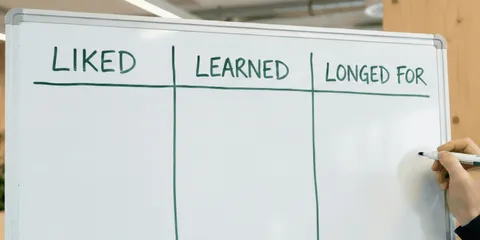
How safe are the general conditions for you? Are learning or performance goals appropriate? If you want to reflect on your goals in a targeted manner, take a look at our target retro.

Blog category

More articles on "transformation"

View all articles in this category
Driving an agile corporate culture with change management

Driving an agile corporate culture with change management

Promoting an agile corporate culture through change management: self-reflection, new methods and continuous feedback for sustainable cultural change.

Checklist: 21 Habits for (new) People Managers (PDF)

Checklist: 21 Habits for (new) People Managers (PDF)

Improve your leadership behavior with our checklist for People Managers! Discover 21 habits of successful leaders and download the PDF template.

Getting started with agile work - Agile Explorers

Getting started with agile work - Agile Explorers

Agile working made easy: Discover how teams establish agility in everyday life. Success factors such as communication, a culture of learning from mistakes, and customer proximity in focus.

Spiral Dynamics (PDF) - A groundbreaking development theory

Spiral Dynamics (PDF) - A groundbreaking development theory

The Spiral Dynamics PDF explains the theory of Beck/Cowan: background, test & application for organizational development. Download the summary now!

In a nutshell: Change management model according to Kotter

In a nutshell: Change management model according to Kotter

Kotter's change management model helps companies in the VUCA world. We explain the 8-stage model, from urgency to anchoring in the culture.

Scrum Master Salary: A brief overview of the Numbers

Scrum Master Salary: A brief overview of the Numbers

What is the Scrum Master salary? We provide an overview of salaries in Germany, the USA, and the UK. Including influencing factors such as experience and industry.

A Framework to understand & change Organizational Culture

A Framework to understand & change Organizational Culture

How do you understand and change your organizational culture? We'll show you frameworks, examples (Amazon, Google, startups) and techniques for development.

Revolutionizing Organizational Development: Reinventing Organizations by Frederic Laloux (Summary)

Revolutionizing Organizational Development: Reinventing Organizations by Frederic Laloux (Summary)

Discover Frederic Laloux's "Reinventing Organizations"! This summary explains agile organizational development and Teal organizations in a simple way.

360-degree feedback review: 21 indispensable measures

360-degree feedback review: 21 indispensable measures

Learn all about 360-degree feedback: Discover 21 measures for successful implementation and avoid criticism. Promote employee development!

Echometer Newsletter

Don't miss updates on Echometer & get inspiration for agile working