Reflect, Refine, Repeat: Retrospectives in UX Design
User experience (UX) design is the process of developing products that provide users with meaningful, relevant, and enjoyable experiences.
In today’s business world, UX design is a key aspect of product development thanks to its people-centric approach.
Its importance stems from its potential to influence user satisfaction and loyalty through usability, utility, and attractiveness when interacting with a product.

But like any other iterative design process, UX design requires constant evaluation and refinement. This is where retrospectives come into play, which we will discuss in detail in this blog post.
Reflect, Refine, Repeat: Retrospectives in UX Design
Learning about UX design:
UX design is about creating a user-friendly, efficient, and enjoyable product.
It focuses on the needs and desires of users and aims to provide a seamless, intuitive experience.
UX design goes beyond just aesthetics; it also includes functionality, accessibility, and overall usability.
By understanding the user journey, UX designers create interactions that provide maximum satisfaction and usability.
In a competitive market, good UX design is a key differentiator that can lead to customer loyalty and business success.
If you are new to this area, you can use the Learn UX design with Uxcel, to develop the capabilities you need to deliver a great user experience.
Reflect, Refine, Repeat: Retrospectives in UX Design
The purpose of retrospectives:
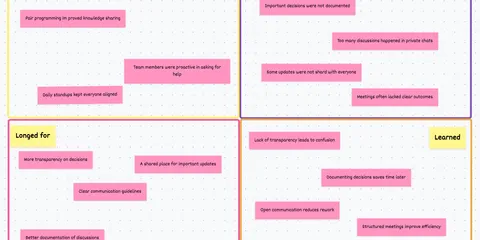
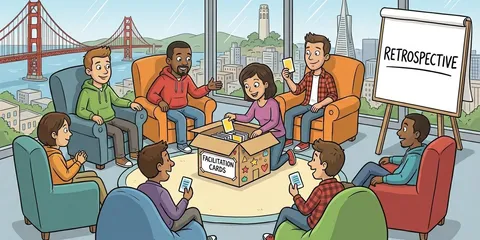
The main goal of a retrospective is to foster an environment of collective reflection.
It provides a platform for UX designers to reflect on their design decisions, understand the impact of those decisions, and evaluate the success and shortcomings of a completed project or sprint.
It allows teams to examine the intricacies of their work from conception to final deliverables and identify areas for improvement.
Regular retrospectives offer a wealth of benefits for UX design teams. Some of the most important benefits are:
- Improved team cohesion and collaboration - Retrospectives enable teams to openly discuss their thoughts and concerns, thus contributing to building mutual respect, trust, and understanding, which form the basis for effective collaboration.
- Improved problem solving skills - Retrospectives foster a culture of proactive problem identification and resolution. Over time, this practice improves the team’s ability to troubleshoot issues, leading to more robust and reliable design solutions.
- Higher efficiency - By continuously refining workflows and removing obstacles, retrospectives can increase team efficiency, resulting in faster project completion and higher productivity.
- Increased morale - Celebrating successes and learning from failures during retrospectives can contribute to a positive team atmosphere, boosting morale and increasing job satisfaction.
Retrospectives in UX design serve as an important mechanism for reflection, refinement, and iteration, ultimately leading to better design practices and outcomes.

Reflect, Refine, Repeat: Retrospectives in UX Design
The three phases of a retrospective:
The retrospective process has three crucial phases: Reflect, Refine, and Repeat. Let’s look at them in detail:
1. The reflection phase
Reflection, the first phase of the retrospective process, is the cornerstone of learning.
This phase is about reviewing the design process and outcomes, reflecting on successes and shortcomings, and gaining a holistic understanding of the project.
Reflection aims to create a collective awareness of the actions taken and their consequences.
Questions that facilitate reflection could be:
- What were our greatest successes?
- Where did we face challenges?
- How effective were our communications and collaboration?
Techniques such as SWOT analysis can help structure the reflection process.
2. The refinement phase
Refinement is the second phase of retrospective and focuses on constructive analysis and evaluation.
Here, the team analyzes the findings from the reflection phase, identifies areas for improvement, and looks for ways to improve the UX design process.
You can use some of the best retrospective tools to help you through this process: Go to retro tool comparison
This phase addresses questions such as:
- How can we build on our successes?
- What actions can we take to address our challenges?
- How can we improve our collaboration and communication?
Techniques like the “5 Whys” can be used for root cause analysis, while brainstorming sessions can facilitate idea generation for improvements.
3. The repetition phase
Repetition, the final phase of retrospective, is about learning from the past and applying it to the future.
It is a testament to the belief that learning is continuous and mistakes are a springboard for improvement.
Here, the team commits to implementing the findings and improvement plans from the previous phases in subsequent UX design projects.
This phase underscores the concept of iteration - in UX design, there is always room for improvement, for trying new techniques, for evolving. It embodies the essence of Agile - reflect, refine, repeat.
The team is encouraged to carry the learnings from each retrospective into future sprints, fostering a culture of continuous improvement and progressive development.
The Repeat phase is a gentle reminder that each retrospective provides valuable lessons, and that consistent application of those lessons can improve UX design processes and outcomes.

Reflect, Refine, Repeat: Retrospectives in UX Design
Best practices for conducting retrospectives:
Conducting effective retrospectives can significantly improve your UX design processes and outcomes.
Let’s take a look at some of the best practices and ideas for retrospectives that you can use to improve this process:
- Create a safe environment - They should foster open, honest communication and ensure that all employees feel safe sharing their thoughts, experiences, and concerns. Encourage a culture of constructive criticism and mutual respect.
- Structure the meeting - A structured format helps keep the meeting focused and productive. A retrospective should typically include several phases, such as setting the stage, gathering data, generating insights, deciding on actions, and closing the retrospective.
- Use moderation techniques - Techniques such as the “Five Whys”, “Start, Stop, Continue” and the “SWOT analysis” can facilitate the reflection and improvement process. Visual aids such as sticky notes, whiteboards, or digital collaboration tools can also be helpful.
- Involve the entire team - Every member of the UX team, from researcher to designer, should be involved in the retrospective. Each individual’s perspective is unique and can provide valuable insights.
- Focus on improvements - The goal of a retrospective is not to assign blame, but to learn and improve. Focus on the processes, not on individuals. Focus on processes, not on individuals.
- Take actionable steps - The insights gained during a retrospective should lead to actionable steps. Ensure that each action item is assigned to someone and followed up on in subsequent retrospectives.
- Conduct regular retrospectives - Ideally at the end of each project, sprint, or major milestone. Regular retrospectives ensure continuous learning and improvement.
- Do not forget to celebrate successes - While retrospectives often focus on areas for improvement, it is equally important to celebrate the team’s successes. This can boost team members’ morale and sense of accomplishment.
Remember, the goal of a retrospective is not just to look back, but to move forward more effectively.
By following these best practices, you can ensure that your retrospectives become a driving force for continuous improvement in your UX design process.

Reflect, Refine, Repeat: Retrospectives in UX Design
The importance of retrospectives in UX design:
In UX design, retrospectives are a powerful tool for continuous improvement.
With a cycle of reflection, refinement, and repetition, your team can learn from past experiences to help your organization have a better future.
As your team continues this iterative process, not only will the products improve, but so will the design methods and user experience.
FAQ - Retrospectives in UX Design:
How often should we conduct retrospectives?
Retrospectives should ideally be conducted regularly - at the end of each project, sprint, or major milestone. Regular retrospectives ensure continuous learning and improvements in your UX design process.
Can retrospectives be conducted remotely?
Yes, retrospectives can be conducted remotely using a variety of digital collaboration tools. These tools can facilitate discussion, record insights, and track action items, making the retrospective process just as effective as an in-person meeting.
Are retrospectives just about discussing mistakes?
No, retrospectives are not just about discussing mistakes. They’re also about celebrating successes, sharing insights and discussing improvements. The goal is to create an open and positive environment for continuous learning and growth.
What should be the main outcome of a retrospective?
The most important outcome of a retrospective should be actionable steps for improvement. These steps, resulting from the findings of the retrospective, should be assigned to team members and reviewed in subsequent retrospectives.
Can retrospectives be used in areas other than UX design?
Yes, although this article focuses on retrospectives in UX design, the concept is applicable in a variety of fields, especially those that use agile or lean methodologies. Teams in software development, marketing, human resources, and many other fields use retrospectives to improve their processes and outcomes.

Author bio:
Kerry Leigh Harrison has more than 11 years’ experience as a copywriter. She graduated from university with a First Class Hons Degree in Multimedia Journalism. In her spare time, she enjoys attending sporting and music events.