
26 Fun & Fresh Agile Retrospective Templates in 2026
Agile Retrospective Templates are one of the core elements for the quick preparation of first-class retrospectives. Thats why I am happy to present you 22 cool Agile Retrospective Templates. Some of them you will have seen before, but many will be new. But before we start with the templates, here is some important information to make your next retrospective a success.
What makes a retrospective successful?
Before we dive into the templates for agile retrospectives, let’s take a quick look at what makes a retrospective successful.
As always, there is no such thing as the ideal retrospective, although there are clues as to what makes one retrospective more successful than others. As a company that helps thousands of teams run better retrospectives, we’ve now gained insight into well over 30,000 retrospectives and have been able to identify commonalities in retrospectives that have been identified as particularly successful.
The most influential factors are:
- The most successful day of the week for a retrospective is Friday, although most retrospectives are held on Wednesday.
- The ideal duration for a retrospective is between 30 and 60 minutes. Short retrospectives tend to be more satisfying.
- Smaller teams hold better retrospectives. - Make sure that the number of participants in a retrospective remains manageable.
- 7-14 days is the perfect frequency for retrospectives.
If you want to get a deeper insight into the best practices of the 30,000 retrospectives, feel free to read our article on the subject: Analysis of 30k retrospectives
If you’re interested in improving your retrospectives, here are some more resources on that:
- An entry guide for retrospectives.
- How to define valuable “measures”.
- Our full retrospective agenda.
- “Psychological safety” for agile teams.
- The best retro check-ins for any situation.
And now let’s start with the agile retrospective templates…
To start: 9 agile retrospective template classics
Let’s start with the “best” templates for agile retrospectives - or at least the 9 most common ones, before we focus on the “Echometer Originals”.
If you want to get started with one of these retrospectives right away, just click the button next to it to open Echometer and try our agile retrospective templates for free.
Agile Retrospective Template 1
1. The ‘What went well’ retrospective 👍
The “What Went Well” retrospective is probably the most popular or well-known among all retrospective templates. It is based on the pattern we find in many other retrospectives, but simply without all the gimmicks around it:
What went well retro 👍: How the retro works
-
Random Icebreaker (2-5 minutes)
Echometer provides you with a generator for random check-in questions.
-
Review of open actions (2-5 minutes)
Before starting with new topics, you should talk about what has become of the measures from past retrospectives to check their effectiveness. Echometer automatically lists all open action items from past retros.
-
Discuss retro topics
Use the following open questions to collect your most important findings. First, everyone does it themselves, covered. Echometer allows you to reveal each column of the retro board individually in order to then present and group the feedback.
- What went well?
- What went not so well?
- How can we improve?
-
Catch-all question (Recommended)
So that other topics also have a place:
- What else would you like to talk about in the retro?
-
Prioritization / Voting (5 minutes)
On the retro board in Echometer, you can easily prioritize the feedback with voting. The voting is of course anonymous.
-
Define actions (10-20 minutes)
You can create a linked action via the plus symbol on a feedback. Not sure which measure would be the right one? Then open a whiteboard on the topic via the plus symbol instead to brainstorm root causes and possible measures.
-
Checkout / Closing (5 minutes)
Echometer enables you to collect anonymous feedback from the team on how helpful the retro was. This creates the ROTI score ("Return On Time Invested"), which you can track over time.
What went well retro 👍

Agile Retrospective Template 2
2. The ‘Mad Sad Glad’ retrospective 😯
The “Mad Sad Glad” retrospective method has a similar pattern, but uses three typical emotions to make it a bit more interesting and also more tangible for the team:
Mad Sad Glad retro 😯: How the retro works
-
Random Icebreaker (2-5 minutes)
Echometer provides you with a generator for random check-in questions.
-
Review of open actions (2-5 minutes)
Before starting with new topics, you should talk about what has become of the measures from past retrospectives to check their effectiveness. Echometer automatically lists all open action items from past retros.
-
Discuss retro topics
Use the following open questions to collect your most important findings. First, everyone does it themselves, covered. Echometer allows you to reveal each column of the retro board individually in order to then present and group the feedback.
- What made you mad? 😤
- What made you sad? 😢
- What made you glad? 🤩
-
Catch-all question (Recommended)
So that other topics also have a place:
- What else would you like to talk about in the retro?
-
Prioritization / Voting (5 minutes)
On the retro board in Echometer, you can easily prioritize the feedback with voting. The voting is of course anonymous.
-
Define actions (10-20 minutes)
You can create a linked action via the plus symbol on a feedback. Not sure which measure would be the right one? Then open a whiteboard on the topic via the plus symbol instead to brainstorm root causes and possible measures.
-
Checkout / Closing (5 minutes)
Echometer enables you to collect anonymous feedback from the team on how helpful the retro was. This creates the ROTI score ("Return On Time Invested"), which you can track over time.
Mad Sad Glad retro 😯

Agile Retrospective Template 3
3. Start Stop Keep or Start Stop Continue 🔖
The Scrum retrospective Start Stop Keep is also known as the Start Stop Continue retrospective. I highly recommend making it the “Keep Stop Start” retro (pay attention to the order). This way you start the retro with something positive, which has proven to be a good entry point:
Keep stop start retro: How the retro works
-
Random Icebreaker (2-5 minutes)
Echometer provides you with a generator for random check-in questions.
-
Review of open actions (2-5 minutes)
Before starting with new topics, you should talk about what has become of the measures from past retrospectives to check their effectiveness. Echometer automatically lists all open action items from past retros.
-
Discuss retro topics
Use the following open questions to collect your most important findings. First, everyone does it themselves, covered. Echometer allows you to reveal each column of the retro board individually in order to then present and group the feedback.
- Keep: What should we keep?
- Stop: What should we stop doing?
- Start: What should we start doing?
-
Catch-all question (Recommended)
So that other topics also have a place:
- What else would you like to talk about in the retro?
-
Prioritization / Voting (5 minutes)
On the retro board in Echometer, you can easily prioritize the feedback with voting. The voting is of course anonymous.
-
Define actions (10-20 minutes)
You can create a linked action via the plus symbol on a feedback. Not sure which measure would be the right one? Then open a whiteboard on the topic via the plus symbol instead to brainstorm root causes and possible measures.
-
Checkout / Closing (5 minutes)
Echometer enables you to collect anonymous feedback from the team on how helpful the retro was. This creates the ROTI score ("Return On Time Invested"), which you can track over time.
Keep stop start retro

Agile Retrospective Template 4
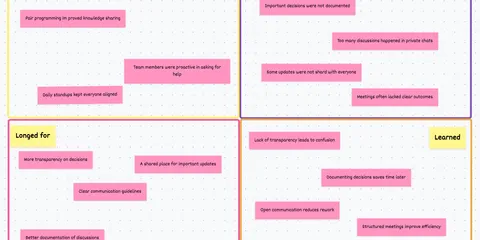
4. Liked, Learned, Lacked, Longed for: 4-L Retrospective 📘
The retrospective “Liked, Learned, Lacked, Longed for” is called the 4L retrospective. The reason why this is so is, I think, clear:
4L retro 📘: How the retro works
-
Random Icebreaker (2-5 minutes)
Echometer provides you with a generator for random check-in questions.
-
Review of open actions (2-5 minutes)
Before starting with new topics, you should talk about what has become of the measures from past retrospectives to check their effectiveness. Echometer automatically lists all open action items from past retros.
-
Discuss retro topics
Use the following open questions to collect your most important findings. First, everyone does it themselves, covered. Echometer allows you to reveal each column of the retro board individually in order to then present and group the feedback.
- Like: What did you like?
- Learned: What did you learn?
- Lacked: What did you lack?
- Longed for: What did you long for?
-
Catch-all question (Recommended)
So that other topics also have a place:
- What else would you like to talk about in the retro?
-
Prioritization / Voting (5 minutes)
On the retro board in Echometer, you can easily prioritize the feedback with voting. The voting is of course anonymous.
-
Define actions (10-20 minutes)
You can create a linked action via the plus symbol on a feedback. Not sure which measure would be the right one? Then open a whiteboard on the topic via the plus symbol instead to brainstorm root causes and possible measures.
-
Checkout / Closing (5 minutes)
Echometer enables you to collect anonymous feedback from the team on how helpful the retro was. This creates the ROTI score ("Return On Time Invested"), which you can track over time.
4L retro 📘

Agile Retrospective Template 5
5. The Sailboat Retrospective ⛵️
Sailboat Retro is the first image-painting retro in this list of Agile Retrospective Templates. So get ready and weigh anchor:
Sailboat retro ⛵️: How the retro works
-
Random Icebreaker (2-5 minutes)
Echometer provides you with a generator for random check-in questions.
-
Review of open actions (2-5 minutes)
Before starting with new topics, you should talk about what has become of the measures from past retrospectives to check their effectiveness. Echometer automatically lists all open action items from past retros.
-
Discuss retro topics
Use the following open questions to collect your most important findings. First, everyone does it themselves, covered. Echometer allows you to reveal each column of the retro board individually in order to then present and group the feedback.
- ⚓️ Your anchor: What holds us back?
- 🦈🧊 Your shark/iceberg: Which dangers or obstacles approach us?
- 💨 Your tailwind: What drives us forward?
- 🏝💰 Your paradise: What achievement or milestones are we working towards?
-
Catch-all question (Recommended)
So that other topics also have a place:
- What else would you like to talk about in the retro?
-
Prioritization / Voting (5 minutes)
On the retro board in Echometer, you can easily prioritize the feedback with voting. The voting is of course anonymous.
-
Define actions (10-20 minutes)
You can create a linked action via the plus symbol on a feedback. Not sure which measure would be the right one? Then open a whiteboard on the topic via the plus symbol instead to brainstorm root causes and possible measures.
-
Checkout / Closing (5 minutes)
Echometer enables you to collect anonymous feedback from the team on how helpful the retro was. This creates the ROTI score ("Return On Time Invested"), which you can track over time.
Sailboat retro ⛵️

Agile Retrospective Template 6
6. DAKI (Drop Add Keep Improve) retrospective ✂️
The DAKI retrospective, standing for the English words “Drop Add Keep Improve”, is a simple acronym that is also classically used as a retrospective method. (More detailed information on the DAKI retrospective: 2 tips for the DAKI retrospective incl. examples )
DAKI retro: How the retro works
-
Random Icebreaker (2-5 minutes)
Echometer provides you with a generator for random check-in questions.
-
Review of open actions (2-5 minutes)
Before starting with new topics, you should talk about what has become of the measures from past retrospectives to check their effectiveness. Echometer automatically lists all open action items from past retros.
-
Discuss retro topics
Use the following open questions to collect your most important findings. First, everyone does it themselves, covered. Echometer allows you to reveal each column of the retro board individually in order to then present and group the feedback.
- Drop: What should we drop?
- Add: What should we add?
- Keep: What should we keep?
- Improve: What should we improve?
-
Catch-all question (Recommended)
So that other topics also have a place:
- What else would you like to talk about in the retro?
-
Prioritization / Voting (5 minutes)
On the retro board in Echometer, you can easily prioritize the feedback with voting. The voting is of course anonymous.
-
Define actions (10-20 minutes)
You can create a linked action via the plus symbol on a feedback. Not sure which measure would be the right one? Then open a whiteboard on the topic via the plus symbol instead to brainstorm root causes and possible measures.
-
Checkout / Closing (5 minutes)
Echometer enables you to collect anonymous feedback from the team on how helpful the retro was. This creates the ROTI score ("Return On Time Invested"), which you can track over time.
DAKI retro

Agile Retrospective Template 7
7. The Three Little Pigs Retro 🐷
The “Three Little Pigs” retrospective is based on the fairy tale of the same name, in which 3 pigs build three houses from completely different materials. Of course, the three houses are built with different levels of robustness. The question is - from what material are the results in your team built?
Three little pigs retro 🐷: How the retro works
-
Random Icebreaker (2-5 minutes)
Echometer provides you with a generator for random check-in questions.
-
Review of open actions (2-5 minutes)
Before starting with new topics, you should talk about what has become of the measures from past retrospectives to check their effectiveness. Echometer automatically lists all open action items from past retros.
-
Discuss retro topics
Use the following open questions to collect your most important findings. First, everyone does it themselves, covered. Echometer allows you to reveal each column of the retro board individually in order to then present and group the feedback.
- House of straw: What do we do that is just holding together, but could topple over at any moment? 🌱
- House of sticks: What do we do that is relatively stable, but could be improved?\n 🪵
- House of bricks: What do we do that is rock solid? 🪨
-
Catch-all question (Recommended)
So that other topics also have a place:
- What else would you like to talk about in the retro?
-
Prioritization / Voting (5 minutes)
On the retro board in Echometer, you can easily prioritize the feedback with voting. The voting is of course anonymous.
-
Define actions (10-20 minutes)
You can create a linked action via the plus symbol on a feedback. Not sure which measure would be the right one? Then open a whiteboard on the topic via the plus symbol instead to brainstorm root causes and possible measures.
-
Checkout / Closing (5 minutes)
Echometer enables you to collect anonymous feedback from the team on how helpful the retro was. This creates the ROTI score ("Return On Time Invested"), which you can track over time.
Three little pigs retro 🐷

Agile Retrospective Template 8
8. The Starfish Sprint Retrospective ⭐️
The Starfish sprint retrospective is particularly interesting visually: 5 questions are asked, which can be optimally divided into the columns of a starfish. The sprint retrospective “Starfish” tends to take a bit longer with 5 questions.
Starfish retro ⭐️: How the retro works
-
Random Icebreaker (2-5 minutes)
Echometer provides you with a generator for random check-in questions.
-
Review of open actions (2-5 minutes)
Before starting with new topics, you should talk about what has become of the measures from past retrospectives to check their effectiveness. Echometer automatically lists all open action items from past retros.
-
Discuss retro topics
Use the following open questions to collect your most important findings. First, everyone does it themselves, covered. Echometer allows you to reveal each column of the retro board individually in order to then present and group the feedback.
- Keep: [Optional: Looking at the last sprint / weeks] What should we keep doing, keep as it is?
- Stop: What should we stop doing?
- Start: What should we start doing?
- More: What should we do more of?
- Less: What should we do less of?
-
Catch-all question (Recommended)
So that other topics also have a place:
- What else would you like to talk about in the retro?
-
Prioritization / Voting (5 minutes)
On the retro board in Echometer, you can easily prioritize the feedback with voting. The voting is of course anonymous.
-
Define actions (10-20 minutes)
You can create a linked action via the plus symbol on a feedback. Not sure which measure would be the right one? Then open a whiteboard on the topic via the plus symbol instead to brainstorm root causes and possible measures.
-
Checkout / Closing (5 minutes)
Echometer enables you to collect anonymous feedback from the team on how helpful the retro was. This creates the ROTI score ("Return On Time Invested"), which you can track over time.
Starfish retro ⭐️

Agile Retrospective Template 9
9. Thumbs Up, Thumbs Down Retro🤙
This agile retrospective template basically has a very similar structure to the “What Went Well Retro”. Only a fourth question has been added here, which makes the small but subtle difference:
Thumbs up/down retro: How the retro works
-
Random Icebreaker (2-5 minutes)
Echometer provides you with a generator for random check-in questions.
-
Review of open actions (2-5 minutes)
Before starting with new topics, you should talk about what has become of the measures from past retrospectives to check their effectiveness. Echometer automatically lists all open action items from past retros.
-
Discuss retro topics
Use the following open questions to collect your most important findings. First, everyone does it themselves, covered. Echometer allows you to reveal each column of the retro board individually in order to then present and group the feedback.
- What do you give a "thumbs up" to?
- What do you give a "thumbs down" for?
- Which new ideas do you have?
- Who or what do you want to recognize, highlight positively?
-
Catch-all question (Recommended)
So that other topics also have a place:
- What else would you like to talk about in the retro?
-
Prioritization / Voting (5 minutes)
On the retro board in Echometer, you can easily prioritize the feedback with voting. The voting is of course anonymous.
-
Define actions (10-20 minutes)
You can create a linked action via the plus symbol on a feedback. Not sure which measure would be the right one? Then open a whiteboard on the topic via the plus symbol instead to brainstorm root causes and possible measures.
-
Checkout / Closing (5 minutes)
Echometer enables you to collect anonymous feedback from the team on how helpful the retro was. This creates the ROTI score ("Return On Time Invested"), which you can track over time.
Thumbs up/down retro

Echometer Originals
Agile Retrospective Templates Your Team Hasn’t Seen…
Now you know perhaps the best or at least most common retrospective methods. However, since agile teams usually like to use a new method regularly (or at least their Scrum Masters or Agile Coaches 😉), you will find freshly developed agile retrospective templates here. “Echometer Originals”, so to speak.
And because I happen to be a nerd, we also start with the nerdiest retrospectives first:
Agile Retrospective Template 10
10. you want something to laugh? The memes retro 🤓
With the modern internet, memes were born. Meme faces are a big part of meme culture. In this retrospective, we’ve taken a fun approach to looking back at the last Sprint:
Pacman retro 🟡: How the retro works
-
Random Icebreaker (2-5 minutes)
Echometer provides you with a generator for random check-in questions.
-
Review of open actions (2-5 minutes)
Before starting with new topics, you should talk about what has become of the measures from past retrospectives to check their effectiveness. Echometer automatically lists all open action items from past retros.
-
Discuss retro topics
Use the following open questions to collect your most important findings. First, everyone does it themselves, covered. Echometer allows you to reveal each column of the retro board individually in order to then present and group the feedback.
- Me Gusta: What did you like about the last sprint?
- 4 Real: When did you feel really pranked in the last sprint?
- I am watching you: What will you be on the lookout for in the future?
-
Catch-all question (Recommended)
So that other topics also have a place:
- What else would you like to talk about in the retro?
-
Prioritization / Voting (5 minutes)
On the retro board in Echometer, you can easily prioritize the feedback with voting. The voting is of course anonymous.
-
Define actions (10-20 minutes)
You can create a linked action via the plus symbol on a feedback. Not sure which measure would be the right one? Then open a whiteboard on the topic via the plus symbol instead to brainstorm root causes and possible measures.
-
Checkout / Closing (5 minutes)
Echometer enables you to collect anonymous feedback from the team on how helpful the retro was. This creates the ROTI score ("Return On Time Invested"), which you can track over time.
Pacman retro 🟡

Agile Retrospective Template 11
11. Not Satisfied With The Velocity? The Mario Kart Retro 🚗
Mario Kart is as unpredictable as today’s work. You never know when a banana peel will be thrown, but you can mentally prepare for it. This time it goes as both a “futurespective” and a retrospective:
Mario Kart retro 🚗: How the retro works
-
Random Icebreaker (2-5 minutes)
Echometer provides you with a generator for random check-in questions.
-
Review of open actions (2-5 minutes)
Before starting with new topics, you should talk about what has become of the measures from past retrospectives to check their effectiveness. Echometer automatically lists all open action items from past retros.
-
Discuss retro topics
Use the following open questions to collect your most important findings. First, everyone does it themselves, covered. Echometer allows you to reveal each column of the retro board individually in order to then present and group the feedback.
- What bananas on the track do we have to look out for?
- What’s an upcoming shortcut we could take advantage of?
- What powerup could we pick up to ensure our win?
- What shortcuts helped us win?
- Which bananas did we slip on?
- What was the powerup that gave us an edge?
-
Catch-all question (Recommended)
So that other topics also have a place:
- What else would you like to talk about in the retro?
-
Prioritization / Voting (5 minutes)
On the retro board in Echometer, you can easily prioritize the feedback with voting. The voting is of course anonymous.
-
Define actions (10-20 minutes)
You can create a linked action via the plus symbol on a feedback. Not sure which measure would be the right one? Then open a whiteboard on the topic via the plus symbol instead to brainstorm root causes and possible measures.
-
Checkout / Closing (5 minutes)
Echometer enables you to collect anonymous feedback from the team on how helpful the retro was. This creates the ROTI score ("Return On Time Invested"), which you can track over time.
Mario Kart retro 🚗

Agile Retrospective Template 12
12. Reach New Level? The RPG Retro 👨🏼💻
The work often feels like a game: With each level (sprint), things get more difficult. But the game character (our team) also develops its strengths to master the challenges:
Roleplay retro 👨🏼💻: How the retro works
-
Random Icebreaker (2-5 minutes)
Echometer provides you with a generator for random check-in questions.
-
Review of open actions (2-5 minutes)
Before starting with new topics, you should talk about what has become of the measures from past retrospectives to check their effectiveness. Echometer automatically lists all open action items from past retros.
-
Discuss retro topics
Use the following open questions to collect your most important findings. First, everyone does it themselves, covered. Echometer allows you to reveal each column of the retro board individually in order to then present and group the feedback.
- What’s our superpower as a team?
- What character class is the hero of the last sprint?
- Looking at recent challenges: Which characteristics & skills should we level up as soon as possible?
- What’s our next game milestone (e.g., villain to tackle)?
- Optional: Who recently rolled a Nat 20 and saved the team?
-
Catch-all question (Recommended)
So that other topics also have a place:
- What else would you like to talk about in the retro?
-
Prioritization / Voting (5 minutes)
On the retro board in Echometer, you can easily prioritize the feedback with voting. The voting is of course anonymous.
-
Define actions (10-20 minutes)
You can create a linked action via the plus symbol on a feedback. Not sure which measure would be the right one? Then open a whiteboard on the topic via the plus symbol instead to brainstorm root causes and possible measures.
-
Checkout / Closing (5 minutes)
Echometer enables you to collect anonymous feedback from the team on how helpful the retro was. This creates the ROTI score ("Return On Time Invested"), which you can track over time.
Roleplay retro 👨🏼💻

Agile Retrospective Template 13
13. One Piece Of The Puzzle Is Still Missing? The Tetris Retro 👾
Tetris is a challenging arcade game with the goal of puzzling under pressure, so to speak. Sounds similar to work? It kind of is. The corresponding Retrospective Template:
Tetris Retro: How the retro works
-
Random Icebreaker (2-5 minutes)
Echometer provides you with a generator for random check-in questions.
-
Review of open actions (2-5 minutes)
Before starting with new topics, you should talk about what has become of the measures from past retrospectives to check their effectiveness. Echometer automatically lists all open action items from past retros.
-
Discuss retro topics
Use the following open questions to collect your most important findings. First, everyone does it themselves, covered. Echometer allows you to reveal each column of the retro board individually in order to then present and group the feedback.
- Which piece fit perfectly into the puzzle in the last sprint?
- Which piece did not fit at all?
- How many uncleared rows have already accumulated?
- When was the last time we cleared multiple rows at once?
- What new piece could we invent to fill a gap we have right now?
-
Catch-all question (Recommended)
So that other topics also have a place:
- What else would you like to talk about in the retro?
-
Prioritization / Voting (5 minutes)
On the retro board in Echometer, you can easily prioritize the feedback with voting. The voting is of course anonymous.
-
Define actions (10-20 minutes)
You can create a linked action via the plus symbol on a feedback. Not sure which measure would be the right one? Then open a whiteboard on the topic via the plus symbol instead to brainstorm root causes and possible measures.
-
Checkout / Closing (5 minutes)
Echometer enables you to collect anonymous feedback from the team on how helpful the retro was. This creates the ROTI score ("Return On Time Invested"), which you can track over time.
Tetris Retro

Echometer Originals
Work-Life Balance Retrospectives Samples
Not everyone is a nerd and keeps themselves alive with computer games. That’s why here are more retrospectives. Work-life balance guaranteed:
Agile Retrospective Template 14
14. Come Down A Little In The Evening? The Campfire Retro
Who doesn’t like sitting around a campfire and letting their mind wander?
The only problem is that it’s best not to start a fire in your office. But that’s exactly why we created the Campfire Retrospective:
Michelangelo retro: How the retro works
-
Random Icebreaker (2-5 minutes)
Echometer provides you with a generator for random check-in questions.
-
Review of open actions (2-5 minutes)
Before starting with new topics, you should talk about what has become of the measures from past retrospectives to check their effectiveness. Echometer automatically lists all open action items from past retros.
-
Discuss retro topics
Use the following open questions to collect your most important findings. First, everyone does it themselves, covered. Echometer allows you to reveal each column of the retro board individually in order to then present and group the feedback.
- Warm fire: What made you feel good in the last sprint?
- Turned to ashes: What did not work as desired and crumbled to ashes?
- The shooting star: What do you wish for the future?
-
Catch-all question (Recommended)
So that other topics also have a place:
- What else would you like to talk about in the retro?
-
Prioritization / Voting (5 minutes)
On the retro board in Echometer, you can easily prioritize the feedback with voting. The voting is of course anonymous.
-
Define actions (10-20 minutes)
You can create a linked action via the plus symbol on a feedback. Not sure which measure would be the right one? Then open a whiteboard on the topic via the plus symbol instead to brainstorm root causes and possible measures.
-
Checkout / Closing (5 minutes)
Echometer enables you to collect anonymous feedback from the team on how helpful the retro was. This creates the ROTI score ("Return On Time Invested"), which you can track over time.
Michelangelo retro

Agile Retrospective Template 15
15. Work Feels Like In The Theater? The Theater Retro 🎭
Sometimes work is like theater. There is so much drama! People play a role instead of being themselves. Let’s look at our work from the perspective of theater:
Theater retro: How the retro works
-
Random Icebreaker (2-5 minutes)
Echometer provides you with a generator for random check-in questions.
-
Review of open actions (2-5 minutes)
Before starting with new topics, you should talk about what has become of the measures from past retrospectives to check their effectiveness. Echometer automatically lists all open action items from past retros.
-
Discuss retro topics
Use the following open questions to collect your most important findings. First, everyone does it themselves, covered. Echometer allows you to reveal each column of the retro board individually in order to then present and group the feedback.
- Who was the (tragic?) hero in the last sprint and why?
- At which point of the storyline did you get lost?
- In which situation did you have stage fright?
- Where would a prompter have been helpful?
- Which role would you like to play in the future?
-
Catch-all question (Recommended)
So that other topics also have a place:
- What else would you like to talk about in the retro?
-
Prioritization / Voting (5 minutes)
On the retro board in Echometer, you can easily prioritize the feedback with voting. The voting is of course anonymous.
-
Define actions (10-20 minutes)
You can create a linked action via the plus symbol on a feedback. Not sure which measure would be the right one? Then open a whiteboard on the topic via the plus symbol instead to brainstorm root causes and possible measures.
-
Checkout / Closing (5 minutes)
Echometer enables you to collect anonymous feedback from the team on how helpful the retro was. This creates the ROTI score ("Return On Time Invested"), which you can track over time.
Theater retro

Agile Retrospective Template 16
16. New Beginning Needed? The Escape Room Retro 🕵🏼
Escape rooms have exactly the right balance of “pressure” and “fun”, just like a good retrospective. If the team feels like it’s stuck somehow, it’s worth trying to break out of your own situation. Just like in an escape game.
Escape room retro: How the retro works
-
Random Icebreaker (2-5 minutes)
Echometer provides you with a generator for random check-in questions.
-
Review of open actions (2-5 minutes)
Before starting with new topics, you should talk about what has become of the measures from past retrospectives to check their effectiveness. Echometer automatically lists all open action items from past retros.
-
Discuss retro topics
Use the following open questions to collect your most important findings. First, everyone does it themselves, covered. Echometer allows you to reveal each column of the retro board individually in order to then present and group the feedback.
- What puzzles do we still have to solve?
- Where are we running out of time?
- Where could communication in the team have been better?
- Which challenge did we master pretty well?
-
Catch-all question (Recommended)
So that other topics also have a place:
- What else would you like to talk about in the retro?
-
Prioritization / Voting (5 minutes)
On the retro board in Echometer, you can easily prioritize the feedback with voting. The voting is of course anonymous.
-
Define actions (10-20 minutes)
You can create a linked action via the plus symbol on a feedback. Not sure which measure would be the right one? Then open a whiteboard on the topic via the plus symbol instead to brainstorm root causes and possible measures.
-
Checkout / Closing (5 minutes)
Echometer enables you to collect anonymous feedback from the team on how helpful the retro was. This creates the ROTI score ("Return On Time Invested"), which you can track over time.
Escape room retro

Agile Retrospective Template 17
17. Not In The Flow? The Surfer Retro 🏄🏽♀️ 🌊
Sun, salty water, waiting for the next wave. Surfing can be a lot of fun and look pretty relaxed. How did your team catch the last wave? Are you guys ready for the next wave yet? Let’s test it with this retrospective template:
Surf retro: How the retro works
-
Random Icebreaker (2-5 minutes)
Echometer provides you with a generator for random check-in questions.
-
Review of open actions (2-5 minutes)
Before starting with new topics, you should talk about what has become of the measures from past retrospectives to check their effectiveness. Echometer automatically lists all open action items from past retros.
-
Discuss retro topics
Use the following open questions to collect your most important findings. First, everyone does it themselves, covered. Echometer allows you to reveal each column of the retro board individually in order to then present and group the feedback.
- What made you fall?
- When have you been able to show your skills?
- What keeps you balanced?
- How can you maximize the chances to catch the next wave even better?
-
Catch-all question (Recommended)
So that other topics also have a place:
- What else would you like to talk about in the retro?
-
Prioritization / Voting (5 minutes)
On the retro board in Echometer, you can easily prioritize the feedback with voting. The voting is of course anonymous.
-
Define actions (10-20 minutes)
You can create a linked action via the plus symbol on a feedback. Not sure which measure would be the right one? Then open a whiteboard on the topic via the plus symbol instead to brainstorm root causes and possible measures.
-
Checkout / Closing (5 minutes)
Echometer enables you to collect anonymous feedback from the team on how helpful the retro was. This creates the ROTI score ("Return On Time Invested"), which you can track over time.
Surf retro

Agile Retrospective Template 18
18. You are designing a masterpiece? The Michelangelo retro 🧑🏾🎨 🖼
Michelangelo was a great artist, known for his artistic paintings. You as a team are basically painting a painting as well. How can you ensure that it will be a masterpiece?
Michelangelo retro: How the retro works
-
Random Icebreaker (2-5 minutes)
Echometer provides you with a generator for random check-in questions.
-
Review of open actions (2-5 minutes)
Before starting with new topics, you should talk about what has become of the measures from past retrospectives to check their effectiveness. Echometer automatically lists all open action items from past retros.
-
Discuss retro topics
Use the following open questions to collect your most important findings. First, everyone does it themselves, covered. Echometer allows you to reveal each column of the retro board individually in order to then present and group the feedback.
- What is the big picture we are working on?
- Which details should we focus on in the next weeks?
- Where do we have difficulties finding the right color?
- Which new brush should we use, which new approaches should we try out in the next few weeks?
-
Catch-all question (Recommended)
So that other topics also have a place:
- What else would you like to talk about in the retro?
-
Prioritization / Voting (5 minutes)
On the retro board in Echometer, you can easily prioritize the feedback with voting. The voting is of course anonymous.
-
Define actions (10-20 minutes)
You can create a linked action via the plus symbol on a feedback. Not sure which measure would be the right one? Then open a whiteboard on the topic via the plus symbol instead to brainstorm root causes and possible measures.
-
Checkout / Closing (5 minutes)
Echometer enables you to collect anonymous feedback from the team on how helpful the retro was. This creates the ROTI score ("Return On Time Invested"), which you can track over time.
Michelangelo retro

Echometer Originals
A Retrospective For Every Season!
When the weather changes, our mood often changes as well. That’s why there is now a suitable retrospective for every season:
Agile Retrospective Template 19
19. Fancy a new beginning? The Spring retro 🌼
A new season is dawning and definitely one of the better ones. The days are getting longer and slowly you can leave your jacket at home. In the best case, your team will blossom like the plants outside the windows. - Find out with these retro questions:
Spring cleaning retro: How the retro works
-
Random Icebreaker (2-5 minutes)
Echometer provides you with a generator for random check-in questions.
-
Review of open actions (2-5 minutes)
Before starting with new topics, you should talk about what has become of the measures from past retrospectives to check their effectiveness. Echometer automatically lists all open action items from past retros.
-
Discuss retro topics
Use the following open questions to collect your most important findings. First, everyone does it themselves, covered. Echometer allows you to reveal each column of the retro board individually in order to then present and group the feedback.
- The first rays of sunshine: What makes us grow?
- Pollen count! What should we shake off?
- Not everything is a fresh start: what do we want to keep for the season?
-
Catch-all question (Recommended)
So that other topics also have a place:
- What else would you like to talk about in the retro?
-
Prioritization / Voting (5 minutes)
On the retro board in Echometer, you can easily prioritize the feedback with voting. The voting is of course anonymous.
-
Define actions (10-20 minutes)
You can create a linked action via the plus symbol on a feedback. Not sure which measure would be the right one? Then open a whiteboard on the topic via the plus symbol instead to brainstorm root causes and possible measures.
-
Checkout / Closing (5 minutes)
Echometer enables you to collect anonymous feedback from the team on how helpful the retro was. This creates the ROTI score ("Return On Time Invested"), which you can track over time.
Spring cleaning retro

Agile Retrospective Template 20
20. Too Hot In The Office? The Summer Retro ⛱☀️
At its best, a sprint feels like what you imagine summer to be like. There’s a positive vibe, the trees are blooming magnificently, everything is working smoothly. Nevertheless, there are some things that can make us sweat:
Summer Retrospective: How the retro works
-
Random Icebreaker (2-5 minutes)
Echometer provides you with a generator for random check-in questions.
-
Review of open actions (2-5 minutes)
Before starting with new topics, you should talk about what has become of the measures from past retrospectives to check their effectiveness. Echometer automatically lists all open action items from past retros.
-
Discuss retro topics
Use the following open questions to collect your most important findings. First, everyone does it themselves, covered. Echometer allows you to reveal each column of the retro board individually in order to then present and group the feedback.
- What was the ice cream, your favorite moment?
- What made you sweat?
- What could be a treat to cope with the summer heat in the future?
-
Catch-all question (Recommended)
So that other topics also have a place:
- What else would you like to talk about in the retro?
-
Prioritization / Voting (5 minutes)
On the retro board in Echometer, you can easily prioritize the feedback with voting. The voting is of course anonymous.
-
Define actions (10-20 minutes)
You can create a linked action via the plus symbol on a feedback. Not sure which measure would be the right one? Then open a whiteboard on the topic via the plus symbol instead to brainstorm root causes and possible measures.
-
Checkout / Closing (5 minutes)
Echometer enables you to collect anonymous feedback from the team on how helpful the retro was. This creates the ROTI score ("Return On Time Invested"), which you can track over time.
Summer Retrospective

Agile Retrospective Template 21
21. Times Have Changed? The Autumn Retro 🍁
After summer inevitably comes autumn. A time of change, but also of new beginnings and gratitude. It’s best to make sure you’re prepared for all eventualities early on.
Autumn retro: How the retro works
-
Random Icebreaker (2-5 minutes)
Echometer provides you with a generator for random check-in questions.
-
Review of open actions (2-5 minutes)
Before starting with new topics, you should talk about what has become of the measures from past retrospectives to check their effectiveness. Echometer automatically lists all open action items from past retros.
-
Discuss retro topics
Use the following open questions to collect your most important findings. First, everyone does it themselves, covered. Echometer allows you to reveal each column of the retro board individually in order to then present and group the feedback.
- 🌧🍂 On which slippery wet paths did we (almost) slip?
- 🌧🌈 What was your rainbow moment (favorite moment of the sprint)?
- 🥜🐿 What do we need to prepare to get well through the winter? (Like squirrels prepare nuts for winter)
-
Catch-all question (Recommended)
So that other topics also have a place:
- What else would you like to talk about in the retro?
-
Prioritization / Voting (5 minutes)
On the retro board in Echometer, you can easily prioritize the feedback with voting. The voting is of course anonymous.
-
Define actions (10-20 minutes)
You can create a linked action via the plus symbol on a feedback. Not sure which measure would be the right one? Then open a whiteboard on the topic via the plus symbol instead to brainstorm root causes and possible measures.
-
Checkout / Closing (5 minutes)
Echometer enables you to collect anonymous feedback from the team on how helpful the retro was. This creates the ROTI score ("Return On Time Invested"), which you can track over time.
Autumn retro

Agile Retrospective Template 22
22. It Runs You Ice Cold Down The Spine? The Winter Retro 🥶
Winter can be a long, hard and cold time. Or it can be a time of coziness and winter sports. Thus, it offers a lot of potential for creative questions that help you reflect on your agile sprint.
Winter retro: How the retro works
-
Random Icebreaker (2-5 minutes)
Echometer provides you with a generator for random check-in questions.
-
Review of open actions (2-5 minutes)
Before starting with new topics, you should talk about what has become of the measures from past retrospectives to check their effectiveness. Echometer automatically lists all open action items from past retros.
-
Discuss retro topics
Use the following open questions to collect your most important findings. First, everyone does it themselves, covered. Echometer allows you to reveal each column of the retro board individually in order to then present and group the feedback.
- Snow: What have we almost forgotten under the snow blanket?
- Ice: Where do we have to be careful not to slip?
- Stove: What warms us up?
- Anticipation: What can we hardly wait for?
-
Catch-all question (Recommended)
So that other topics also have a place:
- What else would you like to talk about in the retro?
-
Prioritization / Voting (5 minutes)
On the retro board in Echometer, you can easily prioritize the feedback with voting. The voting is of course anonymous.
-
Define actions (10-20 minutes)
You can create a linked action via the plus symbol on a feedback. Not sure which measure would be the right one? Then open a whiteboard on the topic via the plus symbol instead to brainstorm root causes and possible measures.
-
Checkout / Closing (5 minutes)
Echometer enables you to collect anonymous feedback from the team on how helpful the retro was. This creates the ROTI score ("Return On Time Invested"), which you can track over time.
Winter retro

Echometer Originals
How is your team doing? Find out with Health-Check Retros!
One of the most important indicators of good performance in a team is team satisfaction. This is precisely why it makes sense to regularly check well-being in addition to project progress:
Agile Retrospective Template 23
23. Health Check Retro: Spotify Squad Health Check 👩🏻💻
The Spotify Health Check (based on the Spotify model) is one of the classics when it comes to frameworks to scale agile. The nice thing about it: The Spotify Health Check Retrospective can be carried out in tribes (several teams) as well as in individual teams.
Health Check Retro: Spotify Squad Health Check 👩🏻💻: How the retro works
-
Random Icebreaker (2-5 minutes)
Echometer provides you with a generator for random check-in questions.
-
Review of open actions (2-5 minutes)
Before starting with new topics, you should talk about what has become of the measures from past retrospectives to check their effectiveness. Echometer automatically lists all open action items from past retros.
-
Health Check
All team members can answer the health checks anonymously on a scale. Then go through the results of the health checks together and record any additional comments if necessary. If you use the same health checks in several retrospectives, you can also track trends over time in Echometer.
- Speed: We get stuff done really quickly. No waiting, no delays.
- Tech Quality: We’re proud of the quality of our code! It is clean, easy to read, and has great test coverage.
- Learning: We’re learning lots of interesting stuff all the time!
- Mission: We know exactly why we are here, and we are really excited about it.
-
Discuss retro topics
Use the following open questions to collect your most important findings. First, everyone does it themselves, covered. Echometer allows you to reveal each column of the retro board individually in order to then present and group the feedback.
-
Catch-all question (Recommended)
So that other topics also have a place:
- What else would you like to talk about in the retro?
-
Prioritization / Voting (5 minutes)
On the retro board in Echometer, you can easily prioritize the feedback with voting. The voting is of course anonymous.
-
Define actions (10-20 minutes)
You can create a linked action via the plus symbol on a feedback. Not sure which measure would be the right one? Then open a whiteboard on the topic via the plus symbol instead to brainstorm root causes and possible measures.
-
Checkout / Closing (5 minutes)
Echometer enables you to collect anonymous feedback from the team on how helpful the retro was. This creates the ROTI score ("Return On Time Invested"), which you can track over time.
Health Check Retro: Spotify Squad Health Check 👩🏻💻
Health Check Questions (Scale)

Note: This retrospective format asks for agreement with the given Health Check items on a scale.
Agile Retrospective Template 24
24. Health Check Retro: The 5 Agile Values
The agile values and principles belong to the basics of a Scrum course. Only when you live up to them, you can reach higher agile maturity levels reach. This Health Check helps you to reflect on the 5 agile Scrum values from a different perspective with your team and to make them measurable - see below for an insight.
Health Check Retro: The 5 agile values: How the retro works
-
Random Icebreaker (2-5 minutes)
Echometer provides you with a generator for random check-in questions.
-
Review of open actions (2-5 minutes)
Before starting with new topics, you should talk about what has become of the measures from past retrospectives to check their effectiveness. Echometer automatically lists all open action items from past retros.
-
Health Check
All team members can answer the health checks anonymously on a scale. Then go through the results of the health checks together and record any additional comments if necessary. If you use the same health checks in several retrospectives, you can also track trends over time in Echometer.
- Courage: We value people showing courage.
- Respect: We value each other’s ideas, even when disagreeing.
- Commitment: Every team member is committed to follow through on what they have promised.
- Focus: We don’t allow ourselves to be distracted from reaching the sprint goal.
- Openness: We are open to constructive feedback and grow from it.
-
Discuss retro topics
Use the following open questions to collect your most important findings. First, everyone does it themselves, covered. Echometer allows you to reveal each column of the retro board individually in order to then present and group the feedback.
-
Catch-all question (Recommended)
So that other topics also have a place:
- What else would you like to talk about in the retro?
-
Prioritization / Voting (5 minutes)
On the retro board in Echometer, you can easily prioritize the feedback with voting. The voting is of course anonymous.
-
Define actions (10-20 minutes)
You can create a linked action via the plus symbol on a feedback. Not sure which measure would be the right one? Then open a whiteboard on the topic via the plus symbol instead to brainstorm root causes and possible measures.
-
Checkout / Closing (5 minutes)
Echometer enables you to collect anonymous feedback from the team on how helpful the retro was. This creates the ROTI score ("Return On Time Invested"), which you can track over time.
Health Check Retro: The 5 agile values
Health Check Questions (Scale)

Note: This retrospective format asks for agreement with the given Health Check items on a scale.
Echometer Originals
Something different? Crazy Retro Templates!
Not everything has to be taken seriously:
Agile Retrospective Template 25
25. Alien Invasion Retrospective 👽
What would you do in the event of an alien invasion? Probably it will never happen, but it is almost certain that other unforeseen things will happen. With this you can prepare your team top.
Alien Invasion Retrospective: How the retro works
-
Random Icebreaker (2-5 minutes)
Echometer provides you with a generator for random check-in questions.
-
Review of open actions (2-5 minutes)
Before starting with new topics, you should talk about what has become of the measures from past retrospectives to check their effectiveness. Echometer automatically lists all open action items from past retros.
-
Discuss retro topics
Use the following open questions to collect your most important findings. First, everyone does it themselves, covered. Echometer allows you to reveal each column of the retro board individually in order to then present and group the feedback.
- New species: what things have you encountered that you didn't expect?
- Alien-Tech: What took your work to new heights this week?
- Armageddon: Where have you seen your work go down?
-
Catch-all question (Recommended)
So that other topics also have a place:
- What else would you like to talk about in the retro?
-
Prioritization / Voting (5 minutes)
On the retro board in Echometer, you can easily prioritize the feedback with voting. The voting is of course anonymous.
-
Define actions (10-20 minutes)
You can create a linked action via the plus symbol on a feedback. Not sure which measure would be the right one? Then open a whiteboard on the topic via the plus symbol instead to brainstorm root causes and possible measures.
-
Checkout / Closing (5 minutes)
Echometer enables you to collect anonymous feedback from the team on how helpful the retro was. This creates the ROTI score ("Return On Time Invested"), which you can track over time.
Alien Invasion Retrospective

Agile Retrospective Template 26
26. Drum Roll… The Circus Retrospective 🤡
Clear the ring for the most varied retro, which also takes place in a tent:
Circus Retrospective: How the retro works
-
Random Icebreaker (2-5 minutes)
Echometer provides you with a generator for random check-in questions.
-
Review of open actions (2-5 minutes)
Before starting with new topics, you should talk about what has become of the measures from past retrospectives to check their effectiveness. Echometer automatically lists all open action items from past retros.
-
Discuss retro topics
Use the following open questions to collect your most important findings. First, everyone does it themselves, covered. Echometer allows you to reveal each column of the retro board individually in order to then present and group the feedback.
- Juggler: What tasks did you have to juggle that made you sweat?
- Acrobat: What helped you to align yourself more flexibly?
- Magician: What would you most like to conjure up that has been missing so far?
-
Catch-all question (Recommended)
So that other topics also have a place:
- What else would you like to talk about in the retro?
-
Prioritization / Voting (5 minutes)
On the retro board in Echometer, you can easily prioritize the feedback with voting. The voting is of course anonymous.
-
Define actions (10-20 minutes)
You can create a linked action via the plus symbol on a feedback. Not sure which measure would be the right one? Then open a whiteboard on the topic via the plus symbol instead to brainstorm root causes and possible measures.
-
Checkout / Closing (5 minutes)
Echometer enables you to collect anonymous feedback from the team on how helpful the retro was. This creates the ROTI score ("Return On Time Invested"), which you can track over time.
Circus Retrospective

Agile Retrospective Templates: Conclusion
Not the one template, it’s the variety that makes the difference
We hope you’ll try some of the retrospective templates mentioned for agile teams. I guess it always depends on the agile maturity level and retro fatigue which methods are most suitable.
Retrospective Templates: Some Final Notes
If you have any more retrospective examples or ideas for an agile retrospective template or would like to give us feedback… - just write to us.
And if you’re looking for a free online retro board software for retrospectives, you may have seen that Echometer is just that. Have fun trying out the different retro templates in our tool 😄

"Many team members are afraid to speak up!"
Solve this challenge
"We discover too many unexpected issues & bugs at a late stage!"
Solve this challenge
"Why does it sometimes take me hours to prepare a simple retrospective?"
Solve this challenge