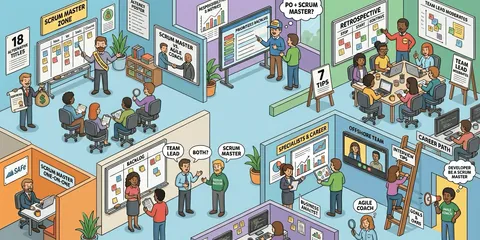

The agile paradox: Flexibility through structure - Part 1: An agile meeting structure

At first glance, agility sometimes seems contradictory. Apparently, a structure is supposed to provide more flexibility. In this series of articles I show you examples of this agile paradox and how it fits in the end.

A meeting now?

When one speaks of agility, it often means that one should critically question regular meetings and, if necessary, delete them. At the same time, the introduction of agile methods adds new meetings every two weeks: regular backlog refinements, reviews and retrospectives. How does that fit together?

The worry seems justified at first, because if you suddenly formulate goals every 2 weeks that need to be achieved, you will probably invest more time with this planning than if you only proceed on a quarterly basis and roughly determine which topics you want to work on.

The framework for fast learning

The advantage of this faster rhythm is that teams can enter a feedback loop with the (internal or external) customer every two weeks to find out whether the customer benefit actually occurs. This early customer feedback on the prototype created in the two weeks enables the newly learned to be taken into account in the subsequent sprint.

The regular meetings within the framework of the sprint cycles create the opportunity to learn quickly and open up the opportunity to correct the course regularly if the goals obviously cannot be achieved. The added value of this learning speed usually outweighs the time invested for the agile meeting structure.

Conclusion

Long-term meeting cycles are a major threat to quick learning and agile work. The meetings created through agile work take time, but they provide the necessary space to create significantly faster learning and thus better long-term customer benefits.

Blog category

More articles on "scale agility"

View all articles in this category
Agile Spotify Model: Squads, Tribes, Chapters & Guilds Explained

Agile Spotify Model: Squads, Tribes, Chapters & Guilds Explained

The agile Spotify model with Squads, Tribes, Chapters and Guilds simply explained. Learn more about advantages, typical stumbling blocks and use cases.

Agility Health Radar: 13 most popular models measuring agile

Agility Health Radar: 13 most popular models measuring agile

Discover the 13 most popular Agility Health Radar models for agile KPIs. Optimize the health of your teams and projects with these tools.

Working Agreements: 10 Examples, Samples & Templates

Working Agreements: 10 Examples, Samples & Templates

Agile Working Agreements: 10 Examples, Patterns & Templates for Scrum, Remote Teams and SAFe. How to improve collaboration and strengthen teams!

The Scrum Master as Servant Leader: 8 Tips & Thoughts

The Scrum Master as Servant Leader: 8 Tips & Thoughts

Learn how to become a Servant Leader as a Scrum Master! 8 tips on communication, self-organization, and agile project management for your agile team.

Product Manager Performance Goals: 5 Examples & Tips

Product Manager Performance Goals: 5 Examples & Tips

Product Manager Performance Goals: Tips & Examples for SMART Goals, Levels and Development. Learn how to make performance measurable here!

What is a Product Owner in the Scaled Agile Framework SAFe? - Facts and Figures 

What is a Product Owner in the Scaled Agile Framework SAFe? - Facts and Figures 

What does a SAFe Product Owner do? We explain the role in the Scaled Agile Framework, tasks, responsibilities and the 6 types of Product Owners.

Scrum - what is it? Easily explained!

Scrum - what is it? Easily explained!

Scrum simply explained: What does agile working mean? We shed light on the roles (Product Owner, Scrum Master, Team), Sprint, Backlog and the success of Scrum.

Combine OKR & Scrum: This is how it works (workshops, sprint goal and cycles)

Combine OKR & Scrum: This is how it works (workshops, sprint goal and cycles)

Learn how to successfully combine OKR and Scrum! We'll show you how workshops, sprint goals, and cycles can interlock optimally. This is how agile working is done!

Agile at Scale: Comparing the 5 most popular frameworks

Agile at Scale: Comparing the 5 most popular frameworks

Agile at Scale: Discover the most important frameworks (SAFe, LeSS, DA, Spotify, Scrum@Scale) for agile scaling in the company. 5 principles & 6 steps.

Echometer Newsletter

Don't miss updates on Echometer & get inspiration for agile working