7 Best Free Retro Boards | 60+ fun retrospective ideas
Online whiteboards or retro boards or perhaps project management tools such as Jira? There are now many ways to conduct digital retrospectives. In this article, I will show you which retro boards are available and what advantages the various online boards offer for retrospectives.
We compare the 7 best retro boards one by one for a short or detailed decision-making basis.
Retro Board with 60+ fun retro methods
For the impatient among you: The retro board from the tool Echometer includes more than 60 interactive, fun and free retrospective ideas.
If you are interested in what they look like, feel free to explore them without logging in:


Retro Boards: Table as a quick overview
Before we go into the different retro software individually in detail, here is a brief overview of the retro boards:
| Evaluation criteria | Echometer | Retrium Board | Team Retro | EasyRetro (formerly FunRetro) | Ludi (formerly MetroRetro) | Parabol Board | Kollabe |
|---|---|---|---|---|---|---|---|
| Interactive online retrospectives | Yes | Yes | Yes | Yes | Yes | Yes | Yes |
| Automatically generated retro summaries | Yes | Yes | Yes | Yes | No | Yes | Yes |
| Support of facilitator (e.g. automated check-ins) | Yes | Yes | Partially | No | Yes | Partially | Yes |
| Templates for every level of team maturity | Yes | Partially | Partially | No | Yes | No | Partially |
| Continuous tracking of action items</br> (retro to retro) | Yes | Partially | Partially | No | Yes | Yes | Yes |
| Team development measured over time | Yes | Partially | Yes | No | Partially | No | No |
| Collecting feedback before retros (optional) | Yes | No | No | No | No | Yes | No |
| Organizational Health Checks | Yes | No | No | No | No | No | No |
| Health Check Item Pool with Nudges (Food for thought) | Yes | No | No | No | Partially | No | No |
| Support for mobile devices </br>(for on-site or hybrid retros) | Yes | No | No | No | Partially | No | No |
| Integrated Online-Whiteboard | Yes | No | No | No | Yes | No | No |
| Data protection (developed and hosted in Germany) | Yes | No | No | No | Partially | No | No |
| Free version (after trial) | Yes | No | No | Yes | No | Yes | Yes |
For those looking for more detailed information, below you will find a detailed comparison of the 7 best retro board tools. We always consider and compare certain criteria - you can find out more behind the respective toggles when presenting the respective Kanban Retro Board Tool (More on: Retrospective Kanban Board ).
Sprint Retro board free: Comparing the 7 best retro boards
Echometer (Retro Board Tool No. 1)
Echometer Screenshot

| Retro board online features in Echometer | |
|---|---|
| Start without login & registration | ✅ |
| Assisted retro facilitation | ✅ |
| (Optional) Anonymity | ✅ |
| Grouping & Linking | ✅ |
| Voting | ✅ |
| Timer for timeboxing | ✅ |
| Flexibility (optional whiteboards) | ✅ |
| Tracking of actions items | ✅ |
| Measuring the quality of a retro (ROTI) | ✅ |
| Automated Retro Summaries | ✅ |
Details on Echometer Retrospective Board
Details on Echometer Retrospective Board
Timer: On a navigation bar at the top, the individual phases of the retro are easy to understand. Each step starts with a short guide that also supports inexperienced moderators. There is also a timer here, with which time management can be easily implemented. Great: The timer even proactively reports when you stay in a step for too long.
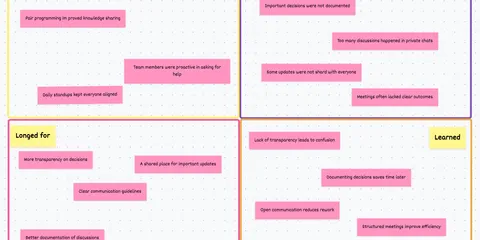
Structure: The retro board appears in Echometer after the check-in in the “Collect data” phase. In this phase team members can enter their topics. Similar feedback can be grouped - this is also possible across columns. All answers are anonymous, but you can highlight your own answers yourself.
Flexibility & Voting: In the “Analysis and Measures” step, further columns and feedback can still be added. Groupings are possible until live voting starts. Moderators can select how many points team members should receive for the vote. I like that Echometer has an optional suggestion for the number of points here. After the vote, the prioritized topics are automatically sorted: topics with many votes are moved up, topics without votes are hidden.
Action items: Measures can be easily created using a “Measures button”. As another option, Echometer offers the option of linking the measures directly to specific feedback. By the way, links also work between feedback and whiteboard. Feedback cards can be copied directly to a whiteboard. copied . By the way, Echometer offers whiteboard templates for creating measures, which are available from the whiteboard templates. You can also create your own whiteboard templates.
Check out: At the end of the retro, the ROTI is automatically requested. This can be combined with the complete retro board, the measures created and the whiteboards can later be accessed in the retro archive. In addition, measures can be stored in Jira boards via the Jira integration.
Analytics: Another special feature of Echometer is that it is a retro board for data-driven agile coaches and Scrum Masters. After and within the retro, there are various ways to discuss and measure the maturity of the team via team health checks. You can find out more on the Echometer website.
In summary, Echometer is an excellent free retro board. You can definitely call it a simple or easy retro board (in terms of operation & UX), and a fun retro board as well - feel free to try it out.
As discussed, one of the nice things about the Echometer sprint retrospective board is that it is a free retro board without login. You can directly open our retro templates below.
Or simply browse our library of retro methods (see “Discover more”) - have fun:


"Echometer is like a combination of Miro and a clever Retro Board. It even provides KPIs on the impact of my coaching and makes it easy to spot trends in team development. I love this tool and recommend it to anyone who wants to make their retros even more effective!"

Duane Hill
Scrum Master
By the way, in the following video, a tech lead, an Echometer customer, explains his 5 favorite features of the Echometer Retro Board Tool.
Spoiler: He was positively “shocked”. 😄
Sprint Retro board free: Comparing the 7 best retro boards
EasyRetro (Retro Board Tool No. 2)
FunRetro former EasyRetro Screenshot

| Features of the Easy Retro Board (former FunRetro) | |
|---|---|
| Start without login & registration | ❌ |
| Assisted retro facilitation | ⚠️ |
| (Optional) Anonymity | ✅ |
| Grouping & Linking | ✅ |
| Voting | ✅ |
| Timer for timeboxing | ✅ |
| Flexibility (optional whiteboards) | ❌ |
| Tracking of actions items | ✅ |
| Measuring the quality of a retro (ROTI) | ❌ |
| Automated Retro Summaries | ⚠️ |
Details on Easy Retro Board (former Fun Retro Board)
Details on Easy Retro Board (former Fun Retro Board)
Structure: With Easyretro, the entire retro takes place on one board. So there is no separate check-in, check-out or similar. This can be configured in advance using templates. Additional columns can be added if required using the “Add” button (More on: Retrospective Board Columns ).
Survey: In the free version, one survey can be linked to a Retro Board. A survey is a question with answer options to tick. Unfortunately, these surveys cannot be sent in advance of the retrospective (as with Echometer), but can only be created and answered during the retrospective. In the paid version, multiple questions can also be added (More on: Software Retrospective Questions ). The team’s feedback is anonymous, although here too, your own answer can be highlighted.
Grouping & Voting: During the retro, the individual feedback cards on the board can be moved between the columns and also grouped. Via the “Facilitation Controls” you can manually set the display/hide of feedback cards, voting and various other options. Voting can be done at any time both on groups and on individual feedback cards. Since Easyretro does not specify a process for the structure of a retro, the collection of feedback, voting and the creation of measures can take place simultaneously. So be careful with the board settings, as this flexibility in the settings can lead to an unstructured retro, especially for users with little experience.
Invitation of colleagues: Via the “Sharing” button you can scan a QR code as well as a link copy, with which also third parties without EasyRetro account can participate in the agile retrospective board (More to: Agile Retrospective Board ).
Retro summary: After the retro, the retro board used can still be accessed and the measures can be viewed on a separate page. Through integrations with Jira, Confluence and Slack, measures can also be exported.
To summarize, this is not a bad free retro board. Like the other retro boards, it can be described as a simple retro board (based on the name alone) and a fun retro board.
However, based on the comparison table above, Echometer can be considered a better retro board tool than EasyRetro.
Sprint Retro board free: Comparing the 7 best retro boards
TeamRetro (Retro Board Tool No. 3)
Team retro Screenshot (fun retro free board)

| Sprint Retro board online features in TeamRetro | |
|---|---|
| Start without login & registration | ❌ |
| Assisted retro facilitation | ✅ |
| (Optional) Anonymity | ✅ |
| Grouping & Linking | ✅ |
| Voting | ✅ |
| Timer for timeboxing | ✅ |
| Flexibility (optional whiteboards) | ❌ |
| Tracking of actions items | ⚠️ |
| Measuring the quality of a retro (ROTI) | ✅ |
| Automated Retro Summaries | ✅ |
Details on the TeamRetro Retrospective Board
Details on the TeamRetro Retrospective Board
Structure: Teamretro is a Retro Board with predefined phases. Here, too, the feedback is not collected in advance via surveys, but during the retro on the Scrum Retrospective Board online (More on: Scrum Retrospective Board Online Free ). What is interesting is that this brainstorming happens in two steps: In the first step, the retro participants can brainstorm privately before the answers are shared publicly. When answers are shared, the moderator can determine before the start of the retro whether the answers are anonymous, with alias or name.
Templates: As with Echometer and Easyretro, there is the option to either select a template for the retro or to design it freely. Also in the design of the answers, participants have the possibility to group answers across columns.
Navigation: A navigation bar makes it easy to switch from one step to the next. There is a voting function for prioritisation.
Action items: Measures (here “Action Plan”) and “Team Agreements” can be created during the entire retrospective via the sidebar.
Check out: At the check-out, the participants can indicate the ROTI on a scale from 1 to 5.
Summary: After completion of the retro, measures are displayed on the home screen. The Retro Board is also accessible after the retro has ended. However, there is no retro archive.
In summary, Teamretro is a decent free retro board. You can call it a fun retrospective board and an easy retro board (in terms of UX), similar to the other retro boards. And it is even is an Azure DevOps retrospective board and a retro board in jira, as it has an integration to both Azure Devops and Jira.
However, based on the comparison table above, Echometer can be considered a better retro board tool than TeamRetro.
Sprint Retro board free: Comparing the 7 best retro boards
Parabol (Retro Board Tool No. 4)
Parabol Screenshot (fun retro free board)

| Retro board online features in Parabol | |
|---|---|
| Start without login & registration | ❌ |
| Assisted retro facilitation | ✅ |
| (Optional) Anonymity | ✅ |
| Grouping & Linking | ✅ |
| Voting | ✅ |
| Timer for timeboxing | ✅ |
| Flexibility (optional whiteboards) | ❌ |
| Tracking of actions items | ⚠️ |
| Measuring the quality of a retro (ROTI) | ❌ |
| Automated Retro Summaries | ✅ |
Details on the Parabol Remote Retrospective Board
Details on the Parabol Remote Retrospective Board
Structure: Also with Parabol the feedback is collected directly on the Retro Board. After the (private) brainstorming, feedback cards are shared anonymously. Cross-column groups are also possible on this retro board. When voting, the maximum number of possible votes per participant as well as per topic/card can be determined. After the voting, all topics are presented again individually for discussion at Parabol. In my opinion, this step should rather take place before the voting or after the voting only with such topics that have been prioritised in order to support good time management. Otherwise Parabol offers a timer.
Action items: When discussing the feedbacks, an action item can be put down at any time.
Retro summary: After all steps of the retro have been completed on the board, a summary of the retro is displayed in the document design. Unfortunately, Parabol does not offer an official check-out with ROTI, nor does it offer integrated whiteboards.
Timeline: After the retro, the results can be accessed again via the “Timeline”. Since the “Timeline” shows various activities, the retro gets somewhat lost. There is no separate retro archive.
In summary, Parabol is another decent free retro board. It deserves to be called a fun retro board and simple retro board (in terms of UX).
However, based on the comparison table above, Echometer can be considered a better retro board tool than Parabol.
Sprint Retro board free: Comparing the 7 best retro boards
Metro Retro (Retro Board Tool No. 5)
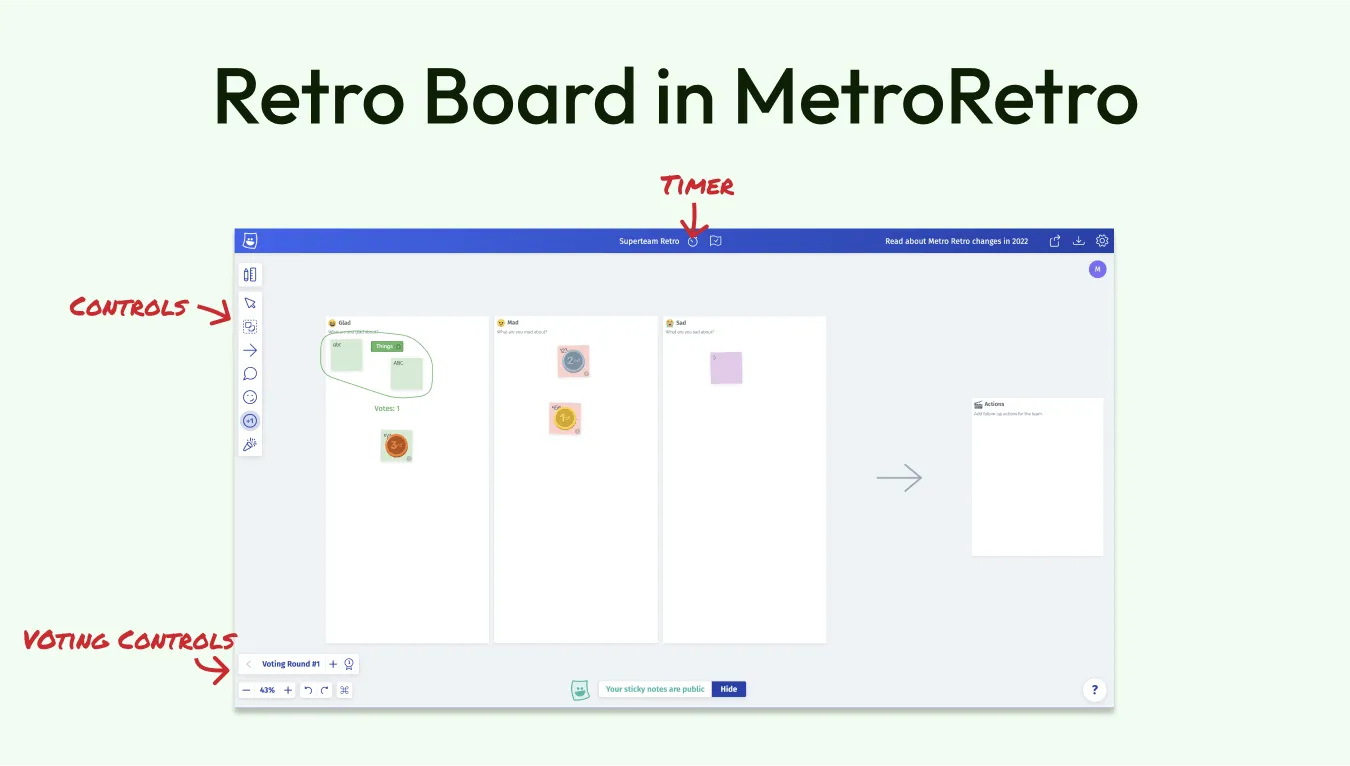
Metro Retro screenshot
| Online sprint retrospective board free: features of Metro Retro | |
|---|---|
| Start without login & registration | ❌ |
| Assisted retro facilitation | ✅ |
| (Optional) Anonymity | ✅ |
| Grouping & Linking | ✅ |
| Voting | ✅ |
| Timer for timeboxing | ✅ |
| Flexibility (optional whiteboards) | ✅ |
| Tracking of actions items | ❌ |
| Measuring the quality of a retro (ROTI) | ❌ |
| Automated Retro Summaries | ⚠️ |
Details on the Metro Retro Retrospective Board
Details on the Metro Retro Retrospective Board
Procedure: MetroRetro is a retro board whose structure is strongly based on a classic whiteboard. The preparation is quick: a template can be selected, then you can start directly. Surveys in advance do not take place here either (More on: Software Retrospective Questions ). Participants give their feedback directly as anonymous Sticky Notes on the retro board. To organize them, they can first be written covered and later uncovered. In addition, the Sticky Notes can be grouped together. When voting, the facilitator can determine the number of possible voting points. Prioritized topics are clearly marked.
Structure: During the retro, there is no process defined by the board, but there are some tips on how to do it. Also, a timer helps with time management.
Action items: For creating actions, there is a specially marked area on the retro board. Like before also the feedback, actions are created as Sticky Notes. Unfortunately, there is no integration with Jira or other tools, the actions must be transferred manually to other tools.
Retro summary: When following up on the retro, it is noticeable that this is not the focus of the application. A retro and action archive is also missing here. However, retros can still be opened at any time.
Worth mentioning: For the fun factor, Metroretro has come up with a funny confetti bomb.
Metro Retro is a good free retro board, which is characterized in particular by its flexibility. It’s quite a fun retro board, and also an easy retro board (if users have some whiteboard experience).
However, based on the comparison table above, Echometer can be considered a better retro board tool than Metro Retro.
Sprint Retro board free: Comparing the 7 best retro boards
Retrium (Retro Board Tool No. 6)
Retrium Screenshot (Scrum sprint retrospective board online free)

| Online sprint retrospective board free: Features of Retrium | |
|---|---|
| Start without login & registration | ❌ |
| Assisted retro facilitation | ✅ |
| (Optional) Anonymity | ✅ |
| Grouping & Linking | ⚠️ |
| Voting | ⚠️ |
| Timer for timeboxing | ✅ |
| Flexibility (optional whiteboards) | ❌ |
| Tracking of actions items | ⚠️ |
| Measuring the quality of a retro (ROTI) | ✅ |
| Automated Retro Summaries | ⚠️ |
Details on the Retrium Retrospective Board
Details on the Retrium Retrospective Board
Templates: Retrium has two different templates for retro boards: a board with Sticky Notes and one with a radar. Depending on which type of retro board is chosen, the available templates also vary. Feedback is anonymous on both boards.
Voting: The anonymous Sticky-Notes retro board is equipped with very similar functions to the retro boards described above. A timer supports the team with time management, and the tool guides them step by step through the retro. The voting function is a bit more sophisticated here: there is a maximum of 3 votes per participant, but also the possibility of abstention.
Structure: As with Parabol, all topics are presented individually for discussion at Retrium after the vote. A discussion on an extra whiteboard is not supported. Actions can only be created when using a Sticky-Notes retro.
Check out: When the retro is finished, the ROTI is asked here and the results of the retro are summarized in an exportable form. Completed retros can also be found and opened again via the “Timeline” here.
Retro Summary: Unfortunately, there is no separate archive where the retros from that time and the actions created in them are listed.
Special feature: The radar retro differs from the board retro, as it focuses primarily on closed scale questions. The live evaluation of the radar (e.g. average value etc.) is a positive feature. Unfortunately, other functions such as voting, creating actions, and creating comments are completely lost.
Retrium is a decent free retro board that can probably be considered one of the most used tools. Much like the other tools, it’s a fun retro board and equally easy retro board.
However, based on the comparison table above, Echometer can be considered a better retro board tool than Retrium.
Sprint Retro board free: Comparing the 7 best retro boards
Neatro (Retro Board Tool No. 7)
Neatro Screenshot (Scrum sprint retrospective board online free)

| Online retrospective board free: features of Neatro | |
|---|---|
| Start without login & registration | ❌ |
| Assisted retro facilitation | ✅ |
| (Optional) Anonymity | ✅ |
| Grouping & Linking | ✅ |
| Voting | ✅ |
| Timer for timeboxing | ✅ |
| Flexibility (optional whiteboards) | ❌ |
| Tracking of actions items | ✅ |
| Measuring the quality of a retro (ROTI) | ✅ |
| Automated Retro Summaries | ⚠️ |
Details on the Neatro Retrospective Board
Details on the Neatro Retrospective Board
Preparation: The retro board from Neatro can be planned in advance with templates and can be shared with the team via a schedule. The retro also takes place here on the board in column format. In the first step, participants can brainstorm on covered Sticky Notes before they are visible to all participants anonymously on the virtual retro board in the next step (More on: Virtual Retro Board ).
Grouping: There is no questionnaire to collect feedback in advance. As soon as all Sticky Notes are uncovered, they can be grouped. A special feature here is that the notes can also be sorted with labels (and later filtered).
Voting: Prioritizing the most important topics is also done here via a classic vote, where the facilitator determines the number of possible votes per person. Afterwards, various filters can be applied (number of votes, label, group, etc.) to talk about the topics in a structured way and derive measures.
Flexibility: The use of a whiteboard integrated into the retro is not possible with Neatro.
Timer: A timer is available for support and participants have the opportunity to submit a ROTI rating at check out.
Follow-up: For follow-up, the retro can be reopened at any time. What’s nice here is that created measures do not “get lost” but have their own dashboard where their status can be tracked. In addition, measures can be exported to Asana, Jira and AzureDevOps.
Last but not least, Neatro is also one of the best free retro boards. Depending on the design of the retro and preparation, it can be described as a fun retro board and also a simple retro board.
However, based on the comparison table above, Echometer can be considered a better retro board tool than Neatro.
Experience report on the best retro board in comparison
Experience report: A new retro board that shocks
Would you like to hear what users of a retro board have to say before you make a decision? Then we have an exciting video for you here.
If you use Echometer as a retro tool for the first time, you might be shocked at how sub-optimally you worked before.
See for yourself:
Scrum Retrospective Board Online
What is the best retro board tool ever built?
By comparing the 7 best retro board tools we want to find out: Which is the best retro board tool ever?
In the following, you will find a summary of how retro board tools can actually be differentiated and what we paid attention to in our comparison. Overall, especially Echometer makes a good impression - find more on that above.
Retrospective Remote Teams: Online whiteboard
Online whiteboards are generic tools that can be used for retros, but obviously also for many other kinds of online collaboration.
The typical online whiteboard allows you and your team to collaborate in real time. You can use whiteboards for the entire retrospective or simply for specific parts of it, like for example brainstorming action items . For this reason, sometimes whiteboards are integrated into the retro tools themselves, as is the case for the Echometer tool.
Popular online whiteboards for retrospectives include (apart from Echometer & Metro Retro as 2 exceptions):
Free Retro boards Online
Retro Boards present the questions of a retrospective in columns (More on: Retrospective Board Columns ). Many retro tools rely on this column view for structured moderation.
In contrast to online whiteboards, free retro boards offer you more structure to present discussed topics in an orderly manner, support with facilitation (e.g. by automatically displaying suitable “food for thought”) and oftentimes a feature for tracking the action items from your retrospectives.
With the structure and retro templates already in place, you usually need much less time to prepare a retro and your team doesn’t lose track during the retro as easily. In addition to the retro board, some retro tools also have the option to flexibly integrate whiteboards.
In the following, we compare (based on these criteria ) the 7 best retro boards:
- Echometer
- FunRetro former EasyRetro Board
- Retro board free: TeamRetro
- Parabol Board
- MetroRetro Board
- Retrium Board
- Neatro
Advantages of retro boards over whiteboards
Maybe you’re currently doing a whiteboard retrospective, using a generic online whiteboard for your retro? Here are some good reasons why you should check out digital retrospective boards from tools designed specifically for agile retrospectives:
- ✅ Retrospectives can be structured and moderated more easily in retro boards
By mapping the different phases of a retrospective in a retro tool, there is less risk of teams trying to define action items too early or of sinking into chaos during discussions. In whiteboards, structure is easily lost and intervention from facilitators is needed more often. - ✅ Retro boards are less distracting than online whiteboards
To give just a few examples: on a whiteboard, all the notes move at the same time, notes regularly overlap, everyone sees what the others are typing and, thus, the results of team members is biased. - ✅ Retro boards are easier to use than online whiteboards
Online whiteboards have more functions than you need for a retrospective. This abundance of functions makes it more difficult to find your way around and causes more problems when using them - especially for participants inexperienced with whiteboards. - ✅ Less effort for administration for Scrum Masters and Agile Coaches
Using whiteboards, the unstructured data and resulting action items have to be transferred manually for documentation and tracking into your project management tool like Jira, Trello etc.. With retro boards online, archiving and action item tracking is oftentimes automated and integrated into the sprint retro board online itself.
I would like to add one thing at this point: Regular 1-on-1 meetings or coaching sessions with your colleagues can have a decisive effect on your team performance (especially when combined with retrospectives). And they can even be data-driven! If you are interested in this topic, take a look here: Here you will find 129 one-to-one meeting (or appraisal interview) questions and Here are the 3 best one-on-one meeting tools in comparison .
Sprint Retro board free: What makes a good retro board?
In this article we have wrote in detail about the outputs and outcomes of retrospectives. Based on that, we deduced which one might be the the 7 best retro tools on the market in general.
In the article at hand, we focus specifically on the retro board: what makes a good board, that is perfect for the successful facilitation of a retro?
There are a few features to look for when choosing a retro board. Here is an overview of the most important ones:
Start without login & participation without registration 🔓
Nothing is more annoying than having to laboriously log in yourself at the beginning - and then all team members have to register for the new retro tool in order to actively participate in the retro. That’s why we take direct access to the board without registration and login with in the comparison.
Flexibility & optional whiteboard 🧭
Whiteboards are not a “must” for a successful retrospective. However, it can be extremely helpful to spontaneously open a blank retrospective whiteboard to delve deeper into topics and feedbacks of team members.
That’s why good retro boards have the option of integrating whiteboards and even linking these to feedbacks that are given within the retro. Additionally, this allows retrospective ideas and methods that are based on whiteboards to be perfectly integrated into retrospectives, for example to brainstorm sustainable action items through the 5-times-why method . It is this flexibility in retrospective ideas & methods that is a prerequisite for creative retros (More on: Creative Retrospective Board ).
Integrated action tracking ☑️
Speaking of action items… The “cherry on the top” is when retro boards also offer the possibility to link action items with retro topics from the retro board. In this way, you can understand why action items were created in the first place, thereby getting a feeling of the progress regarding agile maturity over time.
In turn, the action items that have been decided on will automatically be placed on the agenda of the next retrospective for review. By doing this, the team is held responsible for implementing the action items that have been decided upon - and automatically reflects on the effectiveness of the action items.
Optimally, measures can also be integrated into other task or project management tools such as Jira, Asana, Trello or Microsoft Teams.
(Optional) anonymity 🥸
A good retro thrives on openly shared feedback. Having the option of “anonymity” is important to make sure the feedback of team members is not biasing the gather data phase and prioritization. Retro boards - the Reetro board and most other tools do this - should therefore allow for anonymous feedback when the situation calls for it (an anonymous retrospective online can especially of value for teams with little psychological safety ).
If team members want to, they can of course openly share their opinion when discussing the feedback. The goal should be to have to use the “anonymity feature” less often as the team matures.
Sort, group and link topics 🔗
Oftentimes, feedbacks of different team members are very similar on a retro board. Good retro boards support you in organizing these feedbacks so that you don’t lose track.
Specifically, similar topics should be grouped, and maybe even linked to related retro elements such as action items or whiteboards.
Voting function (voting) 🗳
This feature is a real advantage over whiteboard tools. With the voting feature, you save time when prioritizing, helping you to focus when putting down good action items .
Automatic archiving 🗂
After a retrospective, the next retro is already waiting. Thus, there should be an automatic archive for retro boards, so that the action items are not lost and can still be traced after the retro. Your team should still have access to discussed topics, linked whiteboards and comments etc.. It can have a very positive effect on the agile mindset of team members, when you show how much you improved (compared to the problems from last year’s retro’s).
Timer for timeboxing ⏰
Very simple and super effective. With an integrated timer in a sprint retrospective app, the team does not lose track of time. Slipping into (too) long discussions is over. The timer should be clearly visible in order to fulfill its feature. Automated hints like on the Echometer sprint retrospective board - if you are spending too much time on a topic - are nice to have, too.
Measurement of retro quality (ROTI) 🔟
Measuring ROTI “Return on Time Invested” score (typically on a scale from 0 to 10) helps both you as the facilitator and the team. It strengthens the team spirit if a short feedback on the retro is given after everything is over: How well was the time invested in the retro online meeting?
Sprint Retro board free: Comparing the 7 best retro boards
Online Retro Boards: Honorable Mentions
As you have seen above, there are several really good retro boards. But…
Of course there are many other retro boards from other providers that are worth mentioning in case you need even more input:
Free Retro Board Alternative: Retro Board
Retro Board website: https://reetro.io/
According to its own statement, the Reetro Board Tool focuses on the “small interactions” that are necessary for good retros. At first glance, the Reetro Board looks similar to many other free retro tools. Their website presents the Reetro Board very positively - so it’s certainly worth a look, although Echometer performs better in relation to our comparison criteria mentioned above (see also: Patreon Retrospective Board Comparison).
Free Retro Board Alternative: Retrotool io
Retrotool io website: retrotool.io
A simple and free retro board that covers the basic functions of a retro. With this tool you can personalize the background. With regard to the above-mentioned criteria, Echometer is to be described as the better retro board software compared to retrotool.io.
Free Retro board Alternative: Sprintlio
Sprintlio website: sprintlio.com
With this retro board, the name says it all. Sprintlio is aimed at teams that work in sprints. Integration with Jira and Slack is possible. More information about the Sprintlio alternative Echometer can be found here: Sprintlio vs. Echometer . With regard to the above-mentioned criteria, Echometer is to be described as the better retro board software compared to Sprintlio.
Free Retro Board Alternative: Teleretro
Teleretro website: Teleretro.com
Teleretro is aimed at remote teams. To break the ice quickly, this virtual retro board has some fun check-in questions, music and videos (More on: Virtual Retro Board ). With regard to the above-mentioned criteria, Echometer is to be described as the better retro board software compared to Teleretro.
Free Retro Board Alternative: Timbo Retro
Timbo Retro website: timboretro.com
Timbo not only covers retros, but specializes in meetings in general: From Sprint Planning to Daily, this tool offers an overarching platform (More on: Retrospective Meeting Board ). With regard to the above-mentioned criteria, Echometer is to be described as the better retro board software compared to Timbo Retro.
Sprint Retro board free: Comparing the 7 best retro boards
Conclusion: Many good alternatives, but a clear best online retro board
Without a doubt, there are now several good retro boards that you can use to conduct simple, structured, and results-oriented retrospectives. In our view, Echometer’s retro board is the winner due to its simplicity and range of functions. 🏆
Some retro boards are very simple and focus only on the board itself, while others go further and offer significantly more functionality for team development with Team Health Checks & Co. – like Echometer.
When conducting retrospectives, it is on you and your team how professional you want to do the retrospective online. Surely you will find a digital retrospective board that fits your needs. At least you know which criteria are important when choosing a retro board.
I hope this comparison helped you decide which online retro board to choose. In order to get a valid overview and insight into the tools, I recommend to simply try out a retrospective in the respective retro boards online.
With Echometer, this is very easy without logging in. One of the reasons why, in our view, it is the best retrospective board software tool compared to alternatives.
It should be added that as the developers of Echometer, obviously, we are biased. The rationale in this text and in our in-depth retro tool comparison hopefully helps to understand why we think our tool is the best 🙂.
Next step: 54 Retro Methods for Beginners & Pros
Retrospectives are not just about the tool, but also about the retro format itself - especially when it comes to variety and fun.
Of course, every Scrum Master has their own retro formats. Good retro tools suggest new retro formats on a regular basis to add variety.
Given this, in this article you will find 54 Kickass Retrospective Ideas for Agile Teams , which you can use for your next retro. May it be the Keep-Stop-Start, Harry Potter or “Vacation retro”, you can be sure to find a new, creative retro format.
Here’s an example from the article:
Sailboat Retro ⛵️: How the retro works
-
Random Icebreaker (2-5 minutes)
Echometer provides you with a generator for random check-in questions.
-
Review of open actions (2-5 minutes)
Before starting with new topics, you should talk about what has become of the measures from past retrospectives to check their effectiveness. Echometer automatically lists all open action items from past retros.
-
Discuss retro topics
Use the following open questions to collect your most important findings. First, everyone does it themselves, covered. Echometer allows you to reveal each column of the retro board individually in order to then present and group the feedback.
- ⚓️ Your anchor: What holds us back?
- 🦈🧊 Your shark/iceberg: Which dangers or obstacles approach us?
- 💨 Your tailwind: What drives us forward?
- 🏝💰 Your paradise: What achievement or milestones are we working towards?
-
Catch-all question (Recommended)
So that other topics also have a place:
- What else would you like to talk about in the retro?
-
Prioritization / Voting (5 minutes)
On the retro board in Echometer, you can easily prioritize the feedback with voting. The voting is of course anonymous.
-
Define actions (10-20 minutes)
You can create a linked action via the plus symbol on a feedback. Not sure which measure would be the right one? Then open a whiteboard on the topic via the plus symbol instead to brainstorm root causes and possible measures.
-
Checkout / Closing (5 minutes)
Echometer enables you to collect anonymous feedback from the team on how helpful the retro was. This creates the ROTI score ("Return On Time Invested"), which you can track over time.
Sailboat Retro ⛵️

You can find more retro ideas in our collection 32 Retrospective Methods .
Sprint Retro board free: Comparing the 7 best retro boards
Frequently Asked Questions
What are popular retrospective tools in 2026?
The most popular retrospective tools in 2026 include in particular:
- Echometer: “Retrospectives, 1:1 meetings and team health checks in a comprehensive tool for agile leadership.”
- Parabol: “A tool for all agile meetings – Retrospective, stand-up and planning in one workflow.”
- EasyRetro: “Beginner-friendly & visual – over 100 ready-made templates make retrospectives simple and easy.”
- Neatro: “Promotes continuous improvement with ready-to-use retreat boards that can be used live or asynchronously.”
- Retrium : “A toolbox approach with various retro formats and anonymous feedback, especially for Scrum and Agile teams.”
- TeamRetro : “Guidance and analysis-oriented for retrospectives and team health checks – with templates and metrics”
What are the best retrospective software tools for remote development teams?
It depends on your team and your context which is the best retrospective software tool. A generally recommended software tool for virtual or remote engineering teams is Echometer. It has various features that have been specially developed for remote IT engineering teams, such as: an interactive retro board, various retrospective templates, action tracking and specialized team Health Checks for remote teams.
Where can I find retrospective software tools with customizable templates?
You can find retrospective software tools with customizable templates, formats and techniques on various platforms and in various software tools. For example, we recommend the retrospective software tool Echometer with customizable templates for retrospective questions and techniques. The templates in Echometer include selectable icebreakers and open questions for your retrospective, such as the techniques “Keep Stop Start”, “Mad Sad Glad” or the sailboat retrospective.
You can find an overview of the templates in Echometer here: https://my.echometerapp.com/retro-setup.
What is the cheapest alternative to the Retrospective Software Tool Parabol?
The more affordable alternative to the retrospective software tool Parabol is Echometer, depending on the size of your team. Parabol charges $8 per team member, while Echometer charges per team. Since Echometer costs $29 per month for a full team, Echometer is more affordable if you have more than 3 team members - which is the case for most teams.
Is the Echometer Retrospective Software Tool suitable for younger and older software developers?
Yes, Echometer is suitable for all age groups: Younger software developers will enjoy the playful elements of the software, such as the balloon shooting in the retrospective waiting room. Older software engineers will appreciate the focus on efficiency and the simplicity of the tool.
Scrum, Kanban, Scrumban: Which framework is the Echometer retrospective software tool designed for?
Echometer works independently of frameworks and is therefore ideal for teams that work according to Scrum, Waterfall or Kanban, as well as software teams that use hybrid frameworks and methods such as Scrumban. Even if you don’t use Scrum or an officially existing framework, Echometer is the right software tool for you.
What is important when choosing retrospective board software?
When deciding on a retrospective software tool, you should make sure that the online retro board can do more than just replace colorful sticky notes. Good retro software helps your team to work better together on an ongoing basis and ensures that the retros don’t become routine.
The most important criteria for choosing a retro board are:
- Ease of use & accessibility
Participation should be as uncomplicated as possible – ideally also without registration or with guest access as with the Retro Board of Echometer. - Templates & structure
Different retro templates help to constantly adopt new perspectives and prevent meetings from becoming monotonous. - Interactivity & moderation aids
Features such as check-in questions, anonymous posts or live reactions increase engagement and give all team members a voice. - Tracking of measures
A retro only brings real added value if the agreed action items remain visible and are tracked until the next meeting. Only a few retro board softwares offer this feature, including Echometer. - Measurable team development
Some retro board software tools make it possible to evaluate trends and progress across multiple retros, such as Echometer –, so you can see how team dynamics are improving.
Conclusion:
Good retrospective board software makes the difference between “just talking” and “really improving”. The retrospective board tool Echometer stands out here in particular: it combines interactive retros with continuous measurement of team dynamics and helps to ensure that improvements don’t come to nothing.
With this in mind, it is definitely worth trying out Echometer for yourself – precisely because you can simply take a look at the retro software without having to log in at the following link: Access Echometer Retro Board Software without login.
What is the best retrospective software for beginners to get started with?
If an agile team does not yet have much experience with retrospectives, a tool that effectively guides you through the retrospective and offers many templates is recommended:
- Echometer is known not only for being an intuitive online retro board, but also for offering a very effective guided flow through the retrospective. At the same time, Echometer offers whiteboards that can be flexibly integrated into the retrospective. This makes Echometer very beginner-friendly.
- Echometer also has extremely versatile and creative templates for retrospectives and team Health Checks that stimulate team reflection. Inexperienced teams in particular are very grateful for the food for thought in Echometer.
This makes Echometer the best software recommendation for beginners with agile retrospectives or Scrum beginners. By the way, you can try out Echometer for free without logging in: Echometer Try out the retro tool
What is the best online retrospective tool for managers?
The best online retrospective tool, especially for managers of agile teams, is probably Echometer. Why?
- Typical whiteboard tools (such as Miro or Mural) also offer tools that can be used to conduct online retrospectives. However, these whiteboards are flooded with complex functions that are not needed for simple retrospectives. What the whiteboards lack is the automatic tracking of measures from retrospectives and teams have to build their own workarounds when they use whiteboards for retrospectives. This makes whiteboard tools for retrospectives more time-consuming and also more difficult and cumbersome to use for retrospective participants.
- Other retro tools are often relatively rigid. Echometer, on the other hand, combines a structured retrospective process with flexible online whiteboards. Echometer also has the largest selection of templates for retrospectives. As a manager in Echometer, you benefit from the extremely simple and time-saving preparation and follow-up of retrospectives and at the same time you benefit from engaging and varied retrospectives.
Conclusion: If you are a manager looking for a tool for online retrospectives, try the free version of Echometer first: Try the retro tool Echometer for free without login
What are the limitations of Parabol's retrospective tool?
Parabol is basically a good retro board tool for online retrospectives. Nevertheless, there are a few limitations and weaknesses of the Parabol software compared to Echometer as an alternative tool for team retrospectives:
- Parabol does not have the option of integrating whiteboards into its retrospective. In Echometer you can flexibly integrate whiteboards into your retrospectives.
- Parabol is limited to remote retrospectives. With Echometer you can conduct both remote retrospectives and on-site retrospectives thanks to simple participation with a QR code via smartphone.
- Parabol has limited possibilities to analyze Health Check trends. Echometer can visualize trends over time and optionally over several teams.
- Parabol does not allow the effectiveness of retrospectives to be evaluated. Echometer has an integrated ROTI query (Return On Time Invested) to query the evaluation of the team members directly during the check-out of the retrospective and to reflect on it in the team.
- Relevant for users in the EU: Parabol’s company location and server location is in the USA. This can be a problem for companies in the EU due to compliance and data protection. You can also host Parabol yourself in the Enterprise version to avoid these problems. Or you can use Echometer, which has its company location and server location in Germany.
- The Parabol software assumes that your team works according to the Scrum framework and also has daily standups and sprint planning meetings. So if your team does not work according to Scrum, Parabol might not be a good fit. On the other hand, you can use Echometer as an agile team even without Scrum.
As an agile team, you have to decide for yourself whether these limitations of Parabol are relevant in the team context. A tip: Just try Echometer with your team, because Echometer’s Online Retrospective Tool has its strengths exactly where Parabol has its weaknesses. You can try Echometer for free here: Try Echometer for free
What are the strengths of Echometer compared to Parabol?
Echometer’s online retrospective software has several strengths and distinguishing features compared to Parabol:
- Integrated whiteboards: Echometer offers the option of flexibly adding further whiteboards in retrospectives. These whiteboards can be used in Echometer to discuss individual topics in a focused manner and derive measures. Parabol does not offer integrated whiteboards in retrospectives.
- Pulse checks: Echometer enables automatic, regular team surveys, so-called pulse checks. This automation of surveys does not exist in Parabol. Feedback can only ever be obtained in Parabol in conjunction with a manually created meeting.
- Team Health Dashboards: Echometer’s dashboards serve as a clear mood barometer over time and optionally across multiple teams.
- Remote, hybrid and on-site: Echometer also has a mode for on-site retrospectives. Participants can share feedback and take part in the voting via their smartphone. Parabol, on the other hand, is limited to remote retrospectives.
- Echometer is very beginner-friendly and you don’t need to be an experienced Scrum team to conduct effective team retrospectives.
We have already reported on the overlaps between the retrospective tools of Parabol and Echometer here: Comparison Echometer vs Parabol
Together with your agile team, you can see for yourself the strengths of Echometer’s Retro Board compared to Parabol by testing the free version of Echometer: Try Echometer (free of charge and without login)
What do I need to consider with Parabol as a retrospective tool?
If you are considering using Parabol as software for agile retrospectives and retro boards, team leaders and Scrum Masters recommend that you also try out other tools such as Echometer beforehand. The decision to use retrospectives should be a well-founded, joint decision by the entire agile team.
Consider the following for Parabol as an online retrospective tool:
- The pricing model in Parabol is difficult to calculate, as the tool is billed per team member. So if guests or new colleagues are added, it could become more expensive. In Echometer, on the other hand, you simply pay per team and the costs do not change for the team.
- For users in the EU: Parabol is an American company with servers in the USA and only optional possibilities for hosting elsewhere. Due to the sensitive data in retrospectives, this could be a compliance and data protection issue depending on the company. Echometer has its company and server location in Germany.
Some users of Parabol switched to Echometer in 2025 and are happy with the decision, as Echometer drives team development more effectively and measurably. See: Advantages of Echometer compared to Parabol
Managers in particular are also enthusiastic about Echometer’s integrated tool for 1:1 meetings, which allows managers to get even more value from Echometer.
Our tip for users of Parabol: Take a look at the retro tool Echometer and try out the free plan: Echometer Access without login
Why is Echometer better than Parabol for agile retrospectives?
Echometer is better than Parabol for conducting agile retrospectives (also “Sprint Retrospectives”) because, in addition to the retro board, Echometer offers a wider range of features that make life easier for Scrum Masters and team managers:
- Better retro effectiveness: Retrospectives with Echometer are very effective. You can even measure this: At the end of each retrospective in Echometer, the team is asked about the ROTI, i.e. the “Return on Time Invested”. This ensures that you maintain the quality and effectiveness of your retrospectives in Echometer in the long term. Parabol does not have such a mechanism.
- More flexibility in Echometer: In Echometer, you can use integrated whiteboards during retrospectives to discuss individual topics in a focused way and derive measures for them. You can also create your own whiteboard templates and use them flexibly in your retrospectives. Parabol is not as flexible as Echometer and does not offer integrated whiteboards for retrospectives.
- Long-term team health trends: In Echometer, team development can also be easily tracked over time via the Health Checks team. You can even collect and evaluate overarching metrics in Echometer via Workspace Health.
- Automatic pulse check surveys: In Echometer, you can automate regular team health surveys and rotate topics automatically. In Parabol, you have to manually create a meeting for each data collection.
- It is also not possible to create dashboards of agile pulse surveys as a mood barometer (or Agile / Scrum Health Check) over time.
As a manager, Echometer is therefore probably more effective, more flexible and more time-saving for you than Parabol. Ultimately, of course, your team has to help decide which tool they prefer for retrospectives. So here’s an important tip: simply try out both tools with your team. Because both tools have a free plan: Try Echometer for free without login.
You can see for yourself by testing the free version why Echometer is better than Parabol for agile retrospectives and why many users of both tools say that Echometer is “by far the best tool for online retrospectives.”
How do the prices of Echometer compare to Parabol?
The prices of the online retrospective software tool from Echometer and Parabol differ in the way they are billed:
- Echometer charges per team (Pro plan with a monthly subscription of €35 per month)
- Parabol billed per team member (team plan with monthly 8$ per user)
So depending on how big your team is, Echometer’s online retrospective software is usually cheaper (even significantly cheaper) than Parabol. Only if your team has 4 or less team members, Parabol is cheaper than Echometer:
- For a team with 9 members, Parabol costs you €72 per month (€37 more expensive than Echometer).
- For a team with 8 members, Parabol costs you €64 per month (€29 more expensive than Echometer).
- For a team with 7 members, Parabol costs you €56 per month (€21 more expensive than Echometer).
- For a team with 6 members, Parabol costs you €48 per month (€13 more expensive than Echometer).
- For a team with 5 members, Parabol costs you €40 per month (€5 more expensive than Echometer).
- Only if your team has 4 or fewer members will Parabol be just as expensive or cheaper for you at €32 than Echometer with a standard monthly subscription of €35 per team.
Tip: If you want to save money on your Echometer subscription, opt for the annual subscription and pay just €29 per month per team.
Note: For the sake of simplicity, we assume a 1:1 exchange rate between USD and EURO. This is because the prices of Parabol are quoted in USD and the prices of Echometer in EURO.
Would you like to test the Online Retro Board from Echometer with your agile team free of charge? No problem: Try Echometer Retro Board for free, without login
How does Parabol compare with Echometer's Retrospective software?
Both Echometer and Parabol are very suitable online retrospective software for conducting agile retrospectives.
Both tools include the following functions for online retrospectives:
- Interactive online retro boards that allow grouping and prioritizing feedback
- Integrated tracking of measures from retrospectives
- Surveys: Obtaining anonymous feedback from team members even before the retrospective
- Feedback on a scale for team health queries in the retrospective. The results are automatically recorded on the Retro Board.
- AI support during the retrospective (for example when brainstorming measures)
- Integration with Jira
- Generated icebreakers for retrospectives
- Retro archive, automatic retro summary via email and export of retro results
What distinguishes Echometer and Parabol are the following functions:
- Echometer enables automatic, regular team surveys via so-called pulse checks. This automation of surveys is not possible in Parabol. Feedback can only ever be obtained in Parabol in conjunction with a retrospective.
- Echometer also allows you to create dashboards of agile pulse surveys as a mood barometer over time: For example, the scientifically based query of Psychological Safety or the Spotify Health Check are very good templates for both retrospectives and surveys.
- Echometer offers the option of flexibly adding further whiteboards in retrospectives. These whiteboards can be used in Echometer to discuss individual topics in a focused manner and derive measures. Parabol does not offer integrated whiteboards in retrospectives.
- In addition to the Jira integration, Parabol also has further integrations for GitHub, GitLab, Linear and Azure Dev. Parabol also has messaging integrations with Slack, Teams and Mattermost, as well as a calendar integration with Google Calendar.
- Echometer also has a mode for on-site retrospectives. Participants can share feedback via their smartphone and take part in the voting. Parabol, on the other hand, is limited to remote retrospectives.
Further differences in the functions and target group of Echometer and Parabol:
- In addition to the tool for team retrospectives, Echometer also offers a tool for 1:1 meetings. This means that Echometer is optimized as a software tool for managers of agile teams.
- In addition to the tool for team retrospectives, Parabol also offers software for Sprint Planning (Planning Poker) and Daily Standup Scrum Meetings. This means that Parabol is optimized as a software tool for remote Scrum teams.
Both Parabol and Echometer offer a generous free plan:
- In Parabol, 2 teams are free of charge. Parbol’s free plan includes up to 10 meetings per month (including retrospectives, stand-ups, check-ins and sprint poker).
- The meeting history in the free plan is 30 days in Parabol.
- In Echometer, 1 team is free of charge. In Echometer’s free plan, an unlimited number of retrospectives are possible in the first 3 weeks, then 1 retrospective per month. The number of 1:1 meetings is also unlimited in the free plan.
- In Echometer’s free plan, the history for retrospectives is 6 months.
If you are considering trying out the retrospective software tool Parabol in your agile team or scrum team, take a quick look at the online retro tool Echometer first: Echometer Access without login.
How does Miro compare with Echometer's Retrospective software?
Miro is a generic online whiteboard tool while Echometer is an online retrospective tool. However, the flow of online retrospectives differs in both software tools:
- Structure and process of the retros: Both tools have an online retro board. However, Echometer also has a dedicated mode for carrying out online retrospectives. In Echometer, a retro therefore has several steps, whereas in Miro everything takes place on a whiteboard, which can become somewhat confusing.
- Retro templates & preparation: Miro has many templates for retrospectives, but no dedicated mode for online retrospectives. Accordingly, retro moderators need to think very carefully about how they want to structure a retrospective in Miro beforehand. This means that retrospectives in Miro are more time-consuming to prepare, often less structured and less effective than in Echometer.
The specific advantages of Echometer over Miro for conducting online retrospectives are as follows:
- Echometer offers integrated measure tracking with automatic resubmission of open measures in the next retro
- Echometer offers a structured process for preparing the retrospective with many templates and ideas specifically for retrospectives (both for Scrum retrospectives and general team retrospectives)
- Echometer enables the ROTI score to be recorded when the retro is checked out. This provides quantitative feedback on the perceived effectiveness of the retrospective by the participants.
Miro, on the other hand, has many more generic whiteboard functions compared to Echometer’s online whiteboard when it comes to designing sticky notes. For some participants in agile sprint retrospectives, the range of functions is even somewhat overwhelming because the functions of Miro go far beyond the basics and are therefore more difficult to use. Echometer’s whiteboard is very easy to use in comparison.
So if the use case for the online whiteboard tool Miro is agile retrospectives, it is highly recommended that you at least try out classic sprint retrospective software such as Echometer and evaluate it together as a team: Echometer Retrospective Tool free trial without login
How does Mural compare with Echometer's Retrospective tool?
Mural is a generic online whiteboard tool while Echometer is an online retrospective tool.
Both tools can be used as software for Online Retro Board. However, Echometer also has a dedicated mode for conducting online retrospectives in addition to the Retro Board. Mural does not have a dedicated mode for online retrospectives. Accordingly, retrospectives in Mural are more time-consuming, less structured and less effective than in Echometer.
The advantages of Echometer over Mural for conducting agile retrospectives (or Scrum retrospectives) are as follows:
- Echometer offers integrated measure tracking with automatic resubmission of open measures in the next retro
- Echometer offers a structured process for preparing the retrospective with many templates and ideas specifically for retrospectives
- Echometer enables the ROTI score to be recorded when the retro is checked out. This provides quantitative feedback on the perceived effectiveness of the retrospective by the participants.
Mural, on the other hand, has many more generic whiteboard functions compared to Echometer’s online whiteboard when it comes to designing sticky notes.
In one respect, Echometer’s whiteboard is ahead of the mural whiteboard:
- You can write individual notes face down in Echometer and reveal them later.
- In Mural, on the other hand, hidden notes are not a direct function. Instead, you have to use the “Bulk Mode” to create notes without showing them to the group until the moderator releases them.
So if the use case for the online whiteboard tool Mural is retrospectives, it is highly recommended to at least try out and evaluate classic sprint retrospective software such as Echometer: Echometer Retrospective Tool free trial without login
How does Neatro compare with Echometer's Retrospective Tool?
Neatro and Echometer are both tools for online retrospectives that are very popular with Scrum teams. Both share some similarities, but Echometer is much more sophisticated in the details:
- An online retro board for sharing, grouping and voting on feedback. Both also offer a hidden brainstorming mode for the retro board so that participants do not influence each other when formulating their feedback.
- Neatro and Echometer both have a library of templates for retrospectives. However, Echometer has a wider selection as it includes templates for open retros (more than 50), ideas for Health Checks (more than 100), ideas for icebreakers (more than 50) and whiteboard templates (more than 20).
- Tracking measures from retrospectives works very similarly in Neatro and Echometer: both allow you to create measures based on feedback on the board, mark a due date and define a person responsible. Practical: Echometer also offers the option of having an AI suggest measures for a topic.
- Both Neatro and Echometer offer scale surveys with rating questions. Neatro calls these “Radars” and Echometer calls them “Health Checks”. The radars in Neatro are far less sophisticated than the health checks in Echometer. In Echometer, for example, feedback on health checks can be obtained both in retrospectives and independently in team surveys, or even in cross-team surveys. Via pulse checks, Echometer even allows you to automate the sending of regular surveys.
Key differences between Neatro and Echometer for agile retrospectives:
- Yes, both Neatro and Echometer offer a free plan. However, Neatro’s free plan is very limited in its range of functions (e.g. no export of retros) and only allows 10 participants. The free plan from Echometer is more generous and includes all functions as well as an unlimited number of participants.
- In addition to the Retro Board, Echometer also has integrated whiteboards that can be used flexibly in the retrospective - for example, to investigate root causes or to brainstorm measures.
So our tip: If you’re thinking about trying out the Neatro retrospective software tool in your agile team, take a look at the Echometer retro tool first: Free Echometer access without login
How does TeamRetro compare with Echometer's Retrospective tool?
Both TeamRetro and Echometer offer all the essential functions for preparing and conducting online retrospectives:
- Both TeamRetro and Echometer have an extensive retrospective board for sharing feedback, grouping and voting. However, Echometer also offers integrated whiteboards that can be used flexibly in the retrospective.
- Both TeamRetro and Echometer have integrated Team Health Checks and offer cross-team evaluations.
- Both TeamRetro and Echometer offer random icebreakers for retrospectives.
- Both tools allow the creation and tracking of measures from a retrospective perspective
The main differences between TeamRetro and Echometer are as follows:
- What sets Echometer apart from TeamRetro is its simpler handling and modern design. Users of Echometer report that it is easier in Echometer for all team members to be online quickly and that it is easier for participants to actively take part in Echometer.
- In addition to the Retro tool, TeamRetro also offers Planning Poker. TeamRetro is therefore very focused on Scrum teams. Echometer, on the other hand, also offers a tool for 1:1 meetings in addition to its retro tool and thus focuses more on the managers of agile teams.
- TeamRetro only has a 30-day free trial period, while Echometer offers a permanent free plan.
How does Reetro differ from Echometer?
Both retrospective software from Echometer and Reetro make it possible to conduct interactive online retrospectives:
- Both have a retro board
- Both support Health Checks
- Both support action tracking
- Both support icebreakers
Echometer and Reetro differ as follows:
-
Echometer’s free plan is more generous than Reetro’s free version:
- Reetro only allows 9 team members in the free plan. Echometer allows an unlimited number of team members in the free plan.
- Retro only allows 1 Team Admin and one Orga Admin in the free plan. Echometer allows an unlimited number of Team Admins and Orga Admins.
- Echometer’s free plan includes all features: Also hiding cards and Health Checks. With Reetro, these features are only available in the paid plan.
-
Reetro has a slightly more expensive starting price of €32 per month. Echometer’s Pro Plan starts at €29 per month.
If you’re thinking about trying out the retrospective software tool Reetro, take a quick look at the retro tool Echometer. The special thing about Echometer is that you can simply open the retrospective templates and the retro tool for free and save time without logging in using this link: Echometer Access without login.
How is EasyRetro vs Echometer Retrospective software?
Both the Echometer Retrospective software and EasyRetro allow you to conduct interactive online retrospectives. Some features overlap in both tools:
- Both offer a Google login and login via email
- Both offer a retro board for grouping and tuning feedback
- Both offer Jira integration for saving measures
In principle, both tools allow you to carry out good online or remote retrospectives. However, Echometer goes one step further and offers icebreakers, action reviews and a checkout (ROTI score) in addition to the retro board. In addition to the retro, Echometer also has supplementary functions such as team surveys and team Health Check dashboards.
Therefore, as the name suggests, EasyRetro is actually just a very simple retro tool, while Echometer is a more comprehensive team development tool, of which the retrospective is a central part.
Unlike Echometer, EasyRetro only allows a limited number of team members in the free version. With Echometer, the number of team members is unlimited, even in the free plan.
EasyRetro has significantly fewer features overall than Echometer, for example no integrated online whiteboards and no templates for Health Checks - for example for measuring Psychological Safety. Finally, Echometer’s generous free trial is also outstanding.
Tip: If you’re thinking about trying out the EasyRetro retrospective software tool, take a quick look at the free version of the Echometer retro tool. The special thing about Echometer is that you can open the retrospective templates and the Echometer retro board immediately, free of charge and without having to log in: Echometer Access without login.
How does the Retrium retrospective software differ from Echometer?
Both the Echometer retrospective software and Retrium make it possible to conduct interactive online retrospectives. In principle, both tool alternatives make it possible to conduct good online/remote retrospectives.
Retrium also has fewer retrospective features than Echometer:
- Retrium, for example, does not have integrated online whiteboards and
- not as diverse templates for retrospectives as Echometer.
- Retrium also lacks the option of obtaining asynchronous feedback via a survey before the retrospective.
Finally, Echometer’s generous free trial is also outstanding. While Retrium, unlike Echometer, does not offer a permanent free plan. Retrium is also generally more expensive than Echometer in the paid plans.
If you are thinking about trying out the retrospective software tool Retrium, take a quick look at the free version of the retro tool Echometer. Because the special thing about Echometer is that you can try out the retrospective templates and the retro board immediately (time-saving without login) under this link: Echometer Access without login.
What are the advantages and disadvantages of Echometer as a retro tool?
Advantages of using Echometer as agile retrospective software:
- Simplicity: Simple preparation and implementation of retrospectives for the moderator, which saves time
- Team engagement: Users report that the playful approach increases team engagement
- Successful continuous improvement: integrated tracking of long-term trends and follow-up of retrospective measures
Disadvantages of using Echometer as an agile retrospective tool:
- Holistic mapping of retrospectives: The tracking of measures from retrospectives should ideally also take place in Echometer in order to be able to use the full range of functions.
- Opinionated approach: Echometer provides a certain structure for the retrospectives thanks to its psychologically based approach. Adapting this as a moderator can be somewhat cumbersome, as you may have to manually skip steps in the retrospective.
- The free plan only offers one retrospective per month after the initial trial has expired. On the other hand, the Pro version is relatively inexpensive at €29 per team per month.
What unique features does Echometer's retro tool offer?
The agile retrospective tool Echometer has various unique features that set Echometer apart from other tools for online team retrospectives such as Parabol:
-
Whiteboards for flexible brainstorming during the retrospective including “hidden notes” so as not to initially influence each other
-
The “data collection” of the retrospective can take place asynchronously via a separate survey before the retro
-
Anonymous feedback via survey or on the Retrospective Board
-
Creation of health check surveys or pulse surveys as a happiness check and mood barometer to identify trends in the team early on (e.g. increasing dissatisfaction)
-
Health Check KPIs and agile metrics in the analysis dashboard including trends and history
-
Health Check Survey or pulse surveys also possible across teams
-
Probably the most diverse library of Retrospective templates with special templates such as:
- Spotify Squad Health Check Radar
- Psychological safety Health Check
- DORA Retrospective
- 7 Dwarfs Retrospective
-
The option to conduct retrospectives both online (i.e. in remote teams) and on-site, or hybrid. In on-site retrospectives, you can use the smartphone view to give feedback and vote, while the retro board is shared via a monitor visible to all participants.
Why is Echometer the best software tool for retrospectives?
Echometer is the best software tool for retrospectives compared to alternative retrospective software tools such as Retrium, EasyRetro, Reetro, Neetro and TeamRetro for three reasons:
- Large selection of creative templates for retrospectives: Users of Echometer confirm that Echometer has a uniquely wide range of retro board ideas.
- Echometer has a simple and intuitive structure for retrospectives that guides teams through retrospectives using best practices. This also makes Echometer very beginner-friendly.
- Echometer offers a generous free version.
Users of Echometer particularly appreciate the unique function of Echometer to insert Health Checks into their agile retrospectives: These agile Health Checks make a massive contribution to stimulating team reflection and actively involving every team member in the retrospective.
To summarize, even alternative retrospective software tools such as Parabol do not have the unique features of the Echometer retrospective tool, which are both simple and effective. Therefore, it can be said that Echometer is the best software app for conducting agile sprint retrospective meetings.
What are the greatest strengths of Echometer's retrospective tool?
The greatest strengths of the Echometer retrospective tool are its impact on time savings, participant engagement and productivity.
- With hundreds of ideas for retrospective templates in combination with the integrated surveys, Echometer makes it very easy to prepare great retrospectives in just a few minutes.
- Thanks to the guided steps and the playful and interactive retrospective board, implementation is child’s play, focused and results-oriented at the same time.
- The integrated tracking of measures and team health makes it easier to recognize trends in the team at an early stage and ensure that measures from retrospectives are not forgotten
Combined with the unique features of the agile Health Checks and flexible whiteboards, Echometer is one of the best, if not the best, retrospective tool on the market, even better than the better-known Parabol retrospective tool.