
The most popular questions in agile retrospectives
Many Agile Coaches and Scrum Masters are looking for the best agile retrospective questions - but which ones might those be? Of course, that depends on your own taste and many other things. But if we look at which methods are most commonly used, we may find a pattern that helps us identify the best agile retrospective questions.
Best agile retrospective questions
A few thoughts on the “best” retrospective questions
To be honest, the best agile retrospective questions are always the ones that fit the team’s needs perfectly at the time. That’s why I generally recommend trying out lots of retros to get a good feel for them: 54 fun retrospective methods for every occasion
It could be summer, for example, and it’s brutally hot. Under these circumstances, not everyone is in the mood for a retrospective. You could play with it a little and do the summer retrospective. The same goes for Christmas or Easter, for example.
Looking at the rational above, in my experience as Scrum Master and Psychologist I would say there are two retrospective ideas that are the most common ones, thus, you might call them the best agile retrospective questions.

Some great retrospective questions
First of all, there is a core question that I think is definitely one of the best questions for agile retros. Every retrospective should include it in one way or another:
- What were the reasons why we were unable to complete all the planned user stories?
So if you only want to ask one question, I would recommend asking this question - assuming of course you are working in Scrum sprints/iterations.
If you don’t do this, you can also keep it more abstract: Why have we not yet achieved the goal we set ourselves for today?
In addition, the most typical or most frequent questions asked in a retrospective are basically three questions:
Best agile retrospective questions
The ‘What went well’ retrospective 👍
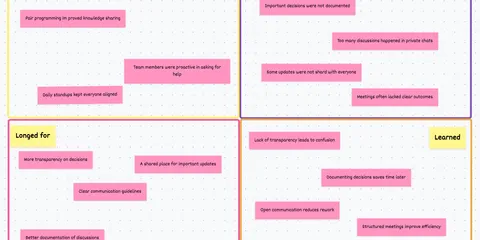
The “What Went Well” retrospective is probably the simplest and most popular or well-known retrospective. It is based on the pattern we find in many other retrospectives, but in its simplest form:
What went well retro 👍: How the retro works
-
Random Icebreaker (2-5 minutes)
Echometer provides you with a generator for random check-in questions.
-
Review of open actions (2-5 minutes)
Before starting with new topics, you should talk about what has become of the measures from past retrospectives to check their effectiveness. Echometer automatically lists all open action items from past retros.
-
Discuss retro topics
Use the following open questions to collect your most important findings. First, everyone does it themselves, covered. Echometer allows you to reveal each column of the retro board individually in order to then present and group the feedback.
- What went well?
- What went not so well?
- How can we improve?
-
Catch-all question (Recommended)
So that other topics also have a place:
- What else would you like to talk about in the retro?
-
Prioritization / Voting (5 minutes)
On the retro board in Echometer, you can easily prioritize the feedback with voting. The voting is of course anonymous.
-
Define actions (10-20 minutes)
You can create a linked action via the plus symbol on a feedback. Not sure which measure would be the right one? Then open a whiteboard on the topic via the plus symbol instead to brainstorm root causes and possible measures.
-
Checkout / Closing (5 minutes)
Echometer enables you to collect anonymous feedback from the team on how helpful the retro was. This creates the ROTI score ("Return On Time Invested"), which you can track over time.
What went well retro 👍

Another very common retrospective is the so-called “Keep Stop Start Retrospective”. It consists of three questions, which you may have already guessed:
Best agile retrospective questions
The ‘Keep Stop Start’ retrospective 👍
Keep stop start retro: How the retro works
-
Random Icebreaker (2-5 minutes)
Echometer provides you with a generator for random check-in questions.
-
Review of open actions (2-5 minutes)
Before starting with new topics, you should talk about what has become of the measures from past retrospectives to check their effectiveness. Echometer automatically lists all open action items from past retros.
-
Discuss retro topics
Use the following open questions to collect your most important findings. First, everyone does it themselves, covered. Echometer allows you to reveal each column of the retro board individually in order to then present and group the feedback.
- Keep: What should we keep?
- Stop: What should we stop doing?
- Start: What should we start doing?
-
Catch-all question (Recommended)
So that other topics also have a place:
- What else would you like to talk about in the retro?
-
Prioritization / Voting (5 minutes)
On the retro board in Echometer, you can easily prioritize the feedback with voting. The voting is of course anonymous.
-
Define actions (10-20 minutes)
You can create a linked action via the plus symbol on a feedback. Not sure which measure would be the right one? Then open a whiteboard on the topic via the plus symbol instead to brainstorm root causes and possible measures.
-
Checkout / Closing (5 minutes)
Echometer enables you to collect anonymous feedback from the team on how helpful the retro was. This creates the ROTI score ("Return On Time Invested"), which you can track over time.
Keep stop start retro

Best agile retrospective questions
The right start to the retrospective
To give your retro that certain something, playful check-ins are worthwhile. Your goal should be that everyone has contributed something in an engaged way. Because the rule of thumb is: Whoever says nothing in the check-in, says nothing in the rest of the retro… Here is a check-in example:
Retro game on the online whiteboard
Duration: 5-15 minutes | Goal: Setting the stage
The basic idea: If our last sprint was one of these animal faces, which one would it be? Have the team choose from the given images and explain their choice.
If you like this check-in game, you will find many more here: The 15 best online retrospective games - feel free to take a look at them 🙂.
Conclusion - The best retrospective questions
If you’re interested in other popular, more offbeat retrospective methods, such as the sailboat retrospective or the Mario Kart retrospective, you can find them here: List of creative retrospective ideas for beginners and professionals . I’m sure you’ll find something there 🙂 .
As you may have seen, you can even open these retrospectives in our retrospective tool: Echometer. It helps you to organize the retrospective in a fun and productive way.

"Many team members are afraid to speak up!"
Solve this challenge
"We discover too many unexpected issues & bugs at a late stage!"
Solve this challenge
"Why does it sometimes take me hours to prepare a simple retrospective?"
Solve this challenge