
Agile Delivery Team Secrets: Harness the Power of Collaboration for Unmatched Results
The agility of a project team has become a cornerstone of success in today’s rapidly changing business landscape. Agile project teams, with their flexibility, iterative progress and deep-rooted culture of collaboration, stand out as beacons of efficiency and innovation. However, the true effectiveness of these teams depends not only on agile principles, but also on the way they embrace diversity, communicate openly, align around common goals, use agile tools and commit to continuous improvement. Let’s explore these facets through concrete examples of how successful agile teams work and the incredible results they can achieve.
Agile Delivery Team Secrets
The three most important Agile delivery factors
After supporting hundreds of companies, we now realize that the success of the best Agile delivery teams is not just down to adherence to the Agilen methodology. It depends largely on how they integrate the key practices into their daily operations.
Three basic elements form the foundation for success in an agile team.
You can find more tips here: Increase your agility in 2024#1. An inclusive team culture
At the heart of a successful agile development team is its commitment to diversity and inclusion. It’s not just about assembling a team of people from different backgrounds, but also about creating a synergy that leverages these differences to drive innovation and solve complex problems. Because at the end of the day, it’s the different perspectives that come together to create a holistic solution.

#2. Maintain open communication
However, in order to harness the diversity of a team, open communication is essential for effective collaboration in agile teams. In a software development company, communication errors and a lack of transparency between team members can quickly lead to significant delays in projects. By introducing agile methods such as daily stand-up meetings, team members are encouraged to share updates, challenges and insights. Another important aspect of truly open communication is what is known as psychological safety. In a nutshell, this means creating an environment in the team where everyone really dares to express their thoughts, no matter how far-fetched. You can find out more about psychological safety here.
#3. Focus on a common vision
In addition to open communication, it is also important to focus on a shared vision. This ensures that every team member is working towards the same goals.
It has been scientifically proven several times that the effectiveness of individual team members decreases as the team size increases. For example, one person alone can achieve 100%, a team of two people only 160% (80% each) and a team of three people only 225% (75% each). This phenomenon increases with increasing team size. In order to ensure that losses due to processes, ambiguities, etc. are kept to a minimum, it is absolutely essential to create a clear shared vision and direction, especially in agile teams.
Agile Delivery Team Secrets
Agile Using methods and tools as leverage
Now that we’ve taken a look at three of the most important factors for effective and efficient delivery in agile teams, let’s take a look at how this can be used in practice.
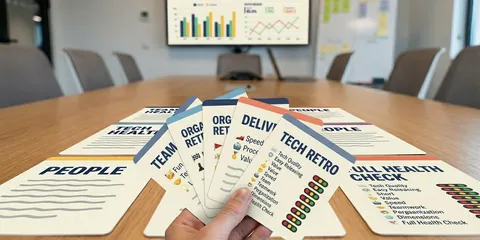
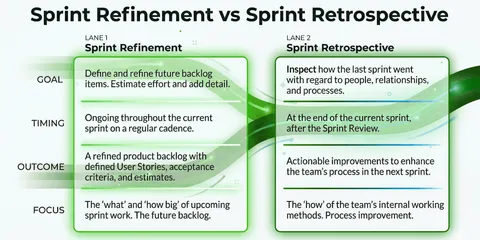
This is because the real change for many agile teams lies in their ability to put agile tools and techniques into practice. Retrospectives are of central importance in the agile process, as they offer teams a regular break to reflect on their performance and identify opportunities for improvement.
An outstanding example of retrospectives is the Agile delivery retrospective:
Agile Delivery Retrospective
This innovative retrospective takes a close look at working methods and their influence on team results:
⚙️ Agile Delivery Retrospective: How the retro works
-
Random Icebreaker (2-5 minutes)
Echometer provides you with a generator for random check-in questions.
-
Review of open actions (2-5 minutes)
Before starting with new topics, you should talk about what has become of the measures from past retrospectives to check their effectiveness. Echometer automatically lists all open action items from past retros.
-
Health Check
All team members can answer the health checks anonymously on a scale. Then go through the results of the health checks together and record any additional comments if necessary. If you use the same health checks in several retrospectives, you can also track trends over time in Echometer.
- We get things done really fast. No waiting, no delays.
- We are able to estimate exactly what we can deliver in a given cycle and with the given resources.
- Our sprint results do not require any post sprint rework to be delivered.
- We limit our 'work in progress' to be focused at all times.
-
Discuss retro topics
Use the following open questions to collect your most important findings. First, everyone does it themselves, covered. Echometer allows you to reveal each column of the retro board individually in order to then present and group the feedback.
- When did our way of working lead to a suboptimal workflow? (e.g. unclear, unsuitable or not followed guidelines)
- When has our way of working worked well?
- What are recent examples for an increment that wasn't working / shippable at the end of the cycle?
-
Catch-all question (Recommended)
So that other topics also have a place:
- What else would you like to talk about in the retro?
-
Prioritization / Voting (5 minutes)
On the retro board in Echometer, you can easily prioritize the feedback with voting. The voting is of course anonymous.
-
Define actions (10-20 minutes)
You can create a linked action via the plus symbol on a feedback. Not sure which measure would be the right one? Then open a whiteboard on the topic via the plus symbol instead to brainstorm root causes and possible measures.
-
Checkout / Closing (5 minutes)
Echometer enables you to collect anonymous feedback from the team on how helpful the retro was. This creates the ROTI score ("Return On Time Invested"), which you can track over time.
⚙️ Agile Delivery Retrospective
Health Check Questions (Scale)
Open questions

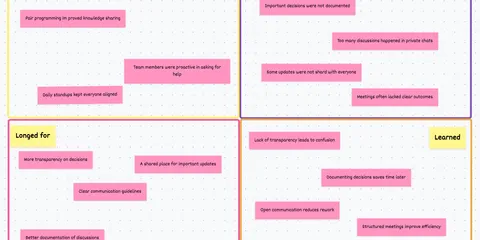
Retrospective formats enable teams to create actionable plans for continuous improvement. They promote a culture of transparency in which feedback is used constructively to improve team dynamics and project results. Retrospectives, enabled by agile methods such as Scrum or Kanban, are more than just a tool for reflection and become catalysts for change, pushing teams to continuously evolve their practices, tools and mindsets.
In addition, the use of agile project management software plays a crucial role in supporting these retrospectives and other agile processes. Tools such as Echometer or JIRA allow teams to visualize their workflows, track progress and manage tasks with greater clarity and efficiency. Integrating these tools into continuous integration and deployment pipelines also helps to maintain the rhythm of deployment and ensure that improvements are implemented and tracked over time.
Conclusion - Agile Delivery Team Secrets
While the principles of diversity, open communication and shared vision are essential to the culture of an agile team, it is the strategic use of agile tools and techniques, particularly retrospectives, that make the difference. Through regular retros like the DAKI or Agile delivery retros, teams can identify precise areas for improvement, fostering a proactive environment for continuous learning and adaptation. In this way, agile teams not only achieve their project goals, but exceed them, setting new benchmarks for excellence in a competitive business environment.