4-Quadrant Retrospective: Examples & Implementation Tips
Are you looking for a structure that helps your team move quickly from discussion to improvement? Then the 4-quadrant retrospective is a very good start.
The most important facts about the 4-quadrant retro
| Point | Recommendation |
|---|---|
| Goal | Structure the review and derive 1 to 2 effective measures |
| Duration | 45 to 75 minutes |
| Team size | 3 to 10 people |
| Preparation | 5 to 10 minutes (board, timebox, guiding questions) |
| Result | Prioritized topics + concrete actions with owners |
| Suitable for | Scrum, Kanban, project teams, remote/hybrid/on-site |
What is a 4-quadrant retro in a sprint retrospective?
A 4-quadrant retro is a sprint retrospective that typically takes place across four quadrants. Each quadrant represents its own perspective on the last sprint or work period.
Well-known variants of the 4-quadrant retro in sprint retrospectives include, for example:
- 4L: Loved, Loathed, Longed for, Learned
- WRAP: Wishes, Risks, Appreciation, Puzzles
- Freely defined team quadrants (e.g., “keep”, “stop”, “uncertain”, “experiment”)
The advantage of the 4-field logic: A sprint retrospective with 4 quadrants prevents one-sided discussions and leads to balanced decisions more quickly.
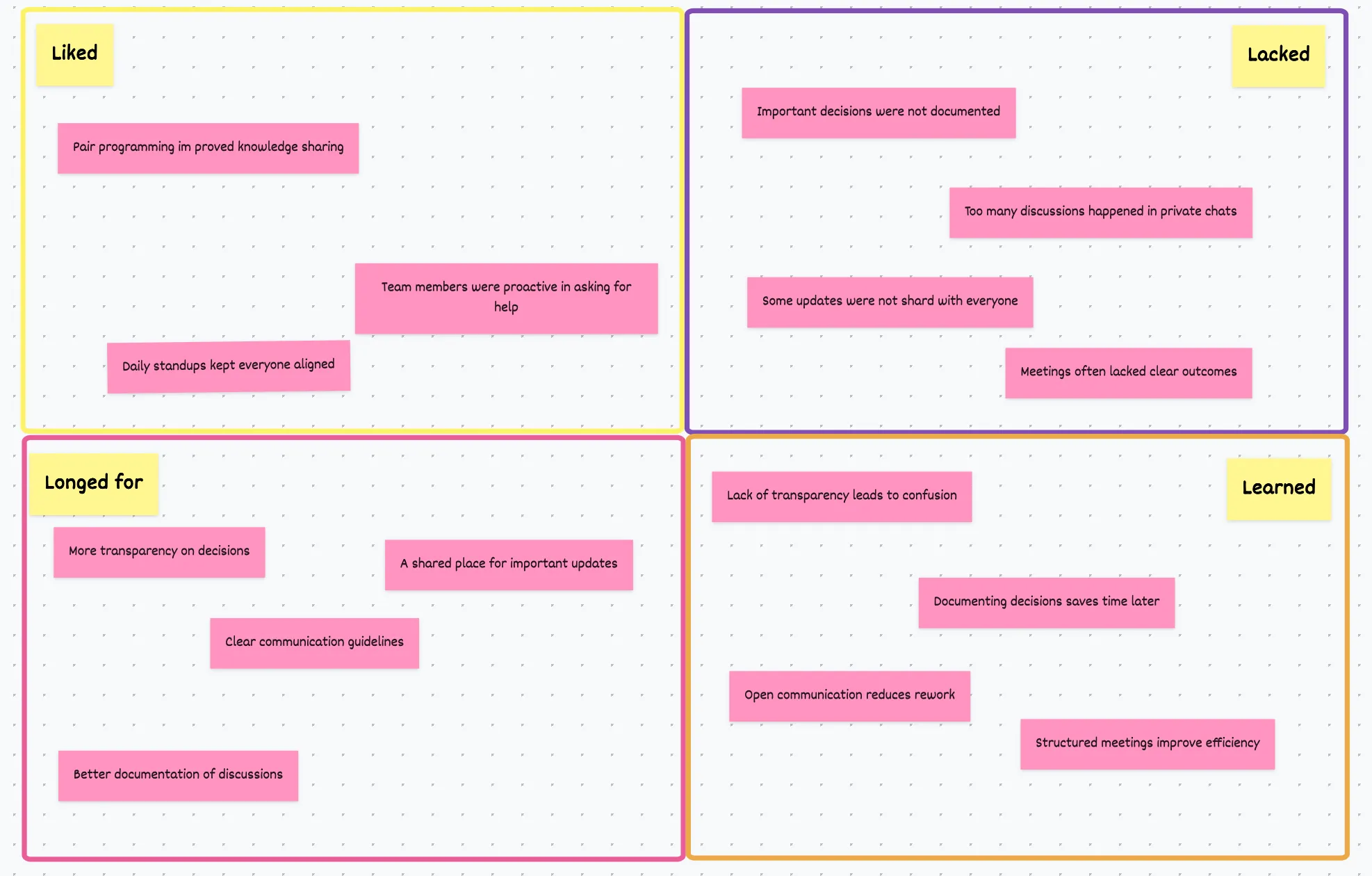
This is how the 4-quadrant retro can look on the whiteboard in the retrospective software tool Echometer, for example.
Origin of the method
The general 4-quadrant logic is a common moderation principle and is not tied to a single framework.
The well-known 4L variant was popularized in agile practice by Mary Gorman and Ellen Gottesdiener.
External classification:
Comparison: Which 4-quadrant variant fits when?
| Format | Focus | Particularly useful when … | Typical risk |
|---|---|---|---|
| 4L | Balanced sprint review | You want to make successes, gaps, learnings, and wishes visible together | Too many topics without hard prioritization |
| WRAP | Future + Risks + Appreciation | You need appreciation and open questions in addition to problems | Appreciation remains superficial if a timebox is missing |
| Custom 4 Quadrants | Context-specific | You have a very specific team problem (e.g., handovers, QA, incident learning) | Quadrants are formulated too abstractly |
| Team Moral Health Check | Making mood and collaboration measurable | You want more objectification via trends instead of individual opinions | Measurement without clear follow-up measures |
Sprint Retrospective with 4 Quadrants: 60-minute process
For a sprint retrospective with 4 quadrants to be effective, a clear process with a strict timebox and a clean focus on a few measures helps.
- 5 min: Check-in and clarity of goals
- 10 min: Silent individual reflection in all 4 quadrants
- 15 min: Clustering and clarifying questions
- 10 min: Voting on the most important topics
- 15 min: 1 to 2 actions with owner and success criteria
- 5 min: Checkout
For a great start to your retro, I recommend taking a look at Retrospective Check-in .
Sprint Retrospective with 4 Quadrants: Two practical examples
Example 1: Transparency problem in the team
- Loathed: “Important decisions were not documented.”
- Longed for: “A central place for relevant updates.”
- Learned: “Documented decisions save time later.”
- Action: “From now on, document every product-relevant decision in the team channel using a template.”
Example 2: Prioritizing the most important topics
- The team clusters similar cards.
- Then it prioritizes the top topics by voting.
- Only the top 1 to 2 points are translated into concrete measures.
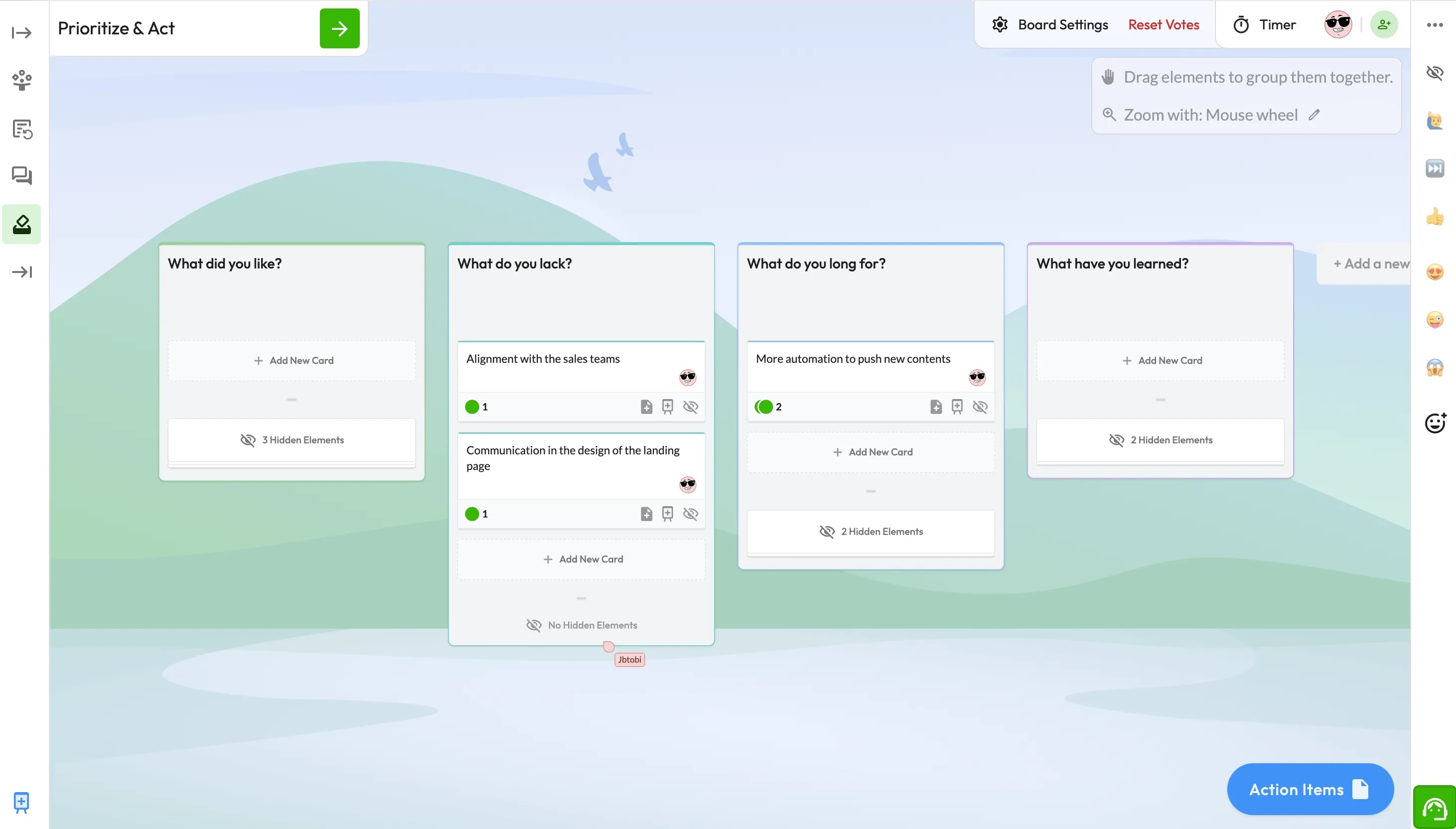
This is what it looks like in the retrospective software tool Echometer when feedback has been prioritized anonymously by team members on the 4 quadrants. Now would be the right time to derive action items directly in the tool.
Scrum retrospective templates that we recommend
Here are two suitable formats from the library that use the idea of the 4-quadrant retro in the sprint retrospective in different ways:
WRAP Retrospective: How the retro works
-
Random Icebreaker (2-5 minutes)
Echometer provides you with a generator for random check-in questions.
-
Review of open actions (2-5 minutes)
Before starting with new topics, you should talk about what has become of the measures from past retrospectives to check their effectiveness. Echometer automatically lists all open action items from past retros.
-
Discuss retro topics
Use the following open questions to collect your most important findings. First, everyone does it themselves, covered. Echometer allows you to reveal each column of the retro board individually in order to then present and group the feedback.
- Wishes: What do you wish for?
- Risks: What risks do you see?
- Appreciation: Who or what deserves recognition?
- Puzzles: What is currently a mystery to you?
-
Catch-all question (Recommended)
So that other topics also have a place:
- What else would you like to talk about in the retro?
-
Prioritization / Voting (5 minutes)
On the retro board in Echometer, you can easily prioritize the feedback with voting. The voting is of course anonymous.
-
Define actions (10-20 minutes)
You can create a linked action via the plus symbol on a feedback. Not sure which measure would be the right one? Then open a whiteboard on the topic via the plus symbol instead to brainstorm root causes and possible measures.
-
Checkout / Closing (5 minutes)
Echometer enables you to collect anonymous feedback from the team on how helpful the retro was. This creates the ROTI score ("Return On Time Invested"), which you can track over time.
WRAP Retrospective

Team Morale Health Check 😇: How the retro works
-
Random Icebreaker (2-5 minutes)
Echometer provides you with a generator for random check-in questions.
-
Review of open actions (2-5 minutes)
Before starting with new topics, you should talk about what has become of the measures from past retrospectives to check their effectiveness. Echometer automatically lists all open action items from past retros.
-
Health Check
All team members can answer the health checks anonymously on a scale. Then go through the results of the health checks together and record any additional comments if necessary. If you use the same health checks in several retrospectives, you can also track trends over time in Echometer.
- Appreciation: We appreciate the achievements and contributions of our colleagues.
- Team Spirit: There is a trusting working atmosphere in our team.
- Transparency: In my team, everyone knows who is currently working on what.
- Recovery & Breaks: I have enough space for breaks in which I can recharge my energy.
- Meeting Culture: Our meetings are well-structured and still leave room for creativity and new things.
- Support: In my team, every team member passes on their individual knowledge and experience.
-
Discuss retro topics
Use the following open questions to collect your most important findings. First, everyone does it themselves, covered. Echometer allows you to reveal each column of the retro board individually in order to then present and group the feedback.
-
Catch-all question (Recommended)
So that other topics also have a place:
- What else would you like to talk about in the retro?
-
Prioritization / Voting (5 minutes)
On the retro board in Echometer, you can easily prioritize the feedback with voting. The voting is of course anonymous.
-
Define actions (10-20 minutes)
You can create a linked action via the plus symbol on a feedback. Not sure which measure would be the right one? Then open a whiteboard on the topic via the plus symbol instead to brainstorm root causes and possible measures.
-
Checkout / Closing (5 minutes)
Echometer enables you to collect anonymous feedback from the team on how helpful the retro was. This creates the ROTI score ("Return On Time Invested"), which you can track over time.
Team Morale Health Check 😇
Health Check Questions (Scale)

If you are interested in deriving really good measures at the end, I can recommend this blog article of ours: Retrospective measures: Tips & examples .
FAQ from our library
Which steps are part of a retrospective?
Typically, there are five phases for retrospectives: Set the stage, Gather data, Generate insights, Decide what to do, and Close. The exact process can vary, but it should always lead to concrete action items. In addition to the classic 5 phases of retrospectives, there is also the Double Diamond model for the phases of retrospectives , which provides facilitators of retrospectives with a more intuitive image for successful and result-oriented facilitation.
What mistakes should definitely be avoided during the first team retrospective?
Especially for teams with little or no experience of retrospectives, care should be taken to avoid the following mistakes:
- Mistake no. 1: Retrospective as a chat meeting. Not all feedback in a retrospective needs to be discussed. Only the topics that have been prioritized together deserve extra attention. All discussions about details before the voting should therefore be moderated and postponed until after the voting.
- Mistake no. 2: Retrospective as a blame game. The retrospective is not there to shift responsibility or blame others for negative events or developments. Improving the status quo is in the hands of all team members!
- Mistake no. 3: Retrospective as a gripe box. Retrospectives are not just about noting what is not working well. Most of the energy should be focused on thinking ahead and defining binding measures.
For the first retrospective, it is a good idea to use a dedicated retro tool for support. Echometer, with its intuitive and guided mode, is very well suited for inexperienced teams. You can try out a retrospective in Echometer here: https://my.echometerapp.com/retro-setup
Does the Echometer Retrospective Software Tool have the Start-Stop-Continue, 4Ls, Sailboat, Starfish and Hot Air Balloon Retrospective templates?
Yes, all these well-known retro formats are included in the tool, and many more that your team probably didn’t know about before.
Conclusion
The 4-quadrant retrospective is powerful because it structures discussions, balances perspectives, and leads teams to clear decisions faster.
Especially for remote and online retros, the right tool can help a lot. That’s why we recommend Echometer: You can try it for free and even look at the flow without logging in.
Have fun at your next retro.