"What went well" Sprint Retrospective: 27 sample answers
I have already participated in more than 200 Sprint Retrospectives and have frequently heard what went well.
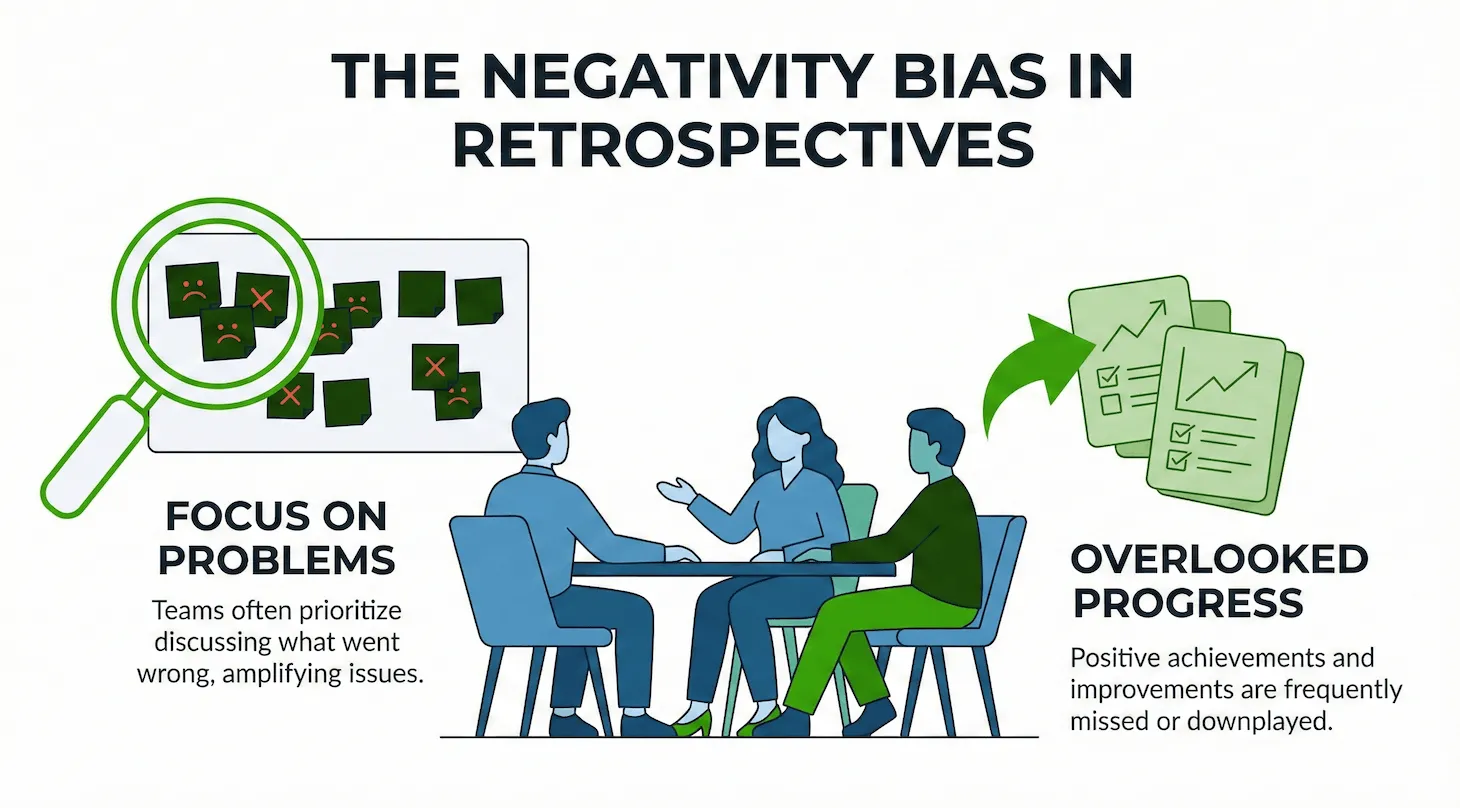
Nevertheless, I experience the same thing over and over again: In many teams, at the beginning of the retrospective, hardly anyone can think of what actually went well. Not because nothing was good. But because we often look at problems faster than at progress.
That is exactly what this post is for. I am sharing sample answers here that have worked in real sprints, so that you can make good working methods more visible and consciously repeat them in the next sprint.
I am writing this from my perspective as a psychologist and Scrum Master.
What went well Sprint Retrospective: 10 quick sample answers
- Positive: Our sprint goal was clear to everyone.
- Positive: We escalated blockers faster.
- Positive: Daily standups were short and helpful.
- Positive: Code reviews came back faster.
- Positive: QA was involved earlier.
- Negative: We had too many context switches and therefore less focus time.
- Negative: Team coordination was unclear in several places.
- Negative: User stories were sometimes formulated too vaguely.
- Negative: Action items from the last retro were not consistently implemented.
- Negative: Communication with stakeholders was too late in some places.
Why the “What went well” question is so important
When I facilitate retros, I consciously make sure that we don’t just talk about problems. This question is important because it:
- regularly creates space for positive things,
- strengthens the team feeling,
- increases psychological safety,
- and preserves good patterns for the next sprint.
If you want to make your start into retros more varied, you can find suitable formats in our post on Retrospective Check-ins .
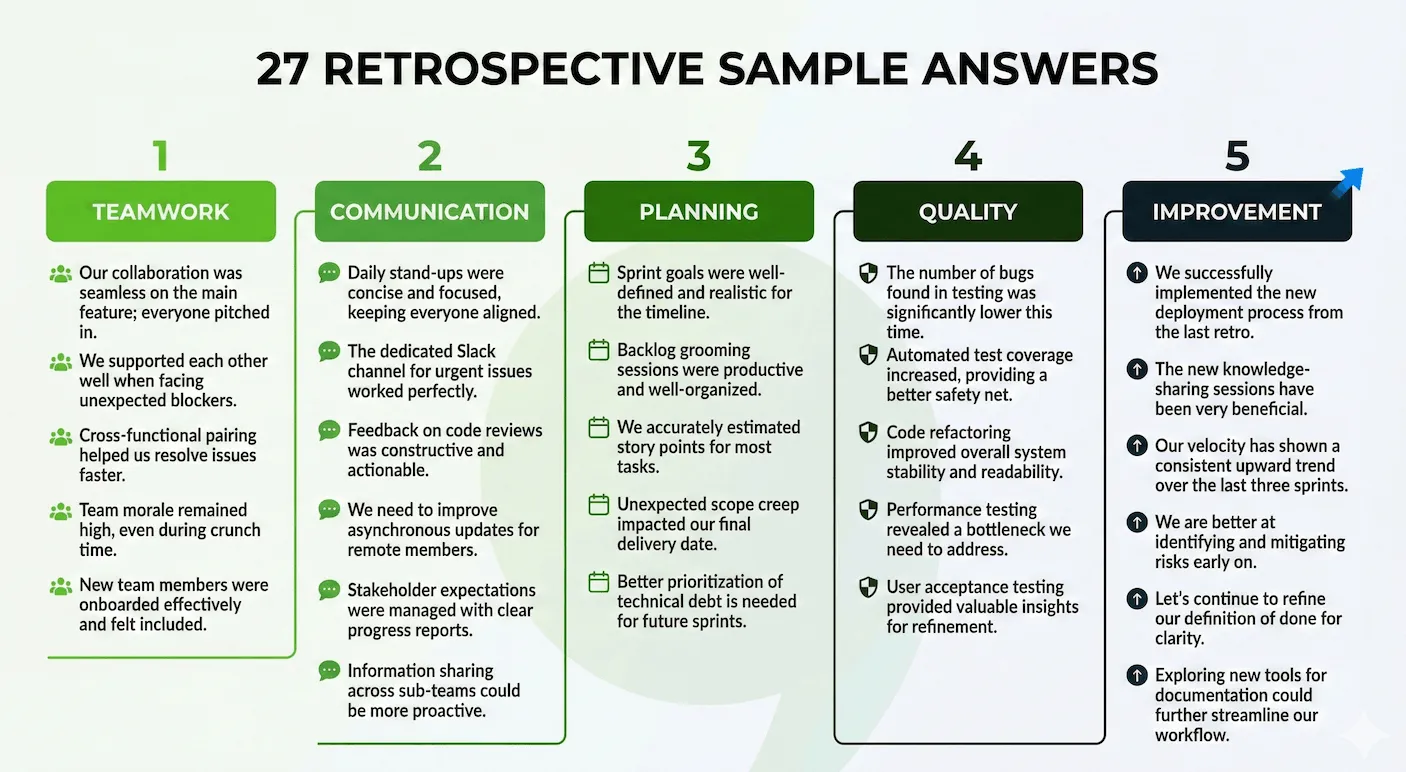
Sample answers by area
I consciously mark each sample answer with Positive or Negative, so that you can use both directly in the team.
Sample answers: “What went well” Sprint Retrospective
1) Team collaboration
- Positive: We proactively supported each other during bottlenecks.
- Positive: Feedback was accepted openly and constructively.
- Positive: Development and QA worked more closely together.
- Negative: Handovers were not properly prepared in several places.
- Negative: Pairing was hardly used, even though it would have helped with complex topics.
- Negative: The team atmosphere was tense at times and not very solution-oriented.
2) Communication and meetings
- Positive: The sprint goal was formulated in a way that everyone could understand.
- Positive: Daily standups remained focused and decision-oriented.
- Positive: Meetings ended more frequently with clear decisions.
- Negative: Risks were addressed too late.
- Negative: Stakeholder communication was sometimes not transparent enough.
3) Planning and focus
- Positive: The backlog refinement was better prepared.
- Positive: User stories were described more clearly.
- Positive: Commitments were set more realistically.
- Negative: Too much unplanned work came into the sprint.
- Negative: We had too little focus time and too many context switches.
4) Quality and delivery
- Positive: Code reviews came back faster.
- Positive: QA was involved in the implementation earlier.
- Positive: Test coverage of new features was better.
- Negative: Critical bugs were only detected late.
- Negative: Too much work remained half-finished at the end of the sprint.
- Negative: The Definition of Done was not always consistently followed.
5) Continuous improvement
- Positive: Action items from the last retro were implemented.
- Positive: We actively maintained functioning practices.
- Negative: Improvements were hardly made measurable.
- Negative: Responsibilities were not always clear.
- Negative: The sprint process seemed unstable overall.
Weak vs. strong answers
Weak answers are usually too general. Strong answers make behavior, impact, and the next step visible.
| Weak | Strong |
|---|---|
| ”Communication was better." | "We addressed blockers directly in the Daily and thereby avoided two days of waiting time." |
| "Code review went well." | "Our review time dropped from about 24 to 8 hours, which allowed us to test earlier." |
| "Teamwork was great." | "When bottlenecks occurred, two colleagues proactively took over tasks, which kept the sprint goal realistic.” |
If you want to go deeper into specific phrasing for development feedback, these practical examples will also help: 20 feedback examples for software developer roles .
Copy-paste template for the retro
In everyday life, I use this structure:
Observation + Impact + Next Step
Template 1
“We did [specific behavior]. As a result, [specific impact] improved. In the next sprint, we will maintain [specific measure].”
Template 2
“[Situation] went particularly well. This helped us to [result]. Next time we will repeat this through [approach].”
Template 3
“Compared to the last sprint, [aspect] was better. This was recognizable by [signal/metric]. Therefore, we are standardizing [best practice].”
With more methods for different team situations, you can find in our overview of Retrospective methods .
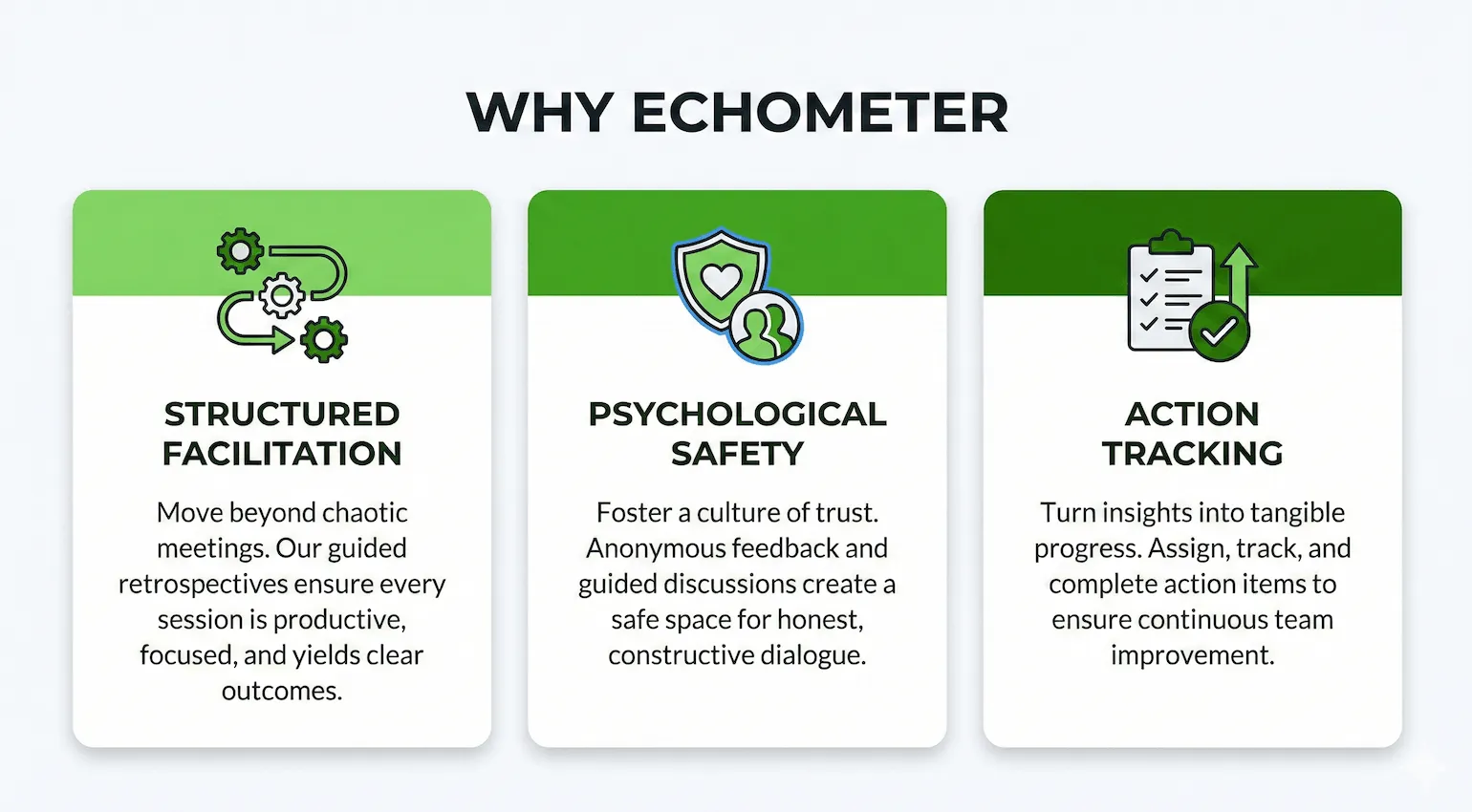
Why Echometer is a strong start from my point of view
When teams want to introduce or improve agile retrospectives, Echometer is particularly helpful from my point of view:
- quick start with a clear structure,
- direct use without much setup effort,
- many templates and questions for immediate moderation,
- psychological focus for better participation,
- action item tracking including reminders.
If you want to start right away, take a look at our Team Retrospective Software or the Team Health Check Software .
For in-depth moderation preparation, you will also find our eBook with tips for retro moderation .
External classification
For additional perspectives on retrospectives, I find these resources helpful:
FAQ: What went well in the sprint retrospective?
Why are retrospectives important?
Retrospectives help teams identify problems early, understand root causes, and collectively decide on improvements. This increases transparency, team satisfaction, and the quality of results.
What mistakes should definitely be avoided during the first team retrospective?
Especially for teams with little or no experience of retrospectives, care should be taken to avoid the following mistakes:
- Mistake no. 1: Retrospective as a chat meeting. Not all feedback in a retrospective needs to be discussed. Only the topics that have been prioritized together deserve extra attention. All discussions about details before the voting should therefore be moderated and postponed until after the voting.
- Mistake no. 2: Retrospective as a blame game. The retrospective is not there to shift responsibility or blame others for negative events or developments. Improving the status quo is in the hands of all team members!
- Mistake no. 3: Retrospective as a gripe box. Retrospectives are not just about noting what is not working well. Most of the energy should be focused on thinking ahead and defining binding measures.
For the first retrospective, it is a good idea to use a dedicated retro tool for support. Echometer, with its intuitive and guided mode, is very well suited for inexperienced teams. You can try out a retrospective in Echometer here: https://my.echometerapp.com/retro-setup
How do you measure the success of a retrospective?
The success of retrospectives is reflected in the fact that agreed measures are implemented and measurable improvements are achieved. In addition to productivity indicators (which should be treated with caution), teams use, for example, the tracking of action items, trends on feedback scales in team health check / pulse check surveys.
Does the retrospective software tool Echometer help to increase psychological safety in teams?
Yes, Echometer is the retrospective tool with probably the strongest psychological focus, as it is originally a spin-off from the Faculty of Psychology at the University of Münster (Germany). Specifically, Echometer helps to strengthen psychological safety in teams (with the primary target group of software development and hybrid product teams) through various icebreakers and retrospective templates.
On the one hand, the fun get-to-know-you questions in the Retro Check-In, for example, help to strengthen psychological safety in teams. On the other hand, there are, for example, dedicated templates for measuring psychological safety in teams.
How does Echometer ensure that retrospective measures are implemented - are there reminders?
Yes, the retrospective software tool Echometer also allows you to save reminders for measures. These are sent by email individually to the person responsible for the measure. This ensures that the implementation of the measure is not forgotten.
Conclusion
The question “What went well?” is not friendly small talk at the beginning of a retrospective. It is the fastest way to make functioning team patterns visible and carry them into the next sprint.
If you work with clear Sample answers “What went well” sprint retrospective and combine the positive perspective with concrete measures, usually not only the quality of the retrospective increases, but also focus, team spirit, and commitment in everyday life.