Sprint Retrospective Antipatterns: 10 Mistakes, 10 Fixes
I have now participated in and facilitated more than 200 retrospectives, and not all of them went well.
I am a Scrum Master, psychologist, and co-founder of the retrospective software Echometer. It is precisely from this perspective that I write about Sprint Retrospective Antipatterns: not as theory, but from situations I see in teams time and again.
When you search for Sprint Retrospective Antipatterns, you usually want three things: quickly recognize what is going wrong, clearly decide what to change, and see real impact in the next sprint.
Many teams also search for the term Sprint Retrospective Anti Patterns, but mean the same thing in terms of content: retrospective antipatterns that cost time in practice.
Quick Check for Sprint Retrospective Antipatterns
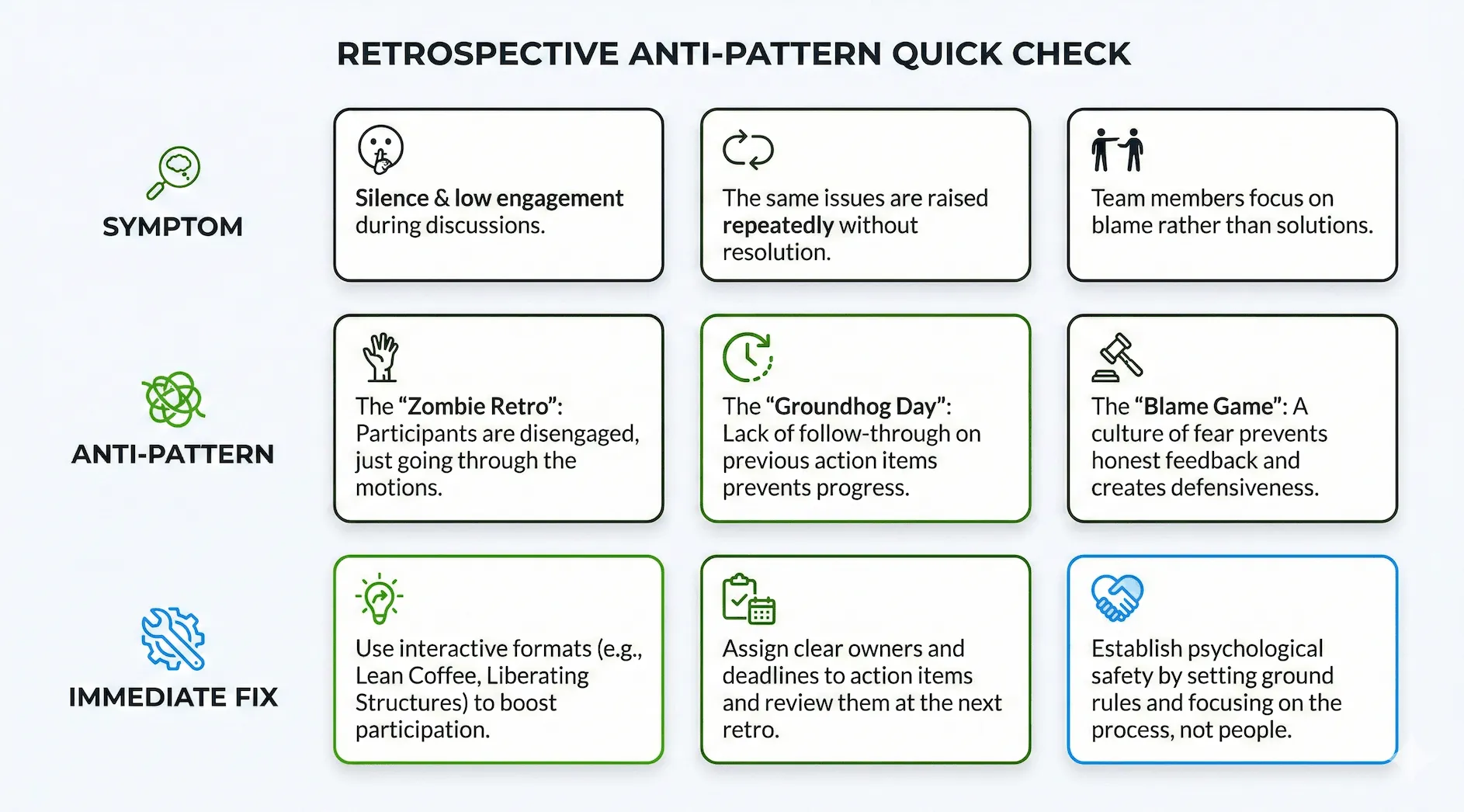
When I notice a retro is tipping over, I first use this quick check:
- Symptom: Everyone is nice, no one addresses critical issues.
Likely Antipattern: Lack of psychological safety.
Immediate Fix: Anonymous start plus clear ground rules for conversation. - Symptom: We discuss too many topics in parallel.
Likely Antipattern: No real prioritization.
Immediate Fix: Cluster topics and vote on exactly one main topic. - Symptom: Good ideas, but no visible change in the next sprint.
Likely Antipattern: Action items without ownership.
Immediate Fix: One action item, one owner, one deadline, one clear success signal.
For me, this step is crucial because otherwise Sprint Retrospective Antipatterns are only described instead of solved.
If the quick check shows a warning signal, I go through the most common patterns in a structured way.
That is exactly where I find the frequent retrospective mistakes that I, as a Scrum Master, see first in most teams.
10 common Sprint Retrospective Antipatterns and how I solve them
1) No clear goal in the retro
Symptom: We talk a lot, but in the end it is unclear what should run differently after the retro.
What is really happening: Without a focus question, the retro turns into a loose conversation.
What I change: I start with a clear goal question: “What do we want to measurably improve by the end of the next sprint?”
Optional Template: Good-Bad
Why this fits: If the goal is unclear, the hard separation into “good” and “not good” helps me so that the team names a common improvement goal faster.
Good vs. Bad: How the retro works
-
Random Icebreaker (2-5 minutes)
Echometer provides you with a generator for random check-in questions.
-
Review of open actions (2-5 minutes)
Before starting with new topics, you should talk about what has become of the measures from past retrospectives to check their effectiveness. Echometer automatically lists all open action items from past retros.
-
Discuss retro topics
Use the following open questions to collect your most important findings. First, everyone does it themselves, covered. Echometer allows you to reveal each column of the retro board individually in order to then present and group the feedback.
- Which 3 things have gone well lately?
- Which 3 things have not gone well lately?
-
Catch-all question (Recommended)
So that other topics also have a place:
- What else would you like to talk about in the retro?
-
Prioritization / Voting (5 minutes)
On the retro board in Echometer, you can easily prioritize the feedback with voting. The voting is of course anonymous.
-
Define actions (10-20 minutes)
You can create a linked action via the plus symbol on a feedback. Not sure which measure would be the right one? Then open a whiteboard on the topic via the plus symbol instead to brainstorm root causes and possible measures.
-
Checkout / Closing (5 minutes)
Echometer enables you to collect anonymous feedback from the team on how helpful the retro was. This creates the ROTI score ("Return On Time Invested"), which you can track over time.
Good vs. Bad

2) Too many topics at once
Symptom: Everything seems important and we jump between topics.
What is really happening: The team gets bogged down instead of deciding.
What I change: Collect, cluster, prioritize, then select one focus problem.
Optional Template: Tetrominos Retro
Why this fits: Tetrominos forces the team to see topics as connected parts. This way, gaps, overlaps, and priorities become visible quickly.
Tetrominos Retro: How the retro works
-
Random Icebreaker (2-5 minutes)
Echometer provides you with a generator for random check-in questions.
-
Review of open actions (2-5 minutes)
Before starting with new topics, you should talk about what has become of the measures from past retrospectives to check their effectiveness. Echometer automatically lists all open action items from past retros.
-
Discuss retro topics
Use the following open questions to collect your most important findings. First, everyone does it themselves, covered. Echometer allows you to reveal each column of the retro board individually in order to then present and group the feedback.
- Which parts fit well together in our process?
- Where do we see gaps or friction?
- Which rearrangement brings us the greatest effect in the next sprint?
-
Catch-all question (Recommended)
So that other topics also have a place:
- What else would you like to talk about in the retro?
-
Prioritization / Voting (5 minutes)
On the retro board in Echometer, you can easily prioritize the feedback with voting. The voting is of course anonymous.
-
Define actions (10-20 minutes)
You can create a linked action via the plus symbol on a feedback. Not sure which measure would be the right one? Then open a whiteboard on the topic via the plus symbol instead to brainstorm root causes and possible measures.
-
Checkout / Closing (5 minutes)
Echometer enables you to collect anonymous feedback from the team on how helpful the retro was. This creates the ROTI score ("Return On Time Invested"), which you can track over time.
Tetrominos Retro

3) Good discussion, no implementation
Symptom: The retro feels good, but two weeks later nothing has happened.
What is really happening: Action items are too large or formulated without commitment.
What I change: I limit it to a maximum of two action items with an owner, date, and check-in appointment.
4) Focus on people instead of focus on the system
Symptom: Sentences like “Person X is blocking us” dominate the retro.
What is really happening: The team discusses blame instead of patterns.
What I change: I direct the focus to recurring situations and triggers in the process. For me, that is good retrospective facilitation: making behavior discussable without attacking individuals.
5) Dominant voices, silent team members
Symptom: Two people speak almost the entire time.
What is actually happening: Important perspectives are missing, decisions become skewed.
What I change: Silent brainstorming, then a structured speaking order.
6) Always the same retro format
Symptom: Participation drops, answers become superficial.
What is actually happening: The format no longer fits the type of problem.
What I change: I deliberately vary based on the goal: analysis, prioritization, or commitment.
Optional template: Rennspiel Retro
Why this fits: The racing game deliberately brings in energy and a change of perspective. Especially with routine retros, the playful framework helps to get honest and concrete contributions again.
Racing Game Retro: How the retro works
-
Random Icebreaker (2-5 minutes)
Echometer provides you with a generator for random check-in questions.
-
Review of open actions (2-5 minutes)
Before starting with new topics, you should talk about what has become of the measures from past retrospectives to check their effectiveness. Echometer automatically lists all open action items from past retros.
-
Discuss retro topics
Use the following open questions to collect your most important findings. First, everyone does it themselves, covered. Echometer allows you to reveal each column of the retro board individually in order to then present and group the feedback.
- Which shortcuts helped us?
- Which bananas did we slip on?
- Which power-ups moved us forward?
-
Catch-all question (Recommended)
So that other topics also have a place:
- What else would you like to talk about in the retro?
-
Prioritization / Voting (5 minutes)
On the retro board in Echometer, you can easily prioritize the feedback with voting. The voting is of course anonymous.
-
Define actions (10-20 minutes)
You can create a linked action via the plus symbol on a feedback. Not sure which measure would be the right one? Then open a whiteboard on the topic via the plus symbol instead to brainstorm root causes and possible measures.
-
Checkout / Closing (5 minutes)
Echometer enables you to collect anonymous feedback from the team on how helpful the retro was. This creates the ROTI score ("Return On Time Invested"), which you can track over time.
Racing Game Retro

7) No connection to delivery, quality, focus
Symptom: Good team discussions, but hardly any effect on lead time, quality, or focus.
What is actually happening: Measures are not linked to real outcomes.
What I change: Every measure is linked to a Sprint Goal or a metric. This is the only way I can implement retrospective measures instead of just documenting them.
8) Too little psychological safety
Symptom: Critical points are only hinted at cautiously.
What is actually happening: Without safety, root cause analysis remains superficial.
What I change: I work with clear safe-space rules and anonymous input for sensitive topics.
9) Retro too long, too little impact
Symptom: Energy drops significantly after 45 minutes.
What is actually happening: Discussion eats up decision-making time.
What I change: Strict timeboxes and an early transition to the decision phase.
10) Perfectionism under time pressure
Symptom: “Today we don’t have enough time for a proper retro.”
What is actually happening: The demand for completeness prevents learning.
What I change: I use my emergency mode with just one question:
“Let’s improve one thing for the next sprint – what could it be? We brainstorm and vote on exactly one.”
Optional template: Good-Bad
Why this fits: Good-Bad is the fastest template in the database. Two columns are enough to choose a clear problem and a concrete next measure in just a few minutes.
Good vs. Bad: How the retro works
-
Random Icebreaker (2-5 minutes)
Echometer provides you with a generator for random check-in questions.
-
Review of open actions (2-5 minutes)
Before starting with new topics, you should talk about what has become of the measures from past retrospectives to check their effectiveness. Echometer automatically lists all open action items from past retros.
-
Discuss retro topics
Use the following open questions to collect your most important findings. First, everyone does it themselves, covered. Echometer allows you to reveal each column of the retro board individually in order to then present and group the feedback.
- Which 3 things have gone well lately?
- Which 3 things have not gone well lately?
-
Catch-all question (Recommended)
So that other topics also have a place:
- What else would you like to talk about in the retro?
-
Prioritization / Voting (5 minutes)
On the retro board in Echometer, you can easily prioritize the feedback with voting. The voting is of course anonymous.
-
Define actions (10-20 minutes)
You can create a linked action via the plus symbol on a feedback. Not sure which measure would be the right one? Then open a whiteboard on the topic via the plus symbol instead to brainstorm root causes and possible measures.
-
Checkout / Closing (5 minutes)
Echometer enables you to collect anonymous feedback from the team on how helpful the retro was. This creates the ROTI score ("Return On Time Invested"), which you can track over time.
Good vs. Bad
This is exactly my most important rule for Sprint Retrospective Antipatterns: When in doubt, make one good decision instead of ten half-hearted ones.
When I look at teams that improve quickly, they primarily solve Scrum Retrospective errors early and consistently.
Improve Scrum Retrospective instead of just facilitating it
If I want to improve a Scrum Retrospective , I use a minimum standard:
The same applies if I want to improve a Sprint Retrospective: discuss less, decide more clearly, follow up more consistently.
- A clear focus topic
- Maximum of two measures
- Follow-up on the last measures at the beginning of the next retro
If you need a specific selection of methods for this, you can find good in-depth information here:
- Overview of retrospective methods
- Retrospective check-in ideas
- Retrospective measures with tips and examples
Why Echometer is my starting point for Sprint Retrospective Antipatterns
Especially with Sprint Retrospective Antipatterns, it’s not enough to just “facilitate better.” I need a process that carries through across sprints. For me, Echometer is the best start for this:
- Clear structure instead of facilitation by gut feeling.
- Immediately usable template library with good questions.
- Action item tracking instead of a whiteboard graveyard.
- Continuous improvement cycle, not just one good meeting.
If you want to dive deeper, these pages are usually the fastest way:
External perspective on Sprint Retrospective Antipatterns
When I coach teams, I often use these sources for classification in addition to my own practice:
Here too, it becomes clear: Sprint Retrospective anti-patterns are rarely a methodological problem, but almost always an implementation problem.
FAQ on the Scrum Sprint Retrospective
What mistakes should definitely be avoided during the first team retrospective?
Especially for teams with little or no experience of retrospectives, care should be taken to avoid the following mistakes:
- Mistake no. 1: Retrospective as a chat meeting. Not all feedback in a retrospective needs to be discussed. Only the topics that have been prioritized together deserve extra attention. All discussions about details before the voting should therefore be moderated and postponed until after the voting.
- Mistake no. 2: Retrospective as a blame game. The retrospective is not there to shift responsibility or blame others for negative events or developments. Improving the status quo is in the hands of all team members!
- Mistake no. 3: Retrospective as a gripe box. Retrospectives are not just about noting what is not working well. Most of the energy should be focused on thinking ahead and defining binding measures.
For the first retrospective, it is a good idea to use a dedicated retro tool for support. Echometer, with its intuitive and guided mode, is very well suited for inexperienced teams. You can try out a retrospective in Echometer here: https://my.echometerapp.com/retro-setup
How do you measure the success of a retrospective?
The success of retrospectives is reflected in the fact that agreed measures are implemented and measurable improvements are achieved. In addition to productivity indicators (which should be treated with caution), teams use, for example, the tracking of action items, trends on feedback scales in team health check / pulse check surveys.
How does Echometer ensure that retrospective measures are implemented - are there reminders?
Yes, the retrospective software tool Echometer also allows you to save reminders for measures. These are sent by email individually to the person responsible for the measure. This ensures that the implementation of the measure is not forgotten.
Conclusion: Resolving Sprint Retrospective anti-patterns pragmatically
For me, the core of Sprint Retrospective anti-patterns is simple: better a few clear decisions with follow-up than many good discussions without impact.
And if a retro really threatens to tip over, I stick to that one question: “What is the one thing that will make us better in the next sprint?”
This way, Sprint Retrospective anti-patterns turn back into exactly what a good retro should be: a short, effective lever for real improvement.